

- Founded
- 1886
- Headquarters
- Rogers, Arkansas, USA
- Specialty
- BB rifles, air rifles, youth first rifles, BB pistols, slingshots, Splat R Ball, airgun accessories
- Category
- BB Rifles & Air Guns
- Website
- daisy.com →
Our verdict
Daisy is on this list because the engineering serves the user — and the user is the kid learning to shoot. The Buck Model 105 we reviewed is the cleanest expression of what Daisy does in the modern small-framed teaching tradition: a 29.8 in / 350 fps / spring-piston lever-action BB rifle that lets an 8-year-old run the rifle himself from the first day. The same engineering DNA goes into the Red Ryder Model 1938 (the iconic Daisy product that has been continuously produced since 1938), the Buck 105 (current production, what we reviewed), the 499B Avanti Champion (the competition target rifle that has dominated the BB-gun competition class for decades), and the Powerline series for older shooters stepping up to pellet capability. For Canadian families, Daisy Canada is the right distribution arm — Canadian inventory, Canadian warranty, free shipping over C$74.
Background
Daisy was founded in 1886 in Plymouth, Michigan — originally as the Plymouth Iron Windmill Company — and pivoted into BB-rifle manufacturing in the late 1880s when the company’s general manager, Clarence Hamilton, demonstrated a hand-held BB gun to the company’s directors as a promotional giveaway with each windmill sold. The company president famously held the gun, fired a shot, and said “Boy, that’s a daisy!” The product caught on, the company shifted from windmills to BB rifles, and Daisy has been making essentially this category of product continuously for 140 years.
The brand’s heritage is concentrated in three landmark products that any North American shooter would recognize on sight:
- The Red Ryder Model 1938 — in continuous production since 1938, the single most-recognized BB rifle in the world, the cultural reference point for the entire youth-first-rifle category, and the rifle most adults of a certain generation learned to shoot on.
- The Daisy Buck Model 105 — the modern small-framed entry into the same teaching tradition, reviewed in our long-form feature, the right first rifle for a 7–10-year-old learning the fundamentals.
- The Avanti 499B Champion — the de-facto BB-gun competition rifle, used in 5-meter BB-gun matches across North America for decades, the precision-target instrument that the Buck 105 graduates can step up to.
Daisy moved its headquarters from Plymouth, Michigan to Rogers, Arkansas in 1958, and the Rogers facility remains the company’s manufacturing and corporate base today. The Canadian distribution arm — Daisy Canada — handles the Canadian market with local inventory, bilingual French/English packaging, Canadian warranty support, and free shipping over C$74. For Canadian families, the buying experience is genuinely Canadian: no cross-border shipping, no duty calculations, no Amazon-imported lookalike products.
How we use Daisy
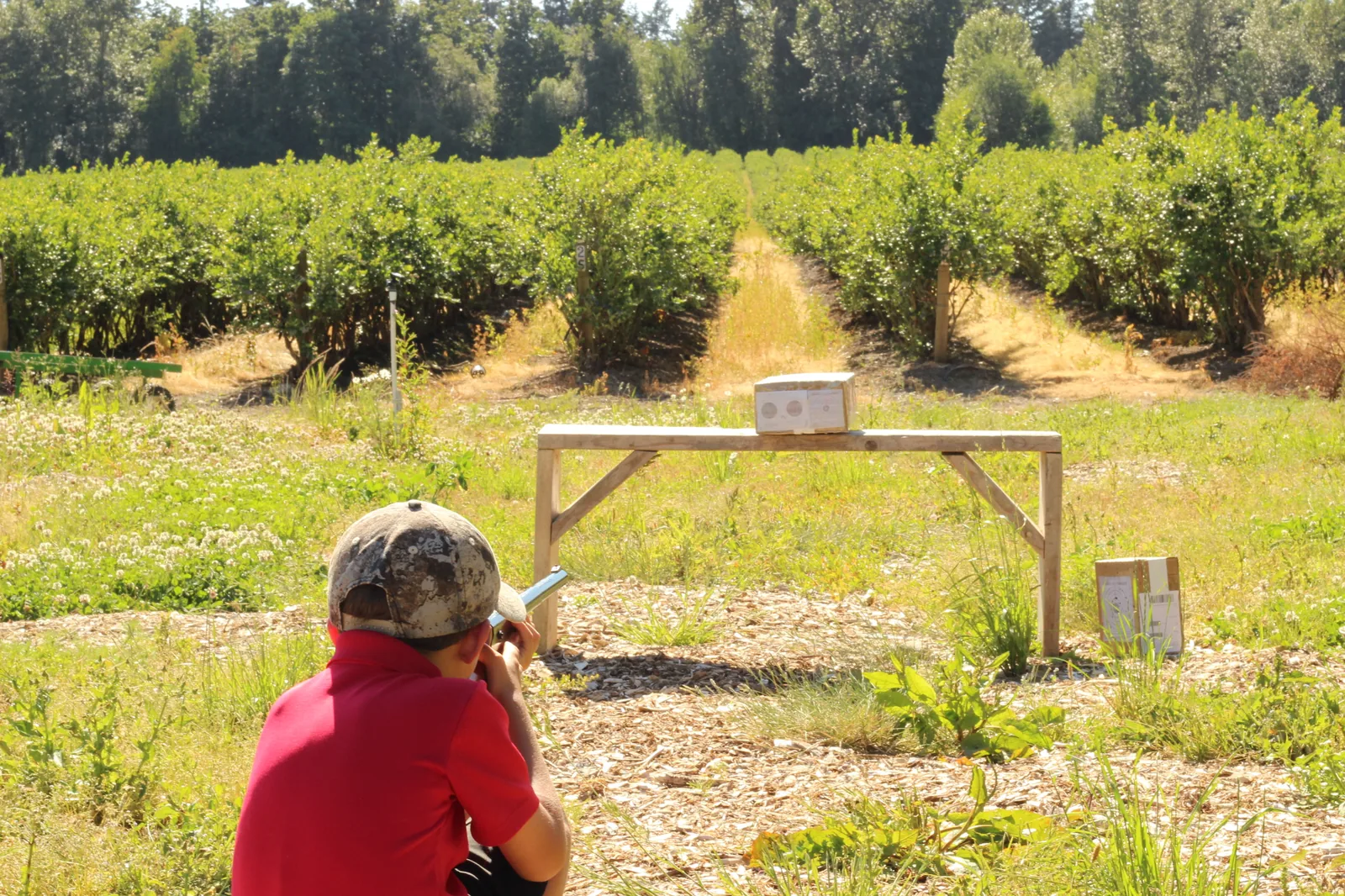
Daisy earns its place on this list through the Daisy Buck Model 105 covered in our long-form review — a 29.8 in spring-powered lever-action BB rifle that an 8-year-old shouldered, cocked, loaded, aimed and shot free-hand at a paper target across a clearing in a blueberry farm. The kid ran the rifle himself, no adult assistance. That’s the editorial proof of the product, and it’s the only meaningful test of a youth first rifle.
For a family teaching a 7–10-year-old the fundamentals of safe rifle handling under supervised conditions, Daisy is the brand we recommend. The Buck 105 is the right starting point at C$79.99 CAD. From there, the natural progression is: → Red Ryder Model 1938 for slightly older or more experienced young shooters → Avanti 499B Champion for the kid who has discovered they want to compete in precision target work → Powerline series for the older youth or adult-supervised teen who wants to step up to pellet capability and higher velocity.
The brand catalogue handles the entire first-decade progression of a young shooter inside a single-vendor relationship with a single warranty path. That’s rare in the category — and it’s why Daisy is on our Recommended Brands roster.
What sets Daisy apart — heritage, scale-to-the-user engineering, real Canadian distribution
Three things matter most.
Genuine 140-year heritage. Daisy has been making BB rifles continuously since 1886 — longer than most countries have existed in their current form. The Red Ryder Model 1938 has been in continuous production for 88 years. That kind of longevity creates real engineering refinement (the modern Buck 105’s cocking spring tension is the product of a century of iteration on how much force a typical kid’s hand can generate) and a mature spare-parts and warranty ecosystem that newer entrants can’t match.
Engineering scaled for the actual user. This is the editorial argument that sets Daisy apart from every “youth” rifle that’s just an adult rifle in 50%-shorter packaging. The Buck Model 105 is 29.8 inches long because that’s the right length-of-pull for a 7–10-year-old. The wood stock is light because the kid has to hold the rifle on target free-hand. The cocking lever takes about 10–12 pounds of force because that’s the upper end of what an 8-year-old can comfortably manage. Every spec is calibrated for the user — and the user is the kid. When the engineering serves the user, the user can run the rifle, and when the user can run the rifle, the user learns to shoot well. That’s the entire teaching loop, and Daisy designed it correctly.
Real Canadian distribution. Daisy Canada is not a reseller or an Amazon import. It’s the authorized Canadian arm of the brand, with local inventory, Canadian-priced product (C$ pricing, not USD-converted), bilingual French/English packaging for the Canadian market, full Canadian warranty support, and free shipping over C$74. For a Canadian family buying a first BB rifle, the buying experience is genuinely Canadian — no cross-border shipping delays, no duty surprises, no warranty-claim friction.
Where Daisy falls short
We’re honest about the trade-offs.
BB-only on the entry rifles. The Buck Model 105 and the Red Ryder Model 1938 shoot .177 BBs only, not pellets. That’s correct for the price tier and the teaching use case — the BB-only platform keeps the rifle simple, safe, and easy for a kid to load and fire — but it means the same rifle won’t move the young shooter up to higher-precision pellet work later. For that progression, the family steps up to a Powerline pellet rifle, which is a separate purchase rather than an upgrade kit.
Fixed open rear sight on the entry rifles. The Buck 105’s fixed open rear sight is the right teaching tool (the shooter learns to compensate with holdover rather than dialing the sight, which builds real iron-sight muscle memory) but it offers no windage or elevation adjustment for precision sight-in. For the kid who progresses into target shooting and wants to dial in their sight picture properly, the natural step is the Avanti 499B Champion with its precision-aperture rear sight.
Spring-piston single-shot operation. All of Daisy’s entry-tier BB rifles use spring-piston single-shot mechanisms. That’s right for the teaching use case — the kid learns the cock-and-fire discipline cycle correctly, with deliberate pauses between shots — but it means rate of fire is limited by the cocking cycle, and it’s not the platform for plinking-style high-volume informal shooting. For that use case, CO2-powered rifles in the Powerline line are the right step up.
The brand’s product range is concentrated in the youth and entry-tier categories. Daisy is not a maker of premium adult-shooter air rifles. For PCP precision air rifles, FX, Weihrauch, Air Venturi, Benjamin, and others occupy that tier — Daisy stays in its teaching and entry-tier lane where its 140-year heritage is unmatched. That’s not a flaw, it’s a positioning, but it means a household that wants both a youth first rifle and a serious adult precision air rifle is buying from two different brands.
Bottom line
Daisy is on our Recommended Brands list because they are the genuine, continuously-operating, original maker of the youth-first-rifle category, and the engineering scales to the actual user — the kid learning to shoot. The Buck Model 105 is the cleanest expression of what Daisy does today: a 29.8 in / 350 fps / spring-piston lever-action BB rifle that lets an 8-year-old run the rifle himself from the first day. That’s the editorial proof of the brand.
When we recommend a Daisy, we’re recommending a piece of equipment from a 140-year-old American manufacturer with real Canadian distribution, a mature spare-parts and warranty ecosystem, and a product catalogue that handles the full first-decade progression of a young shooter inside one brand relationship. For Canadian families teaching kids to shoot safely under supervised conditions, Daisy is the right brand.
The brand also lives at daisy.com (US site) and daisycanada.com (Canadian site) — full catalogue, accessories, warranty registration, and the Canadian dealer network for in-person shopping.
Why we recommend them
140 years of continuous production. Daisy has been making BB rifles since 1886. The current Red Ryder Model 1938 has been in continuous production for 88 years. The spare-parts ecosystem, the BB ammunition supply chain, and the warranty path are all mature — this isn't a one-season import.
Engineering scaled for the small-framed first-time shooter. The Buck Model 105 we tested is 29.8 inches long, light enough to shoulder free-hand, and has cocking spring tension calibrated for a typical 7–10 year old's hand strength. The kid runs the rifle independently from day one — which is the entire point of a youth first rifle.
Real wood, real steel, no shortcuts. The Buck 105 ships with a real wood stock and steel-over-plastic construction at C$79.99 CAD. It looks and feels like a real rifle, not a toy, which matters for the respect-for-firearms lesson the first rifle teaches.
Iron sights that teach the fundamentals. Blade front + fixed open rear is the right teaching configuration. The shooter learns iron sight alignment before ever touching a scope, and the sight picture becomes muscle memory by the time they step up to a higher-tier rifle.
Crossbolt trigger-block safeties that are intuitive for kids. Daisy's safety design is positive, colour-coded, and impossible to disengage by accident. The young shooter can verify safe/fire at a glance — which is exactly how safety should work for a first rifle.
Heritage products you can buy today. The Red Ryder Model 1938 (continuously produced 1938–present), the Buck Model 105 (modern small-frame), and the 499B Avanti Champion (the de-facto BB-gun competition rifle) are all current production at Daisy. The brand catalogue isn't a museum — it's a working line that has stayed relevant for 140 years.
Real Canadian distribution. Daisy Canada handles the Canadian market with local inventory, Canadian warranty support, bilingual (English/French) packaging, and free shipping over C$74. Not an Amazon import — a genuine Canadian arm of a heritage American brand.
Product lines
What they make.
Buck Model 105 (the youth-first-rifle classic)
The [Buck Model 105](/reviews/26/e2/daisy-buck-105-review/) reviewed in our long-form feature — a 29.8 in spring-powered lever-action BB rifle scaled for ages 7–10, the right first rifle for a small-framed shooter learning the fundamentals. Wood stock, blade front sight, crossbolt safety, C$79.99 CAD at Daisy Canada.
Red Ryder Model 1938 (the icon)
The single most recognizable BB rifle in North America. Continuously produced since 1938 — Daisy's flagship and the cultural reference point for the entire youth-BB-rifle category. Lever action, wood stock, 350 fps, classic iron sights. The natural next product to look at after the Buck 105 for a slightly older or more experienced shooter.
499B Avanti Champion (the target rifle)
The Daisy 499B is the de-facto BB-gun competition rifle — the rifle used in 5-meter BB-gun matches across North America for decades. Spring-piston single-shot, precision-aperture rear sight, target stock. For the family where the young shooter has progressed past the Buck 105 and wants to take the next step into precision target work.
Powerline series (the step-up to pellets)
Daisy's Powerline line bridges the BB-only first rifles into pellet-capable air rifles. Models like the Powerline 880, 901, 1000B, and PCP-capable variants serve the older youth shooter or adult-supervised teen who wants higher velocity (~700-800 fps) and pellet precision rather than BB-only fun shooting.
BB pistols (Powerline 340, Model 408, Model 415)
Daisy's BB pistol catalogue — Powerline 340, Model 408, Model 415 and others — for handgun-format shooting practice. Spring or CO2 powered, BB or pellet depending on model. Same engineering tradition as the rifles.
Splat R Ball (kid-safe outdoor play)
Daisy's Splat R Ball line — gel-blaster style outdoor play guns that shoot water-based hydration beads. Sized for kids who want the active-play experience without the BB-gun safety profile. Different category from the BB rifles but still in the Daisy family.
Accessories and ammunition
Daisy makes the BBs (steel .177 in various pack sizes), CO2 cartridges, slingshot ammunition, scopes, red-dot sights, slings, and the targets and pellet traps that round out the family-shooting kit. Single-brand sourcing for the whole introductory shooting setup is genuinely useful.