

- Founded
- 2007
- Headquarters
- Shanghai, China — with warehouses and storefronts in the US, Canada, UK and EU
- Specialty
- Direct-to-consumer industrial, workshop and outdoor equipment; hot tents, shelters, tools and machinery
- Category
- Outdoor & Equipment
- Website
- vevor.ca →
Our verdict
VEVOR is not a heritage brand and does not pretend to be. It is a direct-to-consumer supplier that buys volume in categories where the established names charge a premium, and sells the result at a price that changes who can participate. That model produces some genuinely poor products and some surprisingly good ones, and the difference is almost always visible in the spec sheet if you read it carefully. We include VEVOR here because the hot tent we reviewed spends its limited budget in the right places — bar tacks at the load points, a real flame-retardant stove jack, a generous peg count — and because the listing is honest about the groundsheet and inner tent not being included. Buy on the spec, not on the category name, and VEVOR is often the correct answer.
Background
VEVOR is a direct-to-consumer equipment supplier founded in 2007, headquartered in Shanghai and operating regional storefronts and warehouses across North America and Europe. The model is simple and it explains everything about the products: rather than building a brand in one category, VEVOR sources and sells across an enormous range — machine tools, restaurant equipment, hydraulics, workshop gear, and, latterly, outdoor and camping equipment — and competes almost entirely on price.
The company’s own slogan, printed on the carton our hot tent arrived in, is “Affordable. Reliable. Home Improvement.” That is a fair description of the proposition and of its limits.
How we use VEVOR
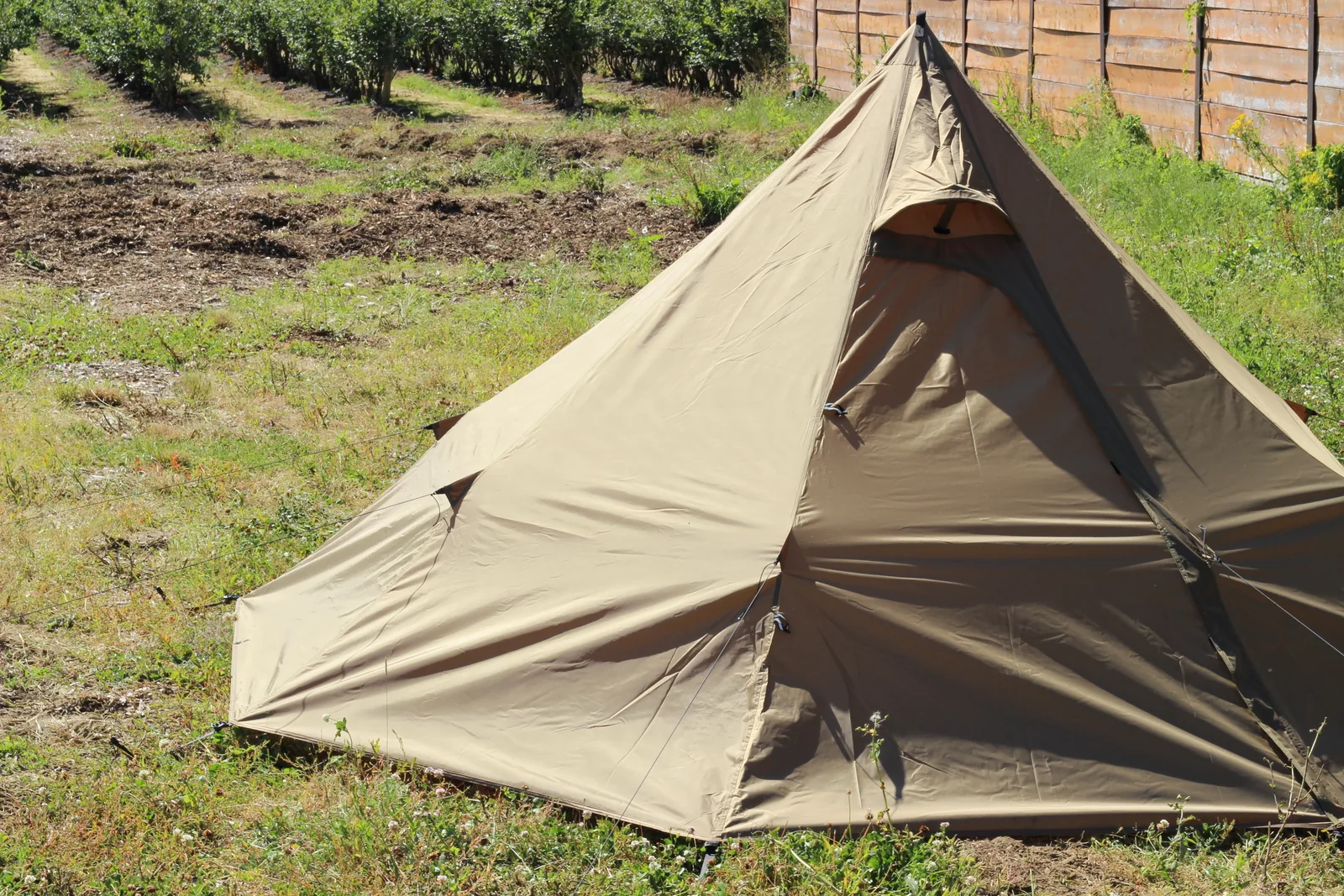
Our first VEVOR review is the YT-02 hot tent — a ten-sided single-pole tipi in 210T taffeta with a flame-retardant stove jack, at C$129.90.
It is a useful test case for the brand, because a hot tent is a product where cutting the wrong corner has consequences. What we found is a canopy that spends its money sensibly: bar-tacked reinforcement at the guy-out points, double-stitched hems, sixteen ground stakes and eight reflective guy lines in the bag, and a stove jack made of genuinely correct flame-retardant cloth properly set into the panel. What it does not include is a groundsheet, an inner tent, or a stove — all of which the listing states.
What sets VEVOR apart — and what to watch
The thing to understand about buying VEVOR is that you are buying a specification, not a reputation. There is no decades-long track record to lean on and no equivalent of Buck’s Forever Warranty standing behind the purchase. What there is, in our experience so far, is a detailed and apparently accurate spec sheet.
That puts the work on the buyer. Read the fabric weight and the hydrostatic head. Check what is and is not in the box. Compare the numbers against what an established brand publishes for the same category, and decide whether the gap matters for how often you will actually use the thing. For gear that goes out four weekends a year, the gap frequently does not matter. For gear that goes out forty nights a year in bad weather, it usually does.
Where VEVOR falls short
We’re honest about the trade-offs.
Documentation is thin. The hot tent manual is a fold-out sheet of line drawings with minimal text — enough to pitch the tent, but you are interpreting diagrams rather than reading instructions.
Materials are specified to a price. The 210T taffeta in the hot tent is a light fabric carrying a “4 season” label on the listing, and that is a stretch. The included stakes are pressed alloy and are the first thing most owners replace for frozen or stony ground.
And there is no heritage-brand safety net. Support runs through a web portal rather than a service department with a reputation to protect. On a low-cost purchase that is a reasonable trade; on an expensive one it would not be.
Bottom line
VEVOR earns a place on this list for one specific reason: it makes categories accessible that were previously gated by price, and it does so without lying about what it is selling. The hot tent we reviewed is not as good as a four-hundred-dollar hot tent, and nothing on the listing claims it is.
If you want to find out whether hot tenting is for you before committing serious money, the YT-02 is a legitimate way to do it. Budget separately for a floor and a stove, take the carbon-monoxide side of it seriously, and you have a working winter camp for a fraction of the usual outlay.
Why we recommend them
They collapse the entry price of expensive categories. Hot tenting has historically started around four hundred dollars for the shelter alone. The VEVOR YT-02 puts a stove-ready tipi with a real flame-retardant jack at C$129.90, which changes the question from can I justify this to do I want to try it.
The spec sheets are detailed and appear accurate. Fabric type, hydrostatic head, pole diameter and wall thickness, peg and guy counts — VEVOR publishes numbers that a buyer can actually evaluate, and in our review the printed parts list in the manual matched the listing.
Regional storefronts with local pricing. VEVOR runs separate US, Canadian, UK and EU stores rather than shipping everything from one warehouse, which means CAD pricing, domestic shipping and a local returns path.
The omissions are disclosed rather than hidden. The hot tent listing states plainly that the ground mat and inner mesh are not included. That is more transparency than a lot of budget outdoor gear manages.
Product lines
What they make.
Hot tents & shelters
Tipi and cabin-style hot tents with flame-retardant stove jacks, from 2-person up. The YT-01 and YT-02 pyramid tipis are the entry point — see our full review of the YT-02.
Camping & outdoor
Awnings, canopies, camp furniture, coolers and general outdoor equipment.
Workshop & industrial
The bulk of the catalogue — machinery, hand tools, hydraulics, restaurant equipment. This is the business the outdoor line grew out of.
Reviews