
Review · Jackery · Power Stations
Jackery Explorer 1000 Portable Power Station Review
Pros
- 1,002Wh capacity handles most camping and emergency power needs
- 3 AC outlets, 2 USB-A, 2 USB-C, and a 12V car port — plenty of outputs
- Pairs seamlessly with Jackery SolarSaga panels for solar charging
- Relatively quiet — no fan noise at low loads
- Clear LCD display shows input/output wattage and remaining capacity
Cons
- 22 lbs is heavy for anything beyond car camping
- 1,000W continuous output limits high-draw appliances
- LiFePO4 competitors now offer better cycle life at similar prices
- Solar charging speed maxes at 200W — slower than newer models
- Price has not dropped despite newer competitors entering the market
Overview
The Jackery Explorer 1000 was one of the first mainstream portable power stations to hit the 1,000Wh mark, and it remains one of the most popular units on the market. We’ve used it extensively over 8 months — at hunting camps, during power outages, and paired with solar panels for extended off-grid use.
Capacity and Performance
The 1,002Wh lithium-ion battery handles most realistic off-grid power needs:
- Charged a laptop (60Wh) roughly 14 times
- Ran a 12V camp fridge for about 18 hours continuously
- Powered LED camp lights for multiple nights
- Charged phones, radios, GPS units, and camera batteries dozens of times per charge
The 1,000W continuous output (2,000W surge) is enough for most small appliances but won’t handle high-draw devices like full-size space heaters, hair dryers, or microwaves. For camp and emergency use, this is rarely a limitation.
Solar Charging
Paired with a 200W solar panel (we tested with both the Jackery SolarSaga 200 and a Renogy 200W), the Explorer 1000 charges from empty to full in roughly 6–7 hours of good sun. The MPPT charge controller built into the unit optimizes panel output well.
The 200W solar input cap is the main limitation here. Newer competitors accept 400W+ solar input, cutting charge times significantly. If you need rapid solar recharging, this is where the Explorer 1000 shows its age.
Build Quality
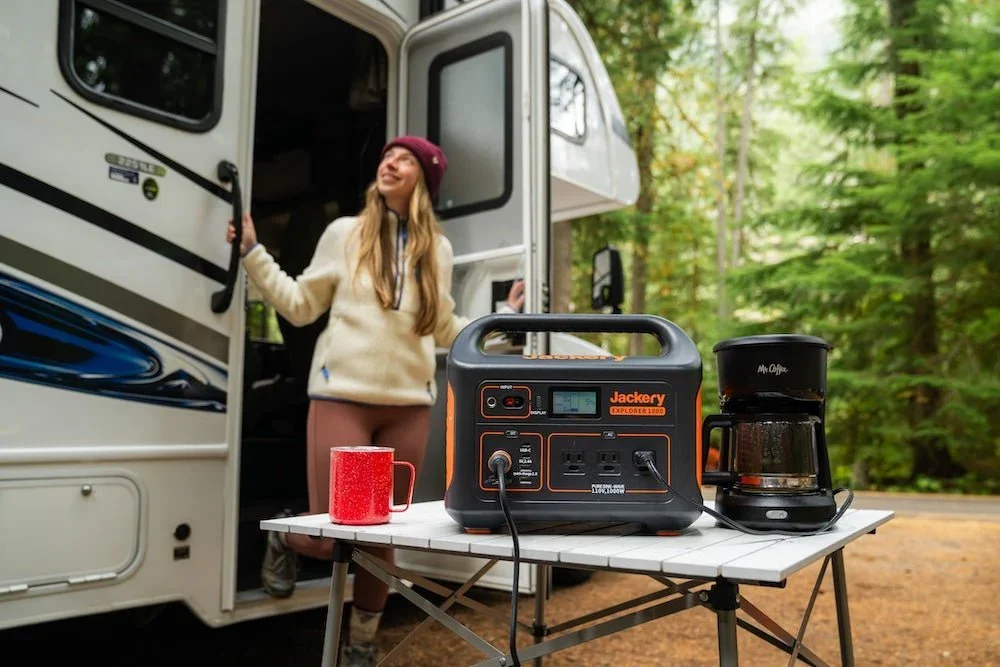
The unit is well-built with a sturdy plastic housing and a comfortable carry handle. The LCD screen is bright and easy to read, showing real-time input/output wattage, remaining battery percentage, and estimated run time.
At 22 pounds, it’s not something you want to carry far from your vehicle. For car camping, overlanding, and home backup, the weight is manageable. For anything requiring a hike in, it’s too heavy.
Real-World Use Cases
Hunting camp (fall, Wyoming): Powered a 12V fridge, charged phones and radios, and ran LED lights for a 3-day camp with one full charge plus daytime solar top-ups. Performed well but we were conscious of power budgeting by day three.
Power outage (winter, home): Kept a router, modem, phone chargers, and a few LED lamps running for about 10 hours. Useful for short outages but won’t power a household through an extended grid-down situation.
Tailgate setup: Powered a TV and speakers for a pre-game setup with plenty of capacity to spare.
Comparison to Competitors
vs. EcoFlow Delta 2 ($999): The Delta 2 offers faster charging (AC wall charging in 50 min), higher solar input (500W), and X-Boost technology for higher-draw devices. At the same price, the Delta 2 is the better buy for most users today.
vs. Bluetti AC200P ($1,299): The Bluetti uses LiFePO4 chemistry with 3,500+ cycle life vs. the Jackery’s ~500 cycles. If longevity matters, the Bluetti wins despite the higher price.
vs. Jackery Explorer 1000 Plus ($1,299): Jackery’s own upgrade uses LiFePO4 and accepts faster charging. Worth the premium if buying new.
Who Should Buy This?
Best for: Car campers and overlanders who need reliable portable power with a proven track record. Also good as a home emergency backup for short outages.
Not ideal for: Buyers looking for the best current value — newer LiFePO4 models offer better longevity and faster charging at similar or slightly higher prices.
Final Verdict
The Jackery Explorer 1000 is a reliable, well-proven portable power station that does what it promises. However, the market has moved on — newer competitors offer better battery chemistry, faster charging, and more features at comparable prices. It’s still a solid unit if you find it on sale, but at full retail, consider the EcoFlow Delta 2 or Jackery’s own Explorer 1000 Plus instead.
Rating: 4.0/5 Stars
Tested over 8 months across hunting camps, home power outages, and daily use. Review conducted independently with no manufacturer compensation.