
Featured Review · Buck · Knives
Buck 110 Folding Hunter Review — The Knife That Made the Lockback Famous
Our Rating
Current Price
- Blade length
- 3.75 in (95 mm)
- Blade thickness
- 0.120 in (3.0 mm)
- Blade steel
- 420HC stainless
- Heat treatment
- Buck BOS, ~58 HRC
Pros
- 420HC steel with Buck's BOS heat treatment — runs ~58 HRC and outperforms every other 420HC on the market
- Genuine ebony hardwood scales and brass bolsters — heirloom-grade materials at a working-knife price
- Rock-solid mid-blade lockback design with 60 years of refinement
- Real leather belt sheath, made in the USA, included in the box
- Lifetime Buck Forever Warranty
- Same model number, same dimensions, same factory since 1964
Cons
- 7.2 oz is heavy by modern EDC standards — you feel it in a pocket
- No pocket clip on the standard model — sheath carry or pocket only
- Two-hand opening — no thumb stud, no flipper, no assist
- 420HC, while reference-grade for its class, won't out-hold S30V or S35VN on edge retention
The Buck 110 Folding Hunter isn’t a knife you review the way you review most knives. It’s a knife you measure other folding knives against. Since 1964 it has done one job, one way, in one place — Post Falls, Idaho — and in the process it more or less invented the modern folding hunter category. Before the 110, “a folding knife strong enough to dress big game” was a contradiction. After it, it was the default expectation.
This review looks at the 110 the way a buyer actually approaches it in 2026 — not as a relic of grandpa’s tackle box, but as a current production knife you can order today, ship in a week, and put on your belt for opening day of deer season. We’ll look at the steel, the build, the materials, and the lock, and we’ll be honest about what 60 years of refinement actually means in the hand. Because here’s the thing nobody tells you about the 110: it’s still the right answer to the question it was designed for.
At a glance
A Quick Note on Why This Knife Matters
The 110 is the reason most folding knives in your life look the way they do. When Al Buck designed it in 1963 and brought it to market in 1964, the prevailing wisdom was that a folder couldn’t be trusted to do hunting work — you carried a fixed blade for that. The 110 broke that assumption with a mid-blade lockback strong enough to dress an elk, scales solid enough to take a generation of abuse, and a profile clean enough to slip into a sheath on your belt without snagging brush. Within a decade, every major knife company in the world had built a competing lockback folder. The category exists because of this knife.
That’s not nostalgia — it’s lineage. And it matters for this review because the 110 you can buy today is the same 110 your grandfather carried. Same model number, same dimensions, same factory, with one significant upgrade (BOS heat treatment, more on that below) and a handful of finish refinements. Most “heritage” gear today is heritage in marketing only. The 110 is heritage in the sense that the SKU number hasn’t changed in 60 years.
In the Box
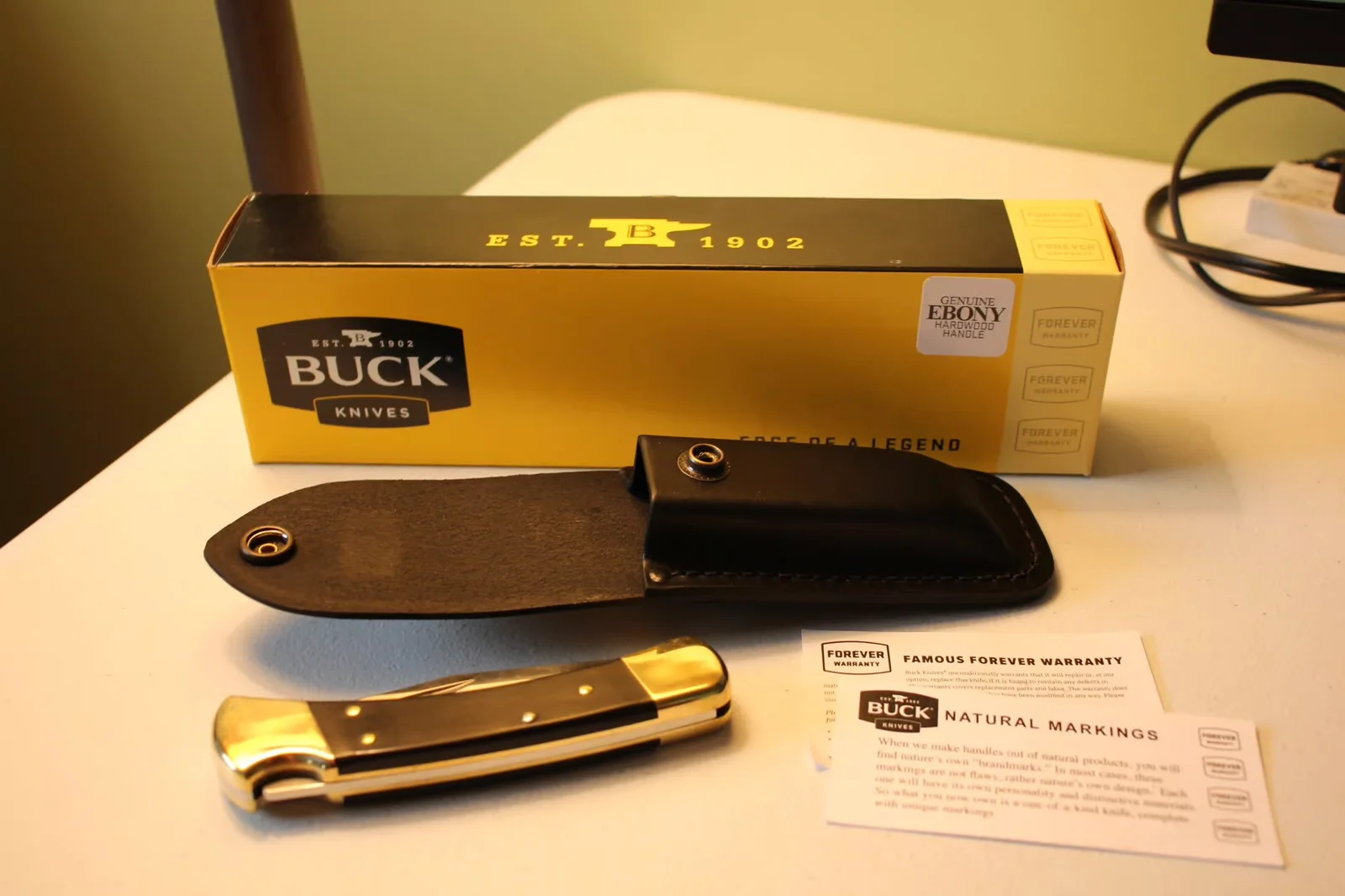
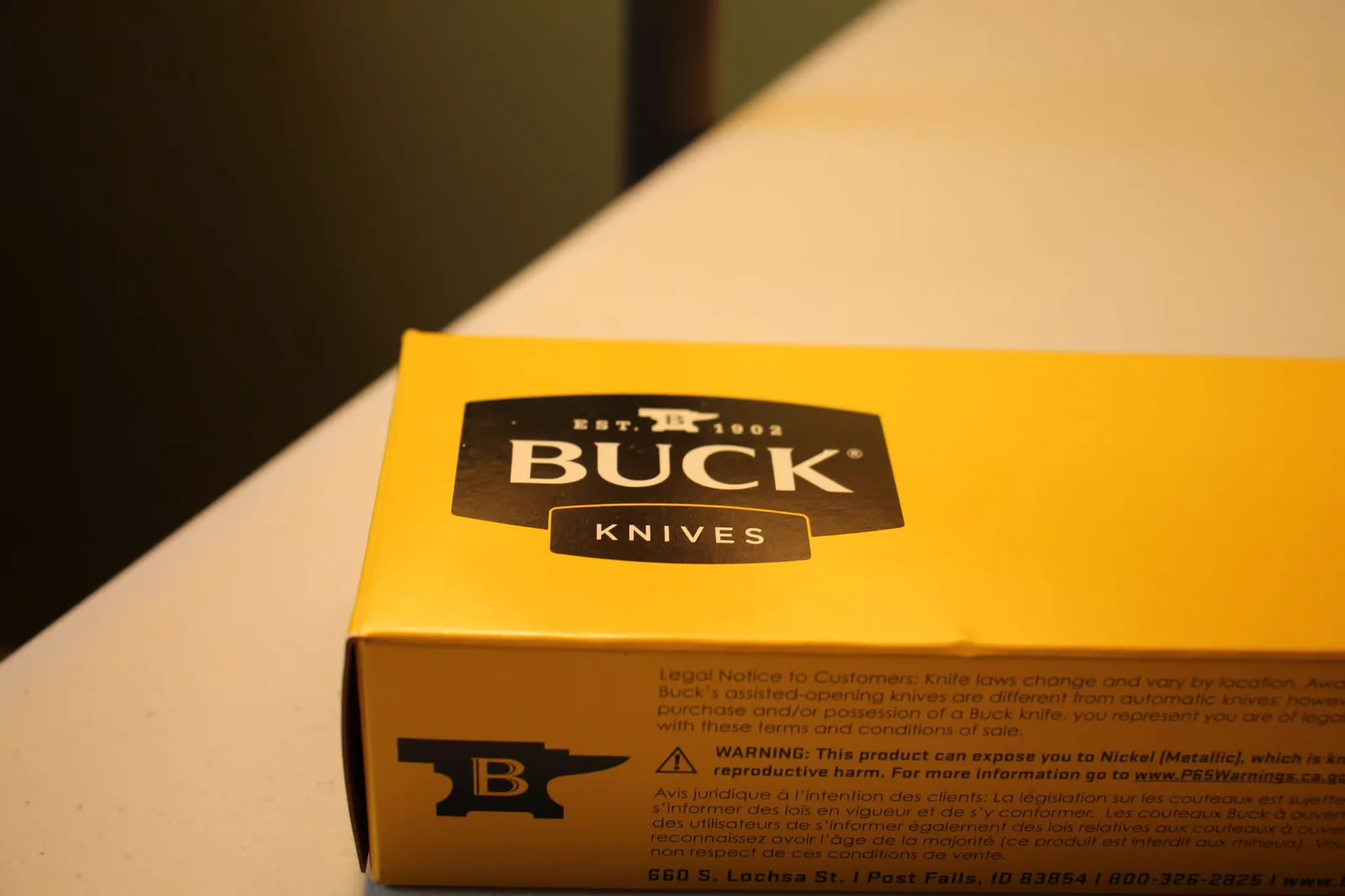
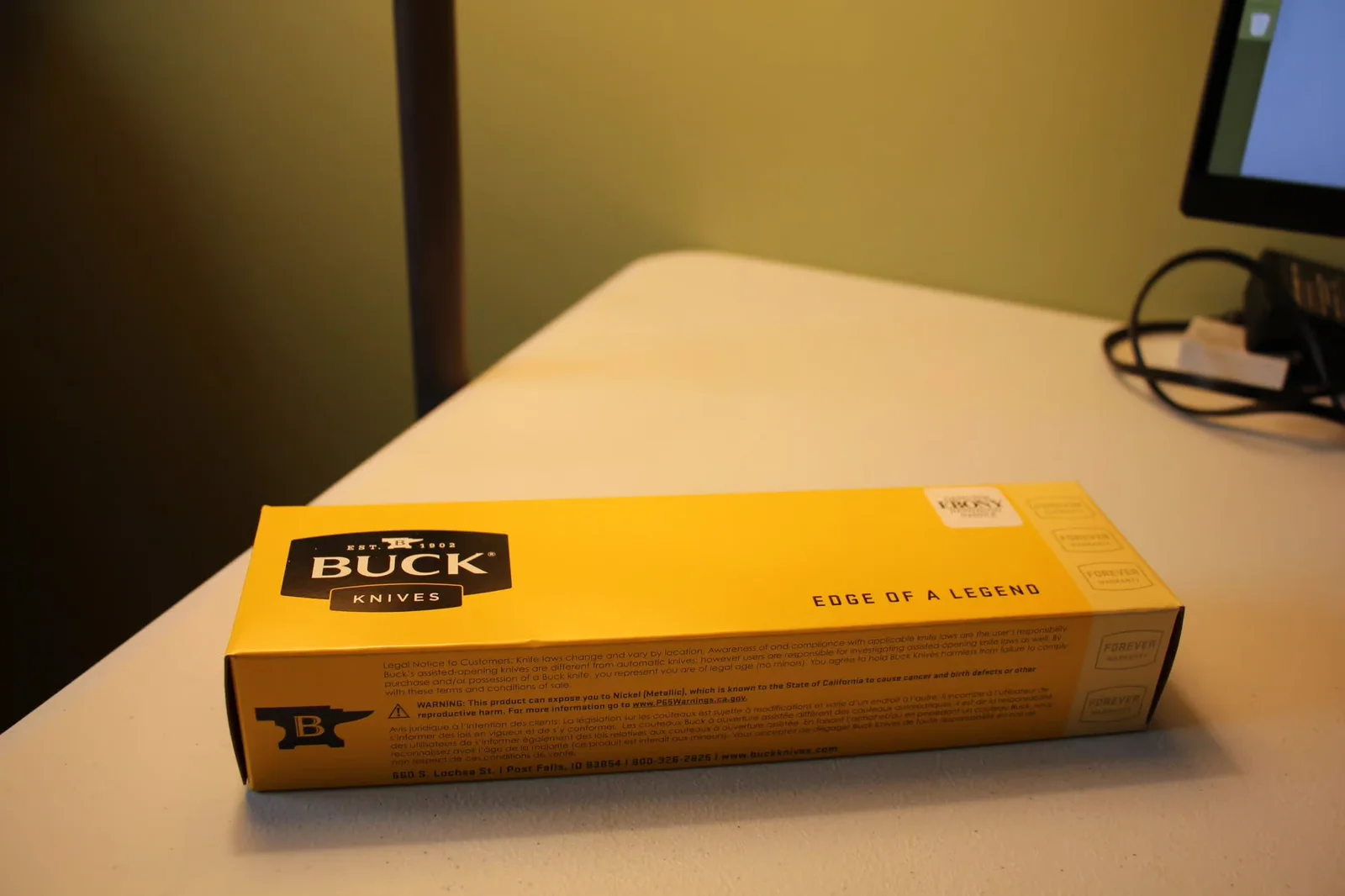
Before the steel, the box. Buck’s standard yellow-and-black packaging for the 110 is intentionally unchanged from how it has shipped for decades. It’s not premium dark/gold packaging like the 663 — it’s the working-knife box. That’s the right call: this is a $105 lifetime knife you carry, not a $230 gift-grade fixed blade that lives in a presentation case.
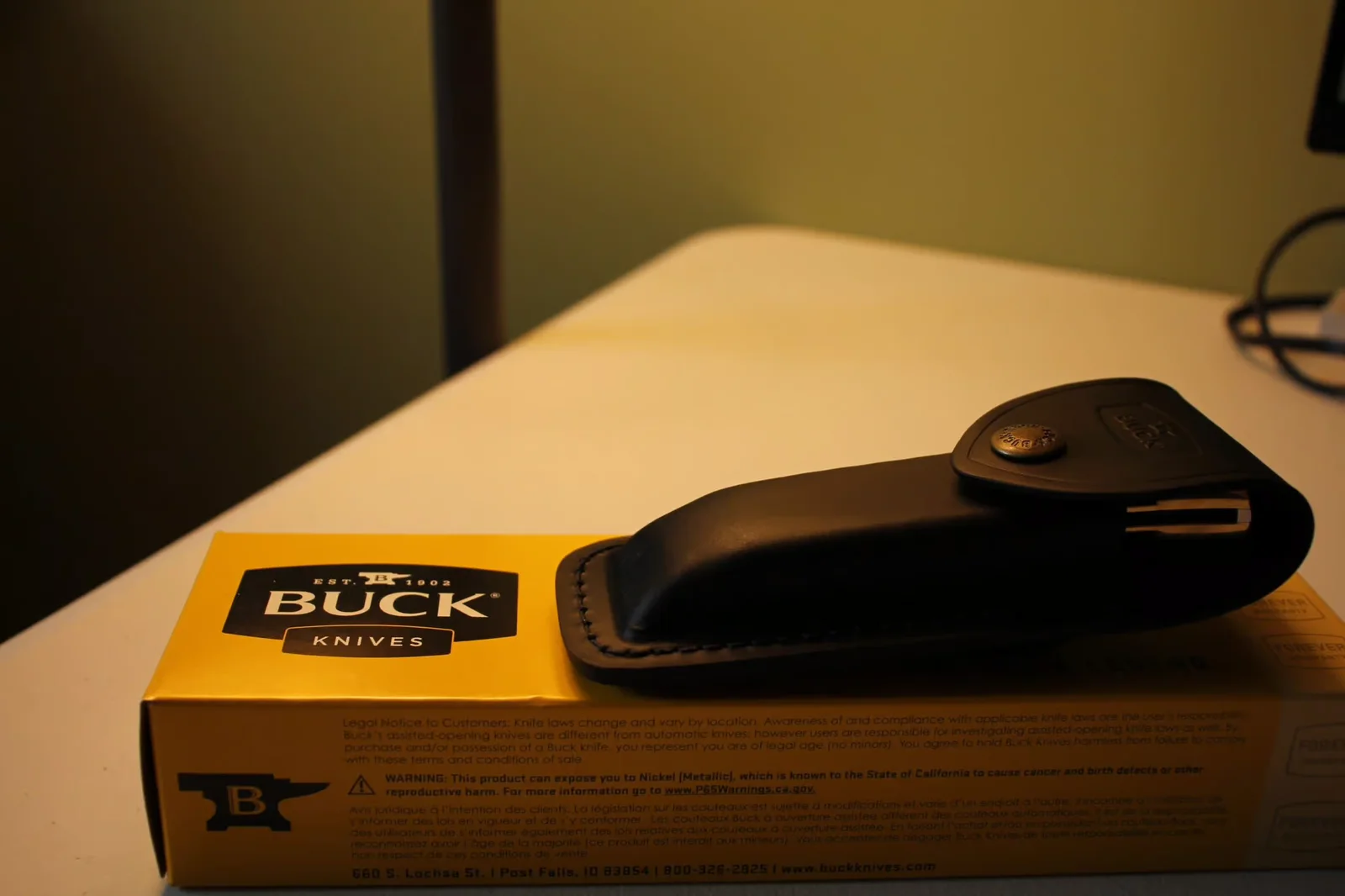
The top of the box carries the “EST. 1902” anvil mark in gold against black — the same B-anvil maker’s mark that’s been on every Buck knife since the company started.
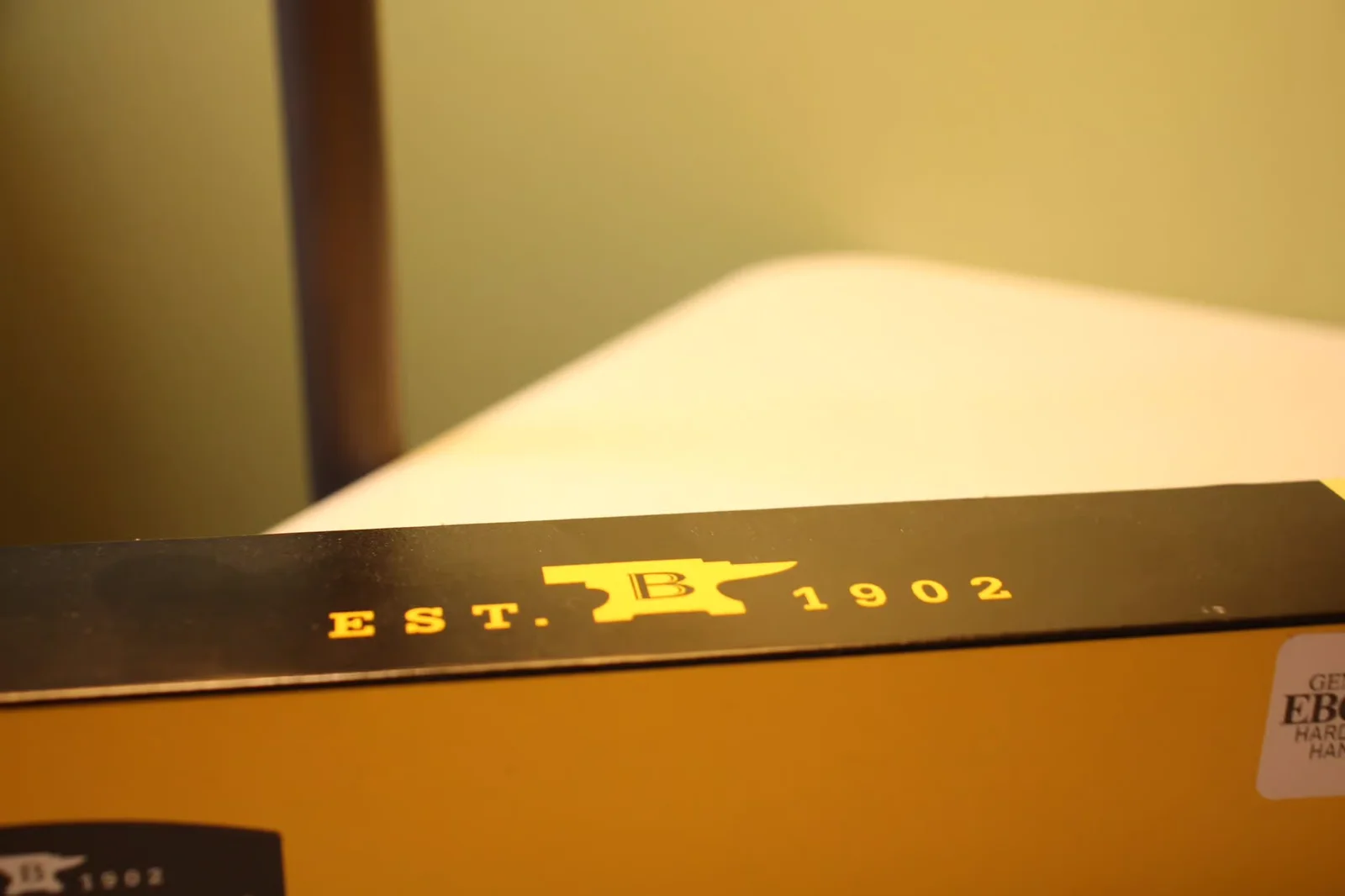
The end label calls out “EDGE OF A LEGEND” — Buck’s house tagline for the 110 line — alongside three Forever Warranty stamps, and a small sticker confirming “Genuine Ebony Hardwood Handle.” That detail matters: the standard 110 ships with real ebony, not stained hardwood or polymer. At this price point, almost nothing else on the market does that.
The side of the box carries the legal copy — California Prop 65 nickel warning, knife law notices in English and French — and the Post Falls, Idaho address. That French copy is your reminder that the 110 has been shipped into Canada for generations; this is one of the few American-made knives where Canadian retailers have been a real channel since the 60s.
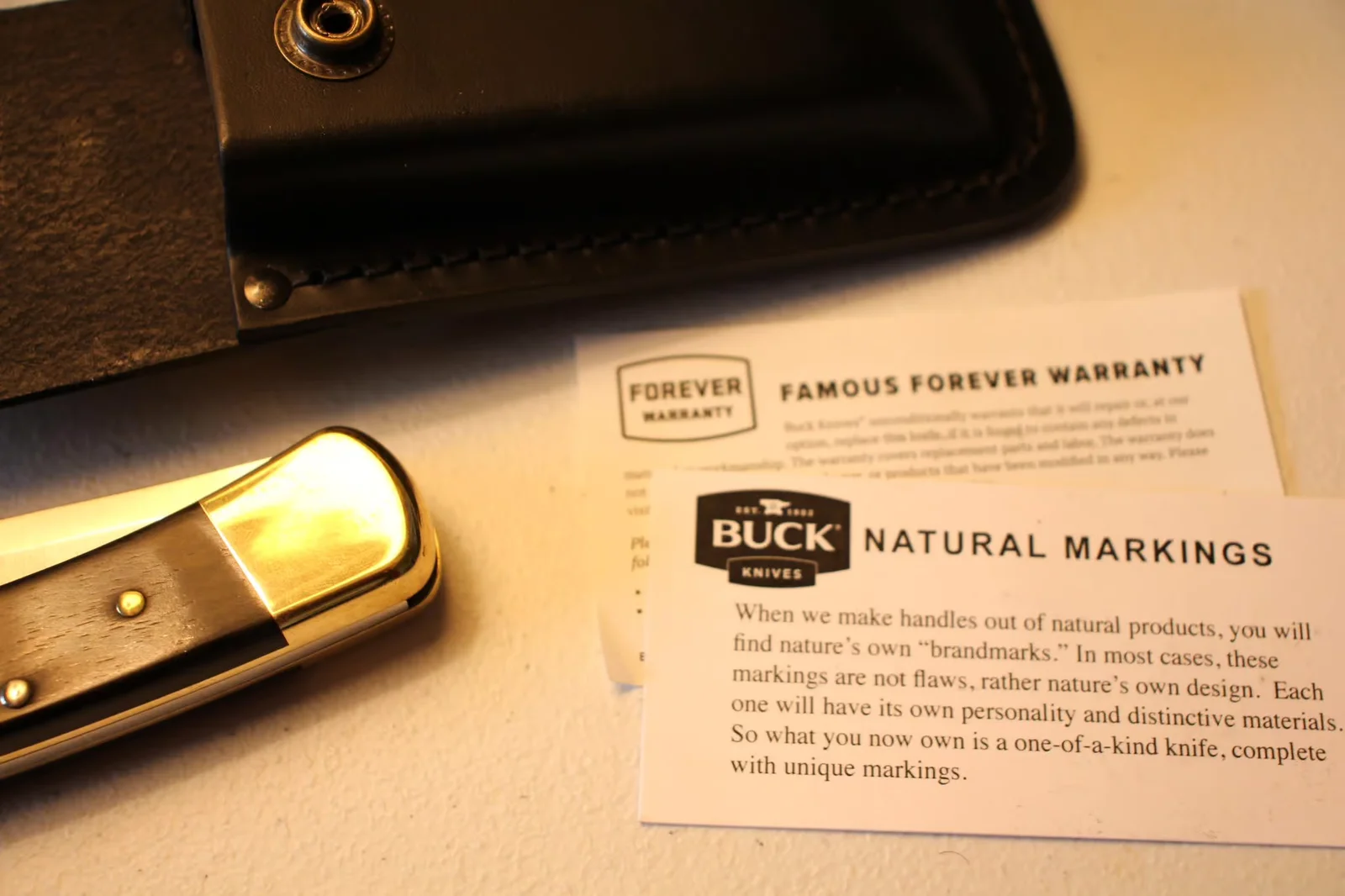
Inside the box: the knife in its leather sheath, a small information card explaining Buck’s Forever Warranty, and a second card on “Natural Markings” — Buck’s note that ebony is a natural material and that grain variations are features, not flaws.
The Sheath
Buck includes a real leather belt sheath in the box. Not a polymer pouch, not a fabric sleeve — black full-grain leather, snap closure, made in the USA. At $105 retail, this would be the easy place to cut cost. Buck doesn’t.
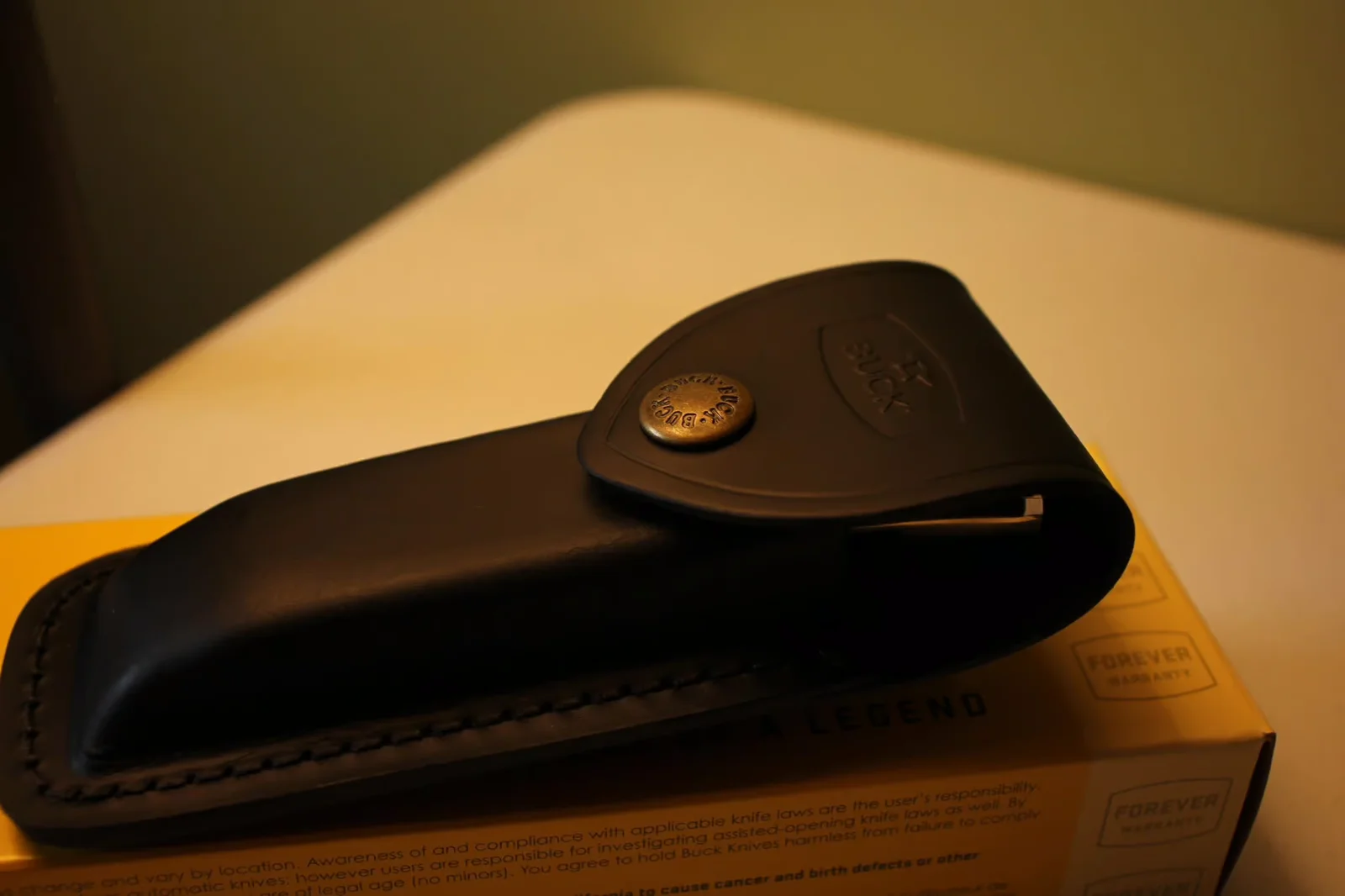
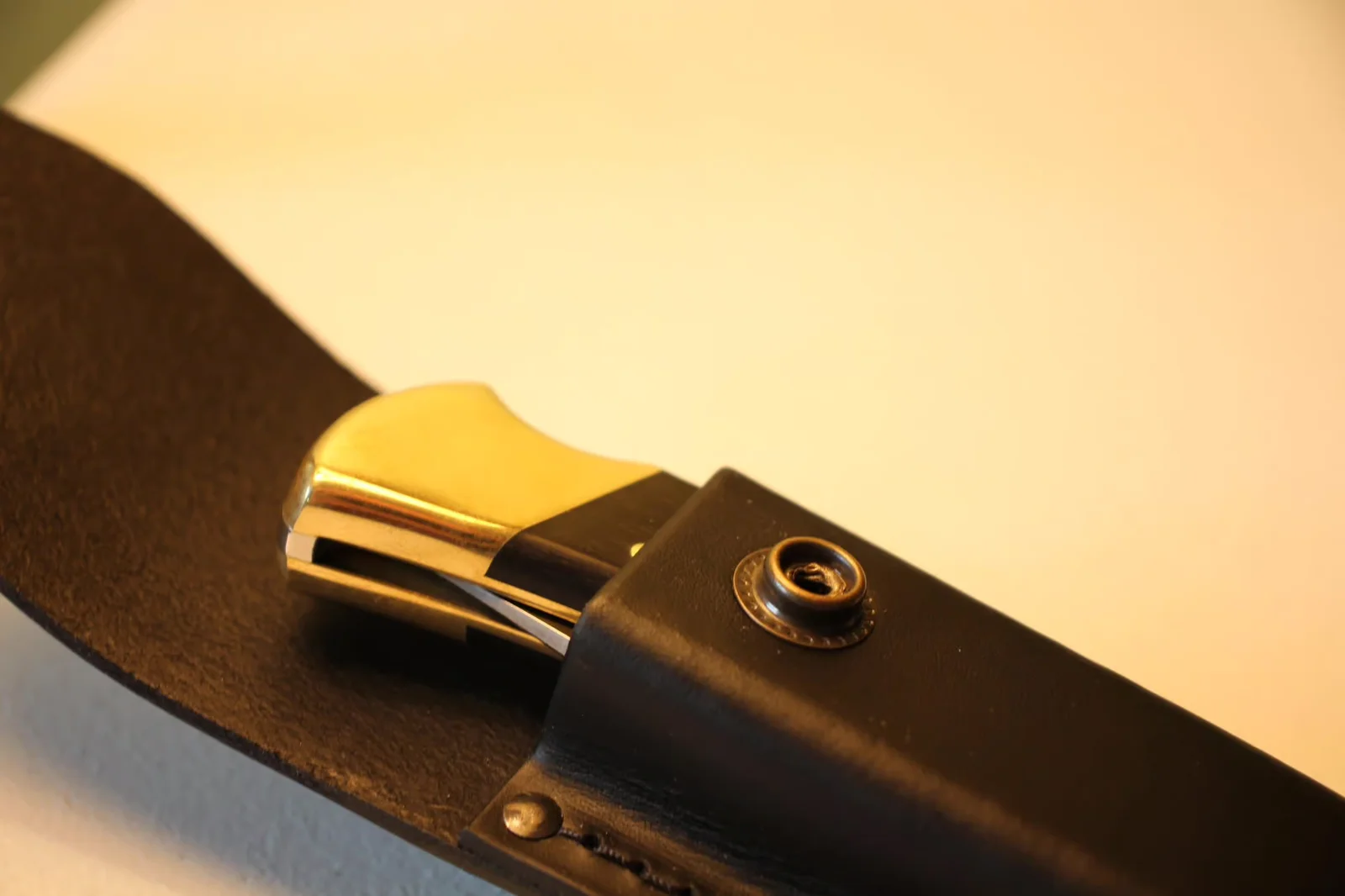
The snap closure carries a brass button with the “BUCK · BUCK · BUCK” branding around its rim — the same hardware Buck has used on this sheath for decades. The leather is stitched along both seams with a contrasting thread, and the throat of the sheath is embossed with the Buck shield logo.
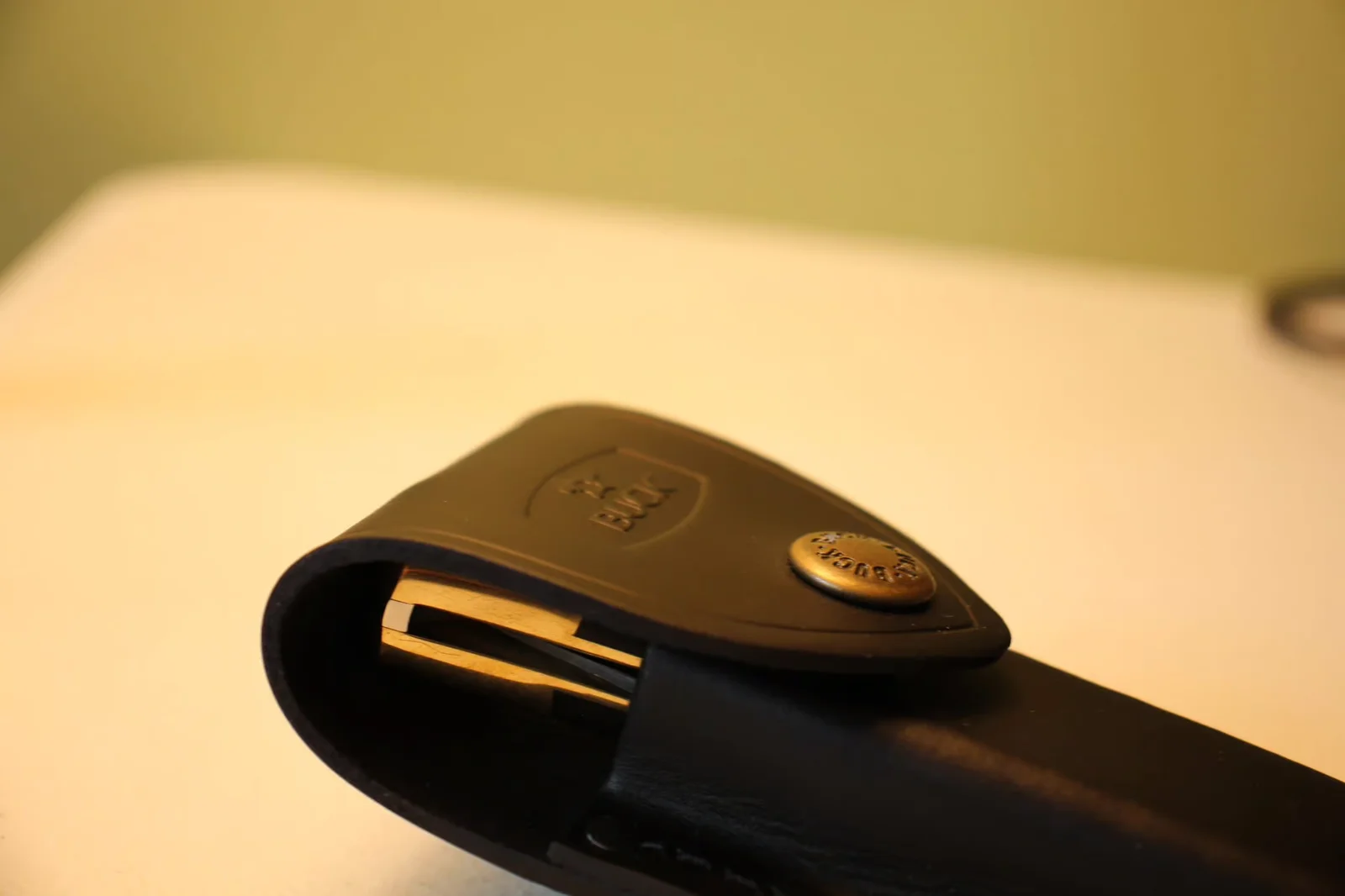
Flip the sheath over and the back panel carries a second embossed Buck logo near the snap rivet. Both faces are clean leather, no rough edges, no glued seams visible.
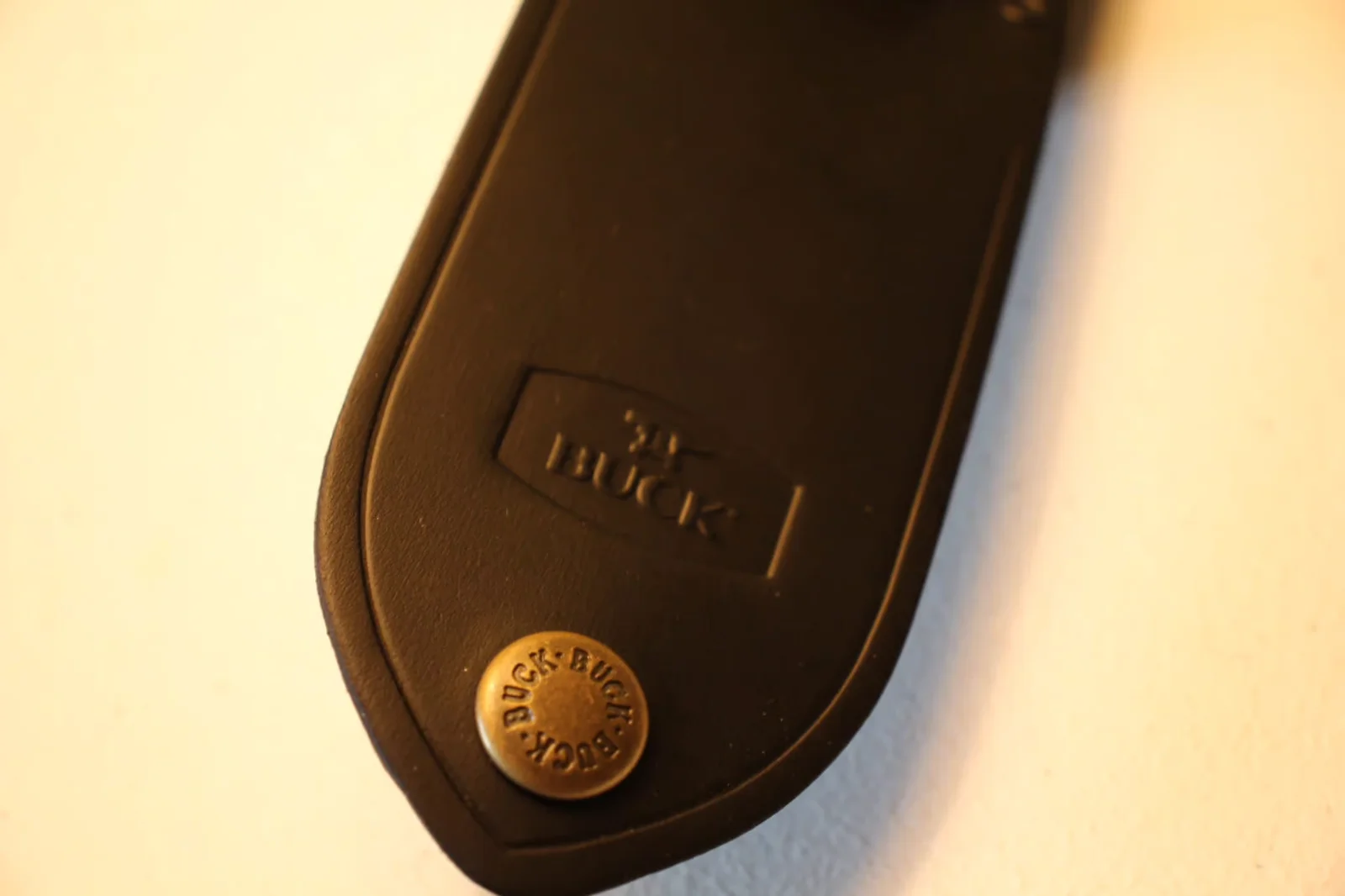
The sheath rides flat against the hip on a 1.5-inch belt and the snap is firm enough that the knife isn’t going anywhere on a fast walk through brush. It’s not a sheath you replace — it’s a sheath you wear in for 30 years.
The Steel: 420HC with BOS Heat Treatment
Here’s where the 110 conversation gets interesting, and where most online discussions miss the point. The 110 runs 420HC stainless steel. By spec-sheet alone, 420HC is unremarkable — it’s a budget steel used in everything from kitchen scissors to gas-station folders. If you compared it on paper to S30V, M390, or S35VN (the steel in the Buck 663 Alpha Guide), 420HC looks like a step backwards.
That’s true on paper. In the 110, it isn’t true in the hand. The reason is BOS heat treatment — Buck’s proprietary protocol developed by metallurgist Paul Bos, who spent decades refining the cryogenic and tempering cycles that get the most out of 420HC. BOS-treated 420HC runs around 58 HRC and is widely regarded as the best execution of 420HC anywhere in the industry. Knife forums and steel-testing channels consistently rank Buck’s 420HC as outperforming most makers’ 8Cr13MoV, AUS-8, and 14C28N — steels that are theoretically “better” on the data sheet but rarely treated with the same care.
The practical translation: this is a steel that’s easy to sharpen in the field, holds an edge well enough for a full day of game processing, and shrugs off rust in wet climates without you babying it. That’s the right answer for a folding hunter that gets carried, used, and put away wet — which is what this knife is built for.
How 420HC compares — at this price tier
Edge-retention rankings change depending on the test (CATRA, cardboard slice cycles, etc.) but the consensus across published comparisons is consistent:
| Steel | Edge retention | Toughness | Corrosion resistance | Sharpenability | Typical HRC |
|---|---|---|---|---|---|
| Buck 420HC (BOS) | 5/10 | 7/10 | 8/10 | 9/10 | 57-59 |
| 8Cr13MoV | 4/10 | 6/10 | 6/10 | 9/10 | 57-59 |
| AUS-8 | 4/10 | 6/10 | 7/10 | 9/10 | 57-59 |
| 14C28N (Sandvik) | 5/10 | 7/10 | 8/10 | 8/10 | 58-60 |
| CPM-S30V (premium) | 7/10 | 5/10 | 7/10 | 4/10 | 59-61 |
Higher is better in all columns. Scored 1-10 against published Crucible, Sandvik, and Buck materials data plus consensus from edge-retention testing communities.
The takeaway: BOS-treated 420HC trades raw edge retention for outstanding sharpenability and corrosion resistance — which is exactly the trade you want in a daily-carry folding hunter you might field-sharpen on a pocket stone after dressing a deer. If you want longer edge retention and you’re willing to deal with harder sharpening and slightly more rust risk, that’s what the Buck 663 Alpha Guide and its S35VN steel are for.
Sharpenability, visualized
Relative sharpenability score, 1-10 scale. Source: synthesized from Buck's published heat-treat documentation and CATRA-protocol industry testing.
The Blade
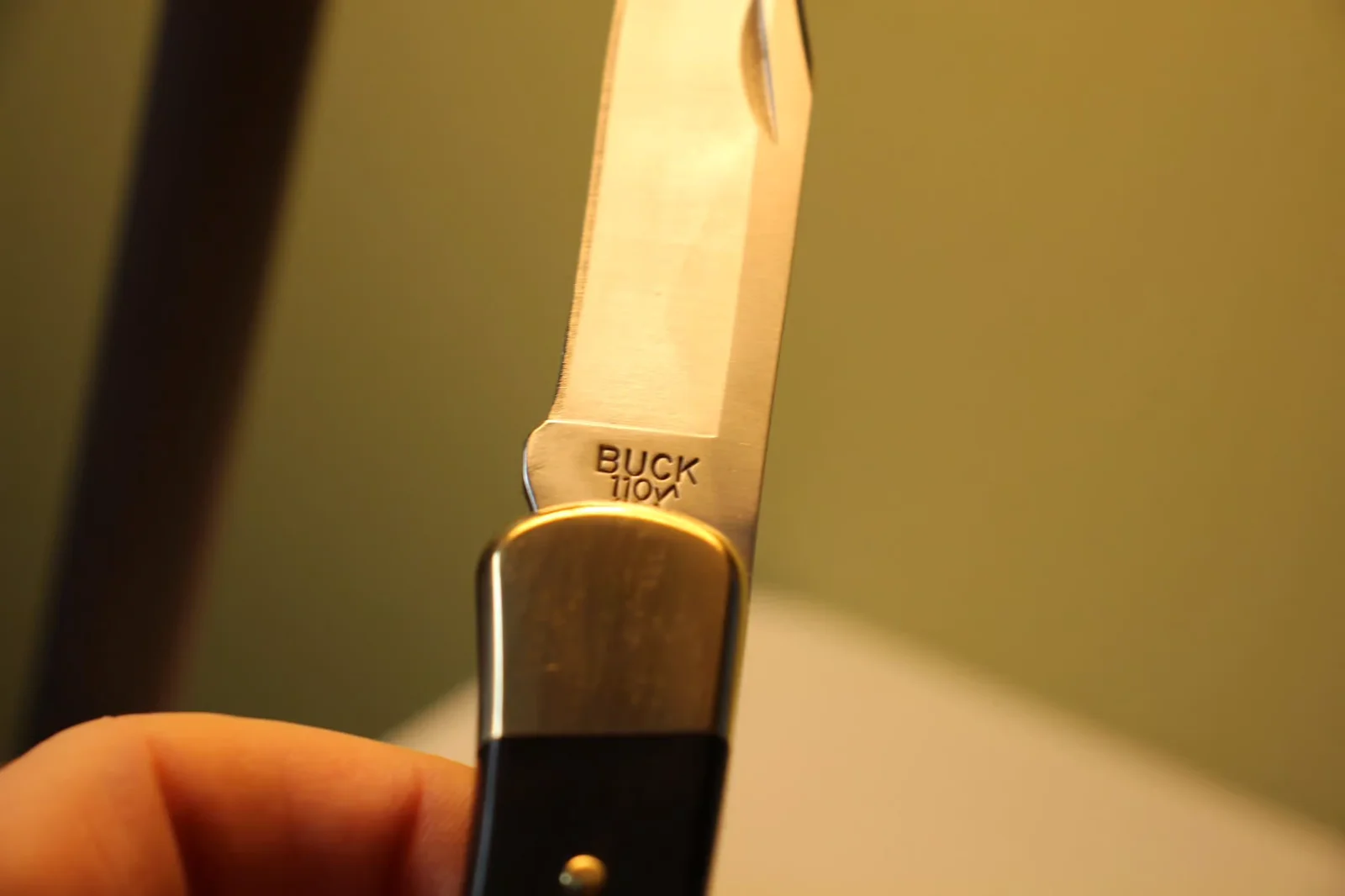
The 110 runs a 3.75-inch clip-point blade with a hollow grind. The clip point is the defining geometry of the American hunting knife — pointed enough for piercing work and tip control during caping, with enough belly behind it for sweeping cuts through hide.
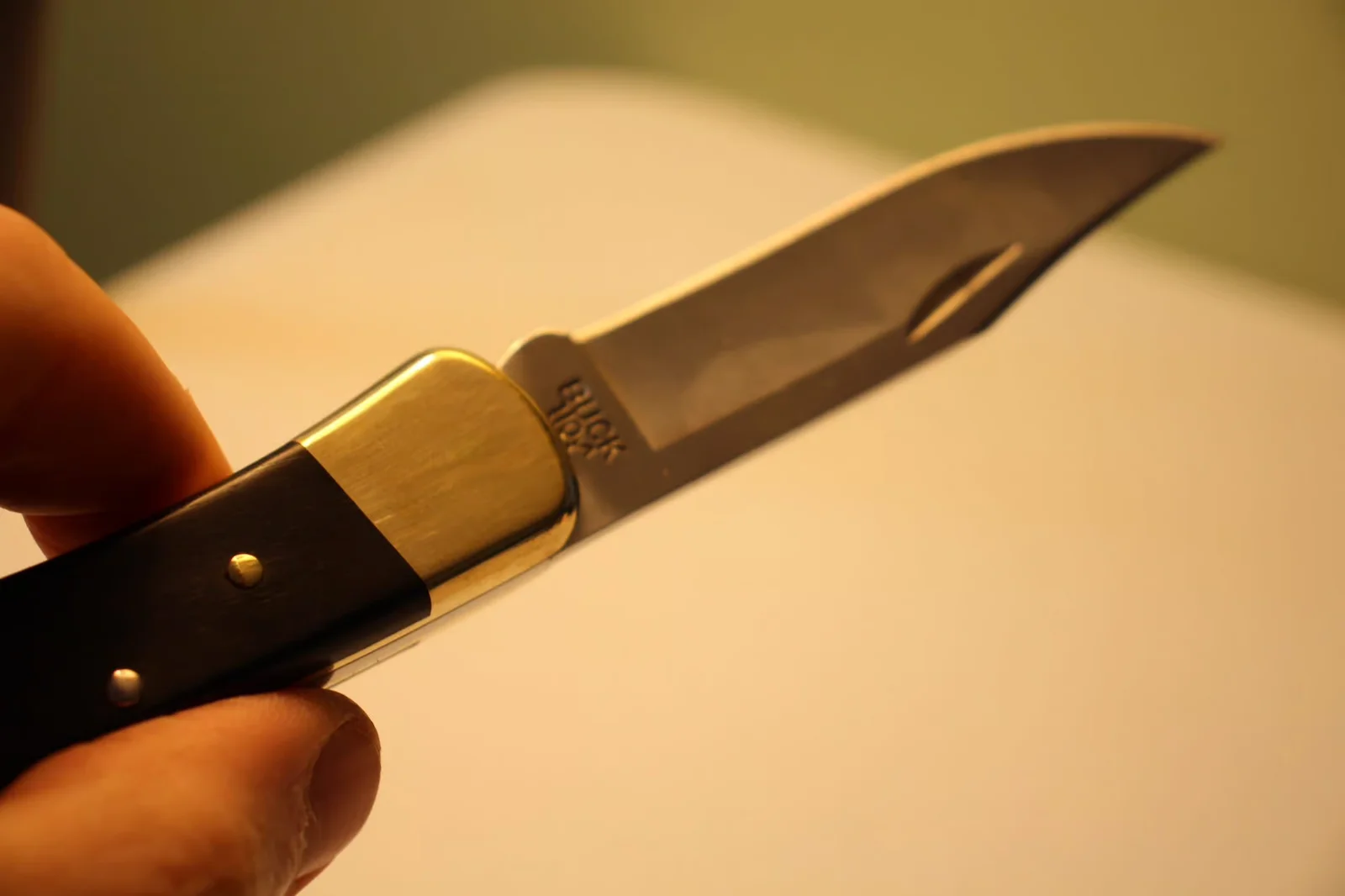
The hollow grind — concave behind the edge — is what gives the 110 its surprising slicing performance for a knife this thick at the spine. A hollow grind on a thin behind-the-edge geometry releases cleanly out of meat and hide; it’s part of why the 110 became the standard for field dressing in an era when most folders couldn’t manage that work.
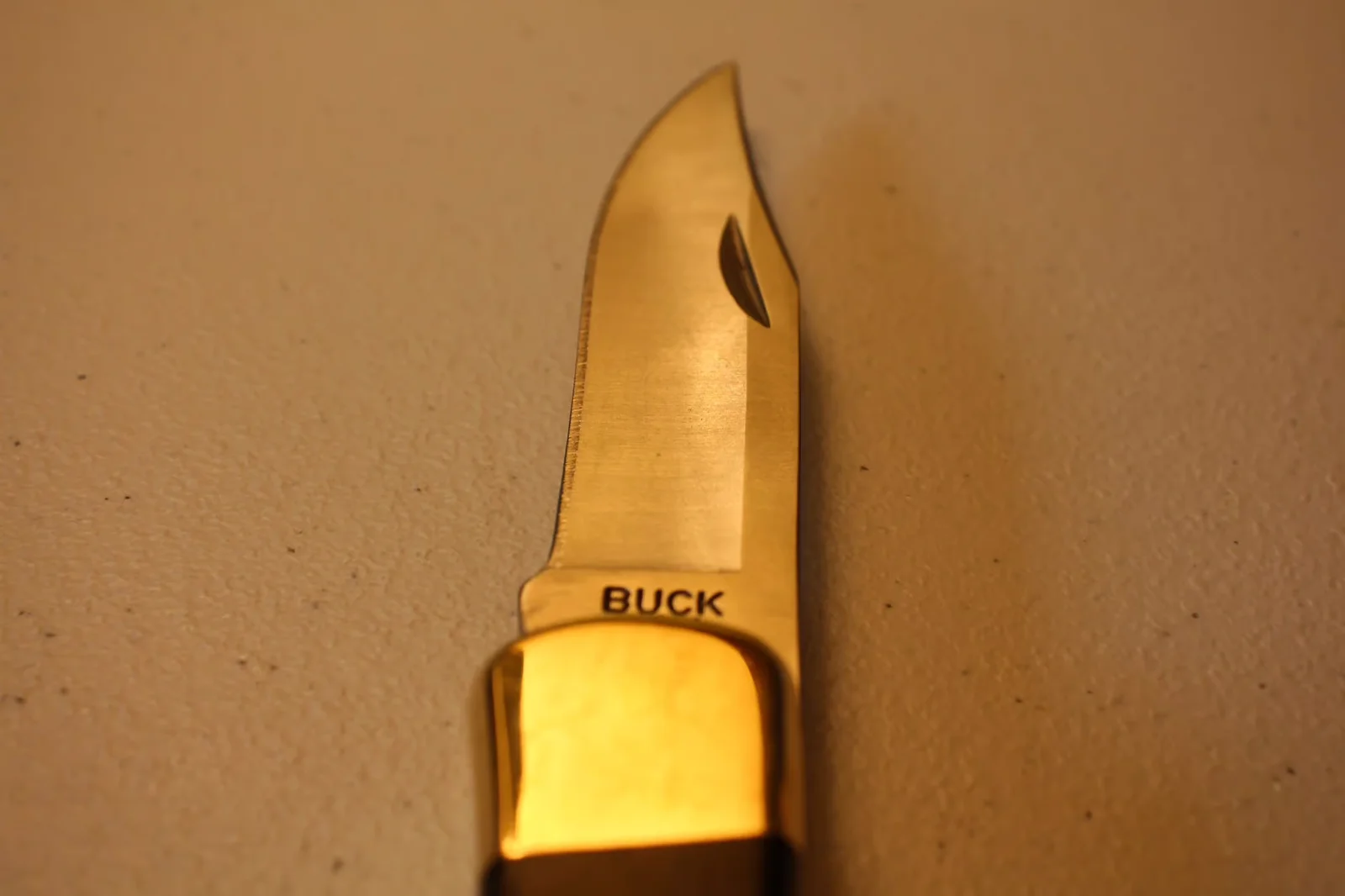
The nail nick is the classic crescent on the right side of the blade — this is a two-hand opening knife, no thumb stud, no flipper, no assisted mechanism. That’s a deliberate choice. The 110 is a slow knife to open, and that’s part of what it is. If you want fast deployment, Buck makes a 110 Auto and an Auto Elite with the same profile and a button release; the standard 110 is the one you carry when you have time to open a knife properly.
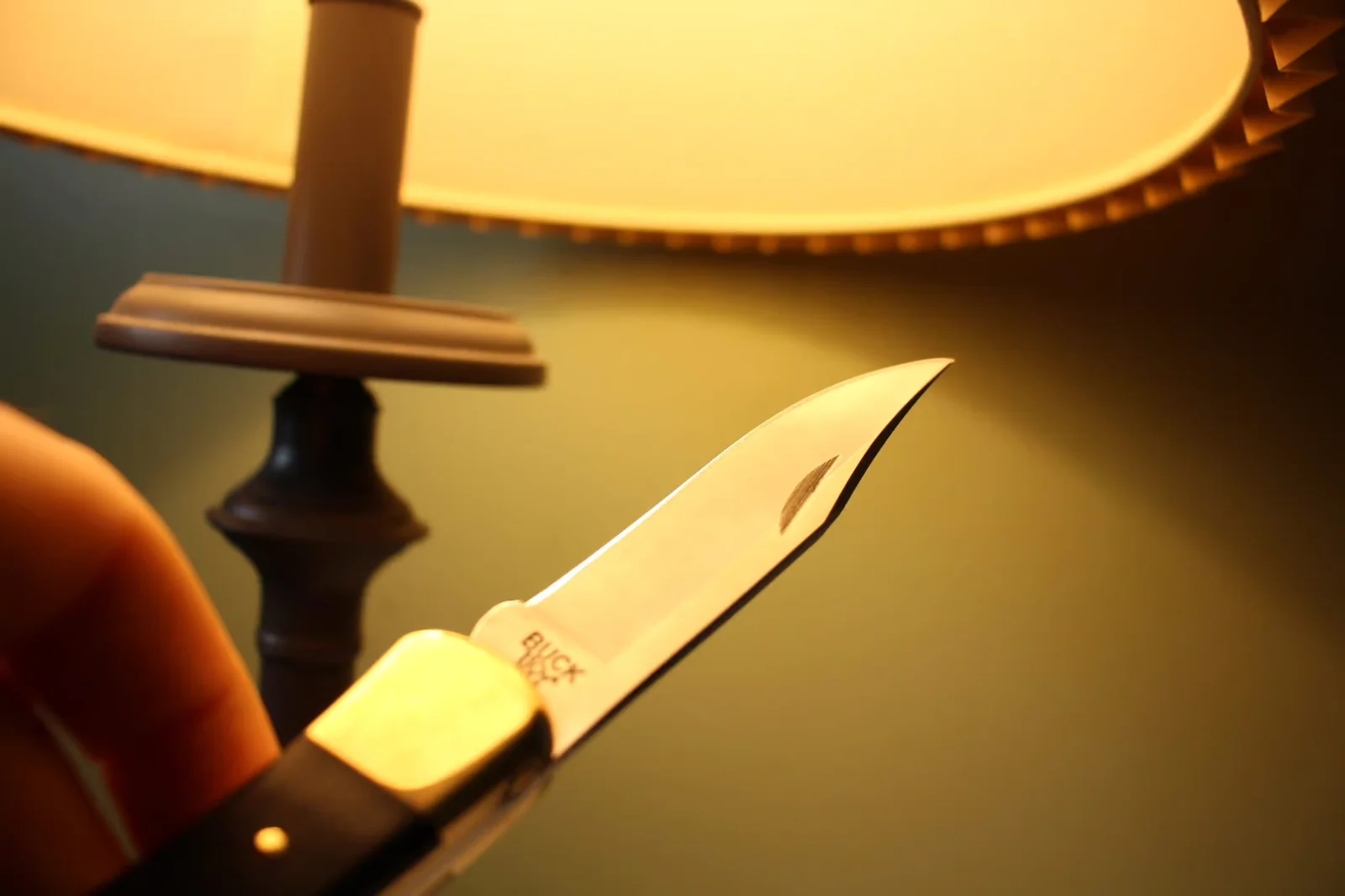
The point sweeps up into a fine clip-point tip strong enough for caping and pelvic work. Buck holds a tight tolerance on the grind here — there’s no wobble, no asymmetry between the two faces, and the edge bevel is even from heel to tip.
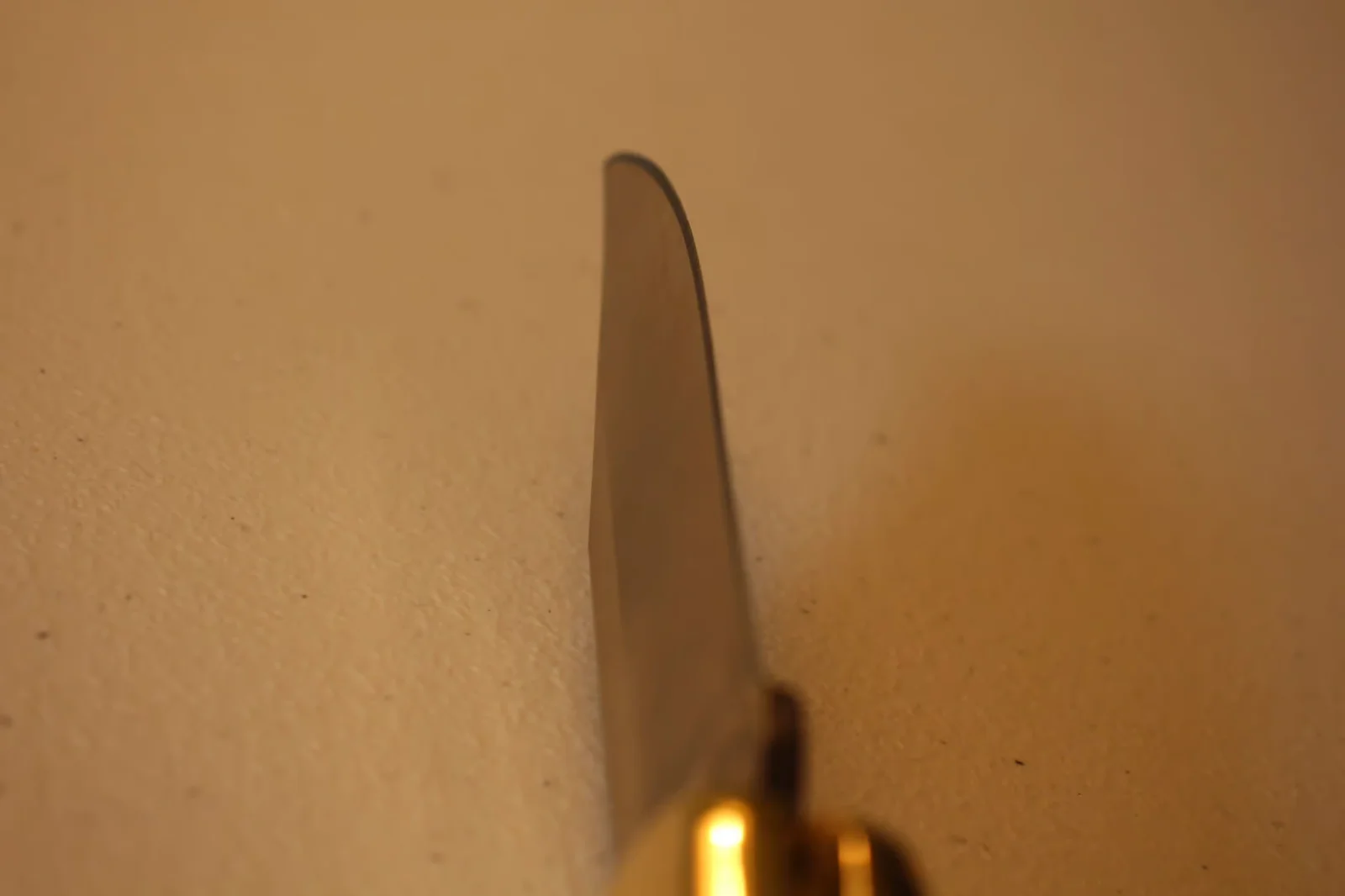
The Lockback — the Mechanism that Made the Category
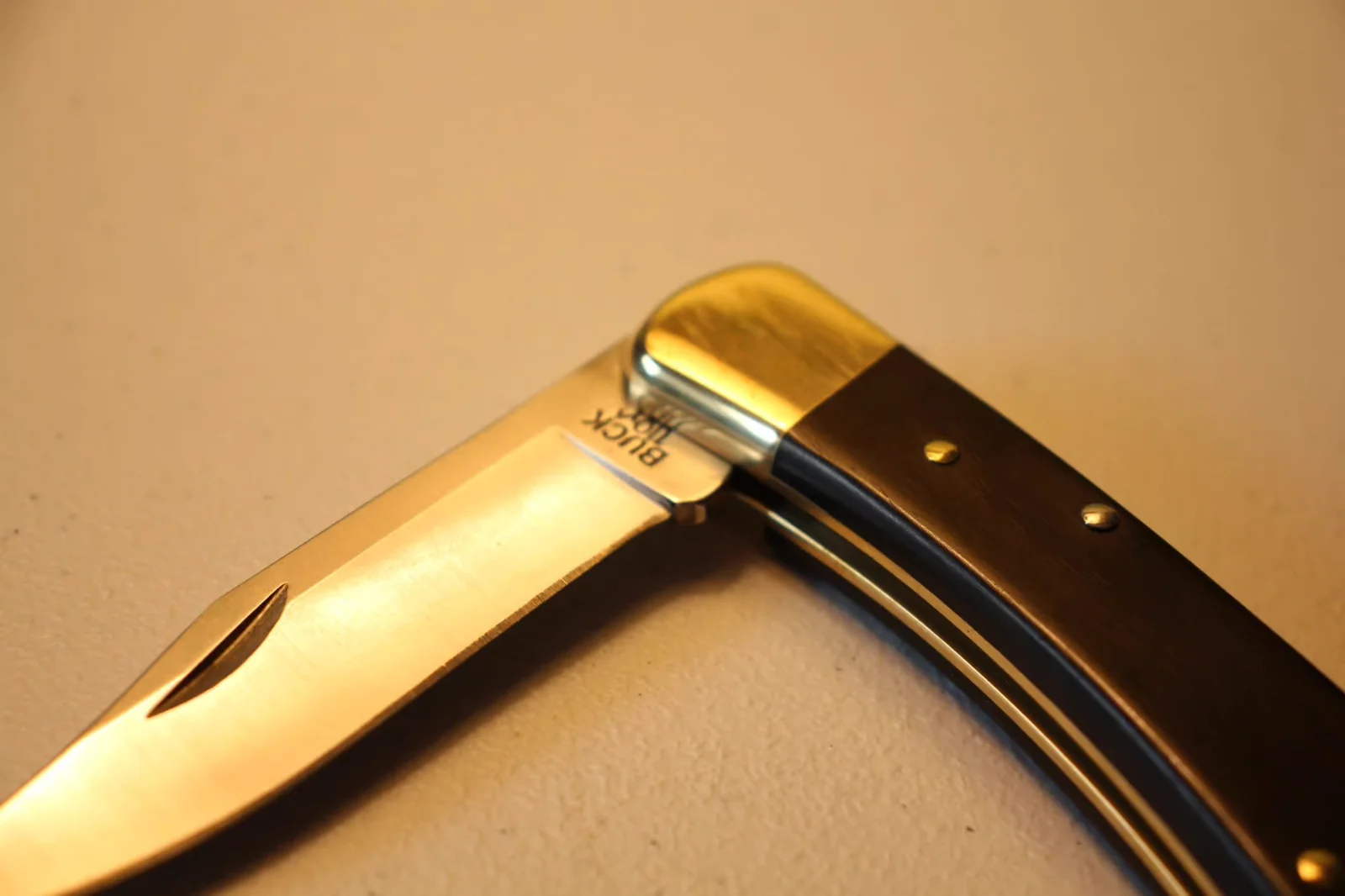
The 110’s mid-blade lockback is the part of this knife that changed the industry. Before 1964, folding knives that opened past 90 degrees either snapped shut on your fingers or used slip joints that depended on spring pressure alone. Al Buck’s design — a spring-loaded bar that drops into a notch in the blade tang and engages with a release at the spine of the handle — solved that problem with mechanical certainty.
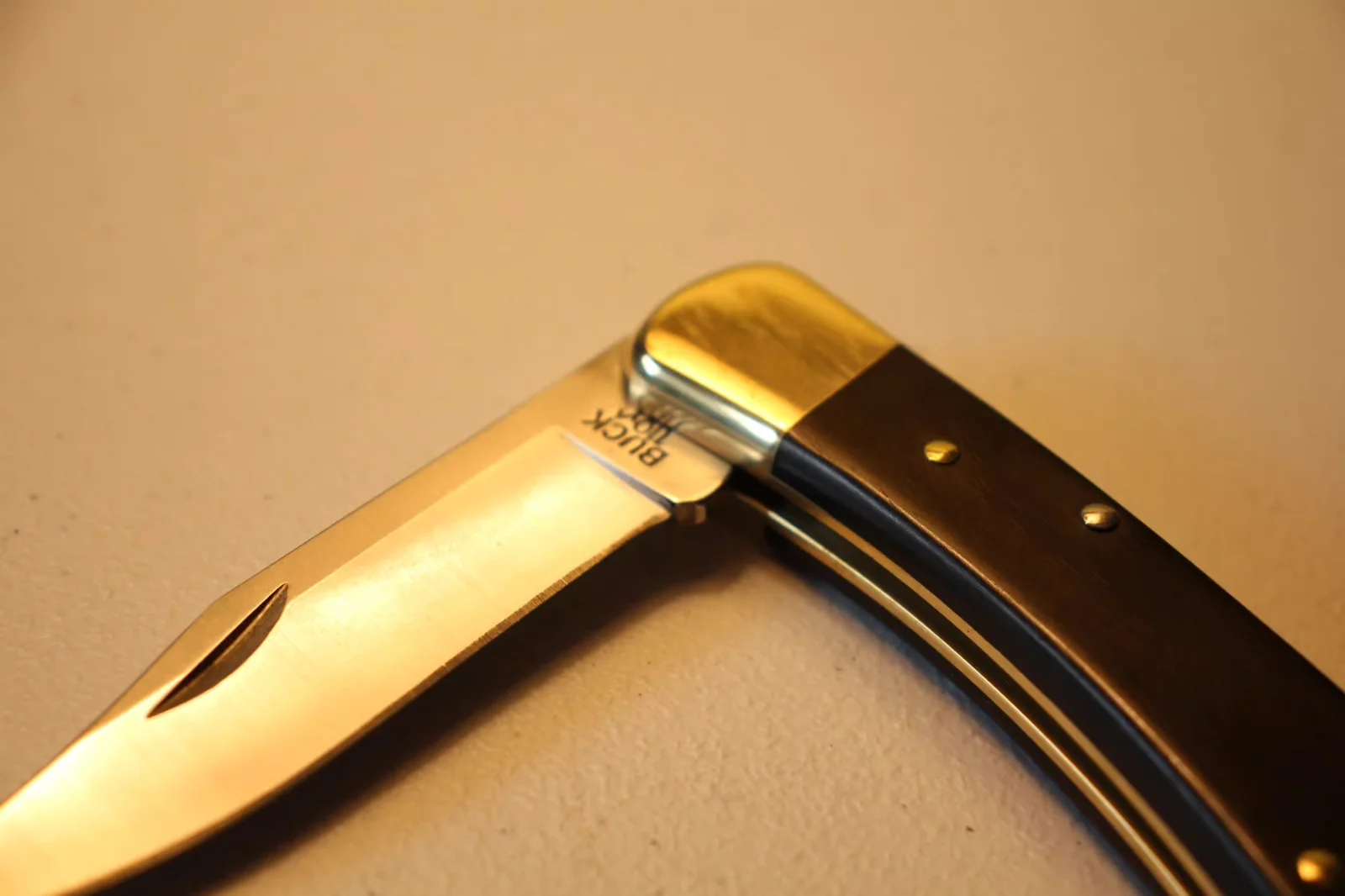
In practice this means the 110 locks open with zero blade play in any direction. Press the release at the spine and the blade swings closed smoothly under spring tension. Sixty years of refinement have made this mechanism close to perfect — the tolerance on the lock face is tight enough that the lock-up feels solid out of the box and stays that way.
Lockback vs. modern lock types
Modern folders mostly run liner locks, frame locks, or compression locks. Each has trade-offs. Here’s how the lockback stacks up against the alternatives you’d see in a $100 folder today:
| Lock type | Strength | One-hand close | Wear over time | Best for |
|---|---|---|---|---|
| Mid-blade lockback (110) | 9/10 | No | Excellent | Hard use, two-hand work |
| Liner lock | 6/10 | Yes | Moderate (drifts) | EDC, light use |
| Frame lock | 8/10 | Yes | Good | EDC, medium use |
| Compression lock | 9/10 | Yes | Good | EDC + hard use |
| Slip joint (traditional) | 3/10 | Yes | Good | Light cutting only |
Strength ratings reflect both static lock strength and resistance to accidental disengagement under field conditions.
The lockback gives you the strongest mechanical lock-up of any classic folding-knife mechanism and the best long-term wear resistance — at the cost of requiring two hands to close. For a hunting folder you carry for years, that’s the right trade.
Ergonomics — Ebony, Brass, and a Handle That Just Works
The handle is where the 110 makes its bones as an heirloom-class knife. Most folders at this price use polymer scales, anodized aluminum, or G10. The standard 110 uses genuine ebony hardwood with polished brass bolsters and brass pivot pins.
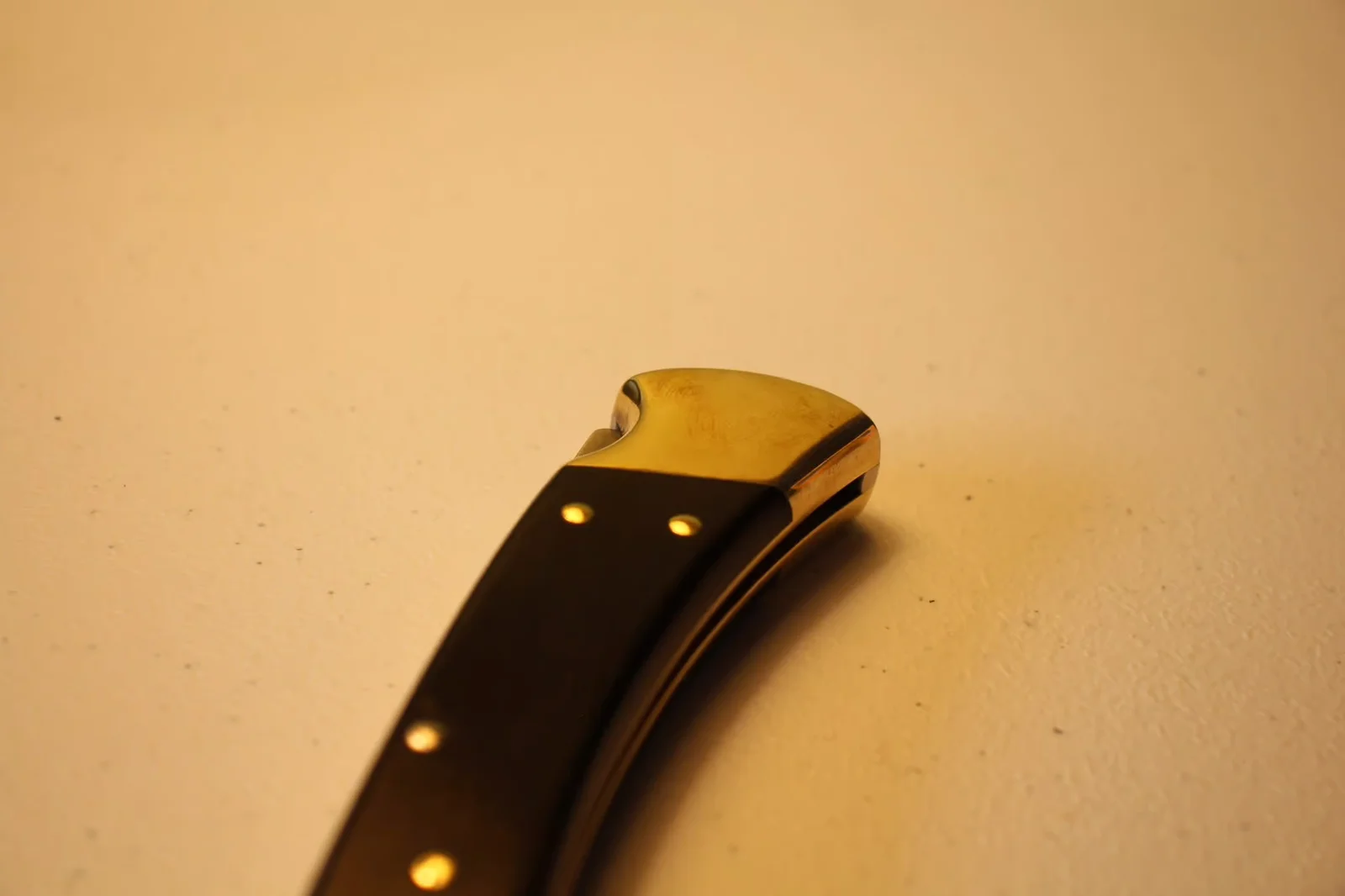
Ebony is the right wood for a knife scale: dense, dimensionally stable, naturally oily so it doesn’t dry out and crack, and it ages into a deep dark patina with use. It’s also heavier than synthetics, which is partly why the 110 weighs 7.2 ounces. That weight is a real consideration — in 2026, where most folders weigh under 4 ounces, the 110 feels substantial in a pocket. That’s not a bug. It’s the knife.
The brass bolsters do real work. They protect the wood scales at the high-wear points (the pivot end and the pommel), add weight to the handle for balance, and provide a metal-on-metal anchor for the pivot pin. Polished brass also patinas naturally — yours will start mirror-bright and over a few years take on a soft, warm gold tone. That’s by design.
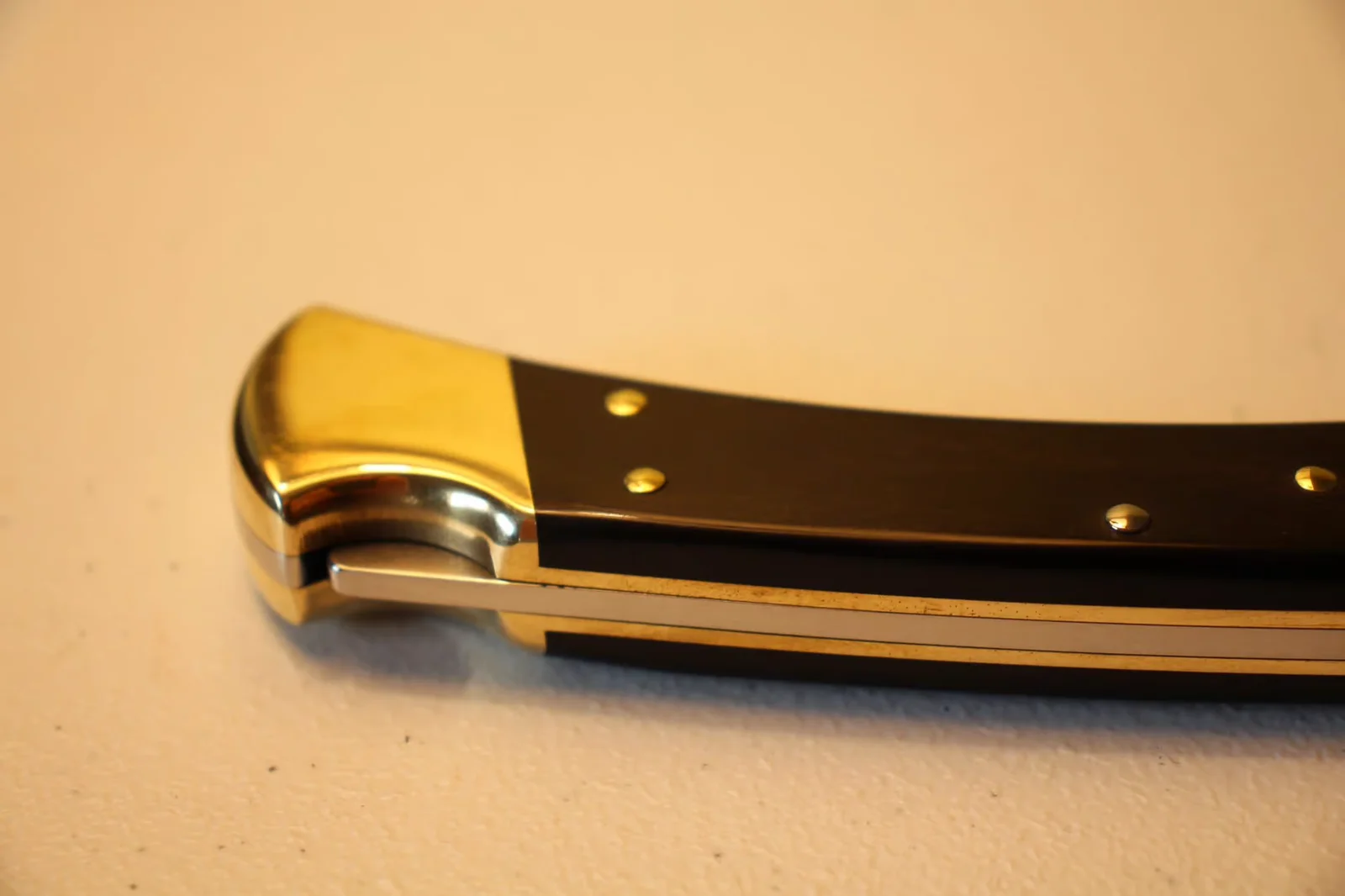
The handle has a slight curvature that fits a closed hand cleanly — index finger behind the bolster, middle and ring fingers along the scale, pinky against the pommel curve. There are no contoured palm swells or jimping ladders, no thumb ramps or chamfered edges. It’s a fundamentally clean handle profile that doesn’t try to anatomically over-engineer the grip. After 60 years of refinement, what Buck has settled on is that the right answer for most hands is to leave it alone.
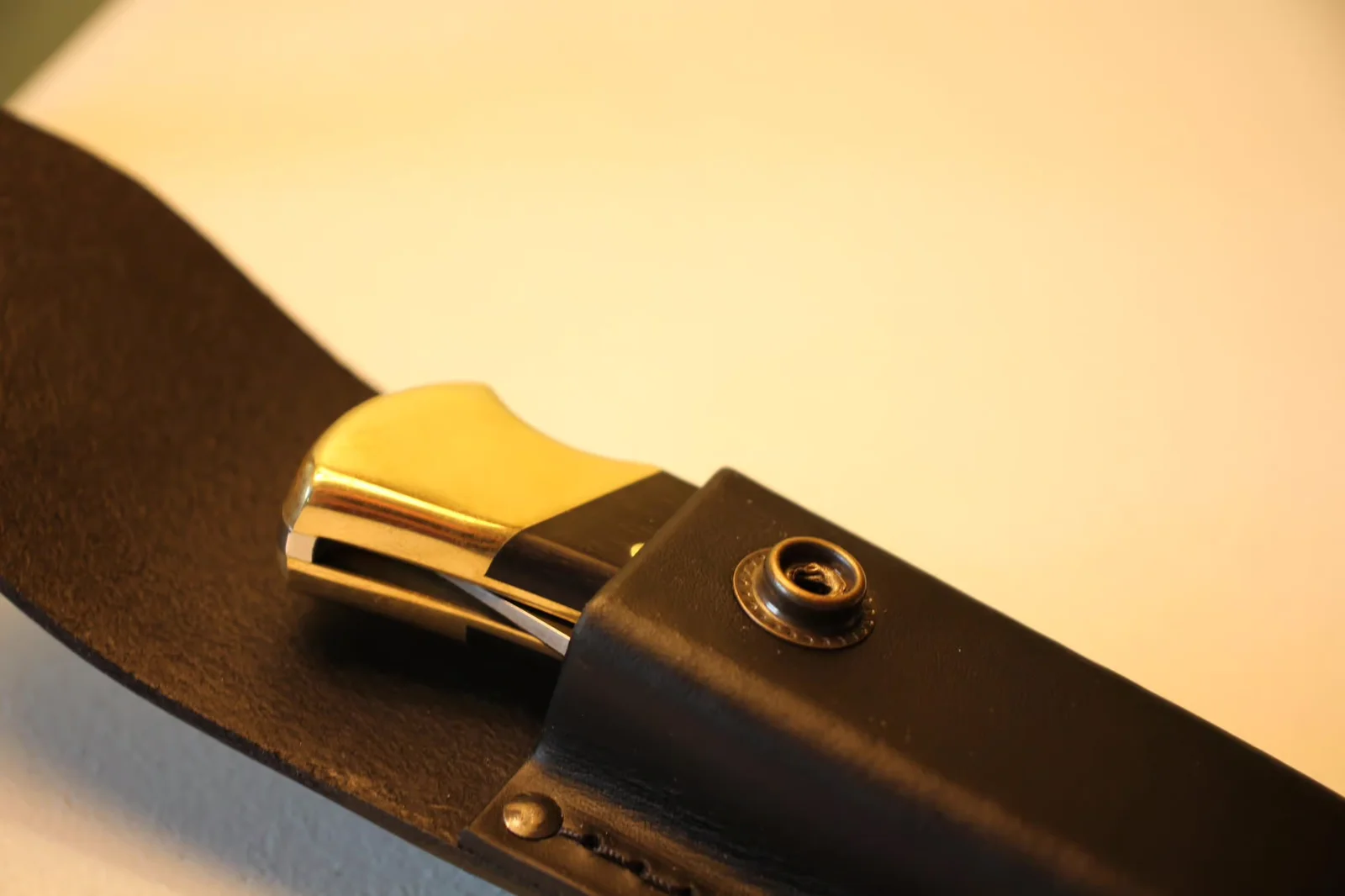
The handle is comfortably long enough for a full four-finger grip in a US large glove, and the brass-and-ebony build is heavy enough that the knife stays put in the hand even with wet, slick, or fat-coated palms — useful when caping a deer or breaking down a duck.
How It’s Built to Be Used
Hunting work was the original use case, and 60 years of customer feedback has kept the design honed for it.
Game Processing
The 3.75-inch clip-point blade is purpose-built for field dressing whitetail, mule deer, antelope, and similar mid-sized game. The point is fine enough to open the abdominal cavity without nicking the gut, the belly is long enough to sweep through hide without sawing, and the hollow grind releases cleanly out of muscle. For caping work — separating hide around the head and neck — the tip geometry threads cleanly between hide and skull.
For elk and bigger animals you’d want more belly and a longer blade; the 110 is workable on a bull elk if you’re patient, but it’s not the right tool. For everything from coyote down through grouse, it’s overspec’d in a good way.
EDC and Camp Work
The 110 is heavier than most modern EDC folders by 3-4 ounces. For pocket carry that’s a real factor — you feel it. The right way to carry it is in the included leather belt sheath, which keeps it out of the pocket entirely and turns the weight into a feature: solid heft for cutting, no flopping around against your phone.
For camp duty the 110 handles everything a 3.75-inch blade is built for: opening packaging, cutting cord and paracord, splitting cured meats and hard cheese, breaking down kindling under hatchet light. It is genuinely better at slicing soft food than thicker survival knives like the ESEE 4 — the hollow grind cuts cleanly through a ripe tomato or a cured sausage without crushing it.
Fire and Tinder Work
The spine of the 110 is rounded for finger comfort during palm cutting, which is the right call for a hunting folder but a small disadvantage for ferro-rod scraping — you can’t get the same sharp 90-degree corner you’d get on a square-spined fixed blade like the 663. In practice this matters less than the internet sometimes claims: a firm scrape with the heel of the edge still throws good sparks off a ferro rod, and a folder isn’t your primary fire-prep tool anyway.
For scraping bark or making fine tinder shavings, the hollow grind is well-suited; it bites cleanly into wood and produces long, even curls.
Edge Retention and Field Sharpening
Here’s where the 110’s “boring” 420HC actually pays for the design choice. After a full day of game processing, you can put a working edge back on the 110 in 30 seconds with a pocket ceramic or a small DMT folding diamond plate. You can do it on a flat creekstone if you have to. Compare that to the field-sharpening experience with S30V or S35VN — those steels reward patience and the right stones, and they punish you in the woods if you’re trying to touch up an edge with what you brought.
The trade is real. The 110 doesn’t hold a working edge as long as a premium-steel folder — but the edge it holds is enough for a deer, and the edge it loses comes back in less time than it takes to wipe the blade clean.
Pros and Cons (the Honest Version)
What this knife does exceptionally well
The materials are right for the price: real ebony, real brass, real leather. The steel is the best 420HC anywhere on the market thanks to Buck’s BOS treatment. The lockback is the most refined mechanism of its kind, and the lock-up is rock solid. The sheath is included, made in the USA, and the kind of leather you wear in over decades. The Buck Forever Warranty backs the whole package, and Buck will refurbish a 110 you bought 30 years ago for almost nothing.
Where it falls short
It’s heavy. 7.2 ounces is a real number to carry, and if you’ve gotten used to a modern 3.5-oz titanium folder, the 110 will feel like a brick the first week. There’s no pocket clip on the standard model — you carry on a belt in the sheath, or in a pocket the old way. Opening is two-handed; no thumb stud, no flipper, no assist. And 420HC, while reference-grade for its tier, will be out-held on edge retention by any premium steel in the $200+ price bracket.
How It Compares
vs. Buck 110 Slim Pro ($89). The Slim Pro is the modern 110 — same blade profile, S30V steel, micarta or G10 scales, pocket clip, 3.2 oz weight. It’s the 110 you’d carry every day for EDC. The trade: no brass, no ebony, no soul. Pick the Slim Pro if you’re a daily-carry knife person who wants 110 DNA at modern weight. Pick the standard 110 if you want the original.
vs. Case Trapper ($65). The Case Trapper is the other American heritage folder. Two blades (clip-point and spey), Tru-Sharp surgical steel, jigged bone scales, slip joint (no lock). For pocket carry and EDC the Case is lighter and friendlier; for hunting work the Buck’s lockback is genuinely safer. If you want a slip-joint traditional, go Case; if you want a hunting folder, go 110.
vs. Spyderco Bushcraft Folder / similar G10 modern folders ($180-220). Modern folders at this price tier offer S35VN steel, lighter weight, one-hand opening, and pocket clips — real advantages for EDC. They don’t offer ebony, brass, leather, and 60 years of refinement. The 110 is the choice when heritage and material quality matter more than weight savings.
vs. Buck 663 Alpha Guide ($229). Different knives for different jobs. The 663 is a premium fixed blade for survival/bushcraft work — S35VN steel, G10 scales, full tang. The 110 is a folding hunter for game processing and belt carry. If you’re picking one Buck, the 110 is the everyday answer and the 663 is the dedicated survival answer.
Who Should Buy the 110
Buy it if you’re a hunter and you want one folding knife that will live on your belt for the rest of your hunting life. Buy it if you appreciate that some designs got it right the first time and don’t need to be redesigned every five years. Buy it if you want something made in the USA, by a family-owned company, that you can hand down to a kid.
Don’t buy it if you want a lightweight EDC folder — get the 110 Slim Pro or a Spyderco Native instead. Don’t buy it if you need one-hand opening for work — get the 110 Auto, or a modern flipper. And don’t buy it if you only need a knife for casual pocket use; you’ll resent the weight.
Final Verdict
The Buck 110 Folding Hunter is the rare piece of gear that earns the word “iconic” honestly. Sixty years of continuous production, in the same factory, with the same model number, doing the same job. The materials are right (real ebony, real brass, real leather, BOS-treated 420HC). The mechanism is right (the most refined lockback in production). The build is right (USA-made, Forever Warranty, the same tolerances Buck has held for decades). And at $105, it’s one of the best material-for-money values in the entire knife industry.
If you’ve never owned a 110, you should. If you have, you already know.
Rating: 4.9/5 Stars
Brands sometimes provide samples for review. Hunt & Live writes its honest opinion either way — gear that doesn’t earn its keep doesn’t get a recommendation.