
Featured Review · Buck · Knives
Buck 284 Bantam BBW Review — The 1.5-Ounce American Lockback That Costs Less Than a Box of Ammunition
Our Rating
Current Price
- Model
- 284 Bantam BBW (0284BKS)
- Blade length
- 2.75 in (6.8 cm)
- Blade steel
- 420HC stainless
- Stated hardness
- Rc 58
Pros
- 1.5 oz on a 3.75-inch closed frame — the lightest knife we have reviewed, by a wide margin, and light enough that you stop deciding whether to bring it
- 420HC stainless at a stated Rc 58, the steel Buck heat-treats better than anyone else in the industry and the reason a budget Buck holds an edge like a costlier knife
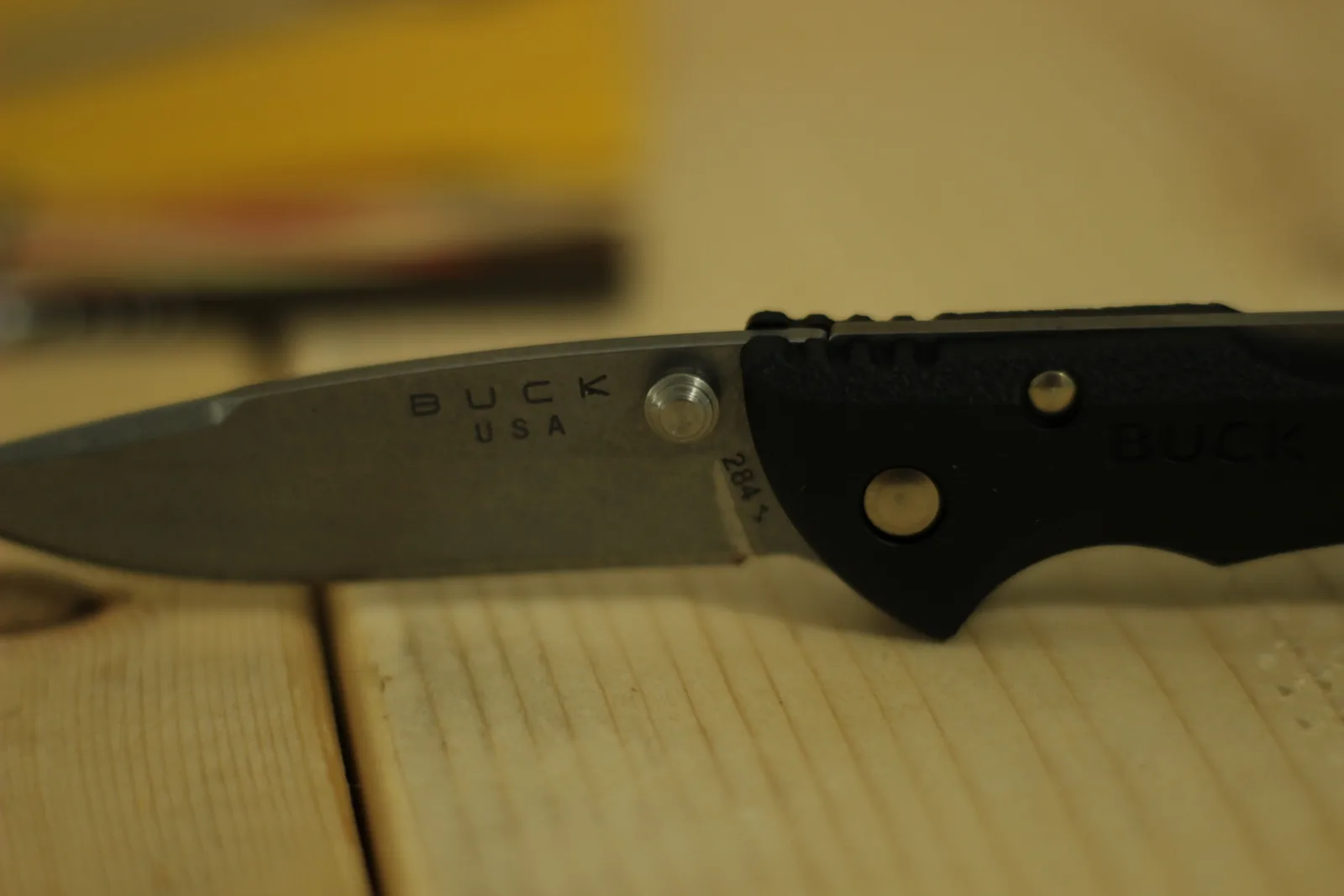
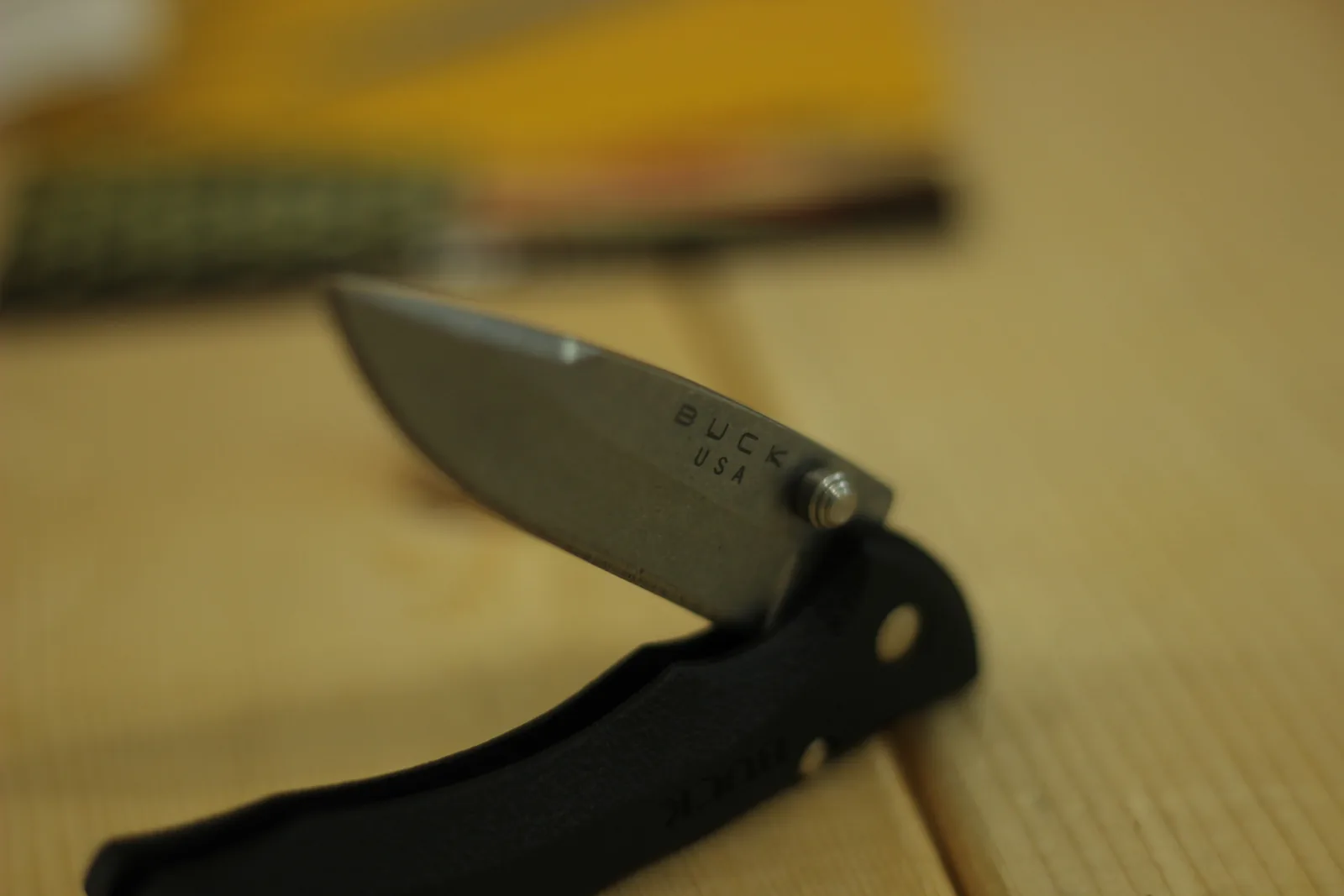
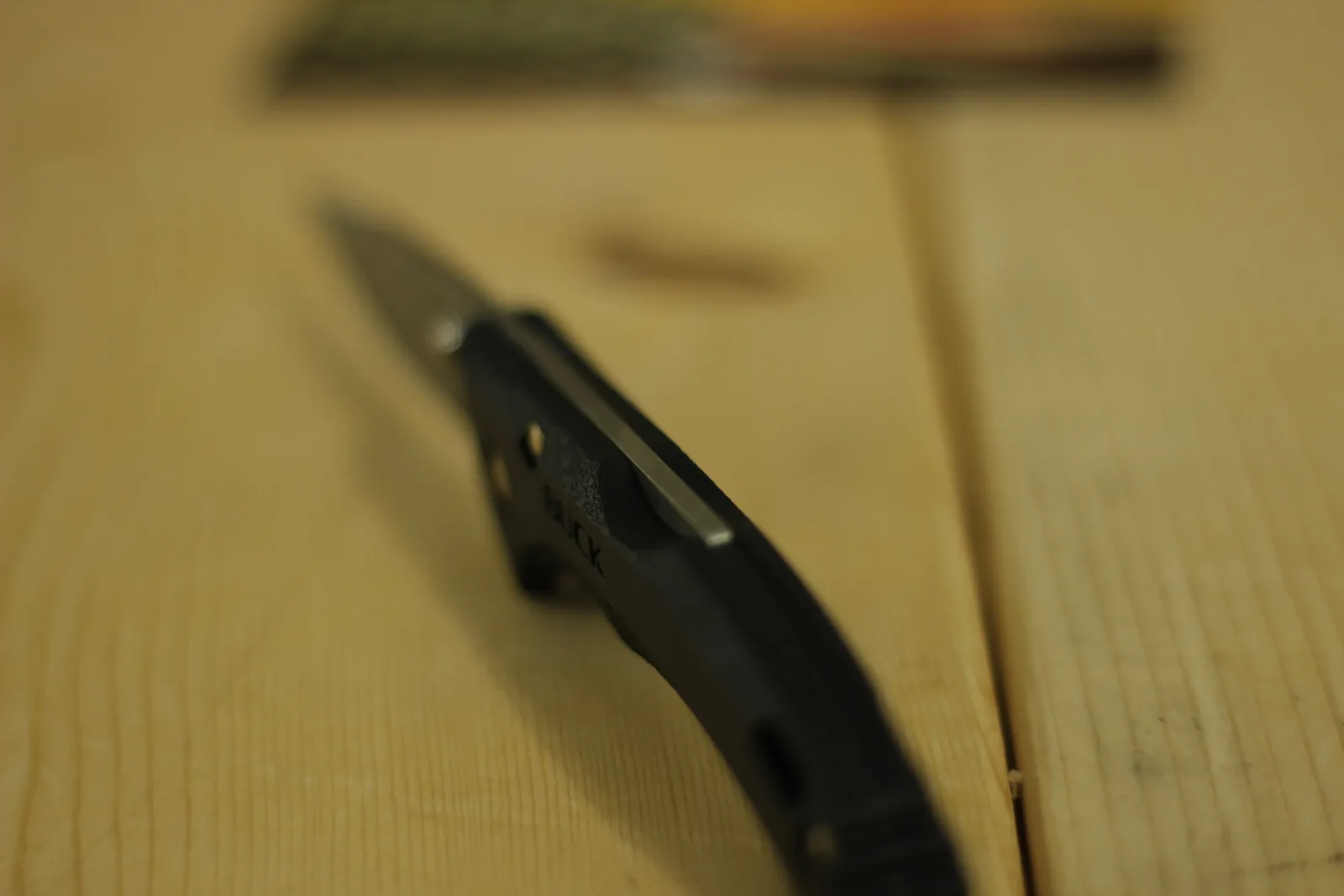
- Made in the USA, and stamped BUCK USA on the tang where you can see it
- Buck's Forever Warranty applies in full — the same unconditional repair-or-replace policy that covers the $229 Alpha Guide covers this $21 folder
- Mid-lockback with a thumb stud, ambidextrous opening, and a lanyard hole — a simple, well-understood mechanism with very little to go wrong
Cons
- No pocket clip of any kind — the Bantam rides loose in a pocket or on a lanyard, and for a knife sold as everyday carry that is a real omission
- The glass-reinforced nylon handle is functional and honest but obviously the cheapest part of the knife — there is no liner, no bolster, and no pretence otherwise
- A 2.75-inch blade is short for serious game work; this is a companion knife, not a primary field-dressing blade
- Closing the lockback is a deliberate two-hand job — quick to open, slower to put away
Almost every knife we have reviewed has been a considered purchase — the 663 Alpha Guide at $229, the Kershaw Deschutes Combo at C$219.99, the 110 Folding Hunter at $105. Those are knives you save for and then own for thirty years. The Buck 284 Bantam BBW is not that. It is a $21 folding knife that weighs an ounce and a half, and it is worth a full-length review for a reason that has nothing to do with being cheap: it is made in Idaho, it is covered by exactly the same Forever Warranty as the $229 knife, and it is the answer to a question the expensive knives cannot answer — what do you carry when you are not carrying a knife?
This review is built on what is in front of the camera and what is printed on the package and the spec sheet. We did not field-dress an animal with it for this piece. The editorial question is narrower and, we think, more useful: does a 2.75-inch 420HC lockback at this price add up to a knife worth owning, and where does it stop being enough?
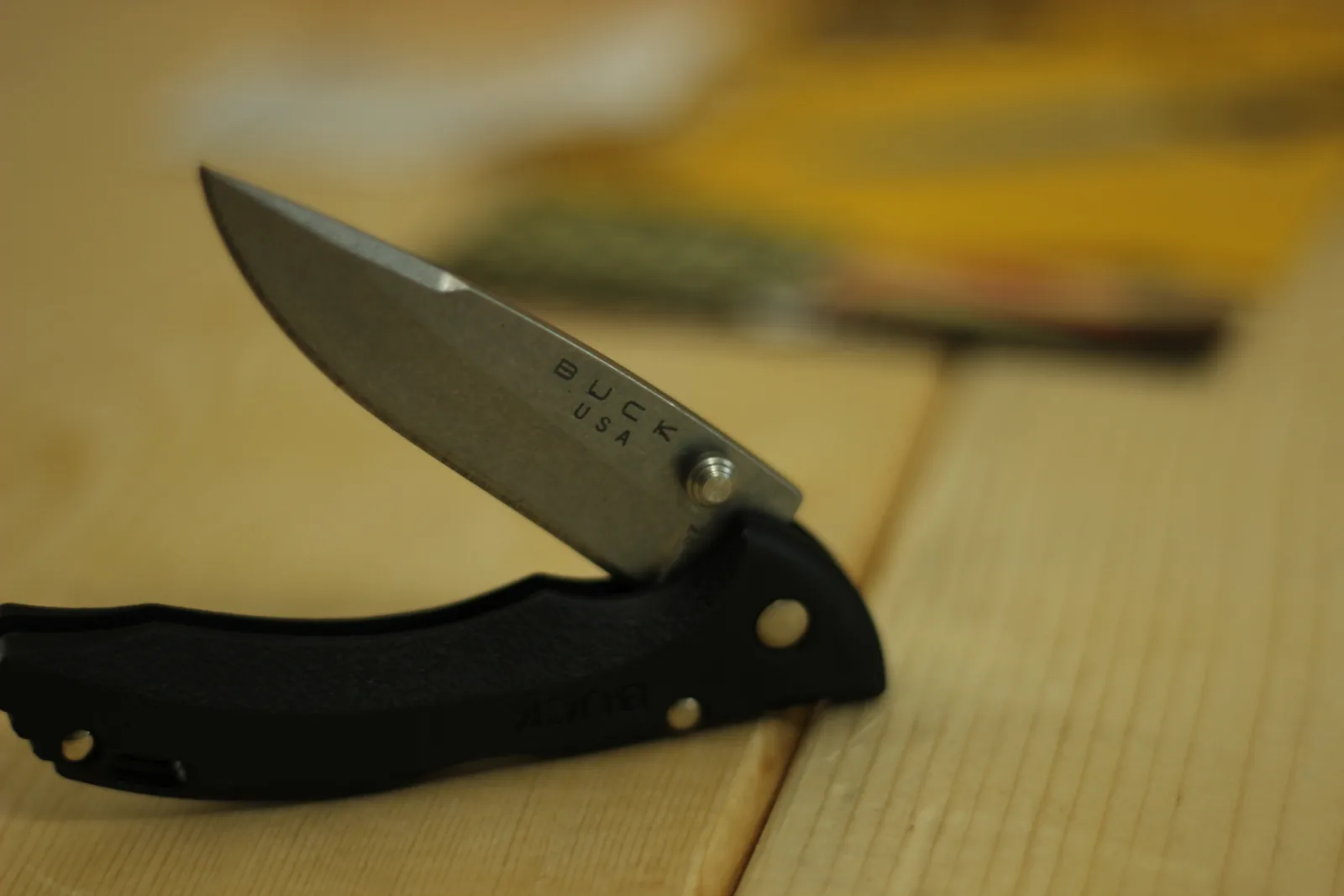
At a glance
In the Box
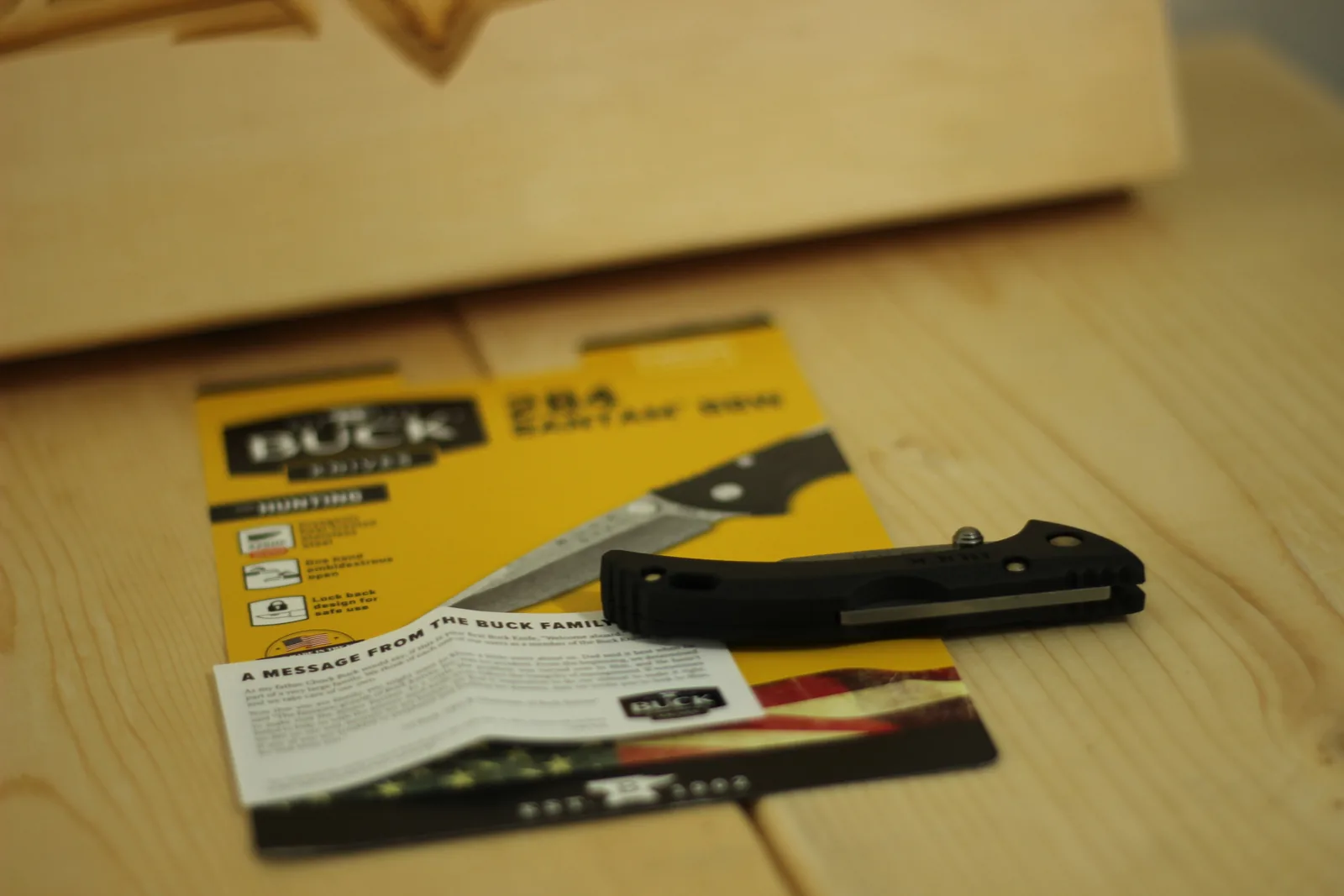
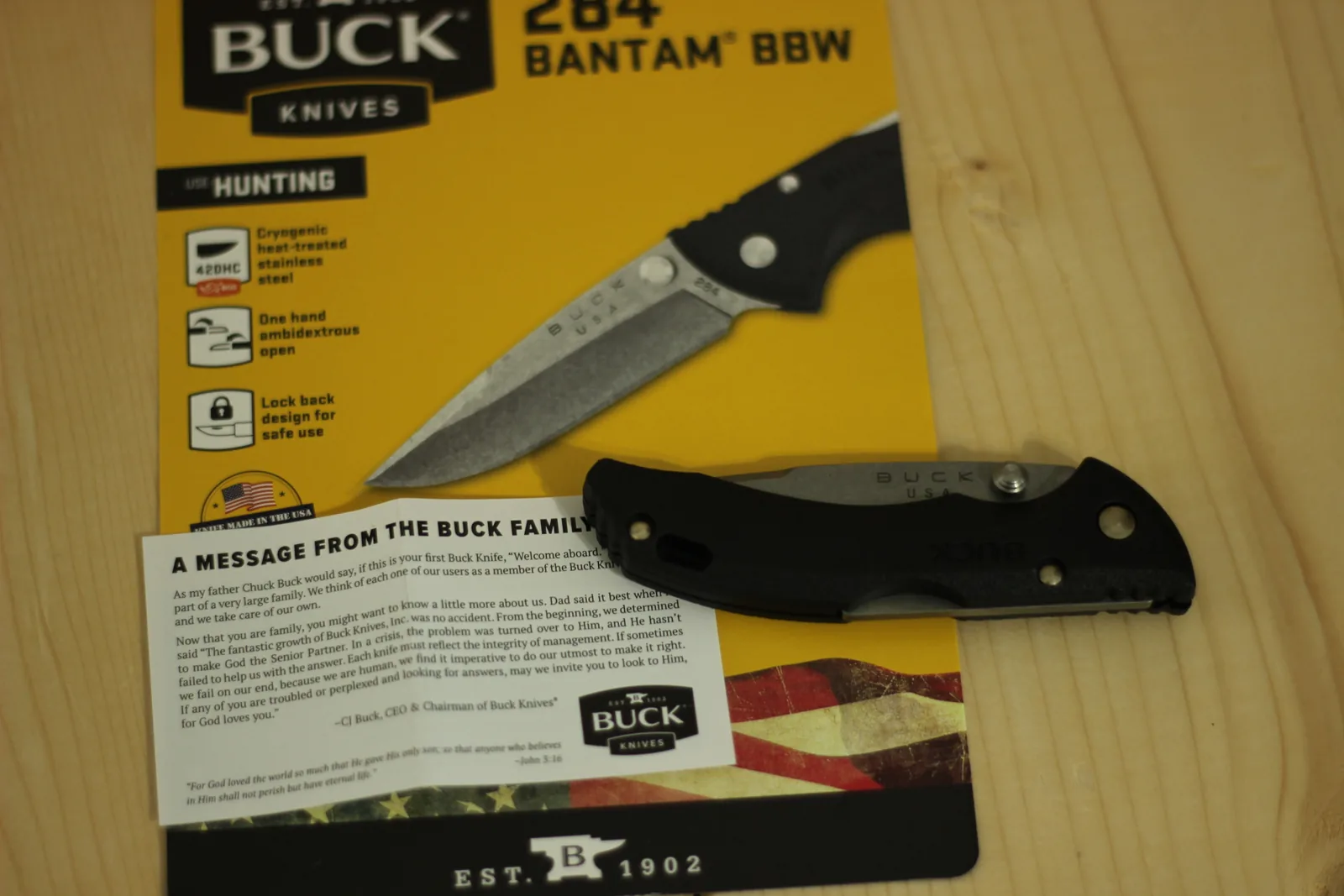
There is no box. The Bantam arrives on a hanging blister card — the yellow-and-black Buck retail packaging you have walked past in a hardware store a hundred times, with the knife visible through the clamshell and the model name set in the same typeface Buck has used for years.
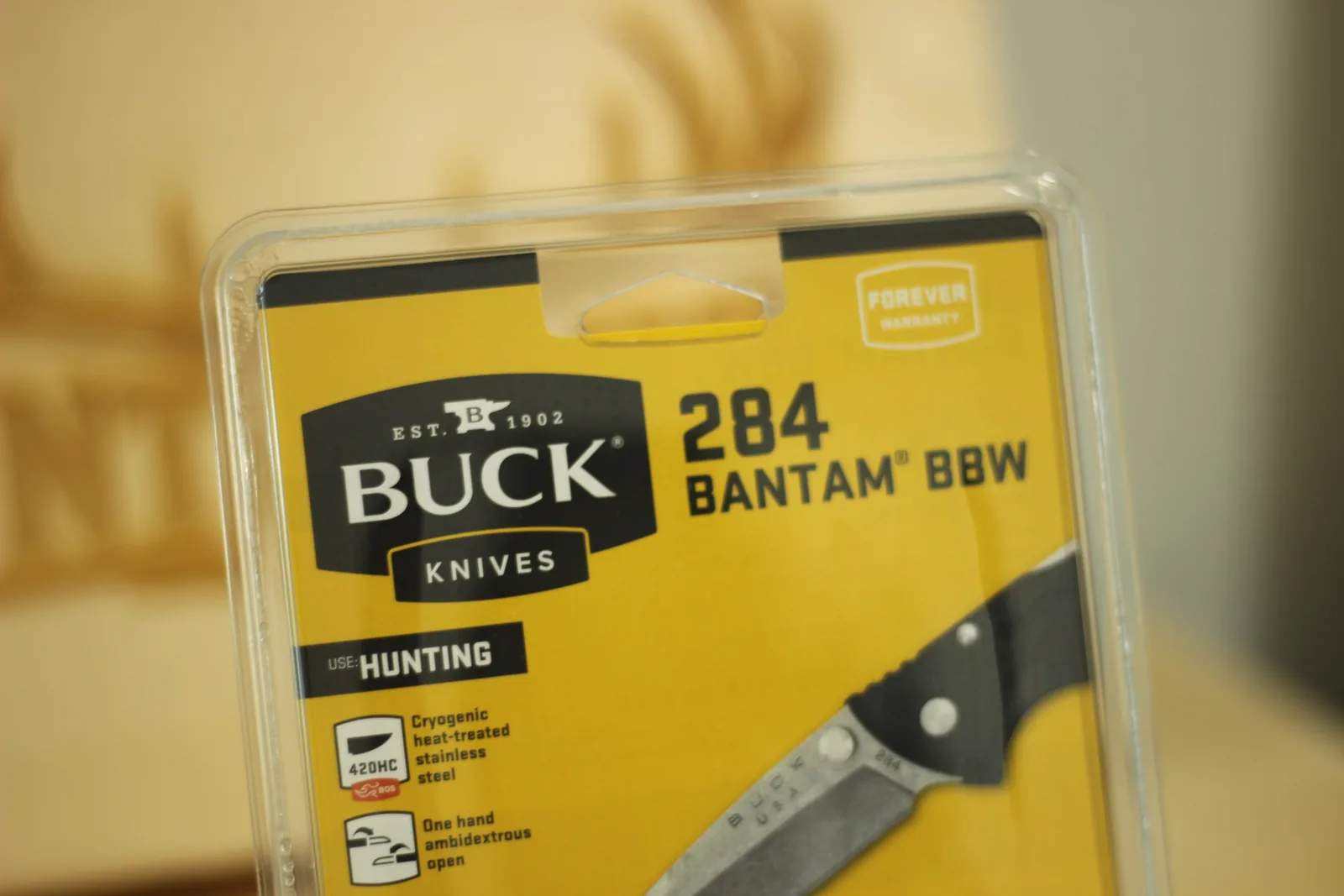
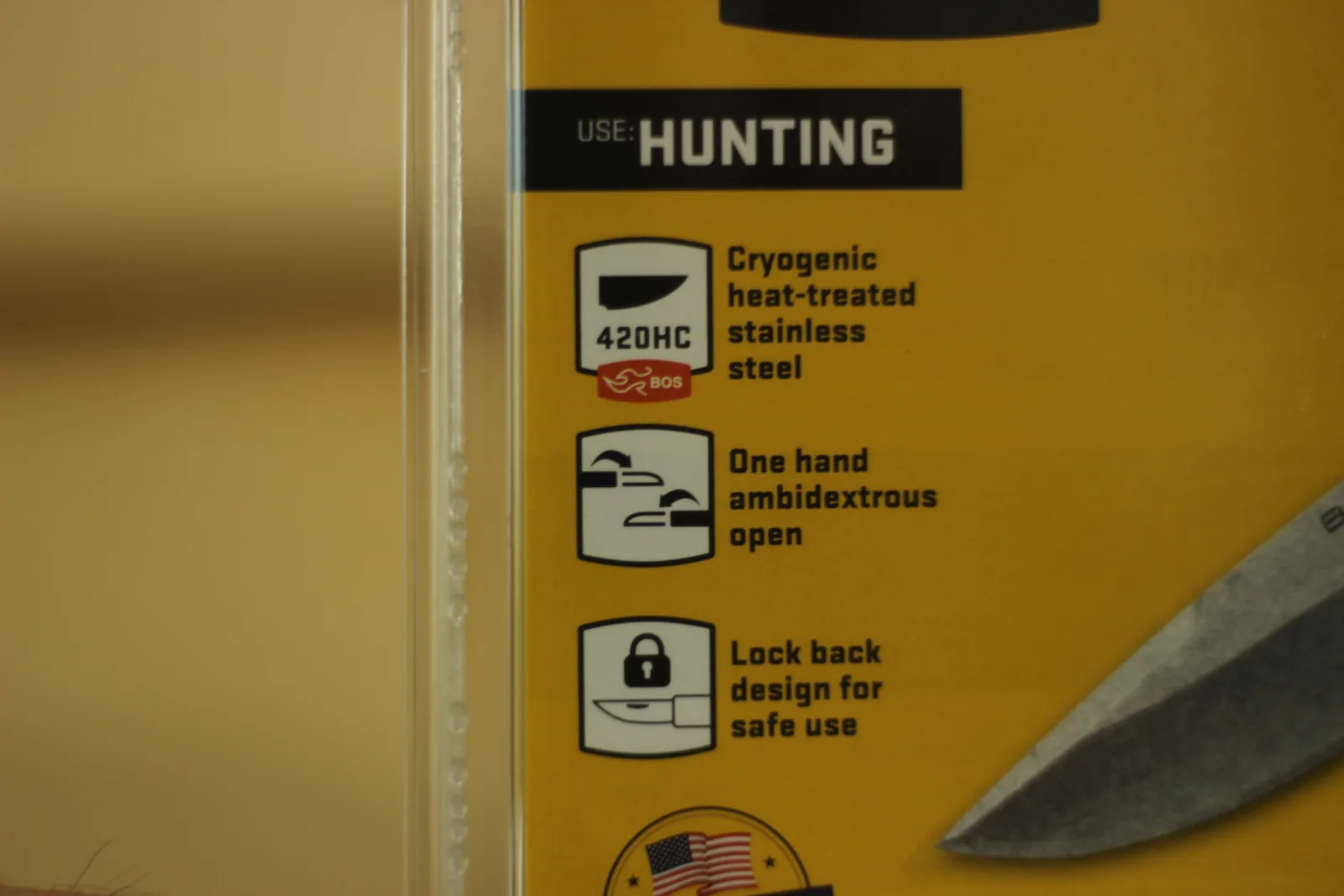
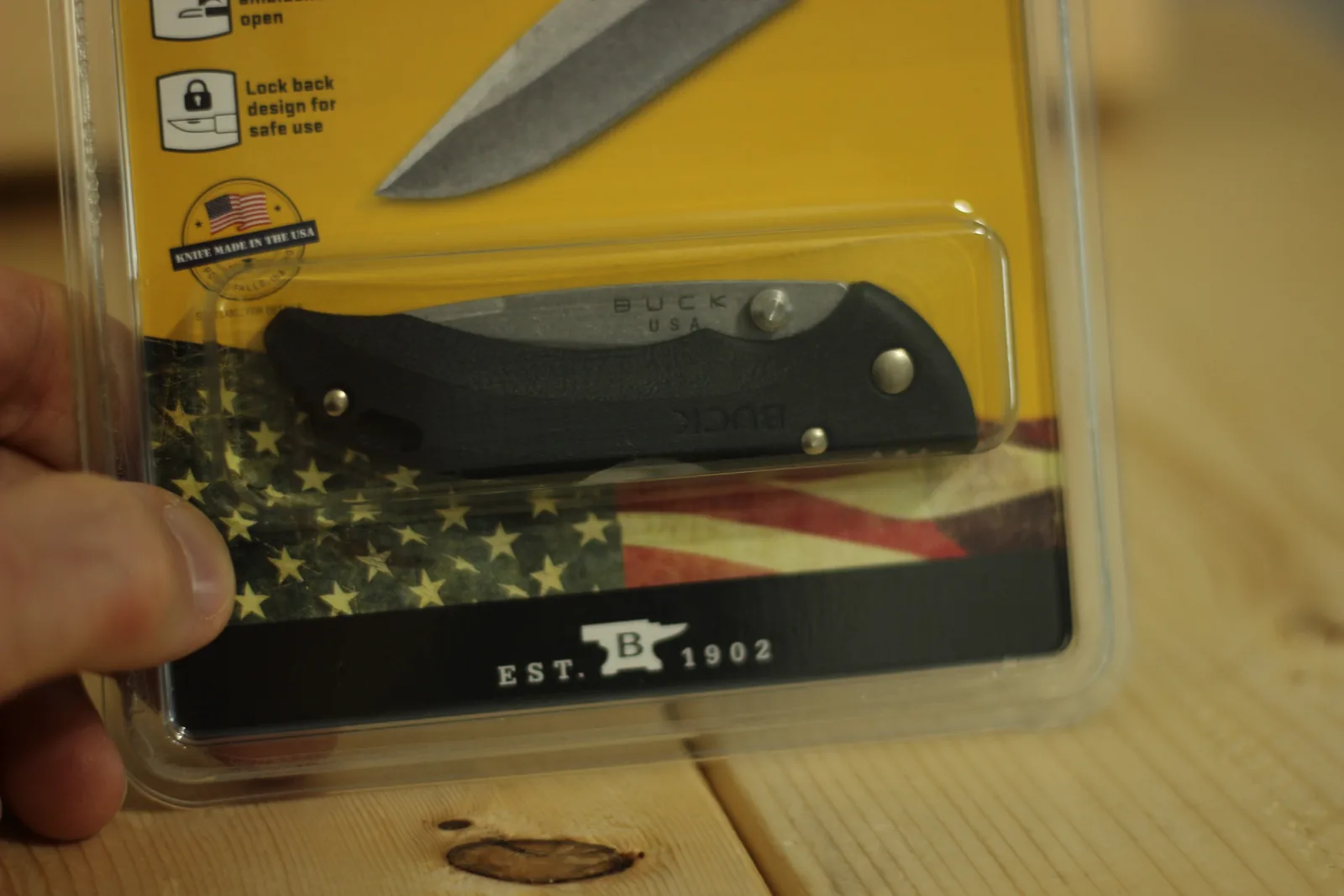
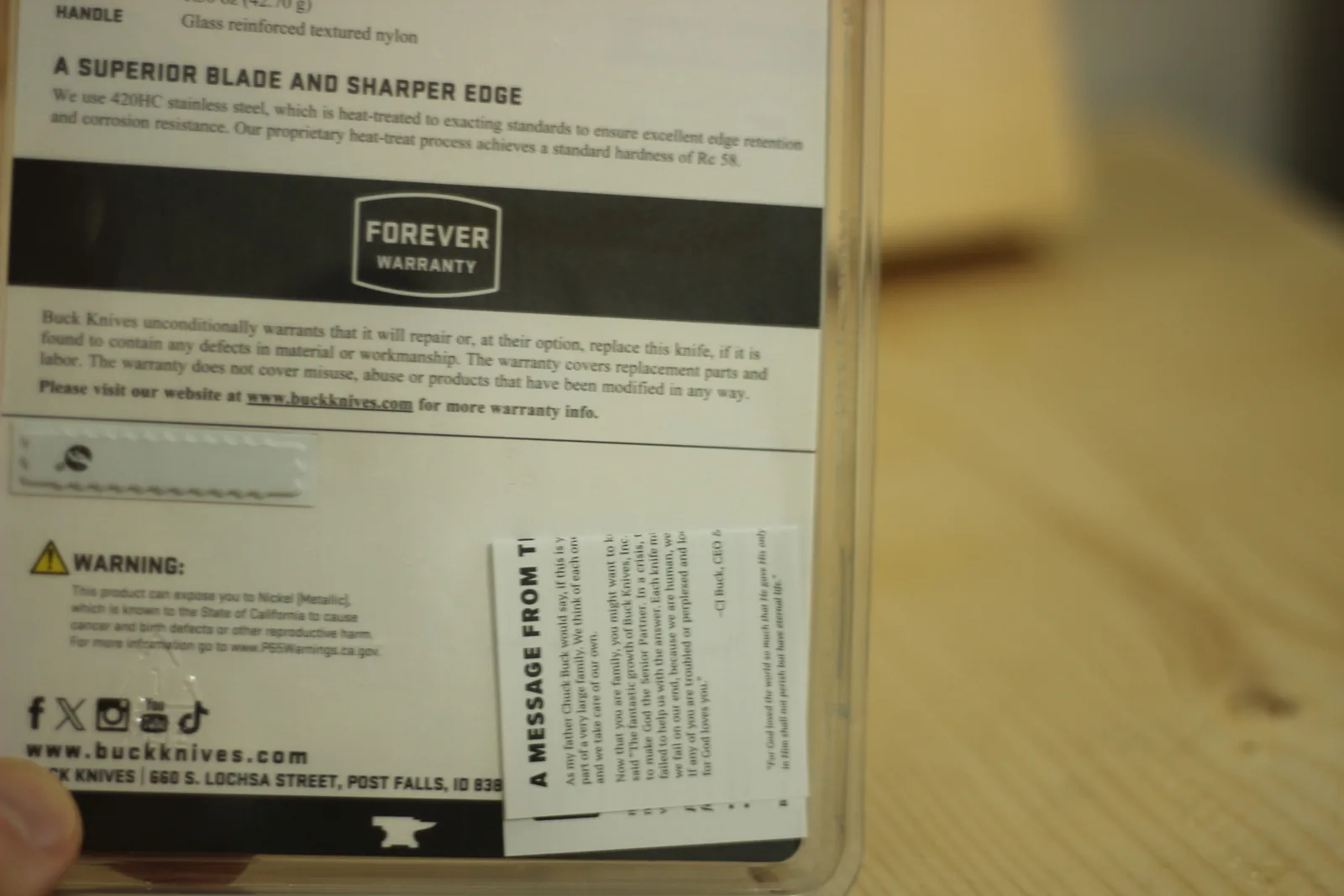
Inside the clamshell with the knife are two small printed cards, and they tell you more about Buck as a company than the knife does.
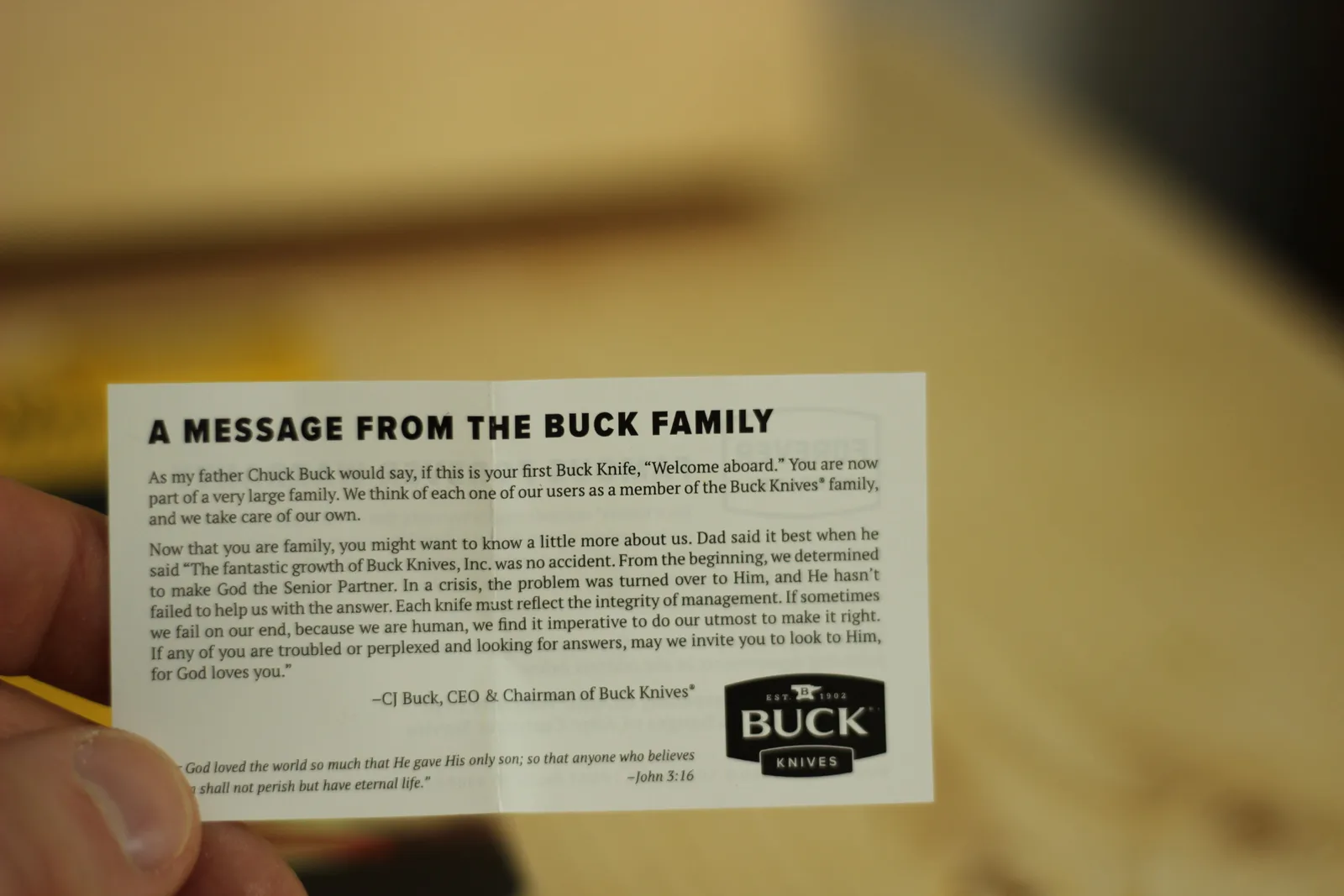
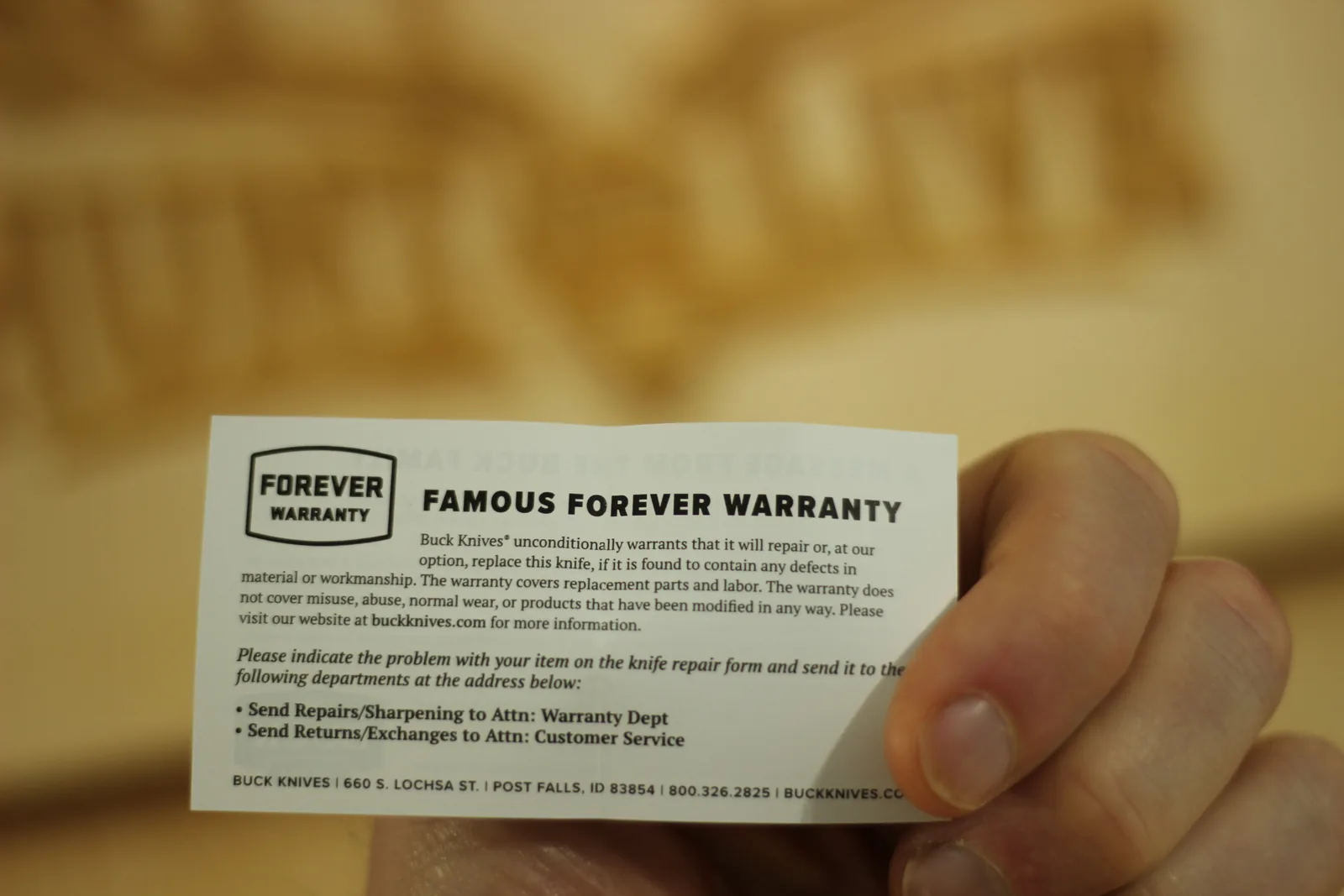
That warranty is the single most important thing about this knife, and we will come back to it. A twenty-one dollar knife with an unconditional lifetime repair policy is a genuinely unusual object.
Design and Build
420HC, and why the steel choice is the right one here
420HC is not a premium steel and Buck does not claim it is. It is a high-carbon variant of 420 stainless: easy to sharpen, highly corrosion resistant, and — on its own — unremarkable for edge retention. What makes Buck’s 420HC different is the heat treatment. Buck’s protocol, developed by metallurgist Paul Bos and marked with the BOS logo you can see on the packaging, is widely regarded across the knife community as the best commercial execution of this steel, and the card on the back of the pack commits to a number: Rc 58.
That figure matters more than the steel name. Two knives in the same 420HC can behave completely differently depending on how they were hardened and tempered, and Rc 58 is at the upper end of what 420HC will hold without becoming brittle. It is the same steel, at the same stated hardness, that Buck puts in the 110 Folding Hunter — a knife that costs five times as much.
| Knife | Steel | Blade | Weight | Price |
|---|---|---|---|---|
| Buck 284 Bantam BBW | 420HC · Rc 58 | 2.75 in | 1.5 oz | ~$21 |
| Buck 110 Folding Hunter | 420HC · BOS | 3.75 in | 7.2 oz | $104.99 |
| Civivi MDRN Hunter | Nitro-V · 59–61 HRC | 4.12 in | 3.65 oz | $86.25 |
| Buck 663 Alpha Guide | CPM-S35VN · BOS | 4.5 in | 7.6 oz | $229.00 |
Manufacturer and retailer specifications, cross-checked against our own reviews of the 110, the MDRN Hunter and the Alpha Guide. Prices are US street or MSRP as listed at time of writing.
The drop point, and what the grind is shaped to do
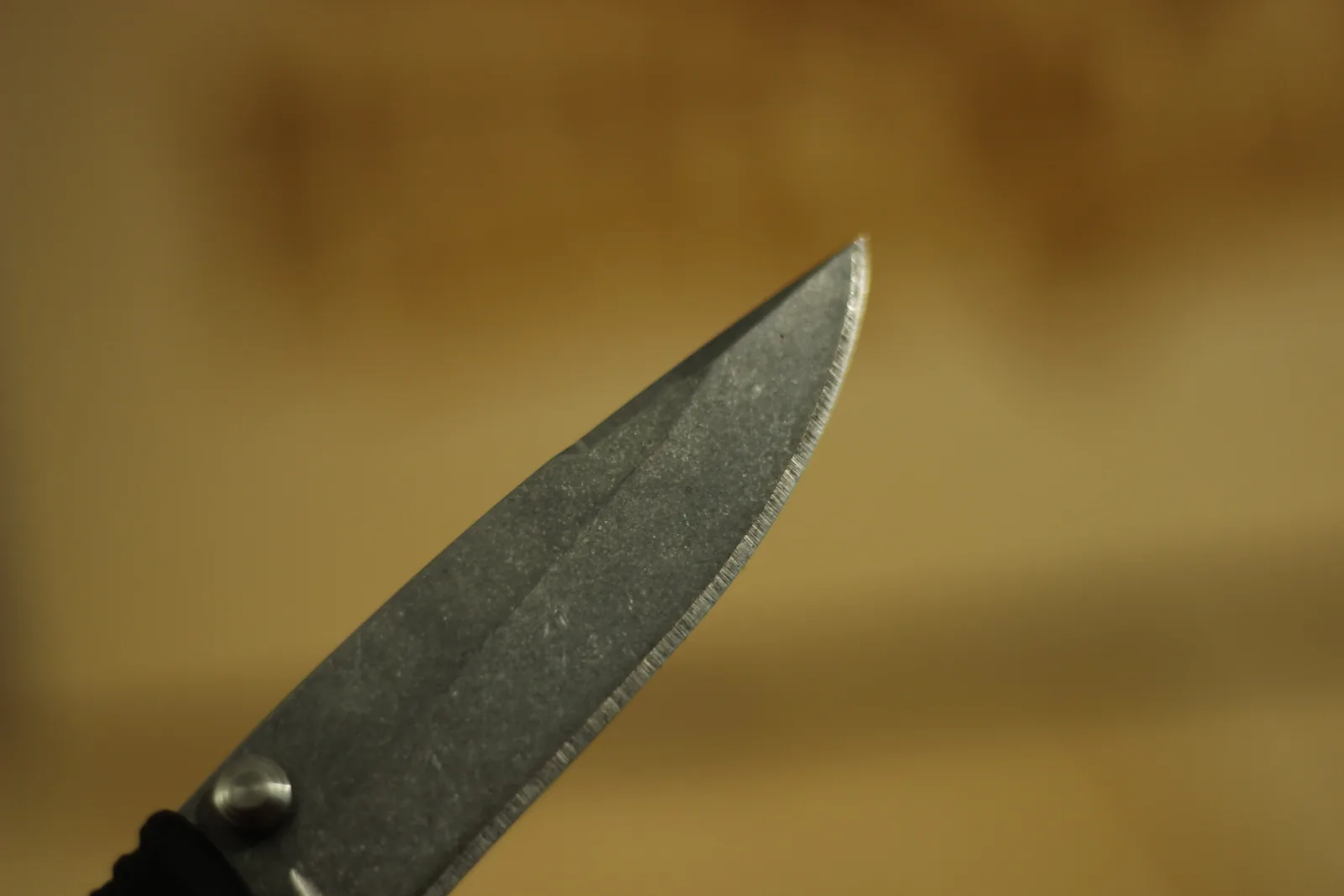
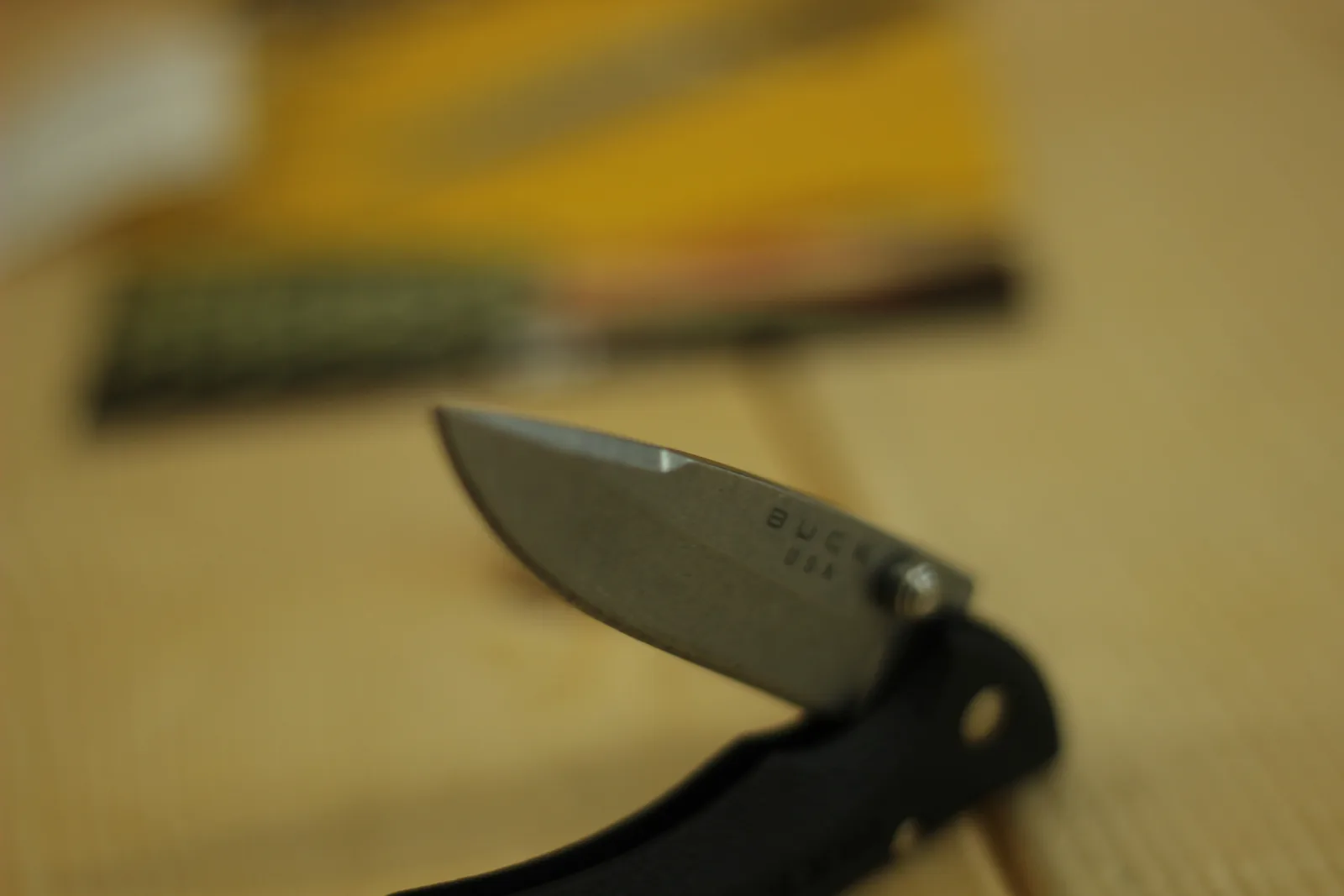
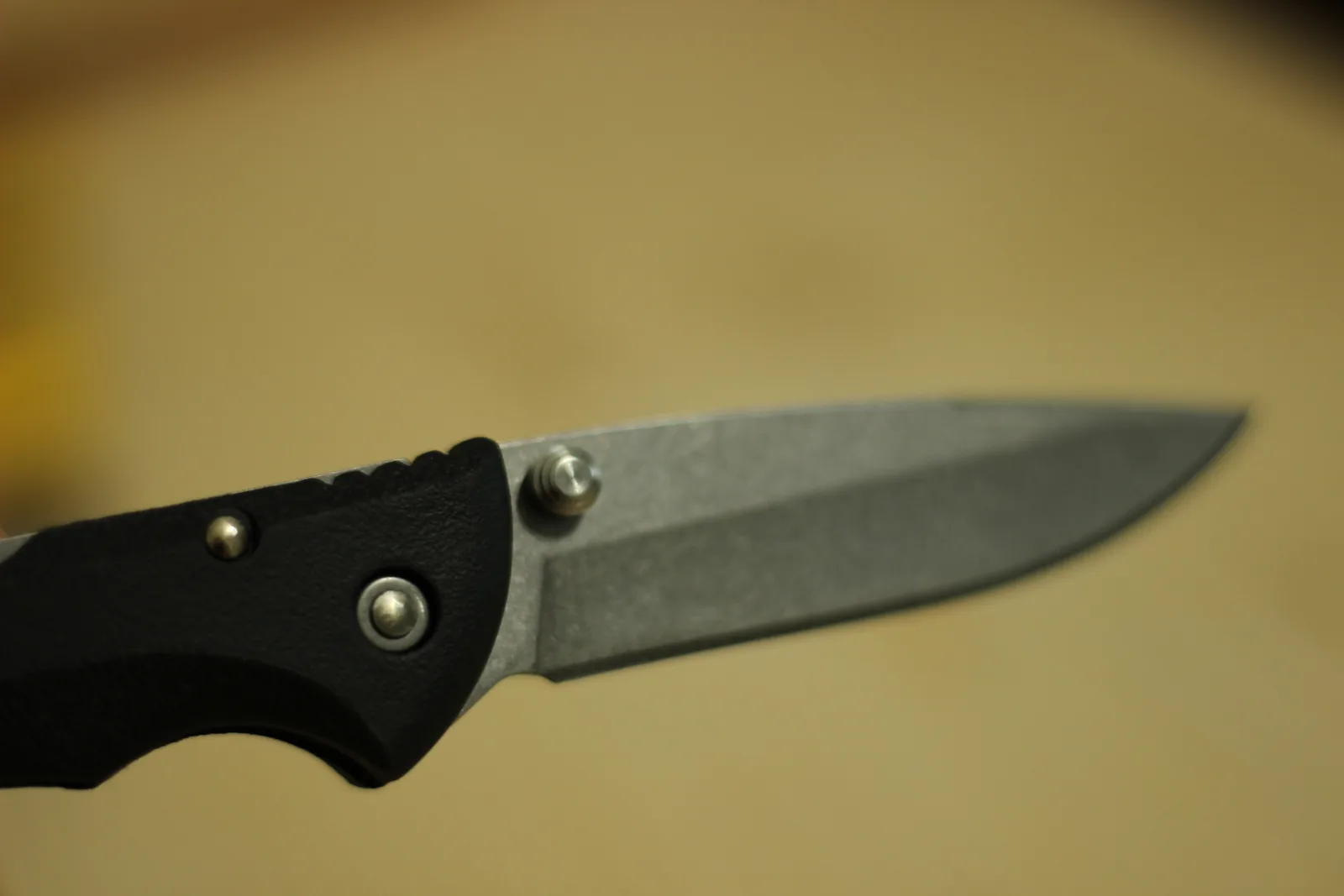
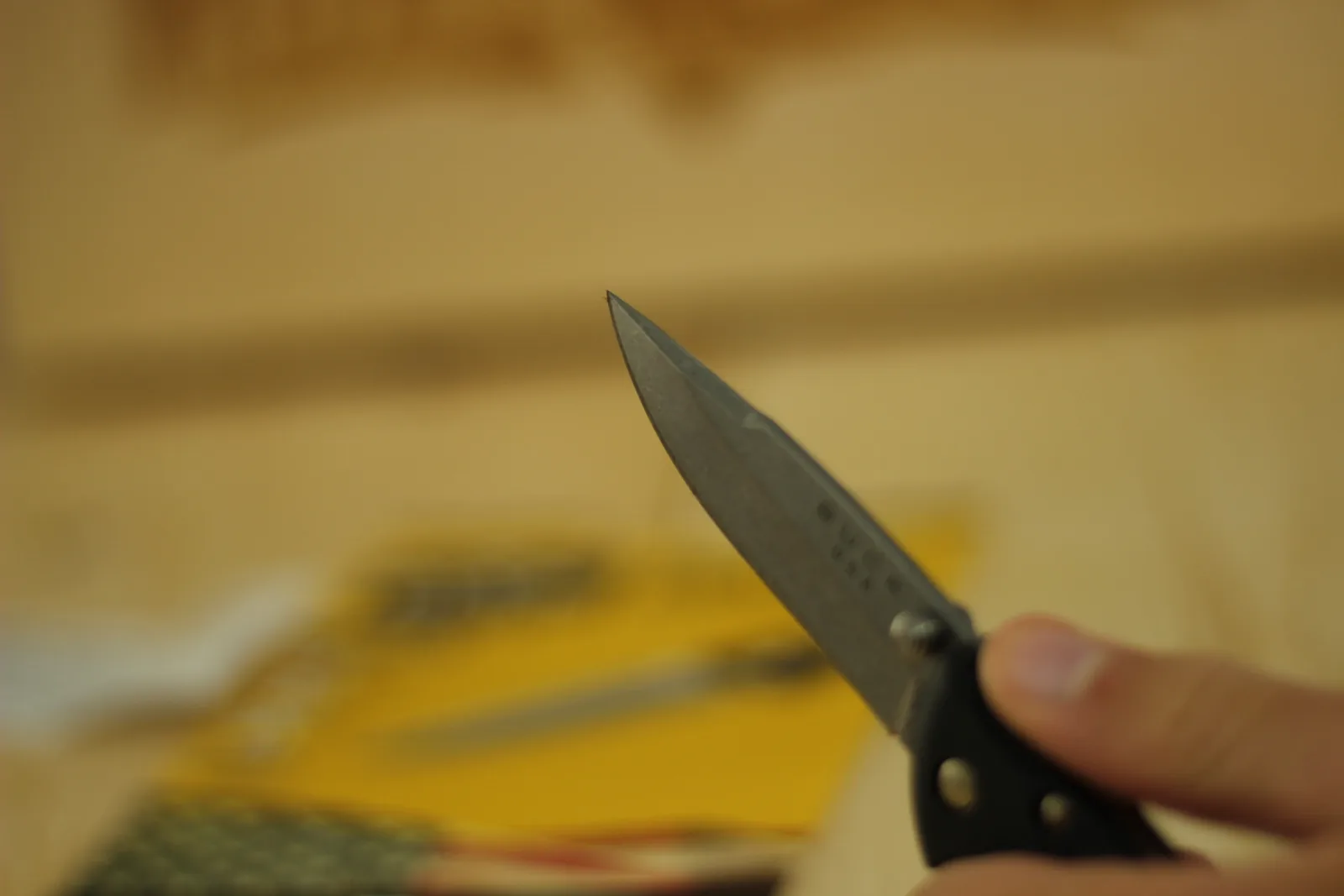
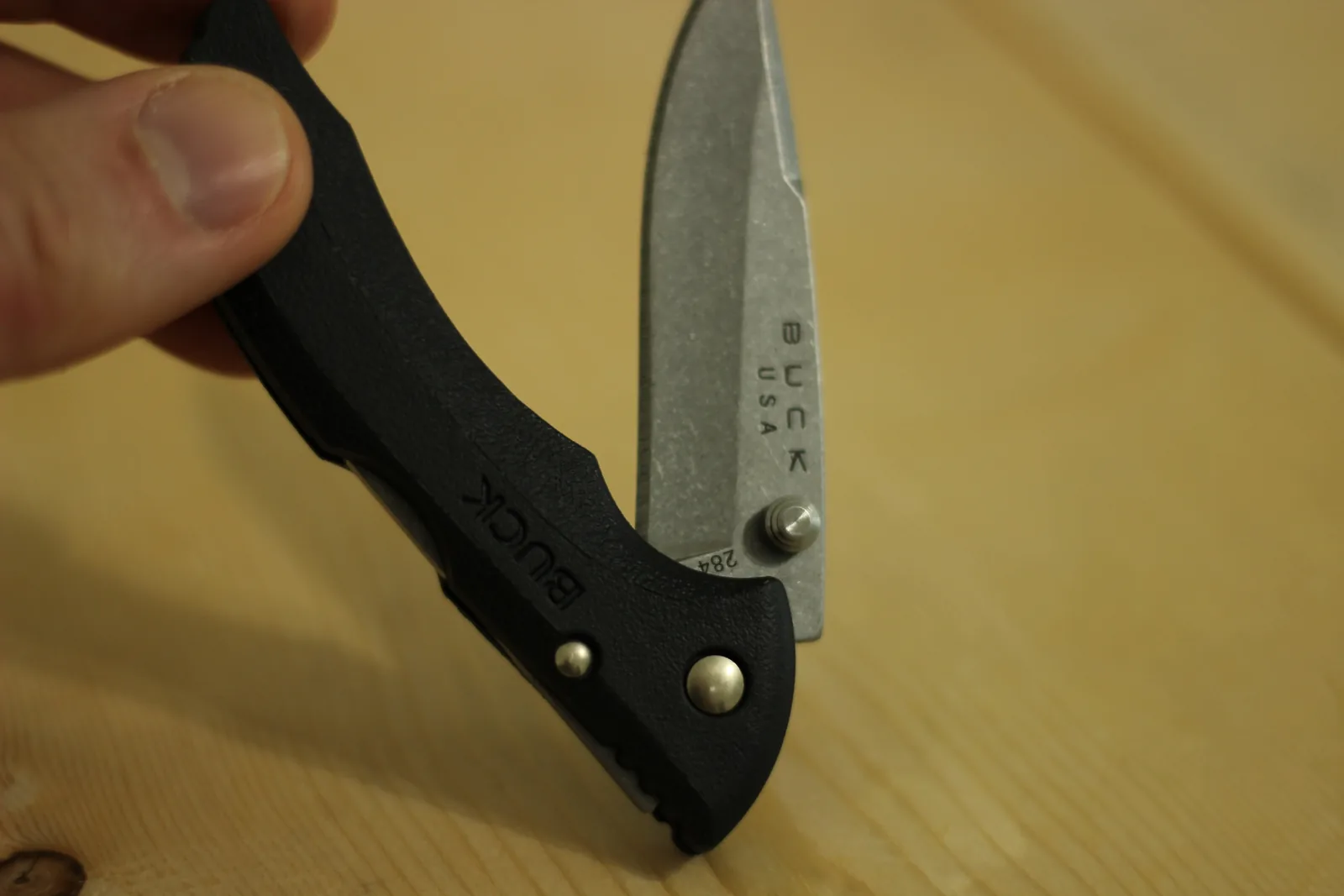
The blade is a plain-edge drop point, 2.6 mm at the spine, with the spine dropping in a long shallow curve to a tip that sits roughly level with the centreline of the handle. That geometry is the reason Buck files the Bantam under hunting rather than tactical: a dropped tip is harder to accidentally push through a hide or a gut sac than a clip point or a spear point, and the belly is continuous enough to make a slicing cut rather than a sawing one.
The handle — cheap, and honest about it
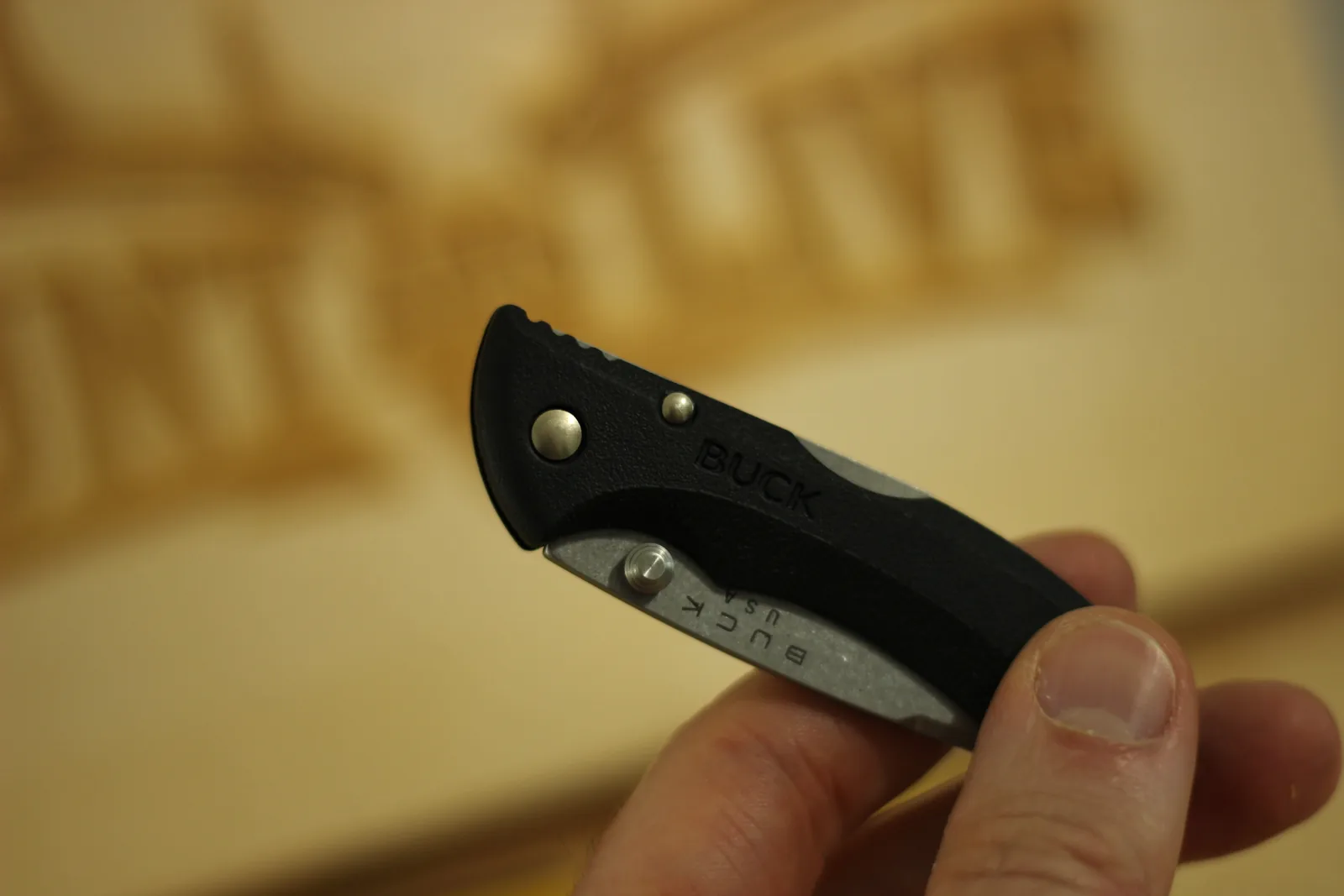
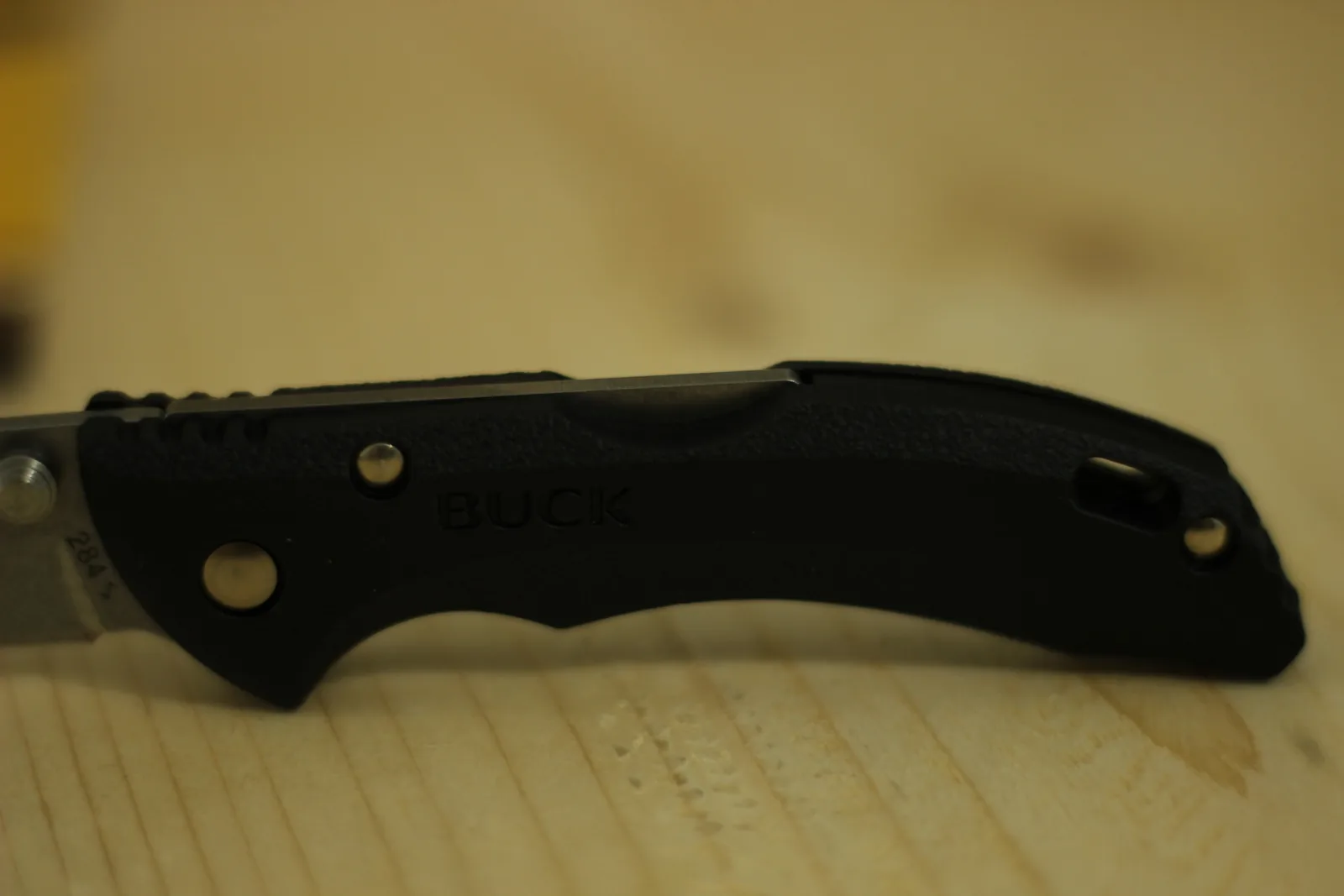
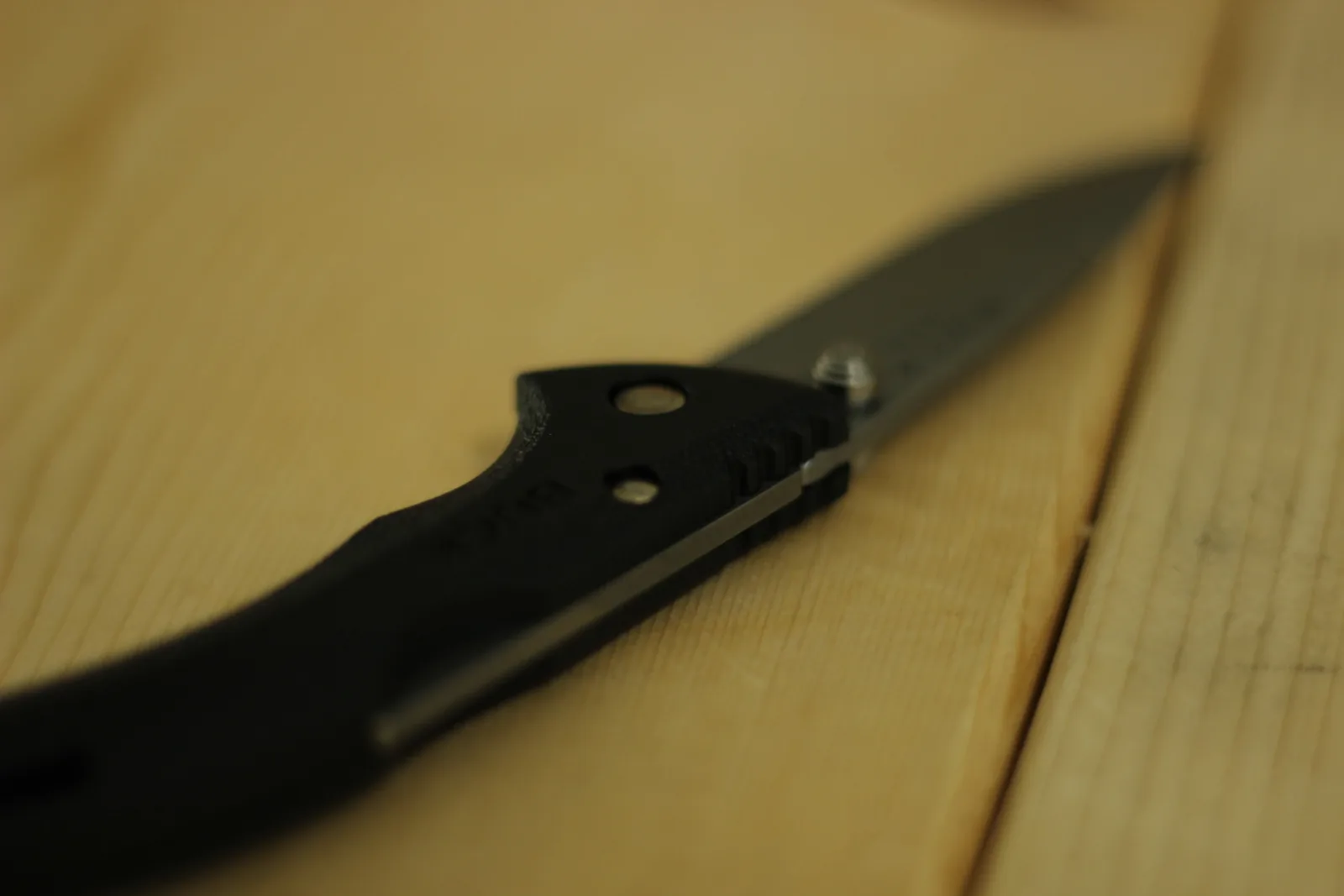
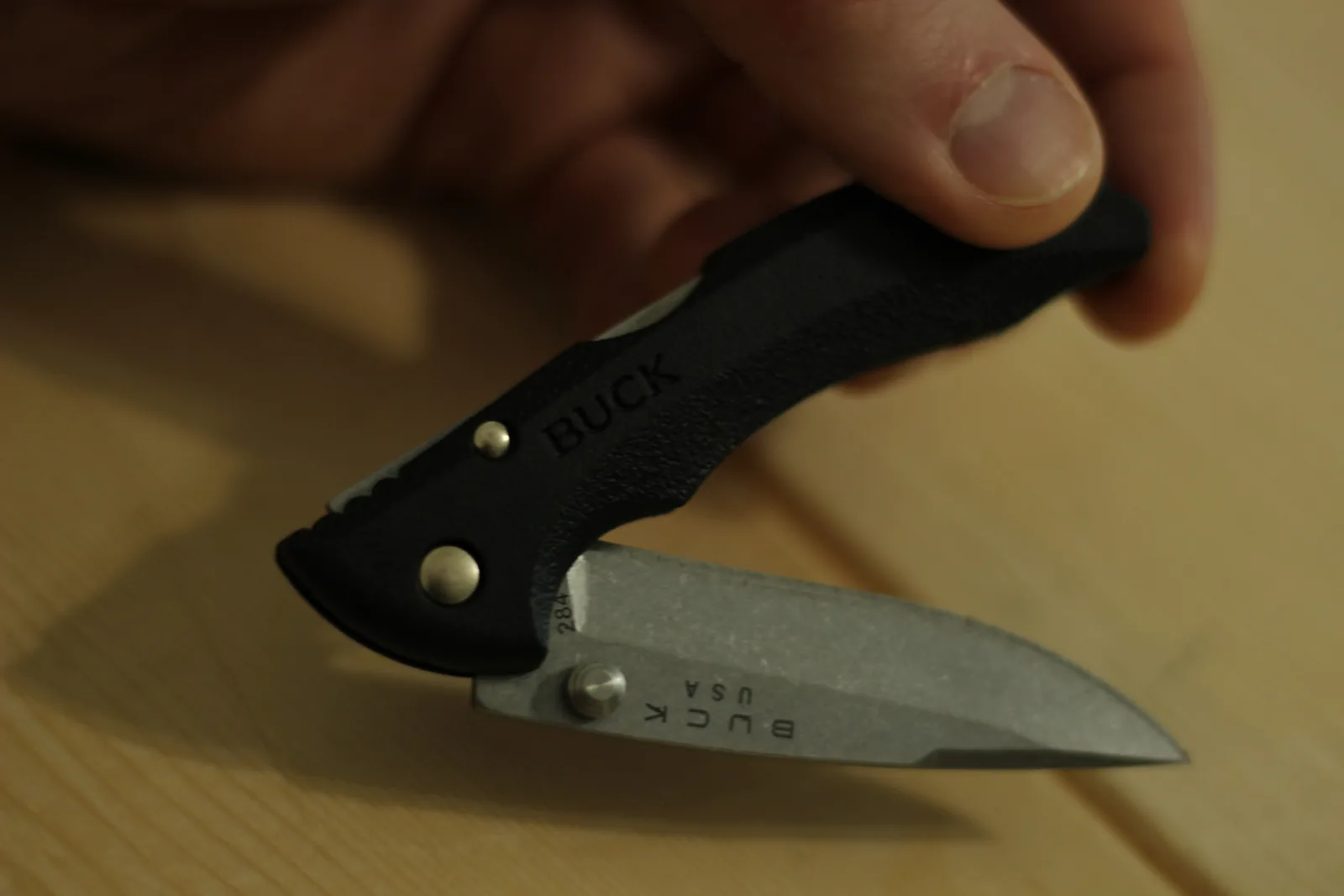
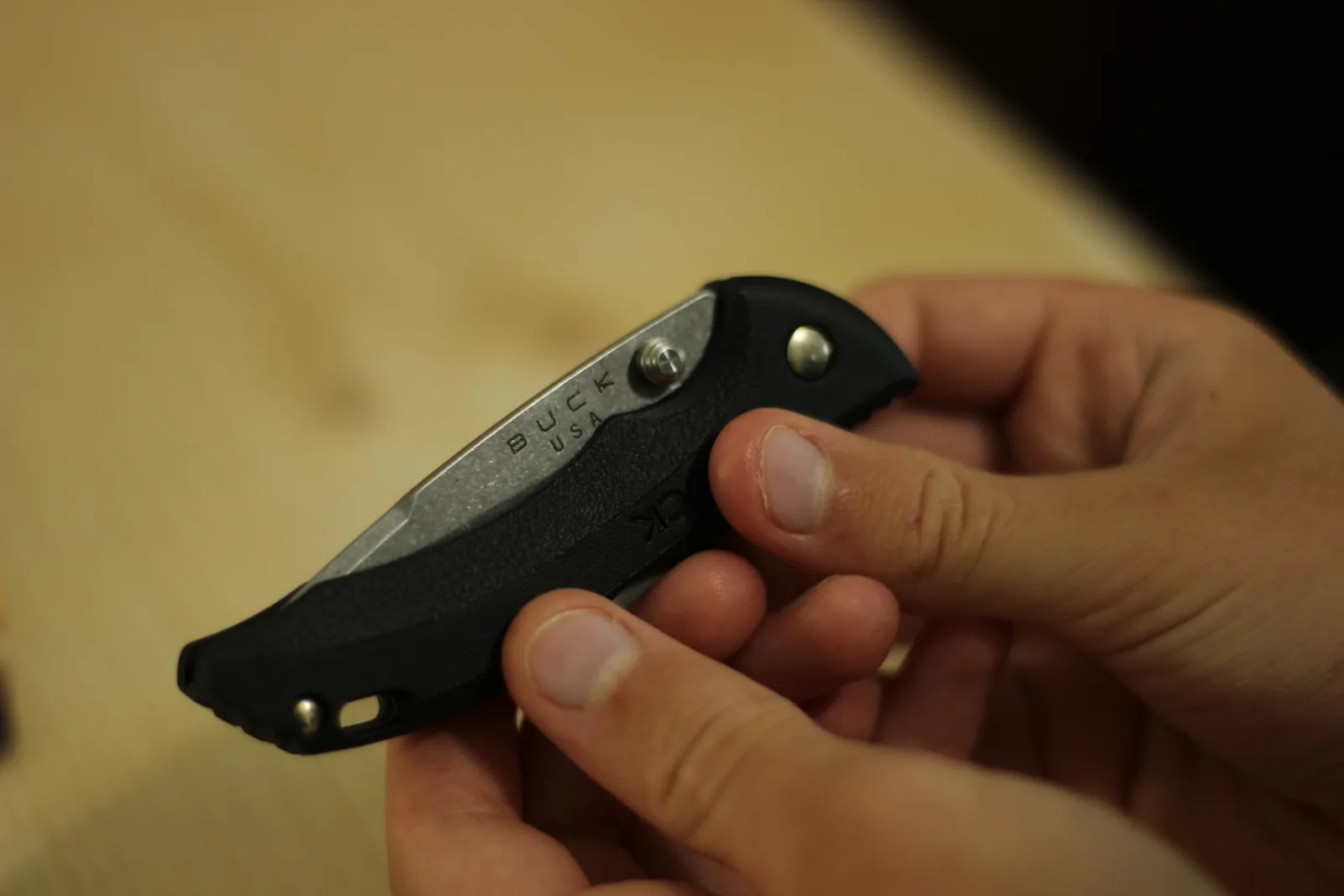
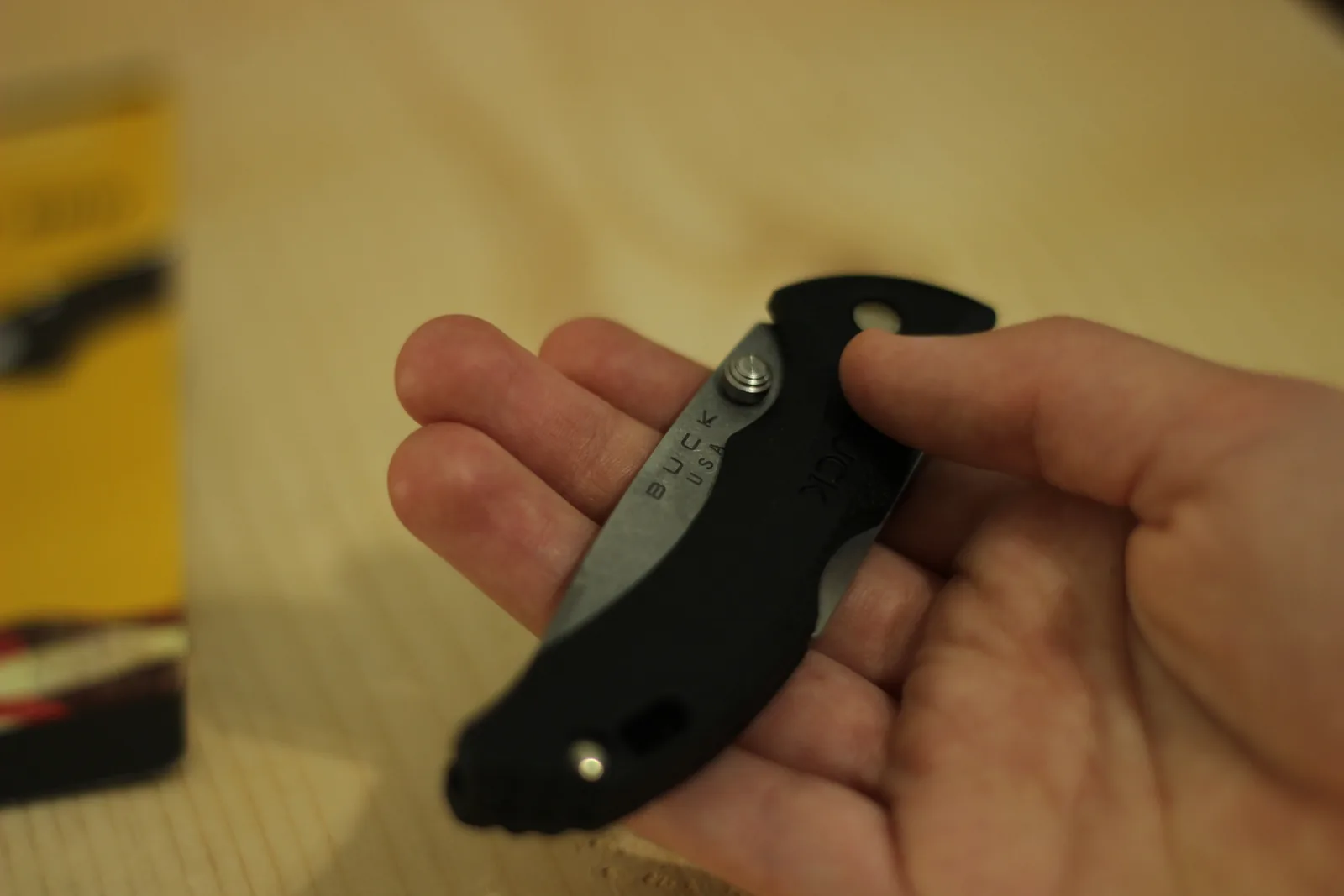
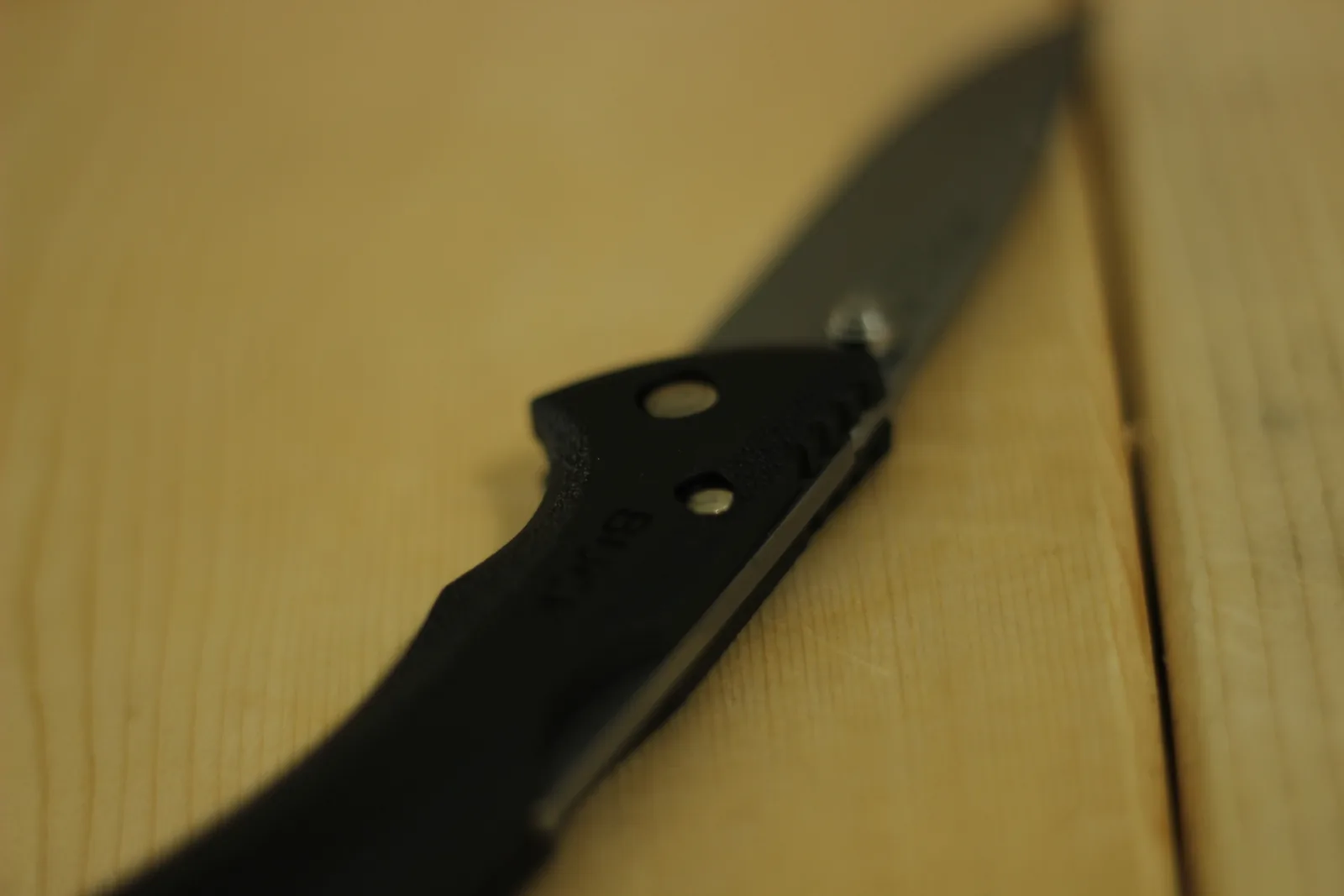
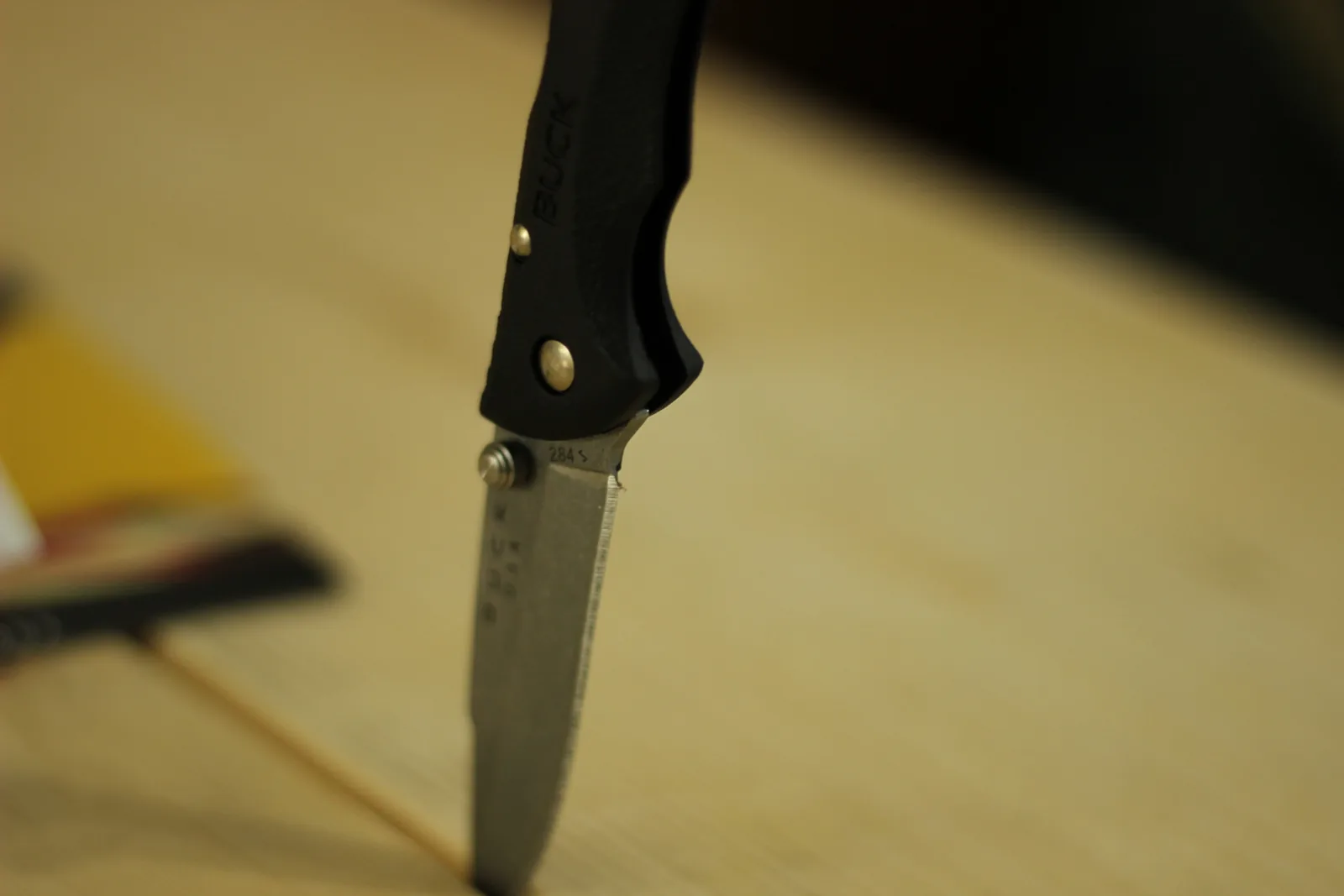
The scales are glass-reinforced textured nylon: a moulded polymer with no liners, no bolsters, and no visible attempt to look like anything else. The texture is a fine pebble rather than a moulded checker. Two polished rivets and the pivot are the only metal you can see from outside.
This is the part of the knife where the price shows, and we would rather say so plainly than dress it up. There is a small amount of flex in the scales if you deliberately squeeze the handle, which is what happens when there are no steel liners. In exchange you get the number that defines this knife: 1.5 oz.
Ergonomics — a small handle in an adult hand
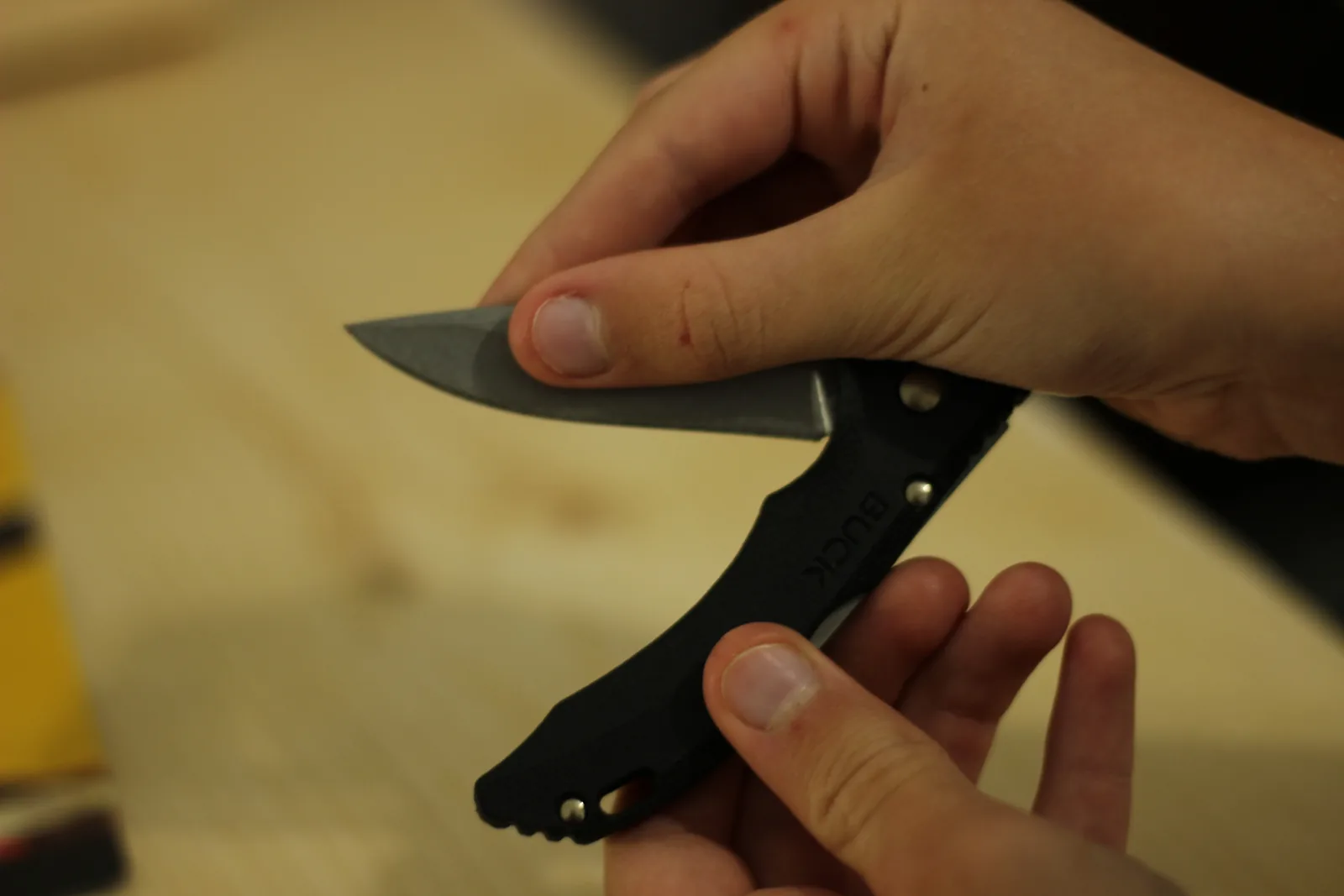
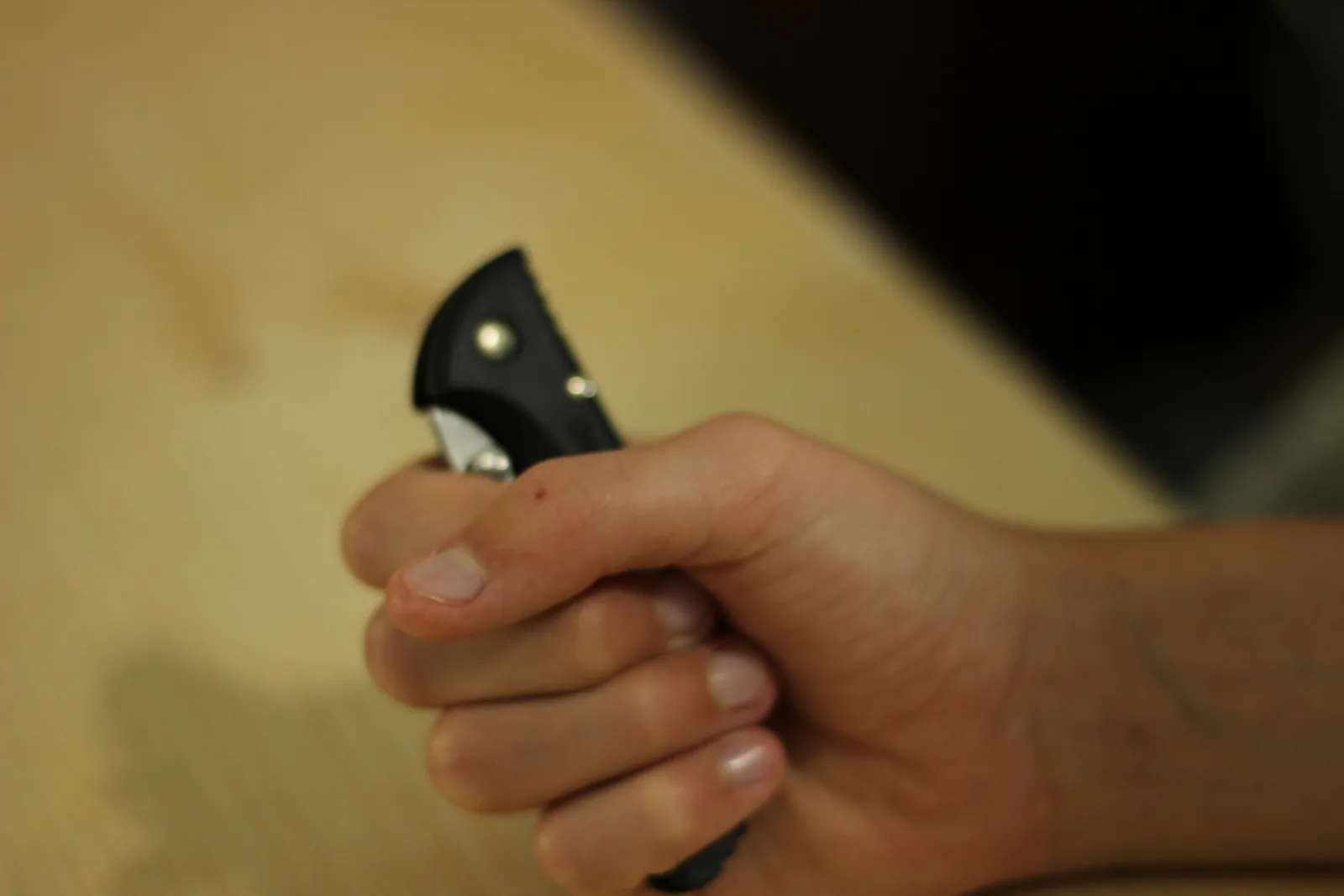
At 3.75 inches closed, the Bantam is shorter than most adult palms are wide. In a full forward grip the little finger runs off the butt, and the knife is held by three fingers and the web of the thumb rather than four fingers and a lock.
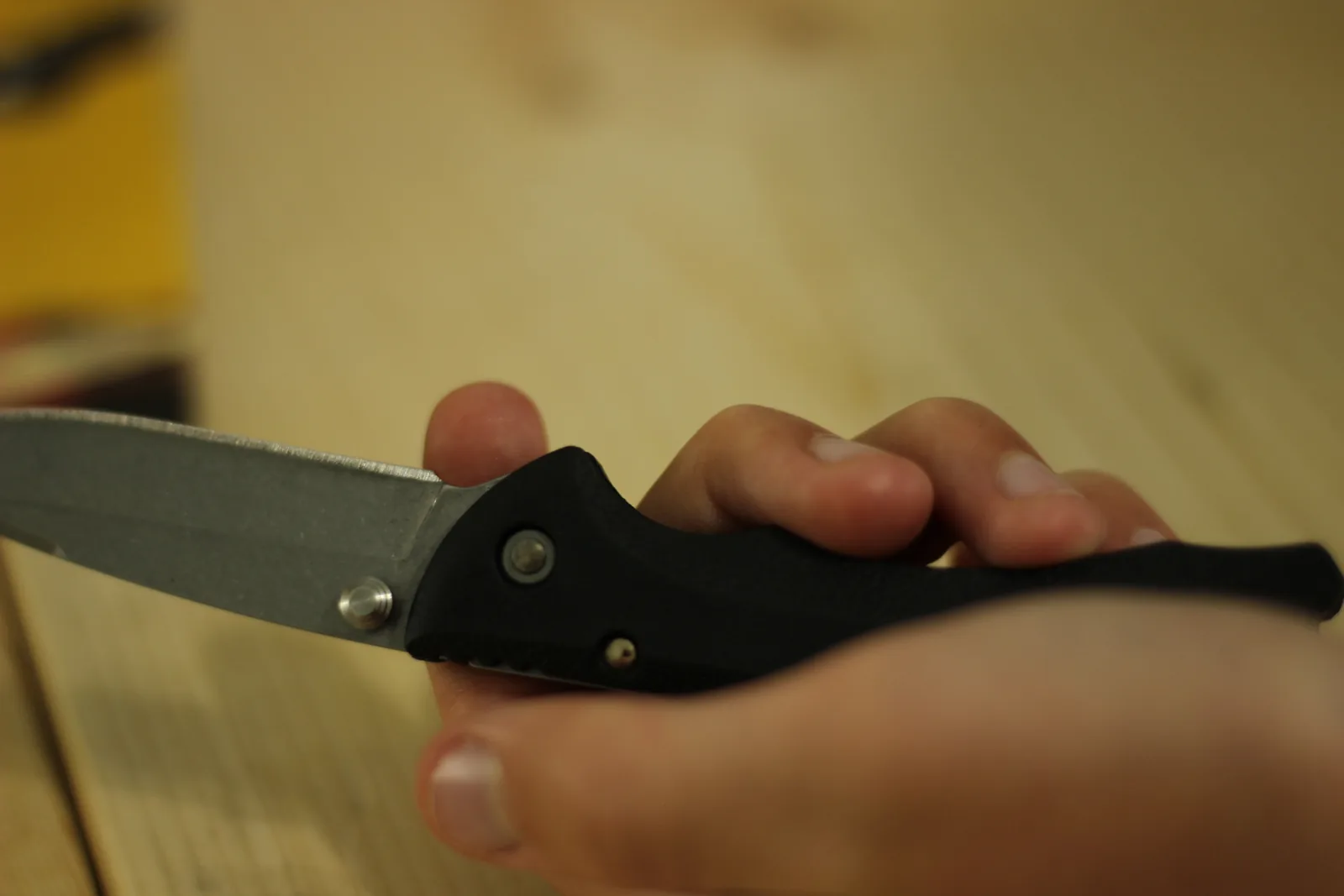
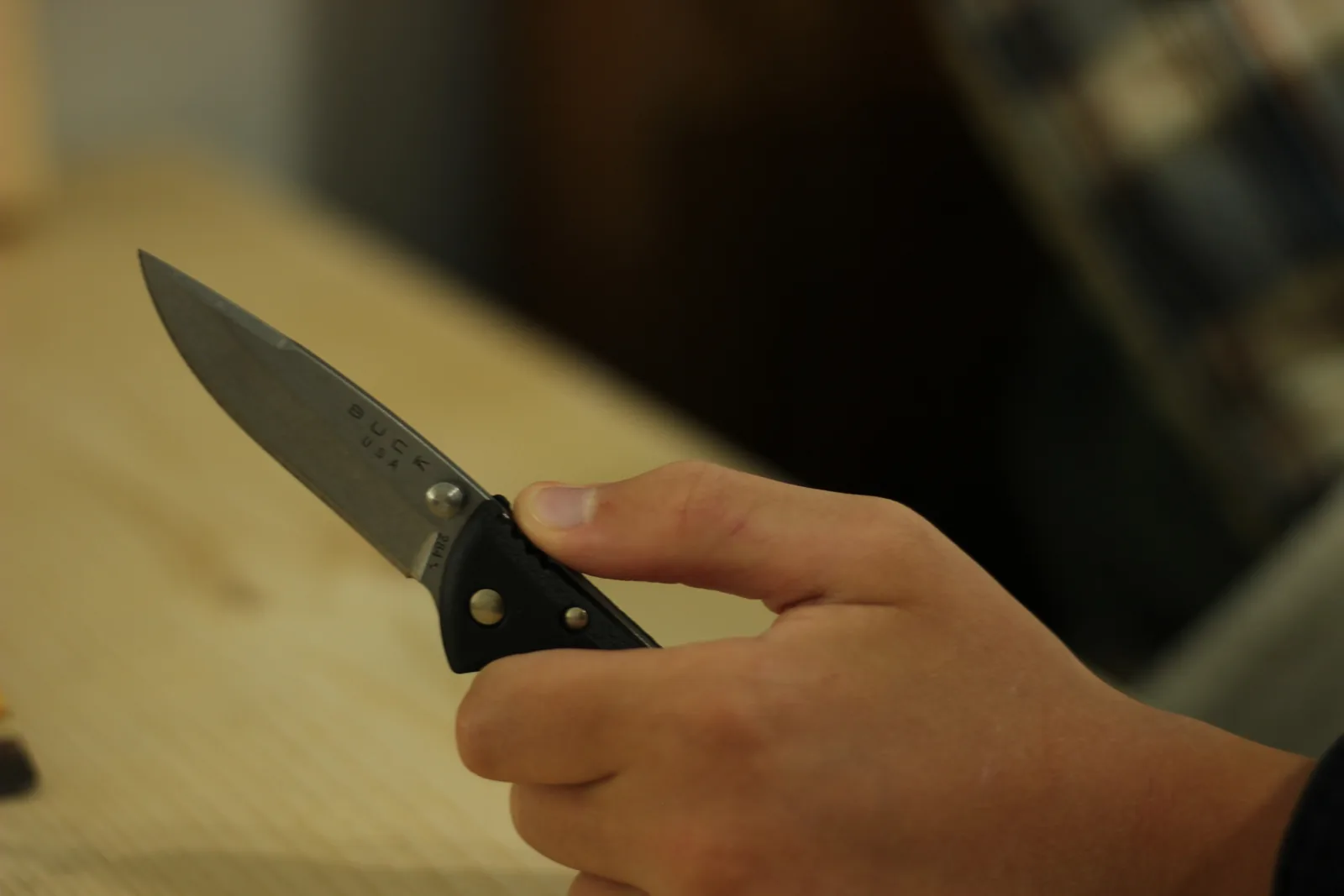
The opening action is the part that surprises. The thumb stud is a plain knurled post rather than a hole or a flipper, and because the blade is so light there is very little mass to move — a short push rolls it out without a wrist flick.
Carry — the omission that will decide it for some buyers
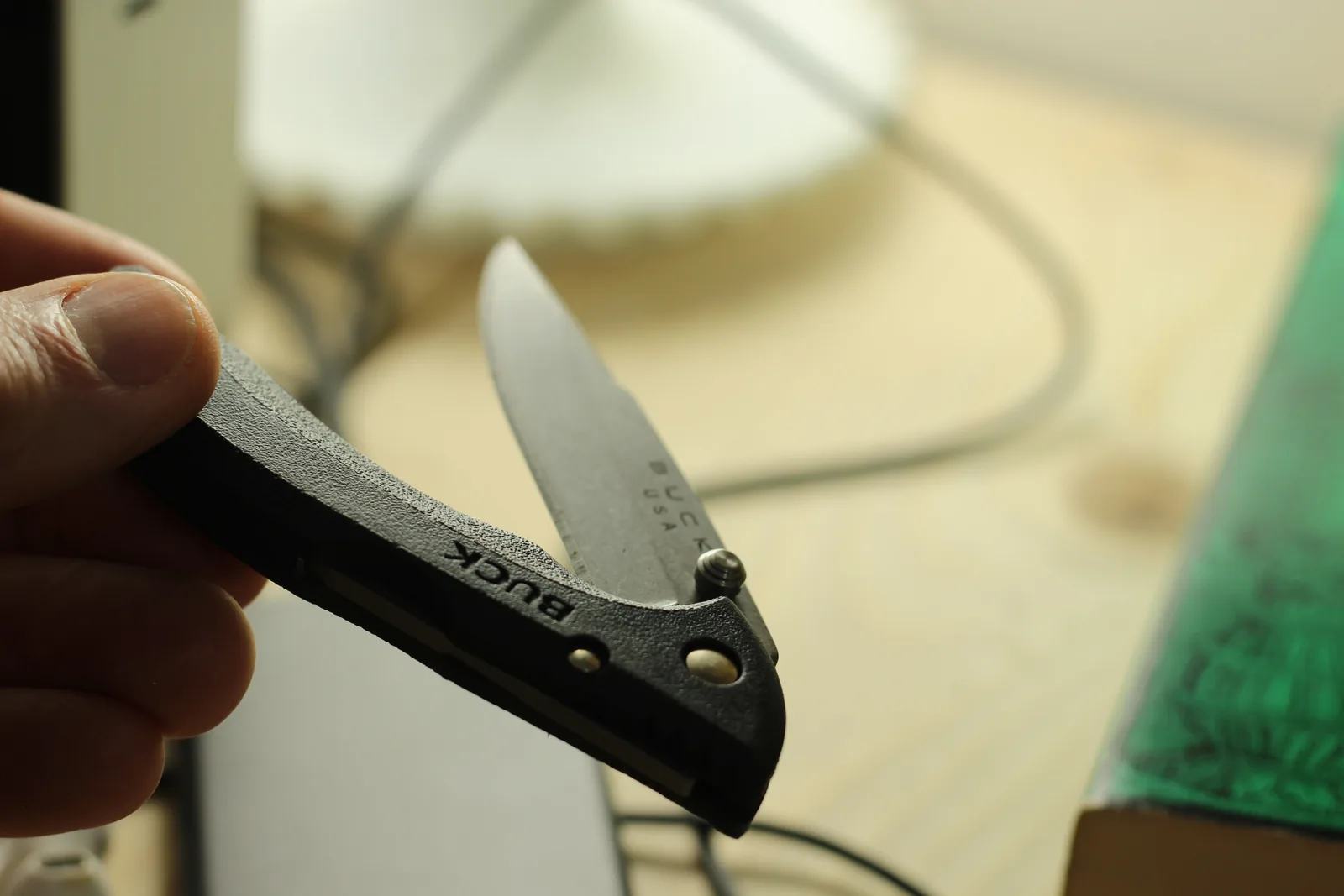
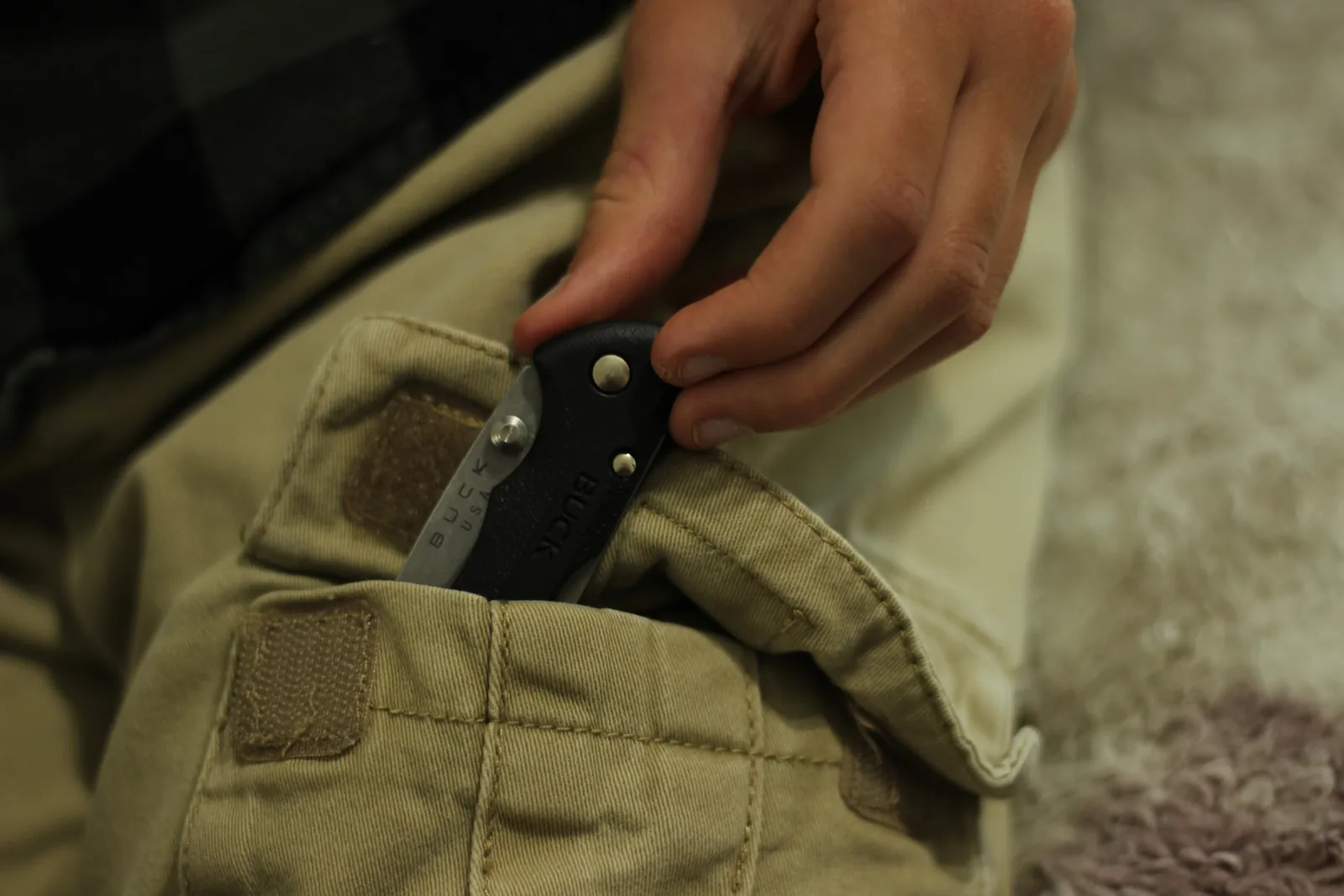
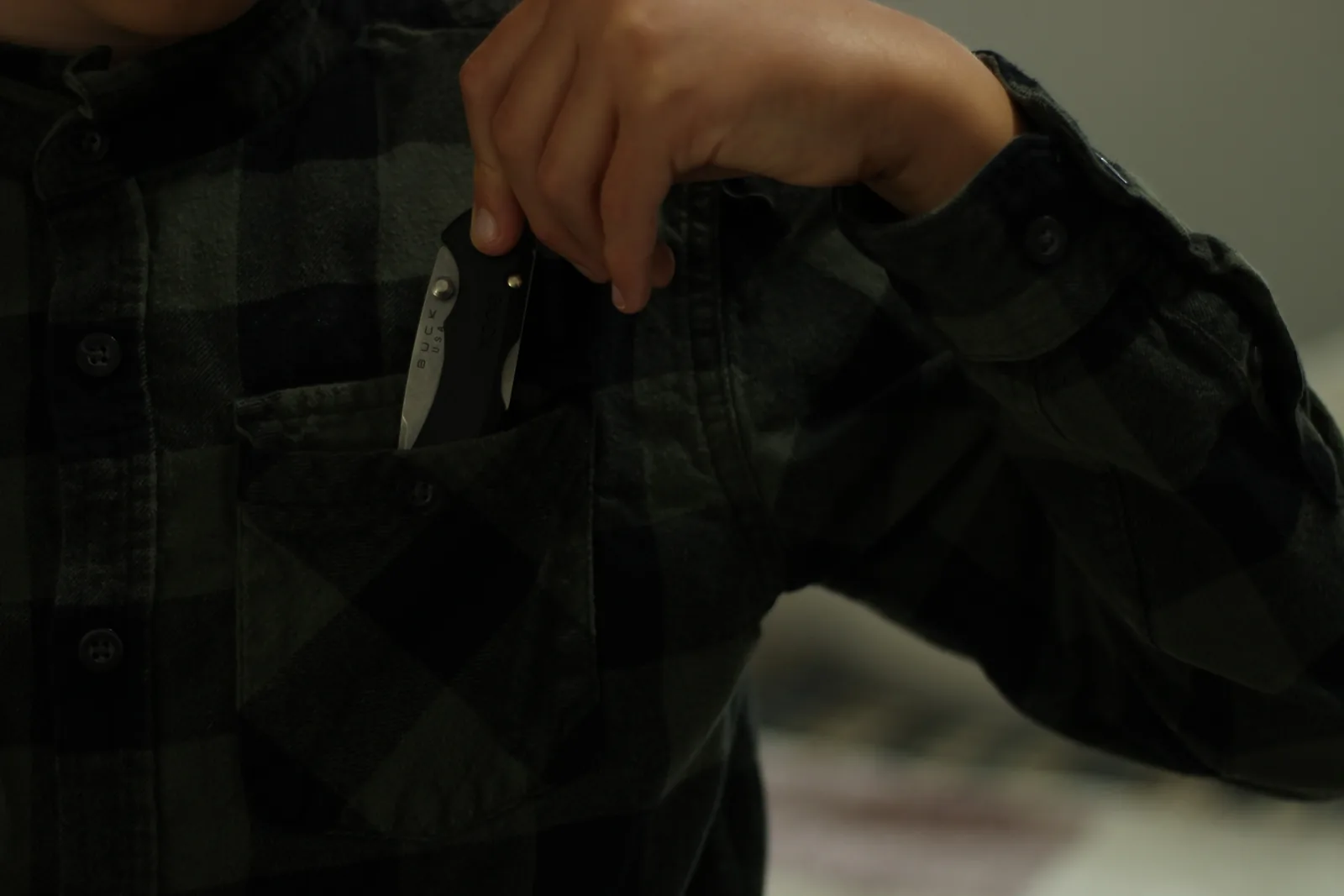
The Bantam BBW has no pocket clip. Not a poorly placed one, not a removable one — there is no clip and no screw holes to add one. For a knife that Buck sells as a hunting and everyday carry folder in 2026, this is the review’s real criticism, and it is not a small one. The modern expectation is that a folder rides at the top of a pocket where you can index it by feel.
What you get instead is a lanyard hole and 1.5 ounces.
Knife weight in ounces, blade only, no sheath. Figures from manufacturer specifications for each knife as recorded in our own reviews. The Bantam is the lightest knife Hunt & Live has covered.
How It’s Built to Be Used
As a second knife on a hunt
A 2.75-inch blade will not break down a deer, and nothing about this review should suggest otherwise. What it will do is the work a primary knife is clumsy at: cutting tags and zip ties, trimming cord, opening feed sacks, working around a joint where a 4.5-inch blade has no room. Paired with a fixed blade like the Deschutes 1883 or the Alpha Guide, the Bantam is the knife you reach for when you do not want to reach for the sharp one.
Small game and birds
This is where the size stops being a compromise. On rabbits, squirrels and upland birds, a short drop point with a continuous belly is genuinely the better tool — there is less blade to steer and the tip stays where you put it. 420HC’s corrosion resistance is also worth something here, because a small knife that lives in a pocket gets wiped rather than washed.
Everyday cutting
Boxes, tape, string, blister packs, apples. The category most knives are actually used for. The Bantam handles it, and the honest observation is that any competent folder does — what distinguishes this one is that it is light enough to still be in the pocket when the moment arrives.
As a first knife
Buck’s own literature keeps pointing this way: “if this is your first Buck Knife, welcome aboard." A lockback with a positive, audible engagement is a good mechanism to learn on, because the knife tells you when it is locked and closing it requires a deliberate act rather than a slip of a finger. That the whole thing costs twenty-one dollars means a first knife can be lost in the woods without it being a disaster.
Edge retention and sharpening
The trade in 420HC is simple: it will not hold an edge as long as the Nitro-V in the Civivi MDRN Hunter or the D2 in the Deschutes pair, and it will come back to sharp faster and with less equipment than either. At Rc 58 it takes a keen edge from a basic stone or a pull-through and does not demand diamond plates. For a knife meant to be maintained casually rather than carefully, that is the correct trade.
Pros and Cons (the Honest Version)
What this knife does exceptionally well. It weighs 1.5 ounces, it is made in Idaho, it runs Buck’s own 420HC at a stated Rc 58, and it is covered by the same unconditional Forever Warranty as knives ten times its price. There is no other knife we have reviewed where the gap between what it costs and what stands behind it is this wide.
Where it falls short. There is no pocket clip, and on a modern EDC folder that is a genuine failure rather than a stylistic choice. The handle has no liners and will flex if you squeeze it. The blade is short enough that it cannot be your only knife on a hunt, and 420HC will need sharpening sooner than the premium steels in this price bracket’s more expensive neighbours. None of these are surprises at twenty-one dollars; all of them are real.
How It Compares
vs. the Buck 110 Folding Hunter ($104.99). The same steel and the same heat treatment, in a knife that weighs nearly five times as much and carries a full inch more blade, with brass bolsters, ebony scales and a leather sheath. The 110 is a knife you own for life and hand down. The Bantam is a knife you carry without thinking about it. They are not really competitors — a lot of people should own both, and the combined price is still under $130.
vs. the Civivi MDRN Hunter ($86.25). Four times the price for a better steel (Nitro-V at 59–61 HRC), a fixed blade, a full tang and a kydex sheath. If you need one knife to process game, this is the one and the Bantam is not. If you need a knife in your pocket on a Tuesday, the comparison inverts completely.
vs. the Buck 285 Bantam BLW (~$25). The Bantam line’s own bigger brother — the same construction and steel with a 3.125-inch blade. If the 2.75-inch blade is the thing giving you pause, the BLW is the obvious answer for a few dollars more, at the cost of some of the weight advantage that makes the BBW interesting in the first place.
Who Should Buy It
Buy it if you want a genuinely light second knife to pair with a proper fixed blade; if you want an American-made folder with a real lifetime warranty and you cannot justify a hundred dollars; if you are buying a first knife for someone learning; if you want something for a shirt pocket, a tackle box, a glovebox or a pack lid where a heavier folder never gets carried.
Don’t buy it if you want a pocket clip — Buck does not offer one on this model and no aftermarket solution exists, so look at the Vantage line or elsewhere entirely. And don’t buy it as your only hunting knife; 2.75 inches is not enough blade for that job, and the Deschutes Combo or the Alpha Guide are the honest answers.
Final Verdict
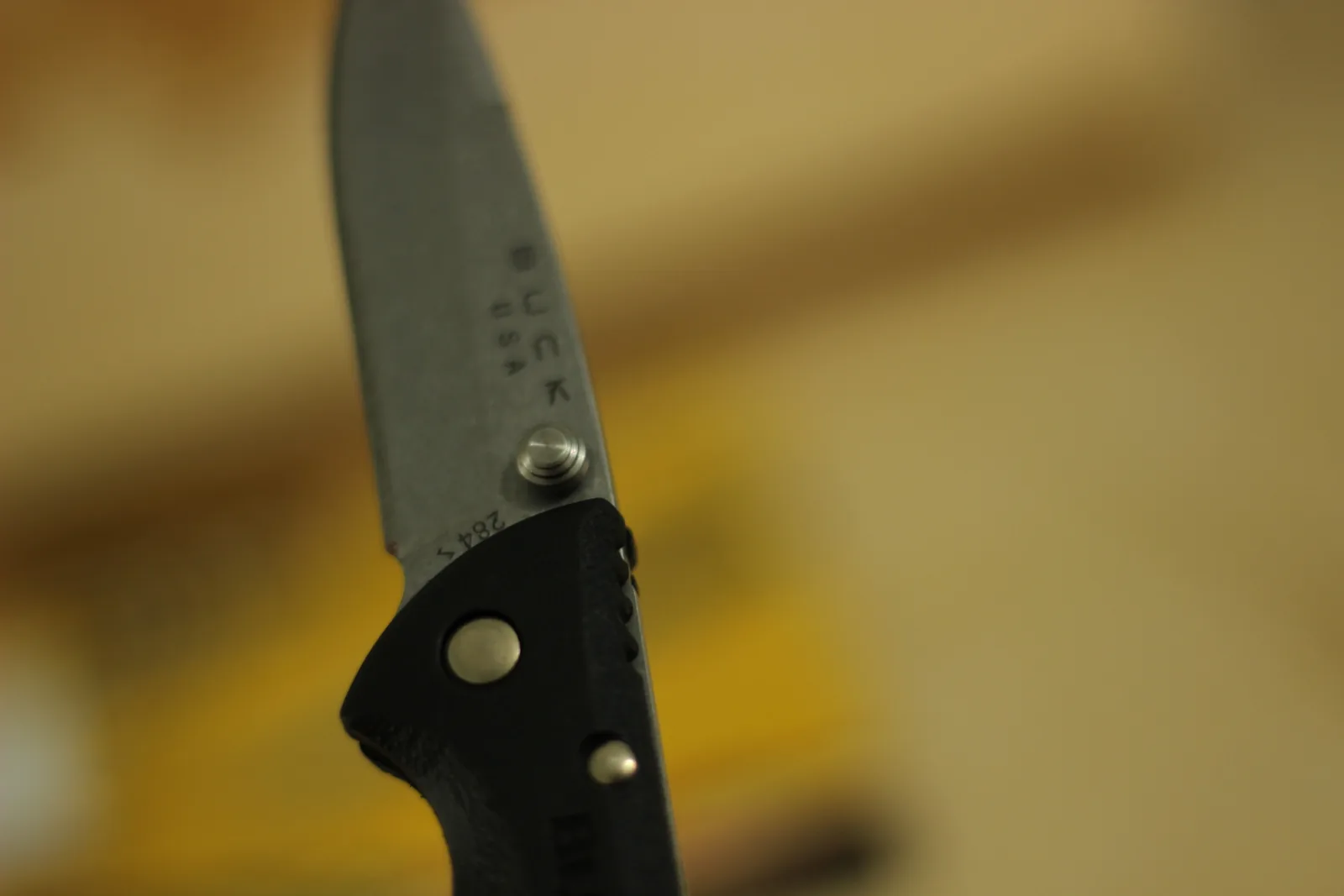
The Buck 284 Bantam BBW is the least expensive product we have ever given a long-form review, and it earns the space for one reason: nothing about the way Buck treats this knife suggests they think of it as a cheap one. The steel is the same 420HC at the same stated Rc 58 that goes into the 110. The tang is stamped BUCK USA. The Forever Warranty card in the packet is the identical card that ships with the $229 Alpha Guide, and the letter from CJ Buck is the same letter. What you give up for the price is a pocket clip, steel liners, and about an inch of blade — and you get back a knife so light you stop weighing the decision to bring it, which is the only quality that matters in a knife you are not otherwise going to carry.
It is not the best knife in this review’s comparison table. It is, by a distance, the best value in it.
Rating: 4.3/5 Stars
Brands sometimes provide samples for review. Hunt & Live writes its honest opinion either way — gear that doesn’t earn its keep doesn’t get a recommendation.