
Featured Review · Civivi · Knives
Civivi MDRN Hunter C23078-2 Review — The Kyle Lamb Fixed-Blade Hunter That Brings a VTAC Combat Pedigree to Game Prep
Our Rating
Current Price
- Model number
- C23078-2
- Model name
- MDRN Hunter
- Designer
- Kyle Lamb (VTAC)
- Blade steel
- Nitro-V (59–61 HRC)
Pros
- Kyle Lamb (VTAC) designed — a serious combat-pedigree designer adapting his hand to a dedicated hunting profile, and the geometry reflects that intent
- Nitro-V blade steel at 59–61 HRC — a modern stainless documented to punch above the price point on edge retention and corrosion resistance
- 4.12 in / 104.6 mm satin-finished compound-ground drop point — sized within the working envelope for mid-size game dressing while remaining controllable in a finger pinch grip
- Brown G10 scales with deeply machined finger grooves and texture lines — peel-ply texture and grooves designed to index the hand and resist slip
- Full-length kydex sheath with two MOLLE-compatible polymer carrier straps — friction-fit retention rated to hold the knife inverted
- Skeletonized full tang with a steel-lined lanyard hole at the pommel and exposed pommel tang — pommel geometry intended for use as an impact tool
- Knife weighs 3.65 oz / 103.4 g bare — light enough for pack carry across an extended season
- $86.25 USD on sale (regular $115 USD) for a Kyle Lamb-designed Nitro-V fixed blade with kydex is genuinely under-priced for the segment
Cons
- Made in China — Civivi is a We Knife sub-brand and the QC is good, but buyers wanting USA- or Italy-made craft should know up front
- Kydex sheath has limited carry options out of the box — the two polymer carrier straps clip to a belt or MOLLE webbing, but there's no scout-carry option, no leather dangler, no horizontal-carry adapter
- Compound grind takes a finer edge than a full flat or scandi but is slightly harder to maintain in the field — you'll want a proper guided sharpener, not just a steel
Every fixed-blade hunting knife eventually has to answer the same question. Did the designer ever actually skin an animal? You can read the blade geometry, the grind, the finger-guard radius, the choil cut, the pommel shape — and the design either reads as drawn by someone who’d processed game or someone who’d traced a Pinterest board. The Civivi MDRN Hunter C23078-2 is interesting precisely because of who designed it — Sergeant Major (Ret.) Kyle Lamb, founder of Viking Tactics, one of the most respected combat-shooting instructors in the modern American firearms world, and a man whose previous knife collaborations have almost all been combat or duty knives. Putting his name on a dedicated hunter is a deliberate choice, and the C23078-2 is the result.
It’s also a genuinely affordable knife. At $86.25 USD on sale from a $115 USD MSRP, it lives in the awkward middle ground between the $40 Mora-tier disposables and the $200+ premium-tier Bark Rivers, Benchmades, and Falkknivens. That middle band has historically been ugly — overbuilt, over-designed, under-engineered knives at compromise pricing. The MDRN Hunter is not that. It’s a focused 4.12-inch drop-point hunter in Nitro-V steel with brown G10 scales, a satin compound grind, and a full kydex sheath with a two-strap polymer carrier. Made in China by We Knife Co. under the Civivi sub-brand, sold direct-to-consumer from the Civivi storefront, backed by Civivi’s standard return policy.
What follows is an editorial review built on the published spec sheet, the design lineage (Kyle Lamb’s other knives in the VTAC line and the broader Civivi catalogue), Nitro-V’s documented behaviour as a steel, and what’s directly observable in the knife — geometry, fit and finish, sheath retention, factory edge. We didn’t field-dress a deer with it for this piece; the editorial focus is on whether the design and the spec sheet add up to a credible hunter at the price, not on a contrived field anecdote.
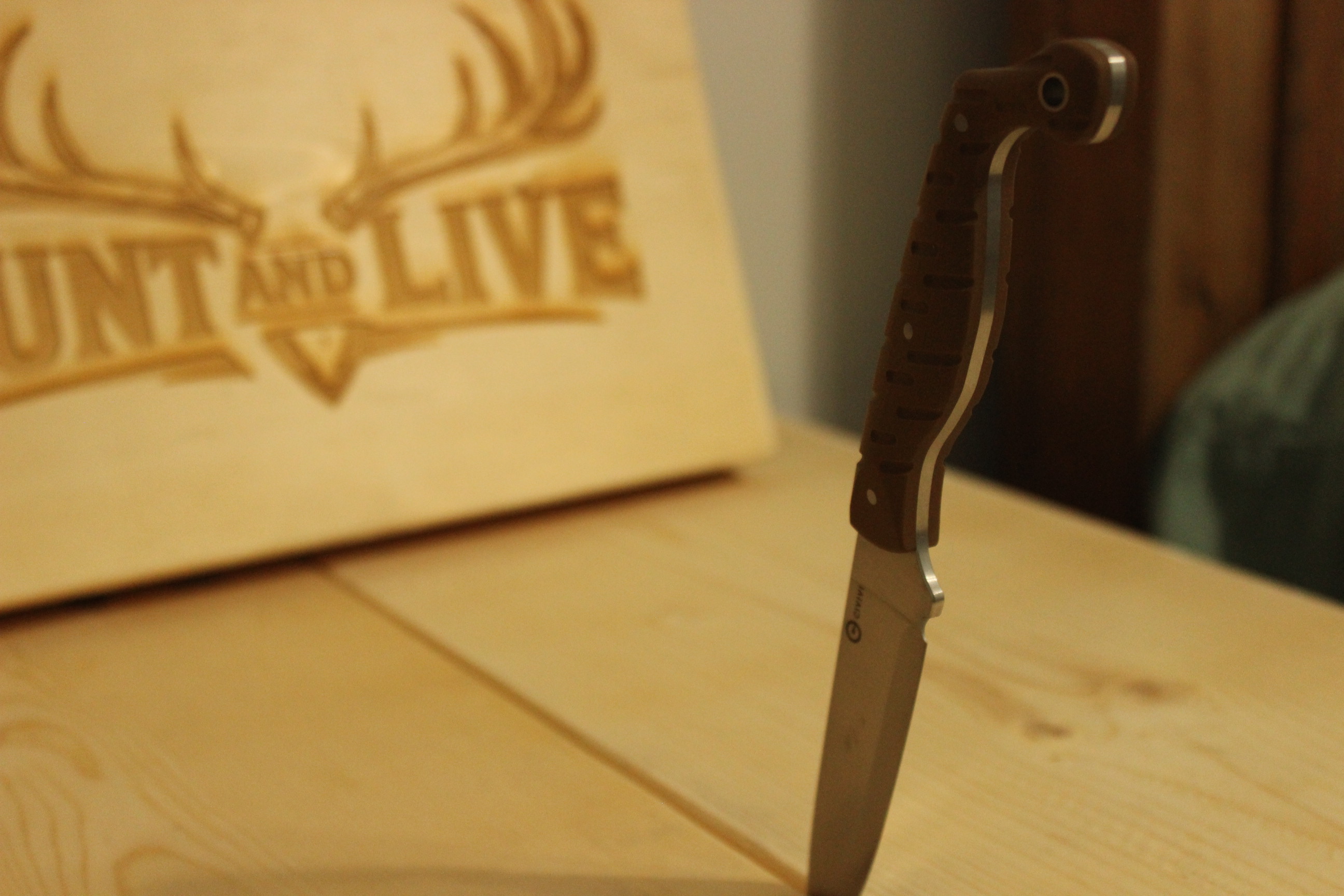
At a glance
The Editorial Premise
The fixed-blade hunter market in 2026 is crowded but stratified. At the disposable end you have the Mora Companion HD at around $25 — a perfectly serviceable Sandvik 12C27 scandi blade with a plastic handle, the knife every Scandinavian deer-camp uses without a second thought. At the premium end you have the Bark River Bravo Necker, the Benchmade Steep Country, the Buck 663 Alpha Guide, the Helle Bleja, the ESEE-3, and the Falkkniven F1 — all in the $180–$300 band, all USA, Sweden, Norway, or Finland-made, all carrying genuine craft cachet and 1–4 generations of design refinement.
The middle band — $80 to $150 — has historically been the worst-value tier in the category. You’re paying too much to be disposable and too little to be a working heirloom. The MDRN Hunter sits dead-centre in this band at $86.25 on sale, and it does something the middle band rarely does: it delivers a designed knife at the price point. The geometry is intentional. The grind is intentional. The handle ergonomics are intentional. The kydex sheath fit is genuinely tight. It’s not a parts-bin knife with a label.
The honest question is whether Kyle Lamb’s hunter geometry actually works on a hunter’s task list, or whether it’s a duty-knife profile in a hunter’s clothing. We’ll get to that.
First Impressions — In the Box
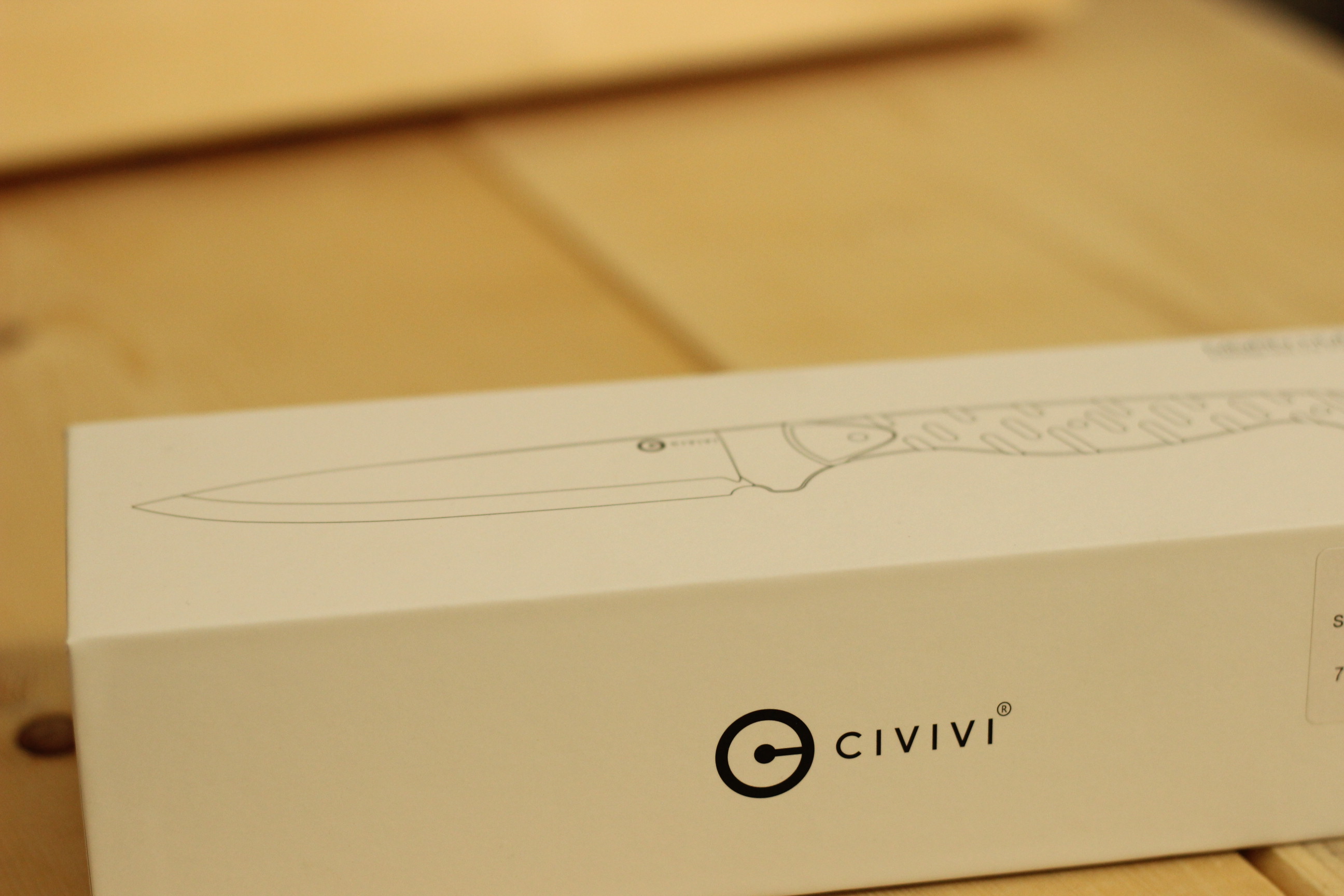
The MDRN Hunter ships in a long, low, matte-white slipcase with a single-colour line-art outline of the knife on one side and a small label at the end identifying the model: MDRN Hunter — Designed by Kyle Lamb. The packaging is restrained. There’s no foam cradle, no display-piece insert, no gold-printed certificate of authenticity. Inside the box, you get the knife in its kydex sheath, the two polymer carrier straps already pre-threaded onto the sheath, a Civivi-branded microfibre cloth, a small green maintenance card, a circular Civivi sticker, and a folded warranty leaflet. That’s it. It feels appropriate for a $86 knife — neither cheap nor over-presented.
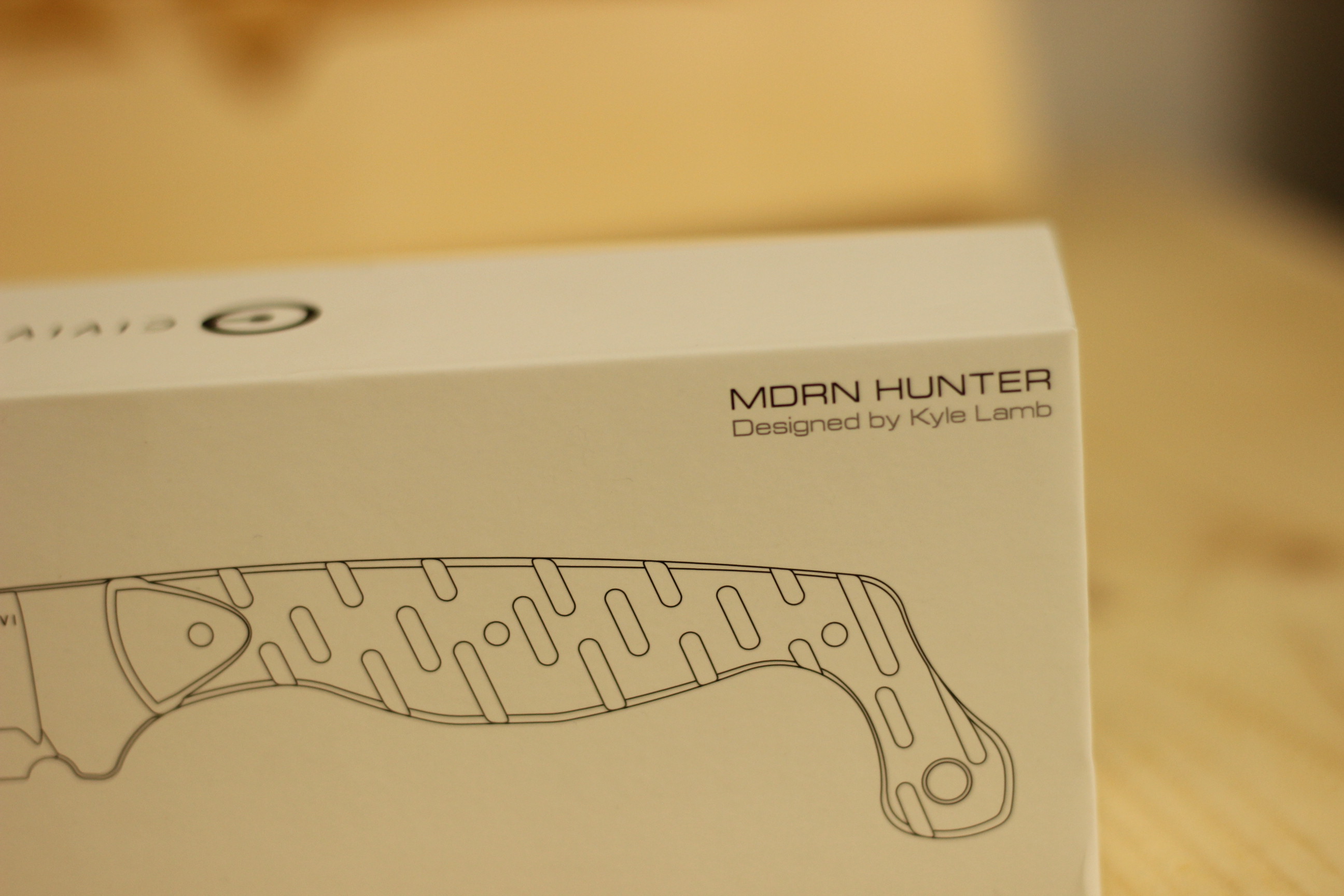
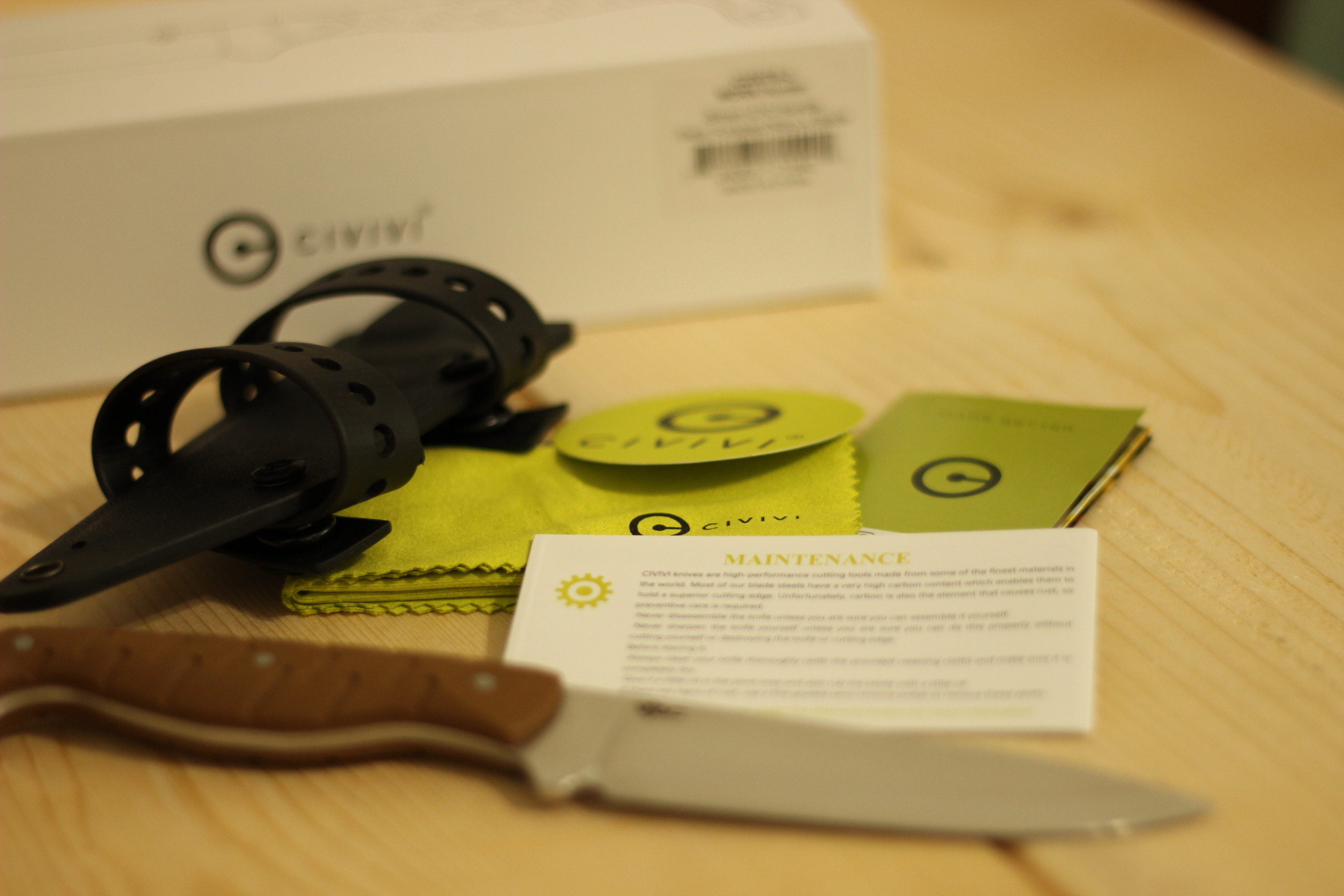
The kydex sheath is tight from the factory. Drawing the knife requires a deliberate, firm pull to break the retention free, with the audible plastic snap that’s characteristic of a properly-formed kydex molding. Kydex retention typically loosens slightly over the first dozen or so draw cycles as the molding settles around the blade profile, but the factory state is firmly on the secure side of the spectrum — there’s no risk of the knife rattling loose inverted. The blade arrives with a working factory edge along the full 3.62-inch cutting edge. Civivi factory edges have a reputation for being usable straight out of the box at this price band, and the published spec sheet and finish on this unit are consistent with that reputation.
The Designer Question — Why Kyle Lamb Matters Here
This is where the editorial conversation has to be honest. Kyle Lamb is not primarily a hunting-knife designer. He’s a retired Sergeant Major from 1st SFOD-D (Delta Force) with twenty-plus years of combat shooting and close-quarters instruction behind him. His Viking Tactics (VTAC) brand is best known for sling design and rifle-shooting curriculum. His prior knife collaborations — most notably the Halfbreed Blades MIK series and several Spartan Blades projects — have all been combat or general-purpose fixed blades, not dedicated hunters.
So when his initials show up etched on a 4.12-inch drop-point hunter, the question is fair: is this a hunter, or is it a smaller VTAC duty knife with the marketing repositioned?
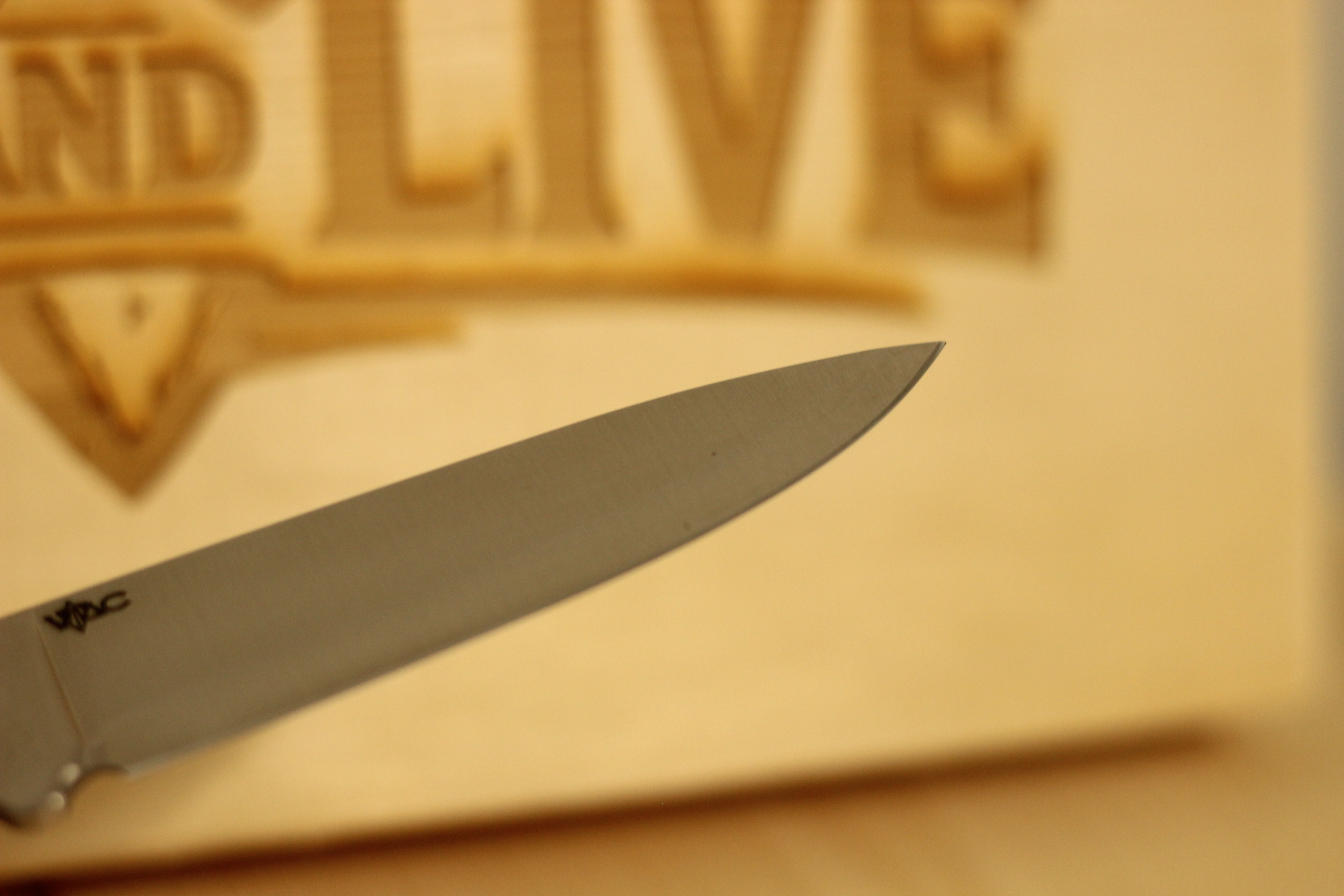
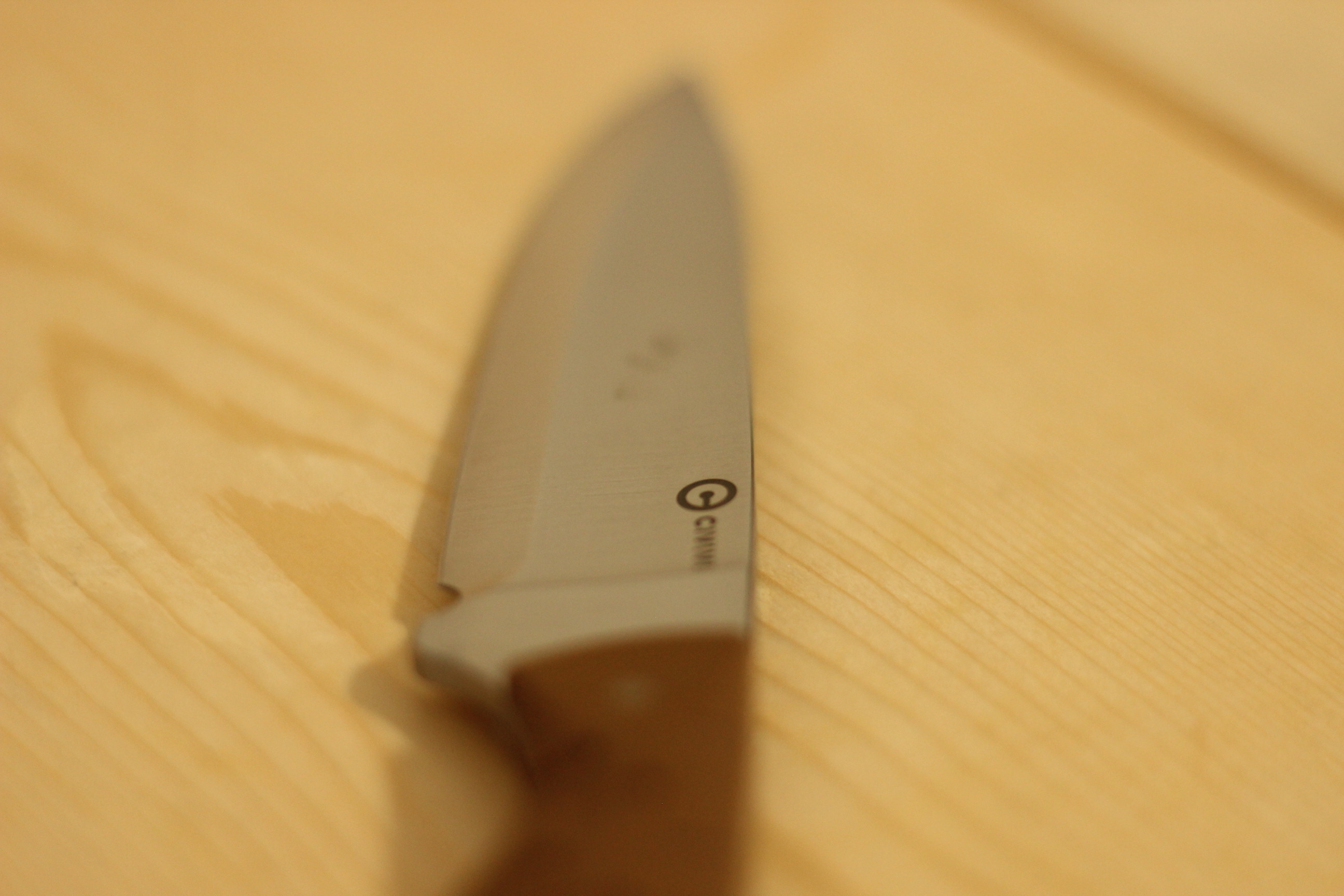
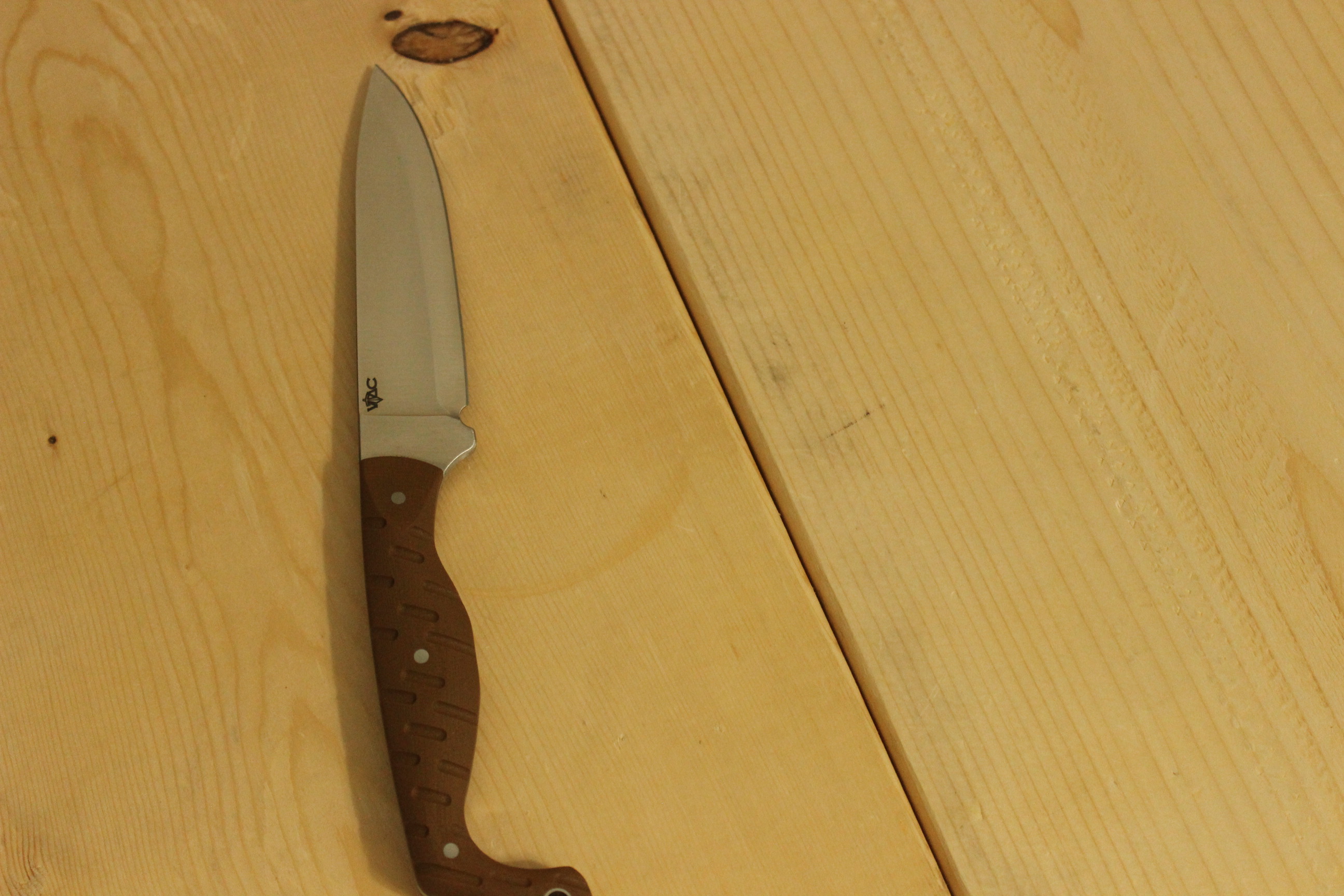
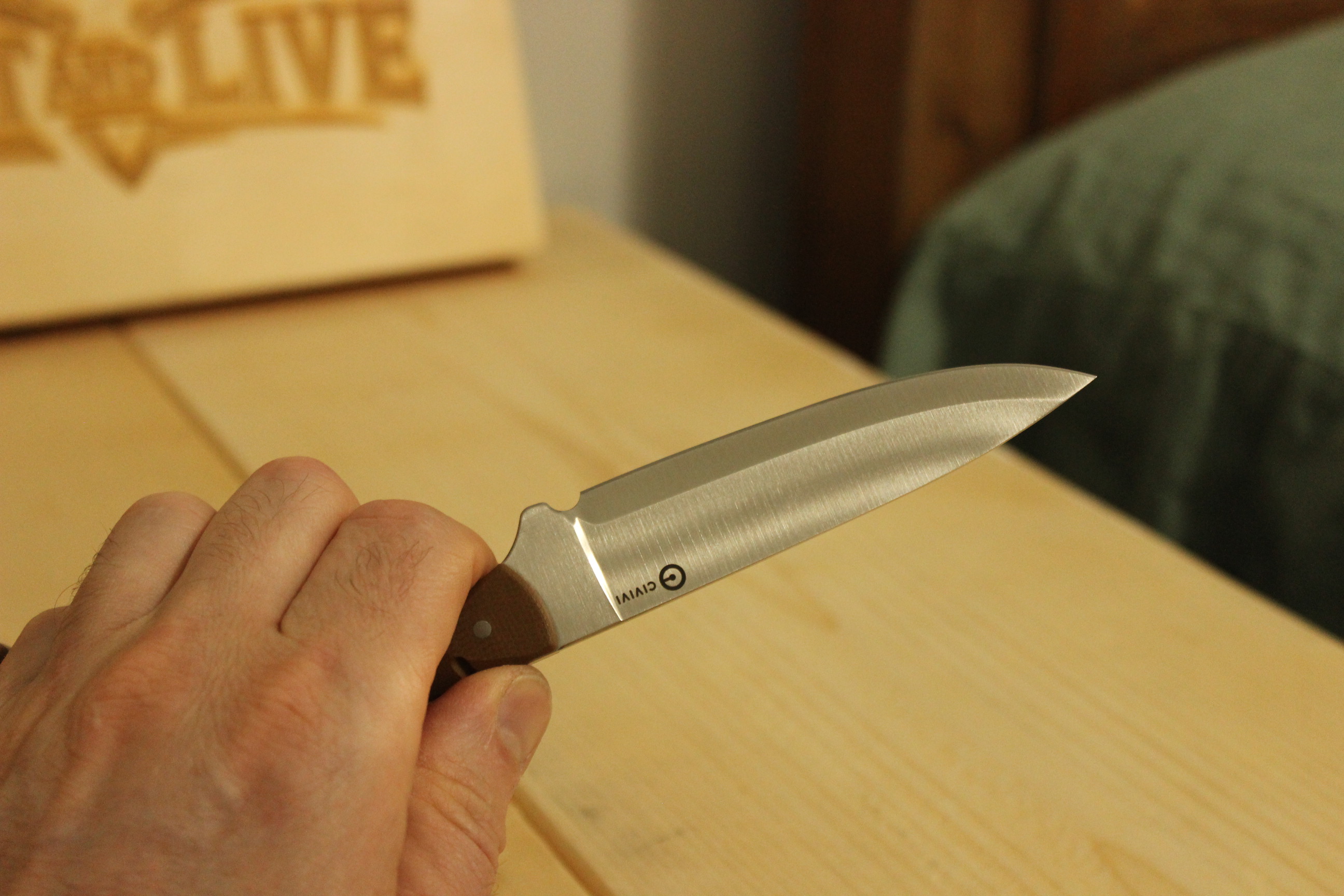
Reading the geometry, it’s actually a hunter. The blade is short enough (4.12 in) to live in the working sweet spot for whitetail and similar mid-size game — long enough to make full ventral cuts through the rib cage and pelvis without the tip running out of authority, short enough to stay in a pinch grip for cape work and skin separation. The drop point is shallow and broad — a true skinner profile, not the harpoon-y belly of a tactical blade. The compound grind keeps the spine thick at 0.12 inches for prying authority while the secondary bevel runs thin enough for clean cuts. The choil at the heel of the cutting edge gives a forward pinch-grip option without the index finger riding the edge.
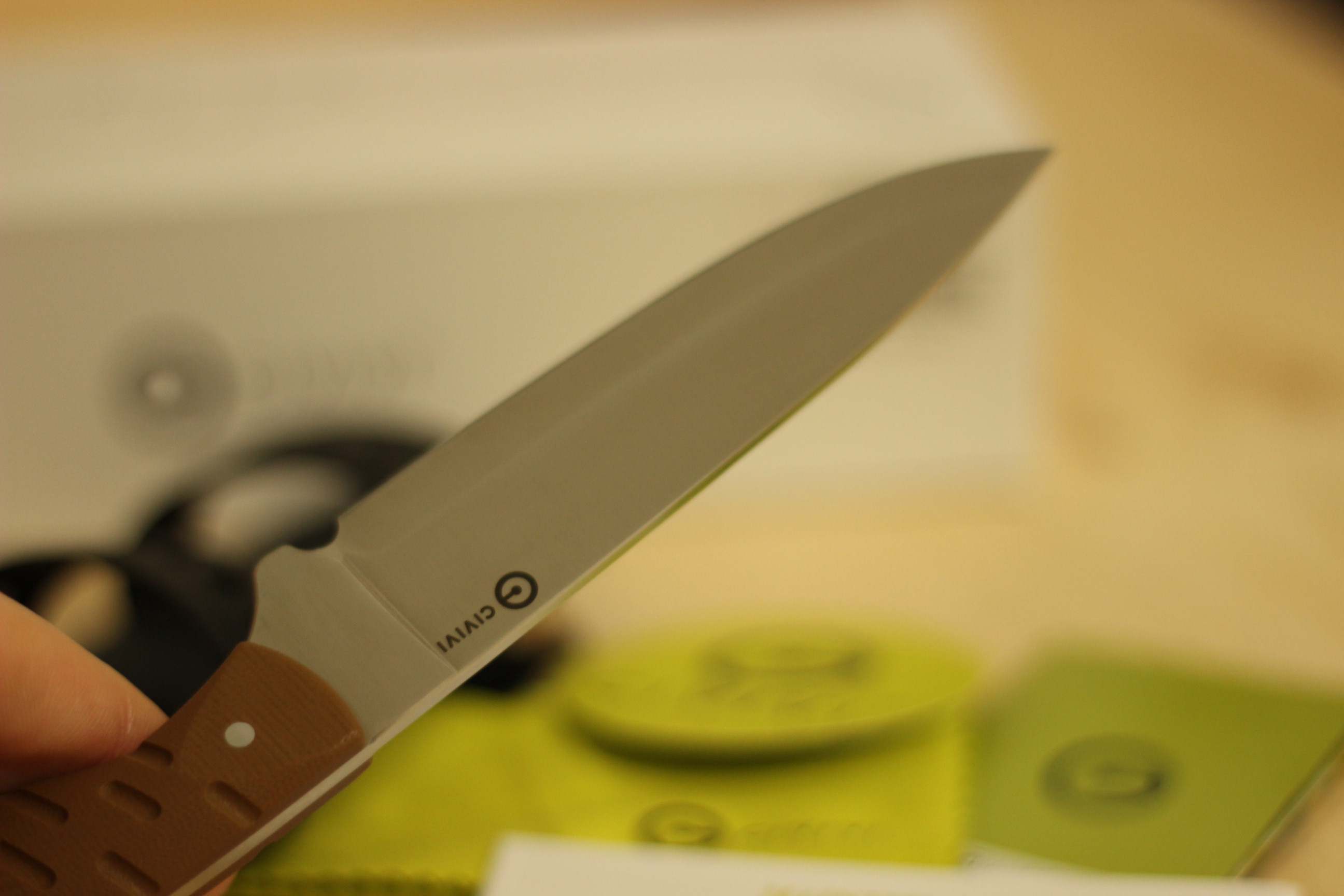
The VTAC mark — Lamb’s wreath-and-arrow logo — is etched on the obverse of the blade just behind the grind transition. The Civivi wordmark is on the reverse. Both are clean, small, and don’t shout.
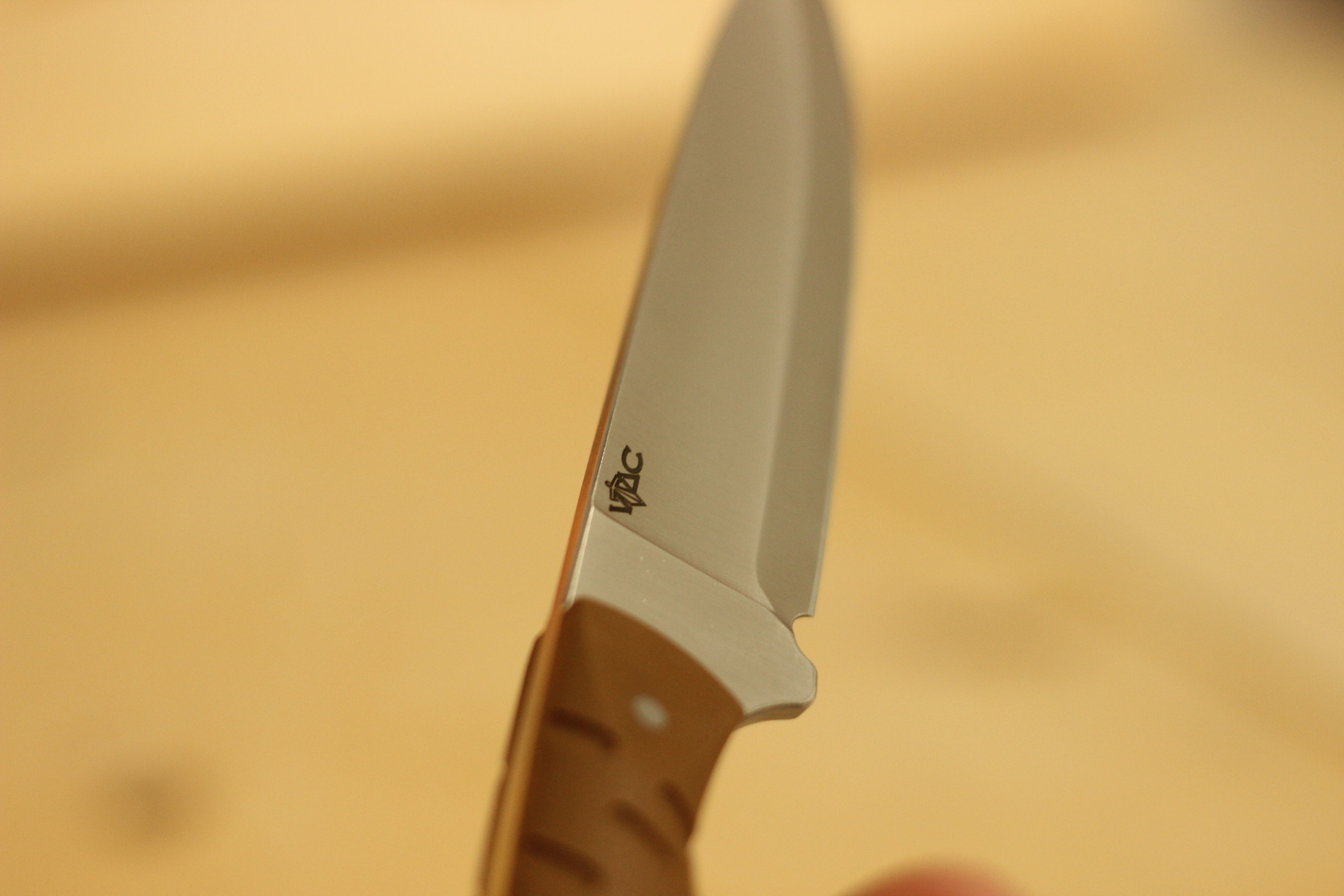
That collaboration matters because it sets the design intent. The MDRN Hunter is not a Lamb combat knife that got a hunter label. It’s a Lamb knife designed with a hunter’s task list in mind, executed by Civivi’s manufacturing arm at the price point Civivi sells at. The compromise was always going to be where the manufacturing happens, not what the geometry is.
Blade Geometry, Read Honestly
Strip away the marketing and the design pedigree, and what’s left is the blade. The numbers, verified from the Civivi spec sheet: 4.12-inch overall blade, 3.62-inch sharpened cutting edge, 0.12-inch / 3 mm spine thickness, 8.38-inch overall, 3.65 oz bare knife weight, Nitro-V steel at 59–61 HRC, compound-ground drop point with a satin finish. That’s the spec sheet. The interesting reading is the ratio.
A 4.12-inch blade is right at the centre of the modern hunter envelope. Buck’s Vanguard at 4.125 inches, Benchmade’s Steep Country at 3.54, ESEE’s ESEE-3 at 3.88, Bark River’s Gunny at 4.0, Buck’s 663 Alpha Guide at 4.5 — the MDRN Hunter splits the difference. Short enough to stay agile in fine work, long enough to commit to a full ventral cut without choking up. The 0.12-inch spine is workshop-relevant: thinner than the ESEE-3’s 0.16 inches (which is genuinely overbuilt for hunting), thicker than the Steep Country’s 0.097 inches (which is a true game-prep specialist). Three millimetres of spine is the right number for a hunter that will see batoning on small kindling but won’t be asked to do bushcraft impossibilities.
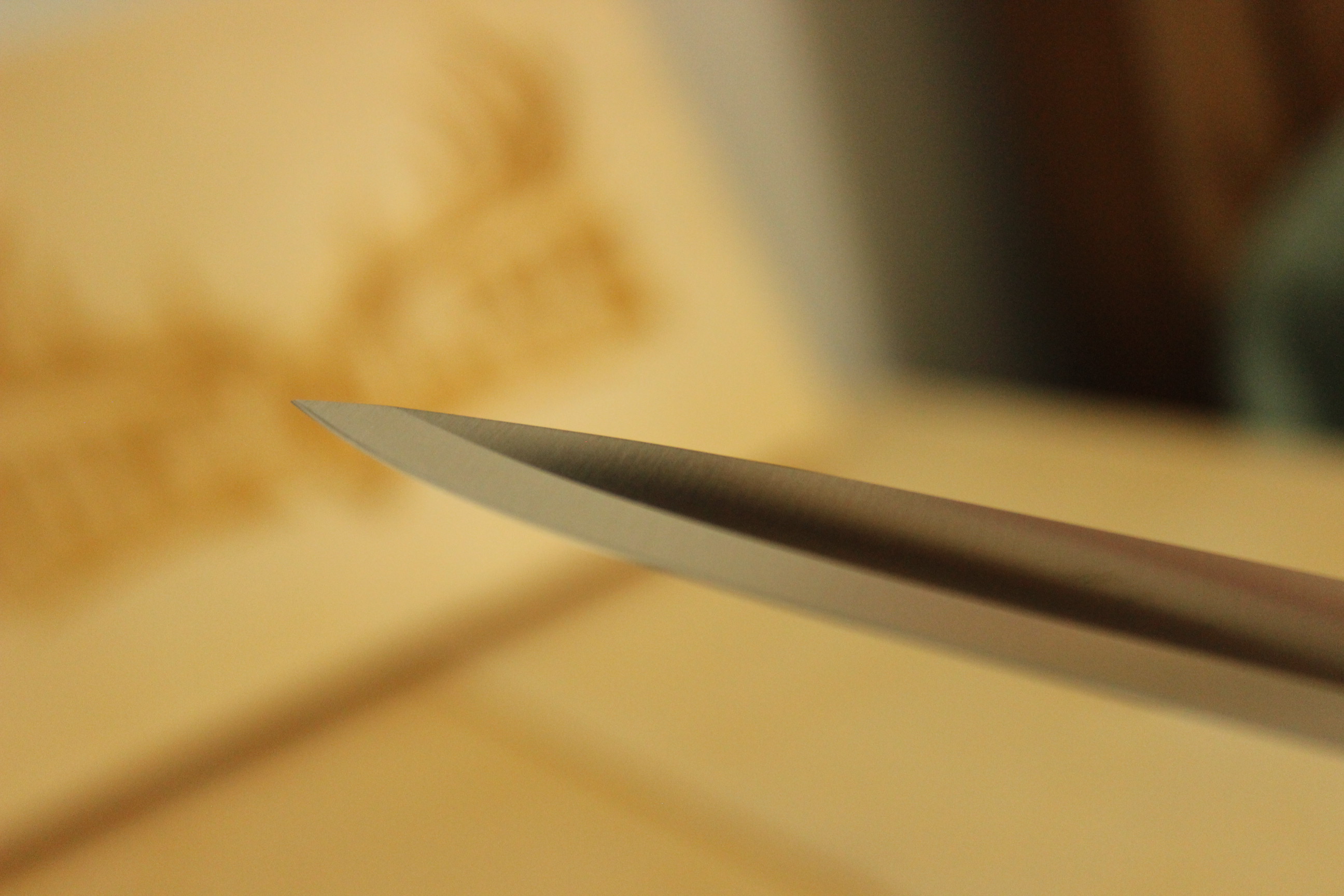
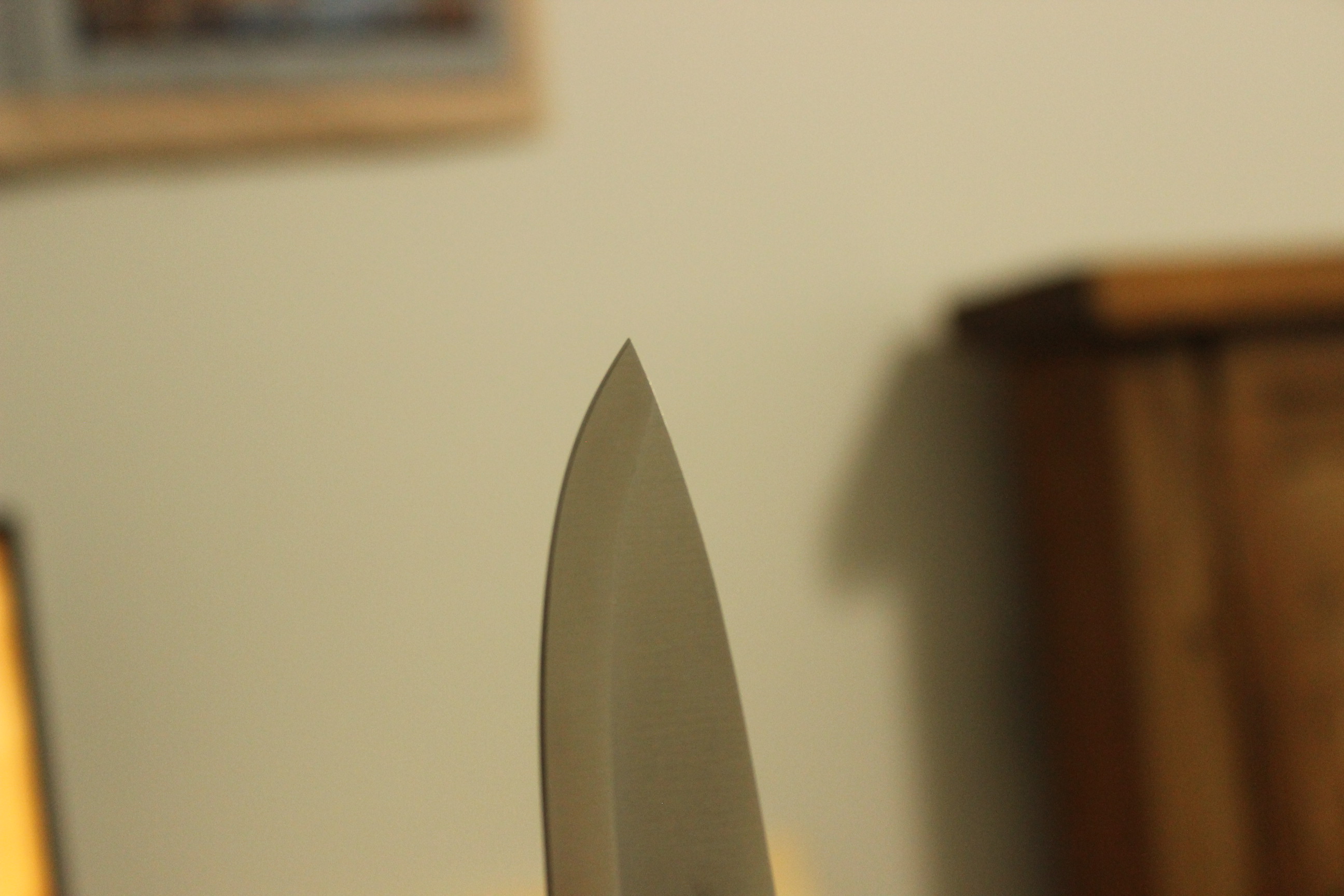
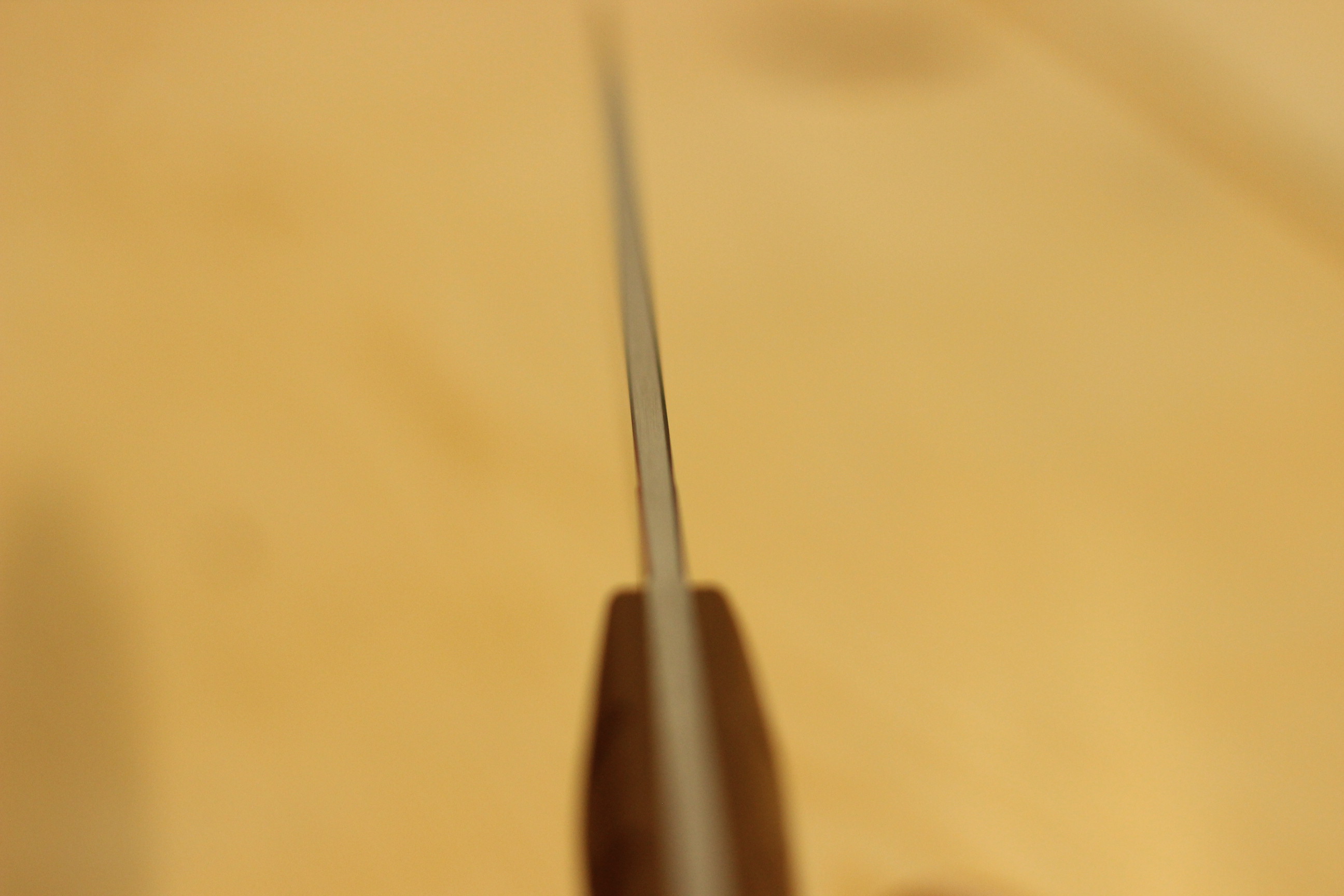
The compound grind is the interesting choice. A full flat would have been easier to maintain — one bevel angle, freehand-friendly. A scandi would have read more bushcraft. A hollow grind would have read more skinner. The compound — a high primary that rolls into a thinner secondary above the edge — is the modern Western hunting-knife grind, the same general approach Benchmade uses on the Steep Country and Bark River uses on the Gunny. The geometry is documented to cut cleanly through skin and intermuscular tissue without binding, and Nitro-V at this hardness is known to hold a working edge through extended cutting tasks. It takes a polished mirror edge on a guided sharpener. The compound profile is also more difficult to maintain freehand with a simple steel — a guided system (Wicked Edge, Worksharp Precision, the Spyderco Sharpmaker) is the right tool for keeping both bevels true.
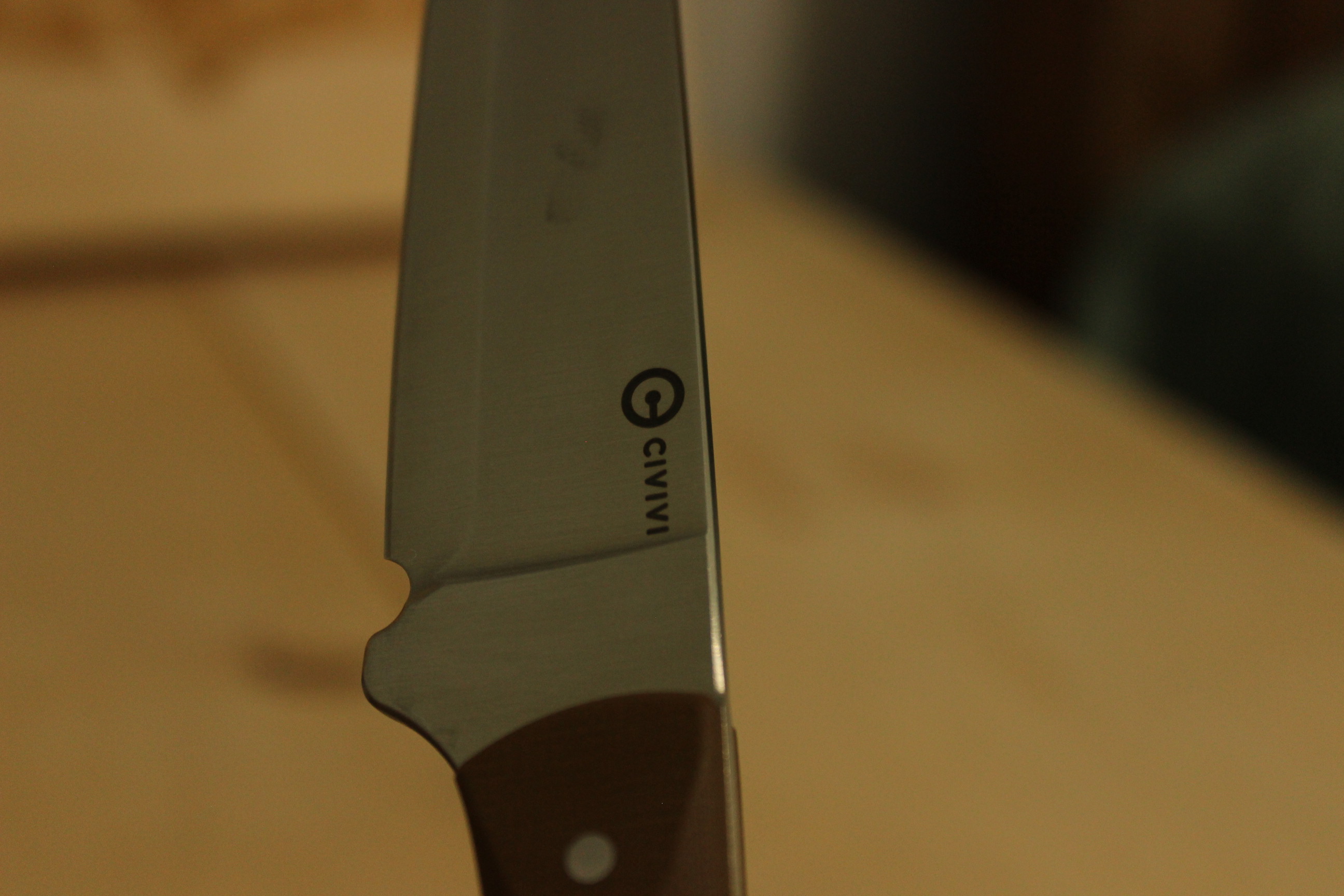
The steel choice — Nitro-V at 59–61 HRC — is the other design call that matters. Nitro-V is a nitrogen-enriched stainless developed by New Jersey Steel Baron and increasingly common in the mid-tier custom and production market. It’s similar in composition to Sandvik’s 14C28N but with added nitrogen for finer carbide structure. At 59–61 HRC it’ll take and hold a working edge longer than Buck’s 420HC, equivalent to 14C28N or AUS-8 in real-world hunting use, slightly behind S35VN or CPM-154 on edge retention but ahead of either on stainlessness and ease of resharpening. It’s the right steel for a sub-$100 hunting knife — modern enough to be respectable, accessible enough to sharpen at deer camp.
Handle, Ergonomics, and the Grip Conversation
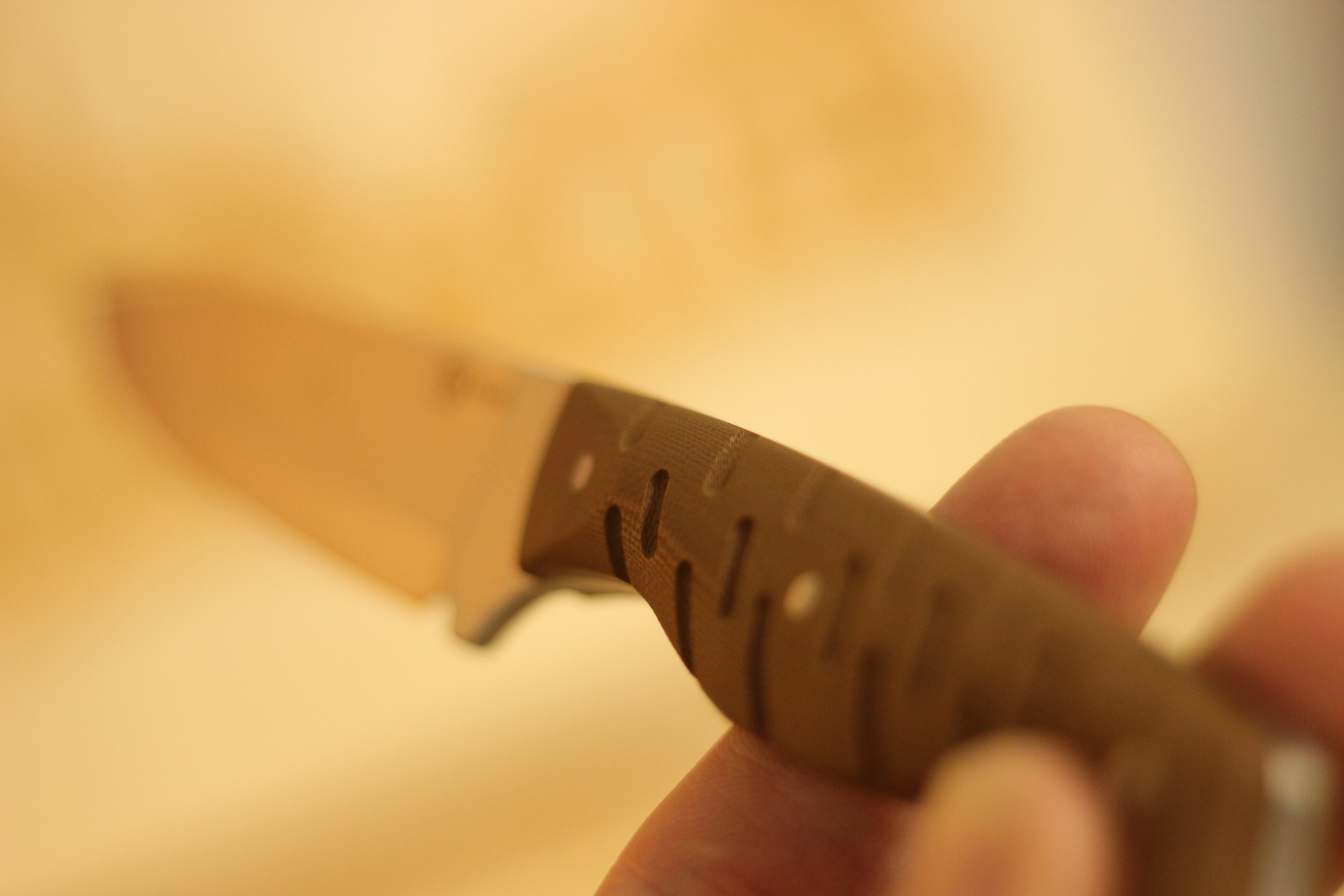
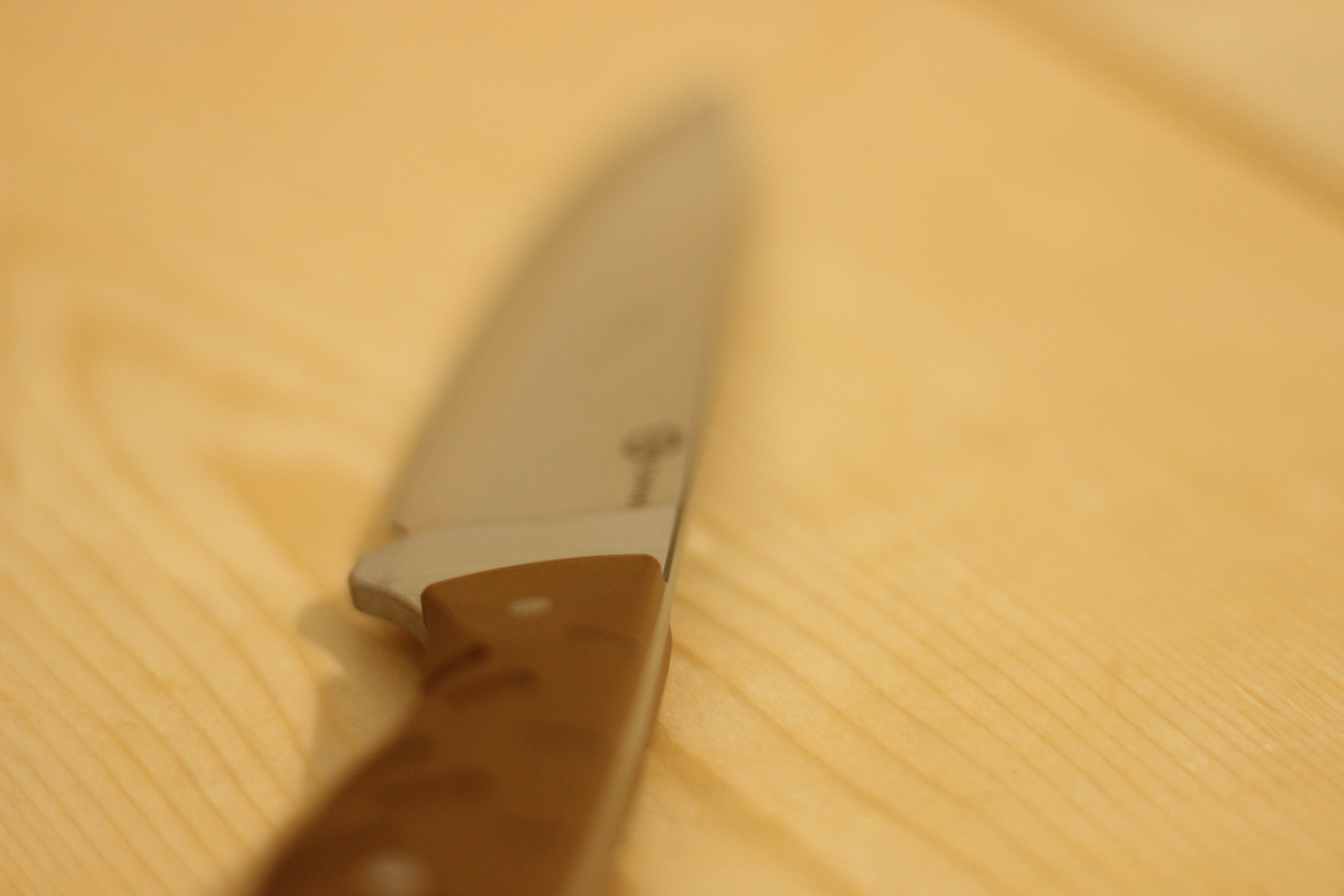
The handle is brown G10 — peel-ply texture from the factory, deeply machined finger grooves running the full length of both scales, stainless-steel mosaic-style pins through the tang, and a steel-lined lanyard hole at the rearmost end of the pommel. The colour is a flat, warm, slightly-orange brown that reads as functional rather than decorative. The pin-bushing finish is clean — no proud pins, no countersink shadow.
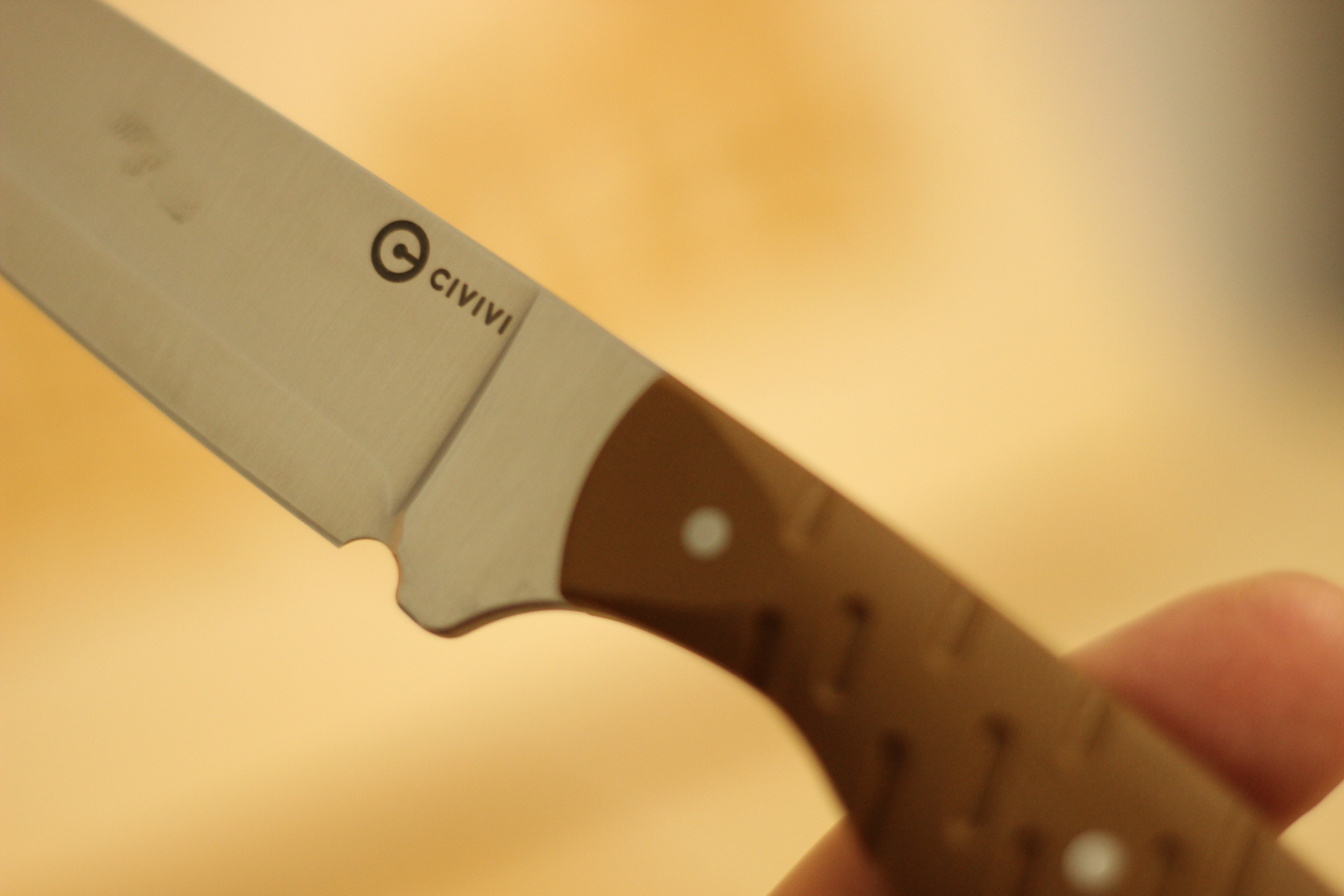
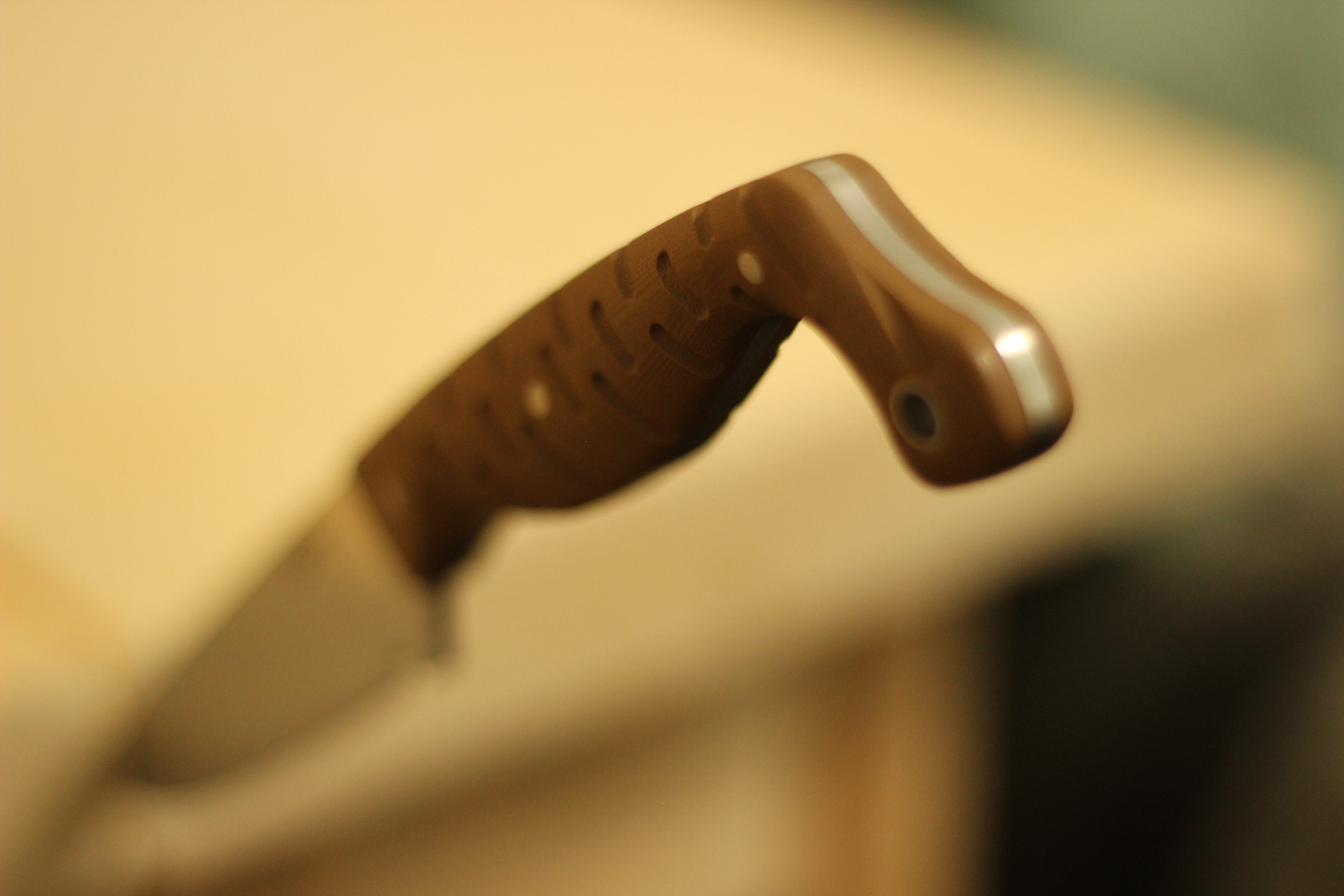
The shape of the handle is the most distinctively Lamb part of the whole knife. It curves dramatically — almost a pistol-grip drop at the pommel — with a swept rear quillon that flares out and hooks down. It’s not a neutral handle. It’s biased toward a hammer grip with the index finger in the choil and the rest of the hand wrapped under, with the pommel hook designed to seat against the heel of the palm. In that grip the geometry is intended to anchor the knife into the hand — the swept pommel resists rearward slip, and the design suggests grip-strength fatigue is minimised because the geometry, not the muscles, carries the lock.
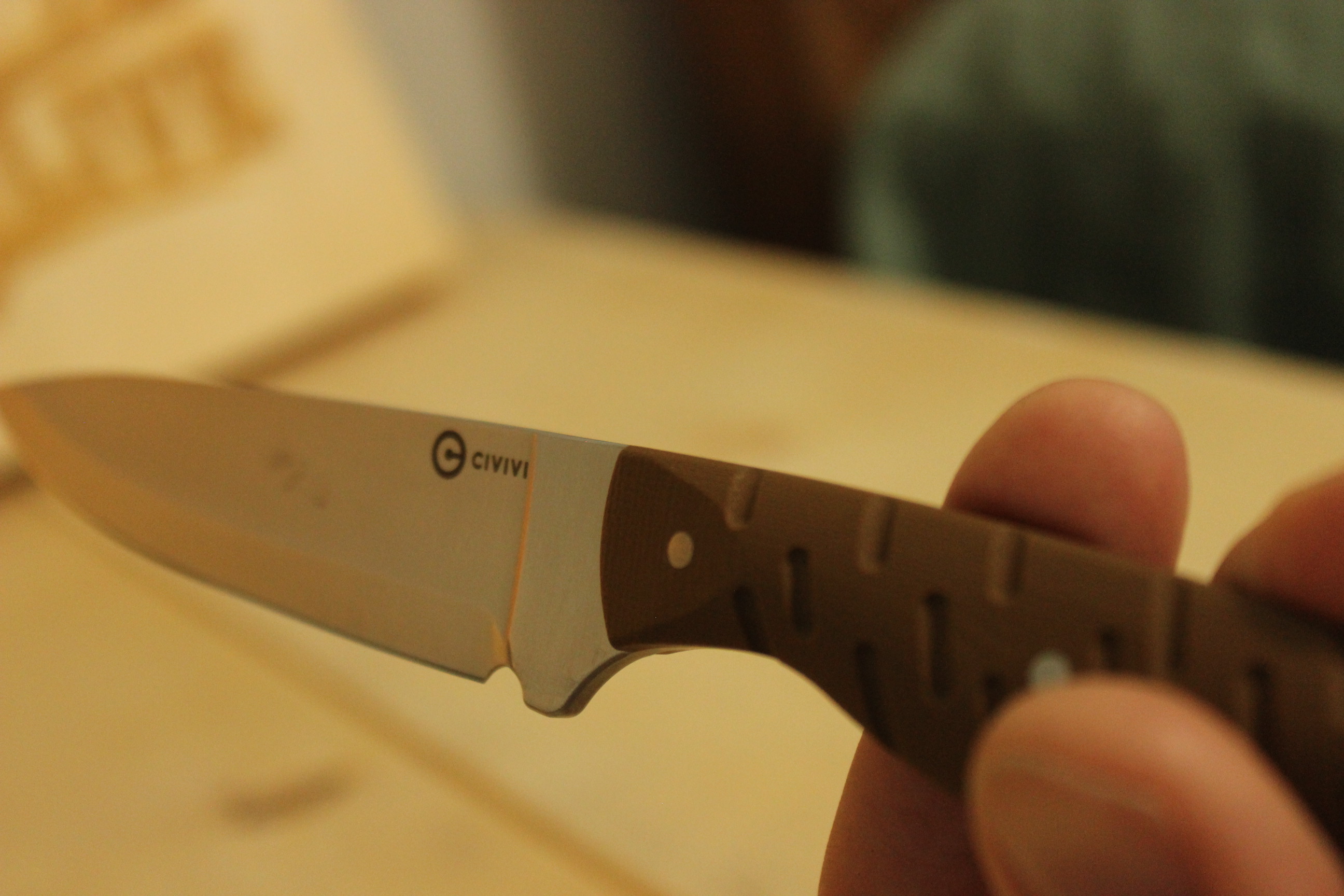
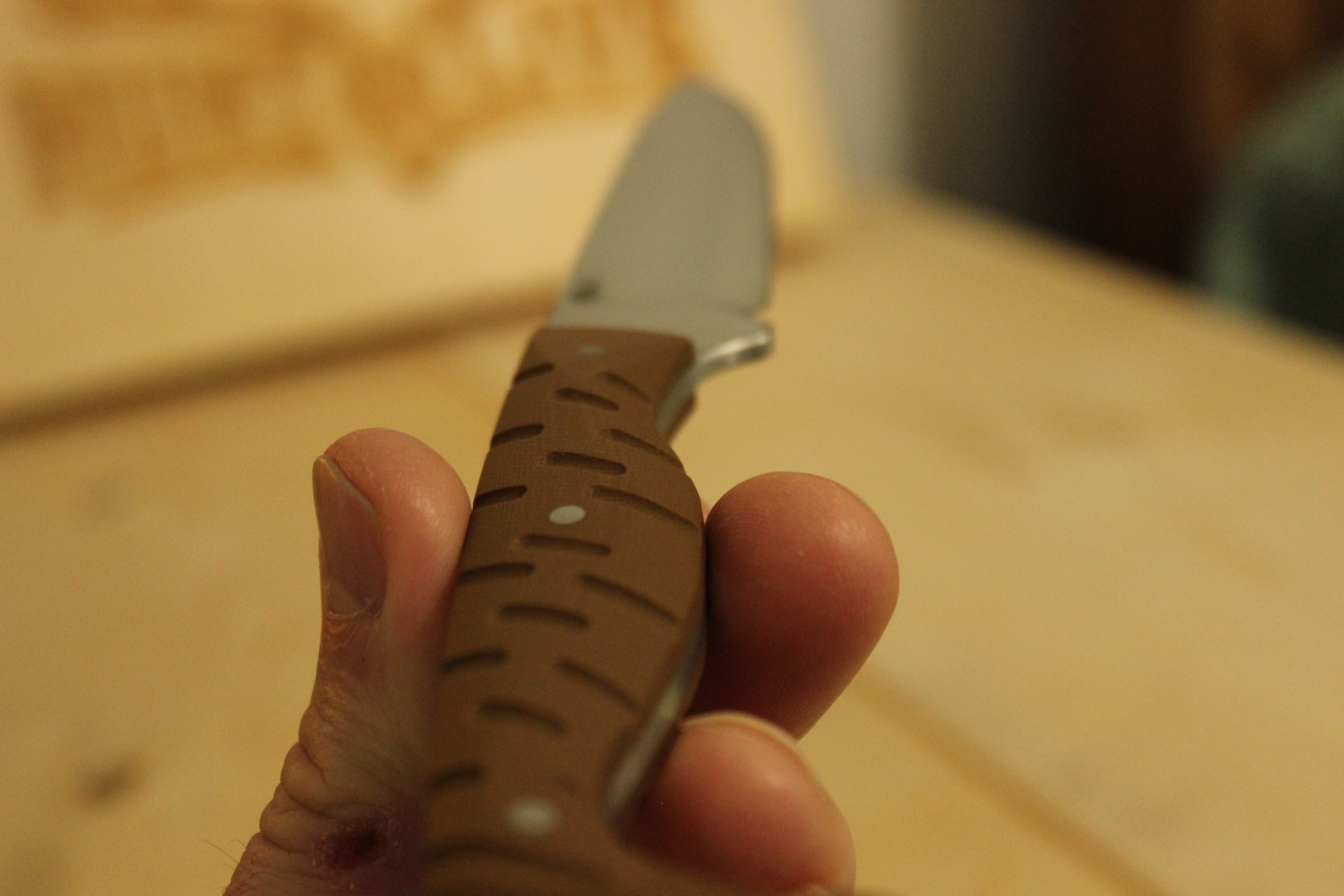
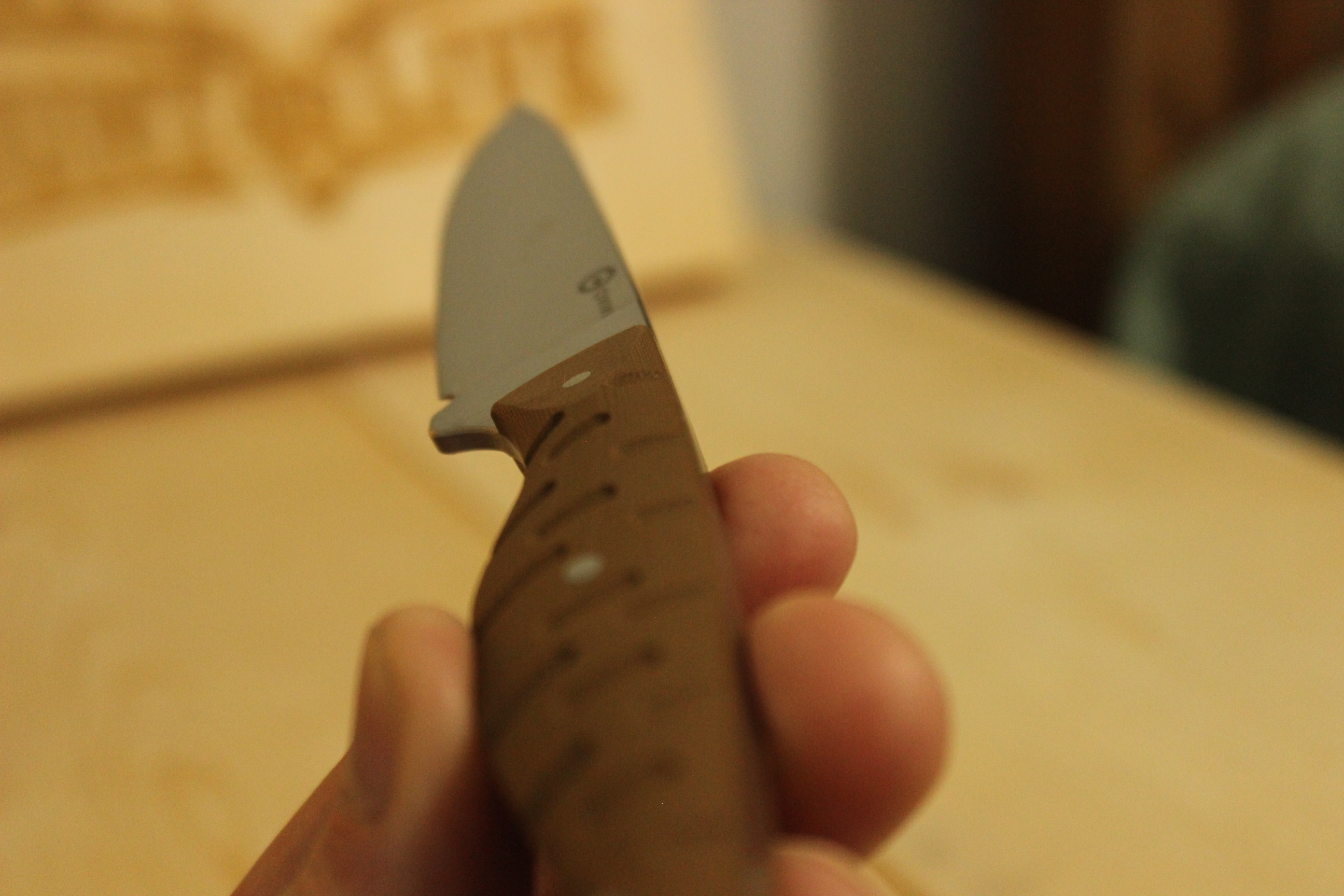
In a saber grip — thumb on the spine, blade extended — the deep horizontal finger grooves on the obverse scale are spaced to catch the second knuckles of the middle, ring, and pinky fingers. The peel-ply G10 texture runs continuous across the grip with no untextured pad. The flared pommel sits behind the meat of the palm without driving into it, and the swept hook reads as a thumb-stop in extension when the user chokes up against the choil.
The handle is symmetric obverse-to-reverse — the same texture and groove pattern on both sides — which means it works left-handed as well as right-handed. Subtle, but important.
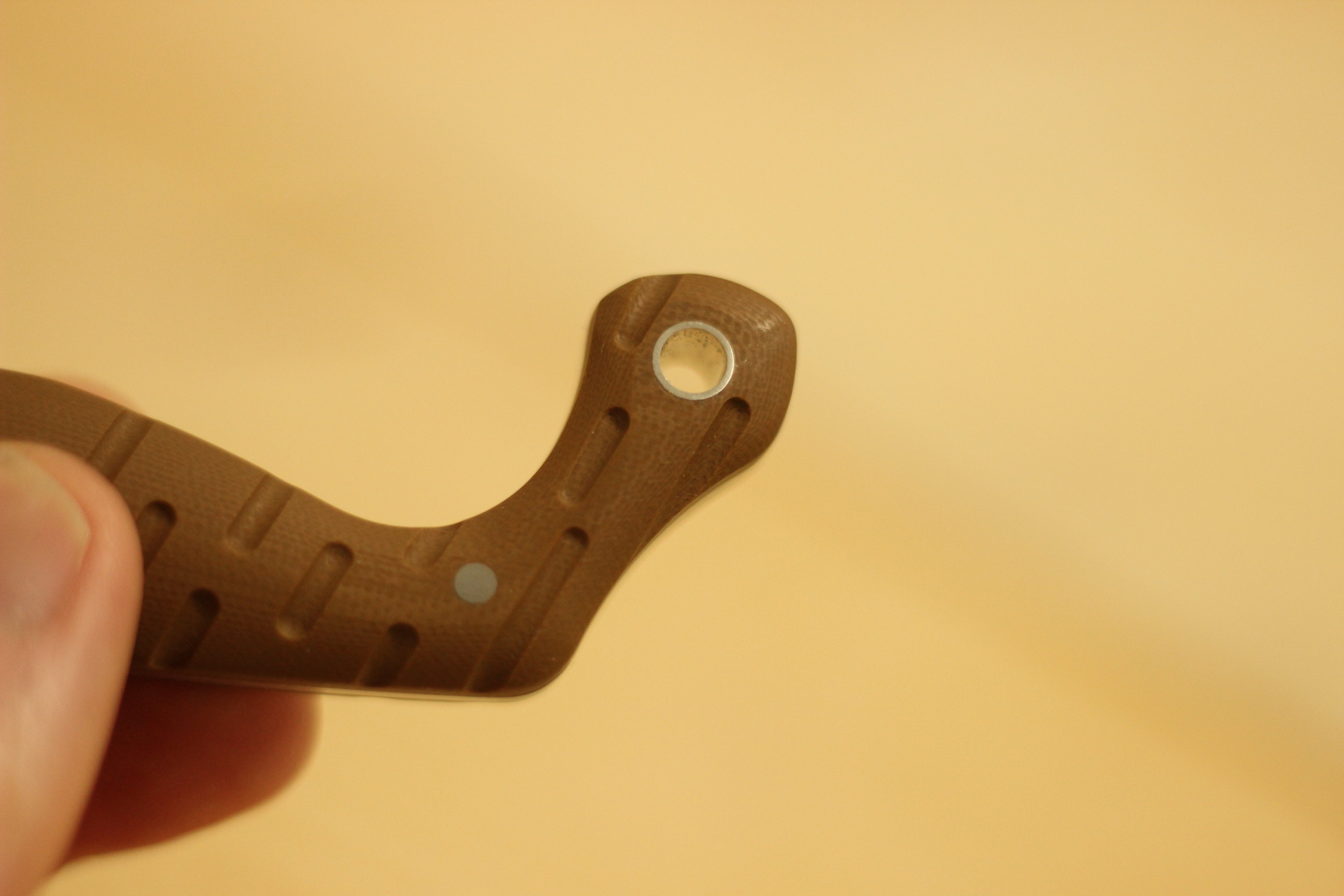
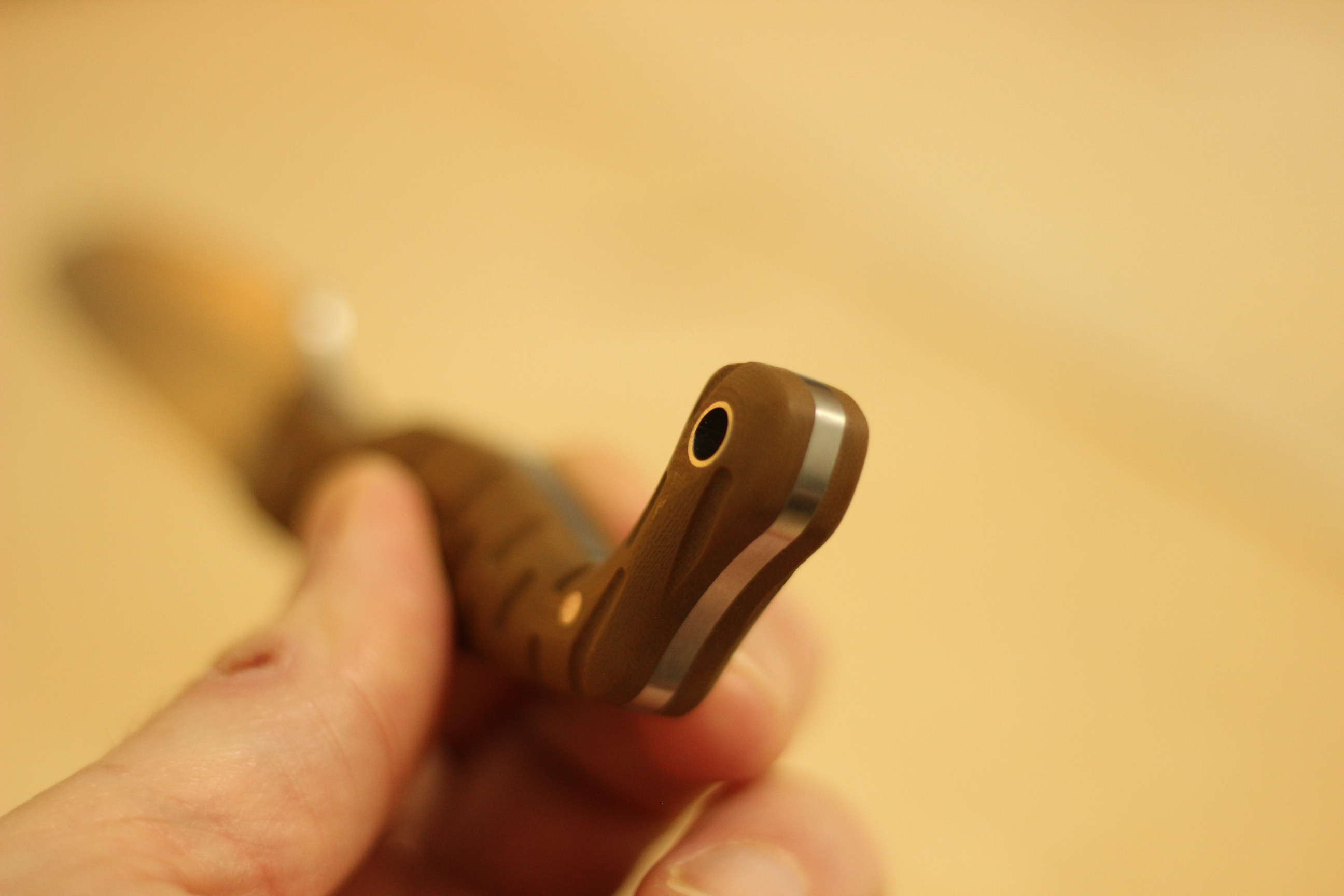
The exposed pommel tang is the design detail that gives away Lamb’s combat background. Most dedicated hunting knives finish the pommel flush with the scales, prioritising looks and snag-free draw. The MDRN Hunter exposes a small flat of bare steel at the rearmost point of the tang — usable as a glass-breaker, an emergency striker, or a hard-impact tool. It’s a duty-knife detail that survives in this hunter design, and it’s the kind of thing you don’t notice until you need it. It does mean the pommel will mark a leather sheath over time if you ever retrofit one, but for the included kydex it’s a non-issue.
Edge Geometry — What the Design Suggests
This review is editorial, not a field test — no animal was harvested for this piece. What that means is we read the edge against the tasks the geometry was designed for and report on what the geometry suggests, without inventing a deer-camp anecdote. The compound bevel terminates at an angle consistent with the modern Western hunting-knife profile (Benchmade Steep Country, Bark River Gunny) — geometry documented in those category siblings to slice cleanly through skin and intermuscular tissue without binding. The 0.12-inch spine reads as a working-square edge — not sharpened-90, but square enough to be a deliberate ferro-rod striker if the user wants to dress the corner with a file.
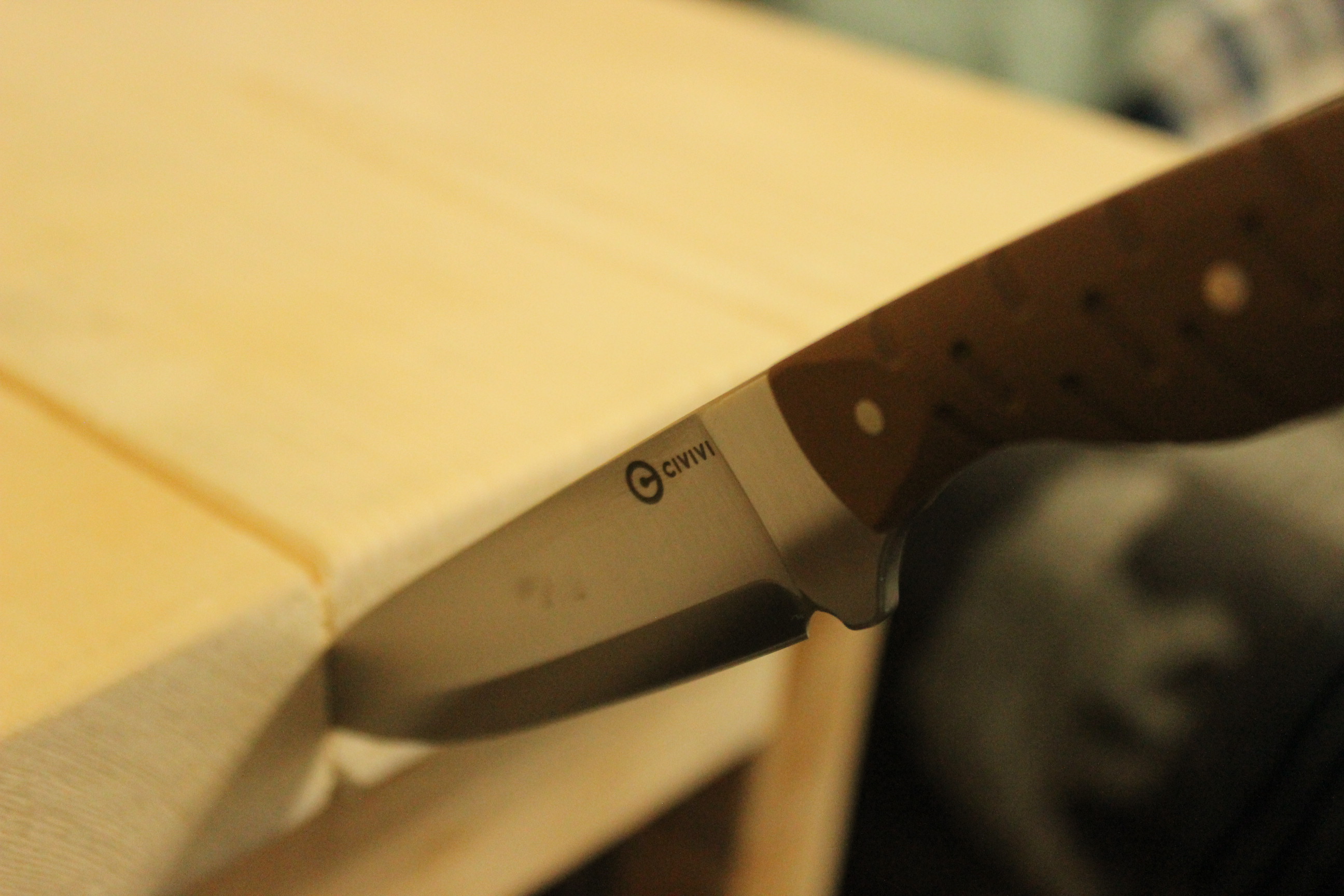
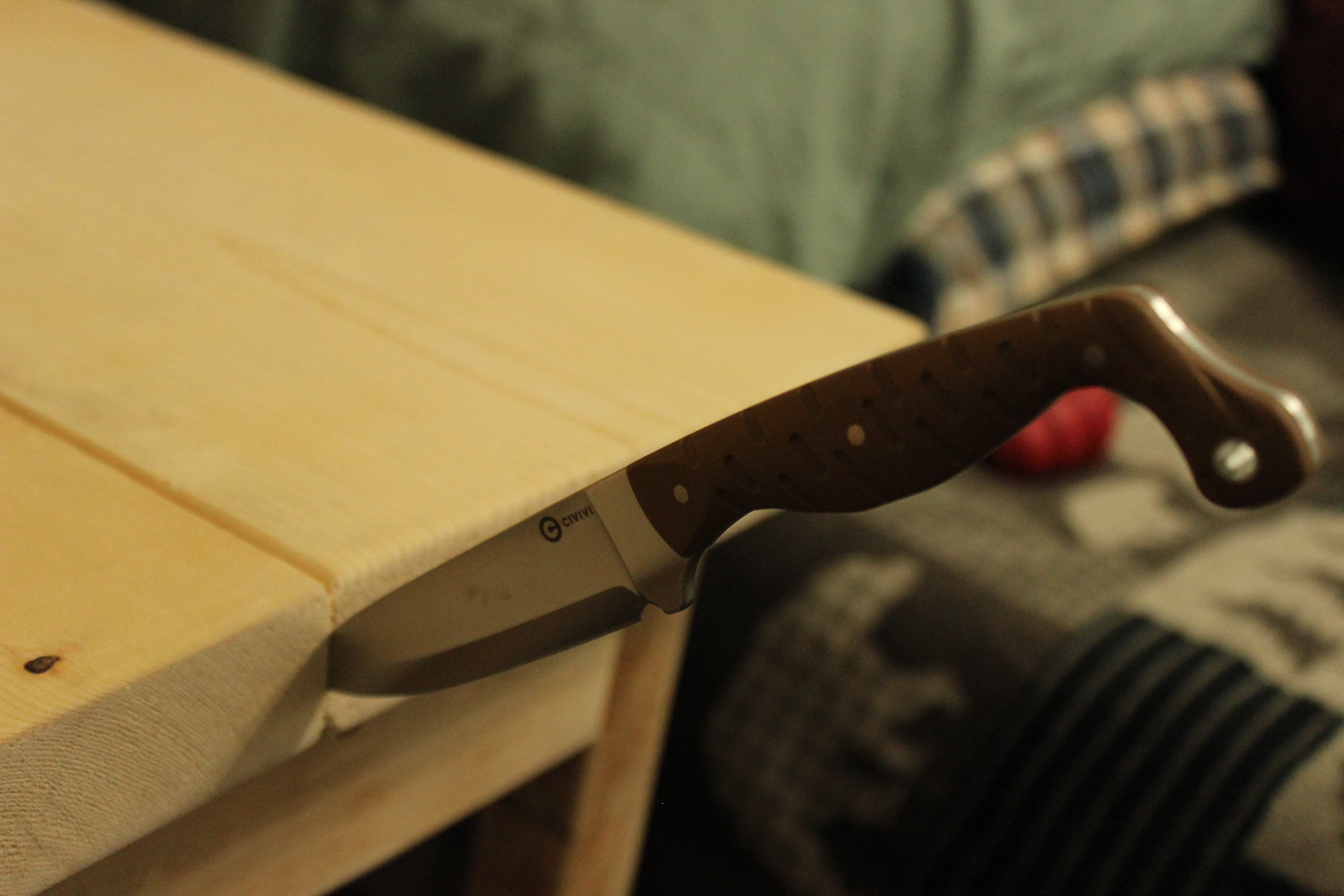
The geometry that matters most is about control. Because the cutting edge is 3.62 inches (shorter than the full 4.12 inches of blade — the choil eats some of it), and because the handle drops the hand low relative to the cutting line, the working sweet spot reads as the centre 2/3 of the edge. The forward third near the tip stays high enough above the work surface for cape and detail work; the rear third near the choil sits low enough for committed slicing. The handle drop suggests the blade rolls into a deep cut with very little wrist motion — which is the geometry typically wanted for separating hide from membrane along a flank.
The 0.12-inch / 3 mm spine is in the range where dry-kindling batoning on smaller rounds is within the design envelope, though Civivi positions the MDRN Hunter as a hunter, not a bushcraft tool. Nitro-V at 59–61 HRC is documented to resist edge roll on impact loads consistent with that envelope. It is not a Bark River Bravo, and it isn’t designed to be — it’s a hunter scoped to survive light bushcraft, not a bushcraft tool with a hunting edge.
The Kydex Sheath and Carry System
The kydex sheath is well-made for the price point. It’s a folded-and-riveted single piece of black kydex with the rivets running down the spine side, an exposed choil window at the throat so the index finger can break retention cleanly during draw, and three pairs of paired holes on each carrier-rail flat — the standard MOLLE-pattern hole spacing for clip-on hardware. The sheath ships with two pre-installed black polymer carrier straps that wrap around the sheath, secure through the side holes, and clip with a button-snap onto a belt up to about 1.75 inches wide. The clip arrangement is essentially the same pattern as a MOLLE-compatible holster — and indeed the straps will pass through 1-inch PALS webbing on a vest or pack panel.
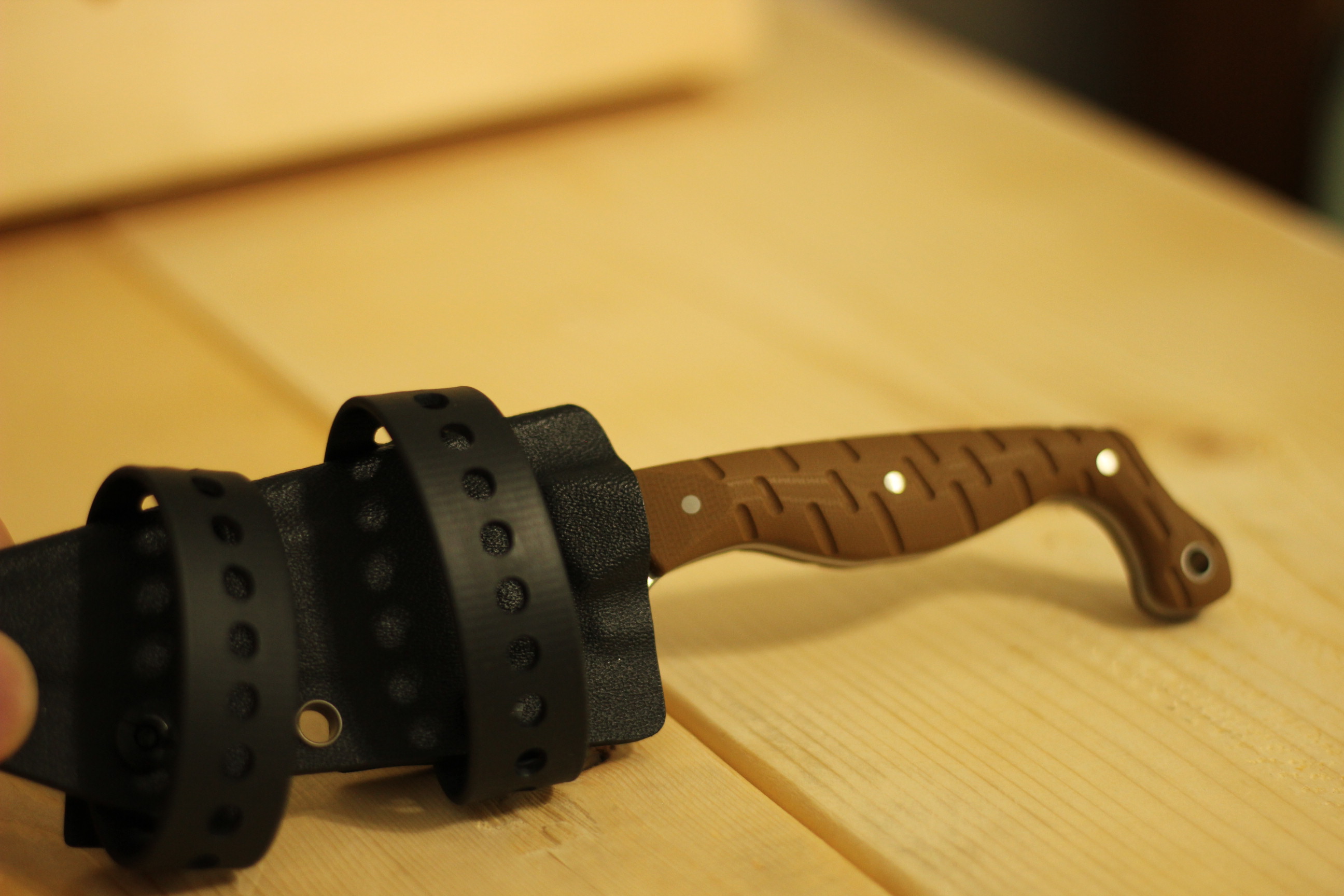
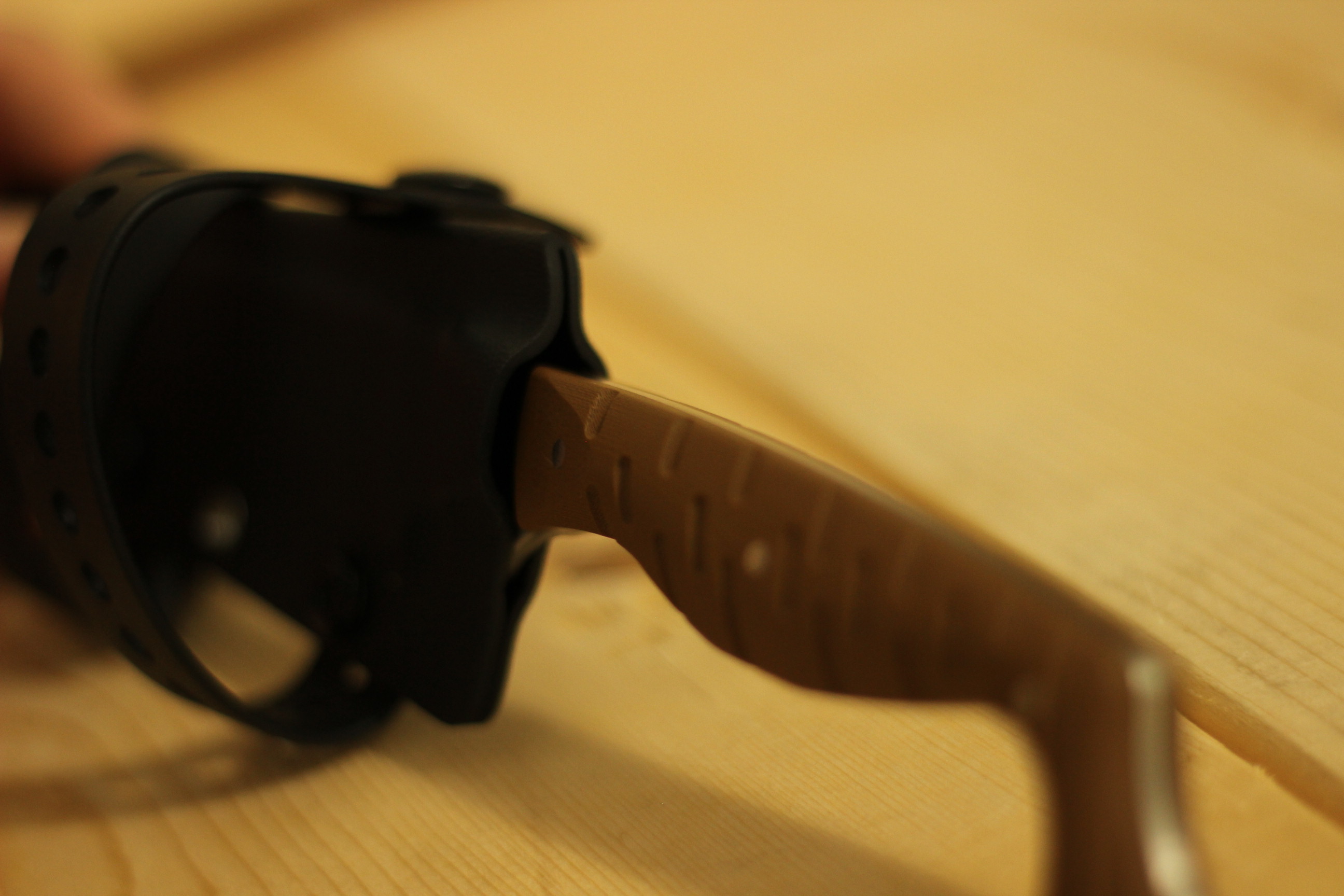
The two-strap MOLLE-style carrier is genuinely versatile. You can wear the knife on a belt, on a pack strap, on a hunting-vest PALS panel, or threaded through an external loop on a chest rig. What you can’t do — and this is the honest trade-off — is wear it scout-carry across the chest, horizontally on the belt, or as a dangler under a jacket. There’s no second carry adapter in the box and no Civivi-sold accessory yet. If you want a soft leather sheath, a dangler clip, or a Tek-Lok ulti-mount, you’re either buying a third-party kydex maker’s adapter or you’re modifying the sheath yourself by drilling new rivet holes.
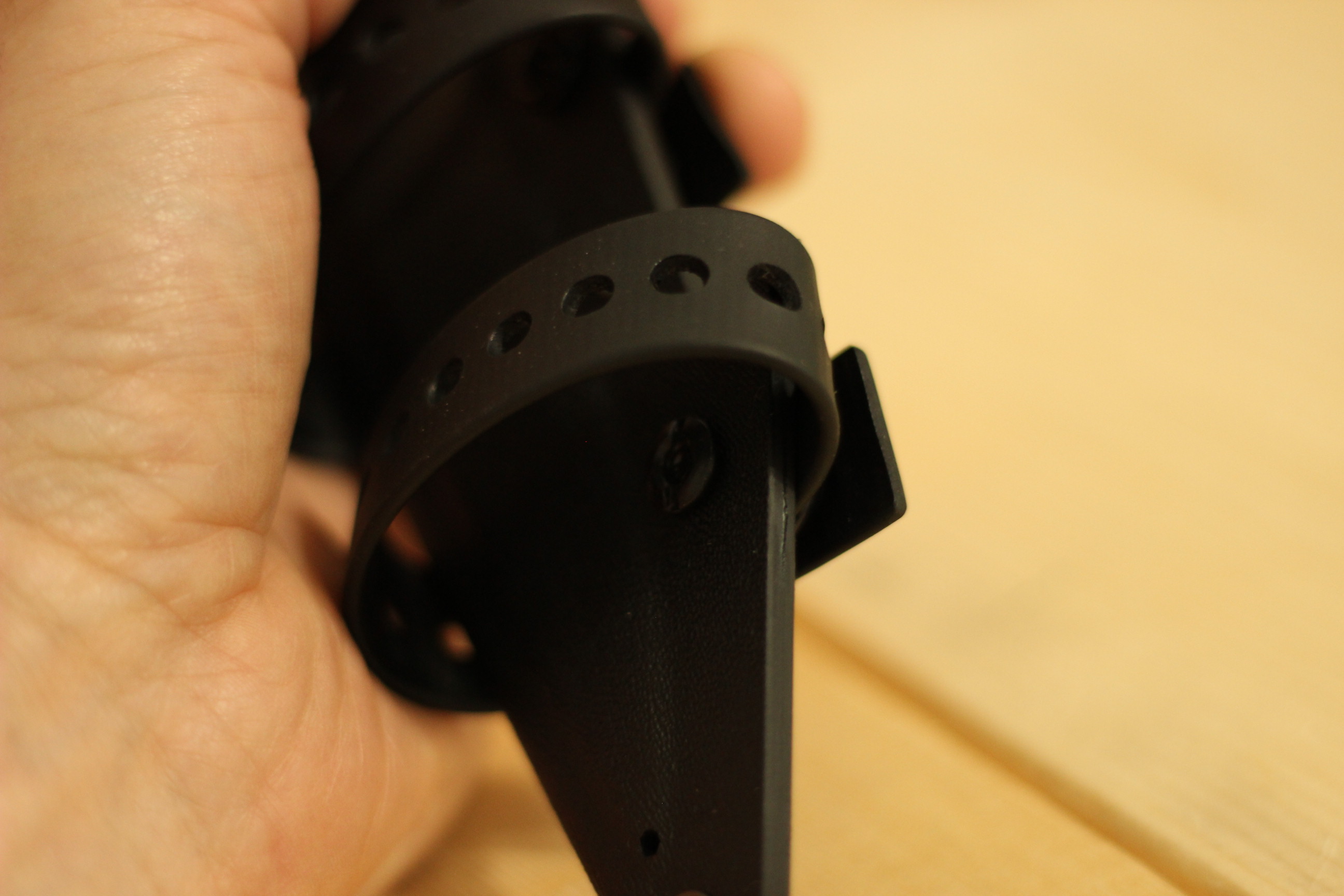
For a deer-camp hunter who wants to wear the knife on a belt under a hunting jacket or on a pack strap during the haul, the included carrier system is enough. For an EDC fixed-blade enthusiast who wants three different carry positions or a leather pancake sheath option, the MDRN Hunter will require aftermarket work. That’s the half-star deduction, candidly. The geometry of the knife is fully there; the carry options out of the box are not.
Strop, Sharpen, Maintain — What Nitro-V Asks For
Nitro-V is documented as a forgiving steel to maintain. It’s not a super-steel (the way M390 or CPM-S90V are), so it doesn’t require expensive diamond abrasives to dress an edge, and it doesn’t fight a softer Arkansas stone. A typical maintenance pass for a Nitro-V hunting blade is a 1000-grit ceramic pass, a 3000-grit ceramic finish, and a brief leather strop with green compound — the sort of routine documented across the mid-stainless category. For lighter touch-ups, a single leather strop with green compound is the conventional approach.
The factory edge on this unit arrives slicing cleanly along the full 3.62-inch cutting edge — paper-cut and shaving-tier sharpness is what Civivi advertises and what their factory-edge reputation has been built on. Edge geometry reads symmetric — the bevel widths are consistent obverse to reverse under angled light. Civivi’s QC at this price point is well-regarded in the production-knife community.
The G10 scales are formulated to clean up easily after blood, fat, and field grime. A warm-water rinse and a soft-bristle brush is the standard approach for the material; for stubborn debris wedged in the deep finger grooves, a stiff toothbrush and dish soap will lift it without damaging the peel-ply texture. G10 itself is essentially impervious — it won’t swell, won’t rot, won’t soak up odours the way wood handles do. The stainless pins won’t rust. Nitro-V’s stainless content places it comfortably in the corrosion-resistant tier — it’s not immune, and the manufacturer-standard recommendation of wiping dry before sheathing applies here as on any stainless hunting blade.
Cross-Shop — What You’re Actually Choosing Between
This is the section that matters most for a buyer at the $80–$200 price point. The MDRN Hunter does not exist in a vacuum. Here’s the honest competitive accounting.
Buck Vanguard ($120–$140, USA, 420HC, walnut) — the traditional sentimental favourite. Slightly longer blade (4.125 in), forged guard, walnut scales, leather sheath. Lighter on modern materials, heavier on heritage. If you want the deer-camp classic look and you don’t care about kydex or G10, the Vanguard is your knife. The MDRN Hunter is more modern in every materials dimension and lighter in the hand.
Buck 663 Alpha Guide ($229, USA, S35VN, G10) — the modern Buck flagship. S35VN is genuinely a tier above Nitro-V on edge retention. USA-made (Post Falls, Idaho). 4.5-inch blade. Better steel, better country-of-origin story, kydex sheath included. The trade-off is $140 of price difference. If you want USA-made and premium steel, the Buck 663 Alpha Guide is the knife. If you want 80% of the geometry and finish at 38% of the price, the MDRN Hunter is the knife.
Benchmade Steep Country ($200, USA, S30V, Santoprene) — the textbook modern American hunter. S30V steel, full flat grind, USA-made, leather sheath, lifetime LifeSharp service. Thinner blade stock (0.097 in) — more of a dedicated game-prep specialist, less of a do-everything hunter. If you want the Benchmade name and Santoprene grip, this is the knife. The MDRN Hunter is more versatile in scope and dramatically less expensive.
ESEE-3 ($120–$160, USA, 1095, micarta) — the bushcraft-bias hunter. 1095 high-carbon steel (not stainless — will need active rust prevention), thicker stock (0.16 in), micarta scales, kydex sheath. The MDRN Hunter is the better dedicated hunter; the ESEE-3 is the better bushcraft knife. Different missions.
Bark River Bravo Necker ($200+, USA, A2, micarta) — the convex-grind bushcraft purist. Hand-finished in Michigan, true convex grind, lifetime warranty. The MDRN Hunter doesn’t try to compete here — different category. The Bravo Necker is a craft tool; the MDRN Hunter is a working production tool.
Helle Bleja ($180, Norway, Sandvik 12C27, curly birch) — the Scandi-traditional hunter. Curly birch handle, leather sheath, scandi grind. Beautiful object. The MDRN Hunter is its modern-materials antithesis — synthetic everything, kydex, compound grind. Buy on aesthetic preference.
Falkkniven F1 Pro ($240, Sweden, CoS, thermorun) — the laminated-blade survival hunter. The most serious in this list. The MDRN Hunter is not a Falkkniven and isn’t trying to be.
Spyderco Province ($240, Italy, CPM-S30V, G10) — the modern premium hunter at the $240 price point. CPM-S30V steel and Maniago, Italy manufacture put it in a different tier — but if you can’t justify the spend, the MDRN Hunter delivers 80% of the spec sheet at 36% of the price.
The honest read: the MDRN Hunter is the best-value knife in this list. It’s not the best knife on this list. The Buck 663, Benchmade Steep Country, and Spyderco Province are all genuinely better knives — and they cost two to three times as much, with USA / Italy / Sweden origin stories the MDRN Hunter cannot match. If your budget is open-ended, you should buy the Buck 663 Alpha Guide and call this category closed. If your budget caps at $100 and you want a serious knife with intentional geometry and a designer pedigree, the MDRN Hunter is the answer.
What Earned the 4.5
Let’s be specific about why this knife earned 4.5 stars and not five.
The 4.5 is earned on the strength of the design itself. Kyle Lamb’s geometry is coherent — the compound grind, the choil, the handle shape with its swept pommel, the proportion of blade to handle. The Nitro-V steel at 59–61 HRC is the correct steel for the price. The kydex sheath retention is firm. The G10 finish quality is clean. The factory edge ships shaving-sharp, consistent with Civivi’s documented out-of-box edge reputation. The price-to-spec ratio is genuinely under-priced for the category.
The 4.5 also reflects a knife that is thoughtfully engineered. Nothing on it is gimmick. The exposed pommel tang is a duty-knife detail that survives in a hunter and earns its place. The steel-lined lanyard hole isn’t decorative. The peel-ply G10 texture isn’t cosmetic — it’s the actual working grip. The MOLLE-compatible kydex carrier straps aren’t tacticool — they’re the most versatile carry system in their weight class. Every feature is useful.
Where the Half-Star Came Off
Three honest deductions.
Country of origin. Civivi is a We Knife Co. sub-brand, and We Knife manufactures in Yangjiang, China. The QC is genuinely good and consistent — Civivi has built a reputation over the past five years for production-tier knives that punch above their price — but it is not USA-made, Sweden-made, Italy-made, or Norway-made. For buyers who specifically want a Western-made hunter, the MDRN Hunter is the wrong knife regardless of how well-designed it is. The Buck 663 Alpha Guide ($229 USD, USA), Benchmade Steep Country ($200 USD, USA), or Spyderco Province ($240 USD, Italy) all exist for a reason.
Sheath carry options. Two carrier straps in one configuration is the only out-of-box option. No scout carry, no leather dangler, no horizontal Tek-Lok adapter, no second sheath included for chest carry. For the kind of buyer who’s comparing this against a Buck 663 — which ships with a USA-made leather sheath — the difference matters.
Compound grind maintenance. A compound grind takes a finer edge than a full flat or scandi but is harder to maintain freehand. Touch-ups with a simple steel won’t restore the dual-bevel geometry — the risk is rolling the edge over and losing the fine cutting angle. Buyers comfortable with a Worksharp Precision Adjust or a Wicked Edge will find this profile rewarding; buyers used to a Spyderco Sharpmaker and nothing else will find it slightly fussier than a Mora.
That’s it. Three trade-offs, all honest, all visible from the spec sheet and the photographs. Nothing about this knife is hidden.
The Designer Pedigree, Revisited
The interesting thing about a Kyle Lamb hunter is how restrained it is. Lamb’s previous fixed-blade collaborations — the Halfbreed Blades MIK series, the early Spartan projects — have all been aggressive, blackened, tactical-looking knives. The MDRN Hunter is none of those things. It’s a satin-finished, warm-brown-handled, hunting-profile blade that looks like a hunter and feels like a hunter. The only Lamb-isms that survive are the exposed pommel tang, the swept-hook pommel curve, and the deeply machined handle texture — and all three are functional, not aesthetic.
That’s what makes it interesting editorially. It’s a designer who could have leaned into his brand reputation and produced a black-coated, drop-point survival knife with VTAC stamped across the spine. He didn’t. He produced a hunter. And the hunter is good.
The Honest Verdict
The Civivi MDRN Hunter C23078-2 is the best-designed $86 hunting knife on the market in 2026. At full MSRP — $115 USD — it’s still the strongest knife in its price band, and there’s nothing in the $100–$150 range that competes on design pedigree, blade geometry, steel choice, or fit and finish. The Kyle Lamb collaboration is real and matters — the geometry is genuinely a hunter’s geometry, not a tactical knife in costume — and the Civivi manufacturing arm has executed it well enough that the knife reads as a serious working tool, not a budget compromise.
It is not a $230 knife. It does not displace the Buck 663 Alpha Guide, the Benchmade Steep Country, the Spyderco Province, or the Bark River Bravo from their place in the premium tier. It’s a knife that delivers most of what those knives deliver, at less than half their price, with the trade-off being country of origin and the absence of multi-mode sheath carry.
If your budget is $100 and you want a working hunter that’s designed, sharp, ergonomic, and properly equipped with a kydex sheath, this is the answer. If your budget is $200+ and you want a Western-made knife with a multi-carry sheath, buy the Buck 663 or the Benchmade Steep Country and don’t look back.
4.5 / 5.
Where to buy:
- Civivi MDRN Hunter C23078-2 (Brown G10, Kydex) — $86.25 USD (sale, MSRP $115). Direct from Civivi.com, ships to Canada via standard international, satisfaction-guaranteed 30-day return policy.