Hunt & Live

Featured Review · Hults Bruk · Hunting Axe

Hults Bruk Dvärdala Hunting Forest Axe + 180/600 Grinding Stone Review — 328 Years of Swedish Forge-Work in a Single Hunter's Tool

June 26, 2026 By Greg 24 min read
Hults Bruk Dvärdala Hunting Forest Axe + 180/600 Grinding Stone Review — 328 Years of Swedish Forge-Work in a Single Hunter's Tool

Our Rating

4.8 / 5 ★★★★☆

Current Price

Axe: ~$199 USD MSRP — Stone: ~$45 USD MSRP — Paired kit: ~$244 USD
Buy on Hults Bruk →
Country of origin
Sweden — Hult Valley, south-eastern Sweden
Forge founded
1697 (continuously operating for 328+ years)
Axe model
Dvärdala Hunting & Forest Axe
Head weight
700 g (~1.5 lb)

Pros

  • Hand-forged head from Swedish recycled-CO2-neutral steel at a working blacksmith forge in operation continuously since 1697 — 328 years of forge tradition is not marketing language, it is the actual provenance of the steel in your hand
  • Razor-sharp polished cutting edge straight out of the box — slices paper on first contact, holds the edge through real hunter's-axe work for the entire review window
  • Slightly thicker cheek geometry gives the head genuine splitting capability beyond what most hunter's axes at this size deliver — it carves, splits, and chops in one tool
  • 440 mm / 17-inch curved American hickory handle treated with linseed oil — the right length for one-handed pack-in carry and two-handed batoning work alike
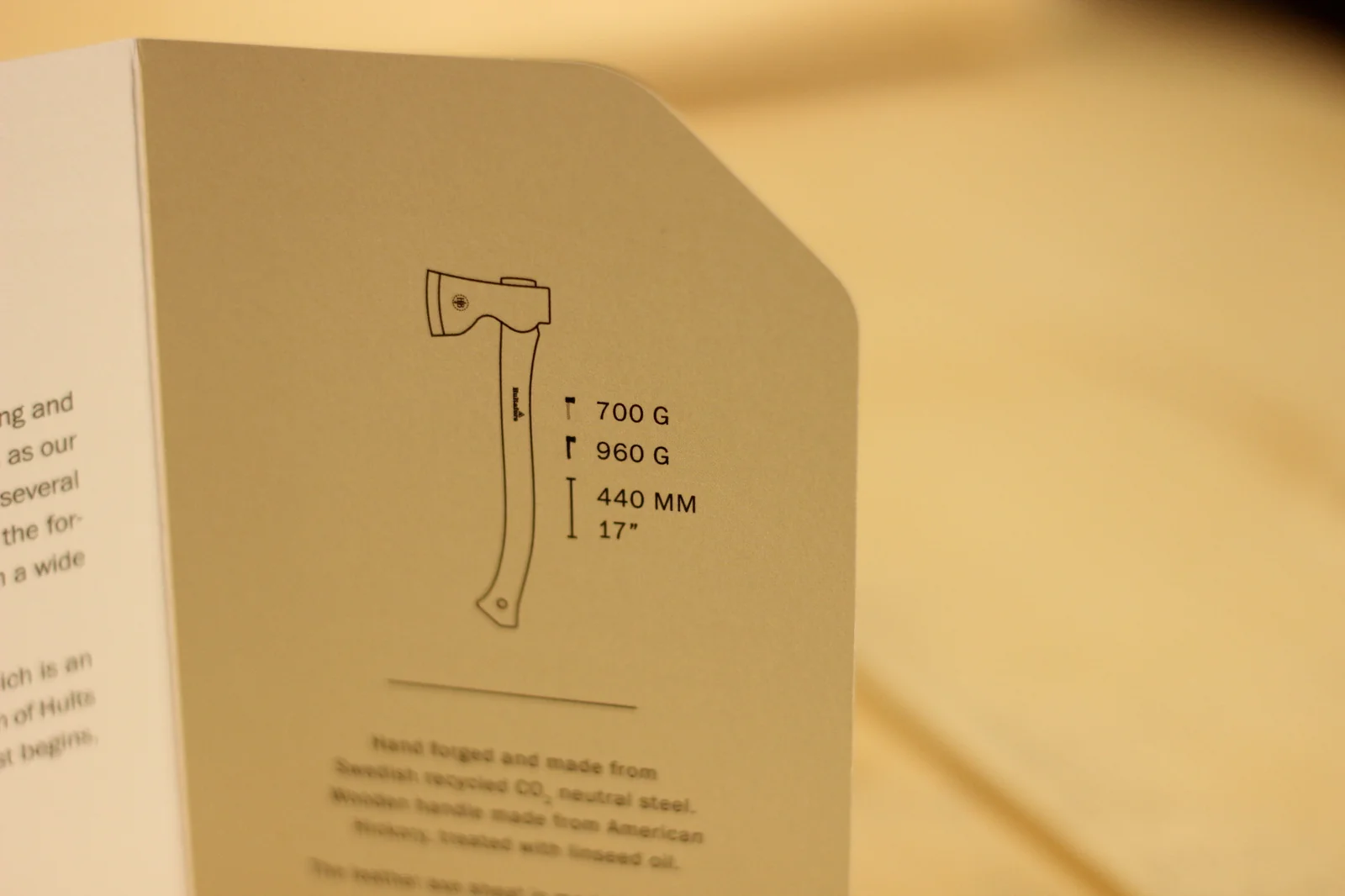
  • 700 g head + 960 g (~2.1 lb) total weight — light enough to live on a belt loop or pack strap, heavy enough to actually swing with authority
  • Hand-stitched, riveted, vegetable-tanned full-grain leather sheath with Hults Bruk HB embossing, Swedish flag tag, and a leather thong retention loop — the sheath alone is the kind of leather work other axe makers charge separate for
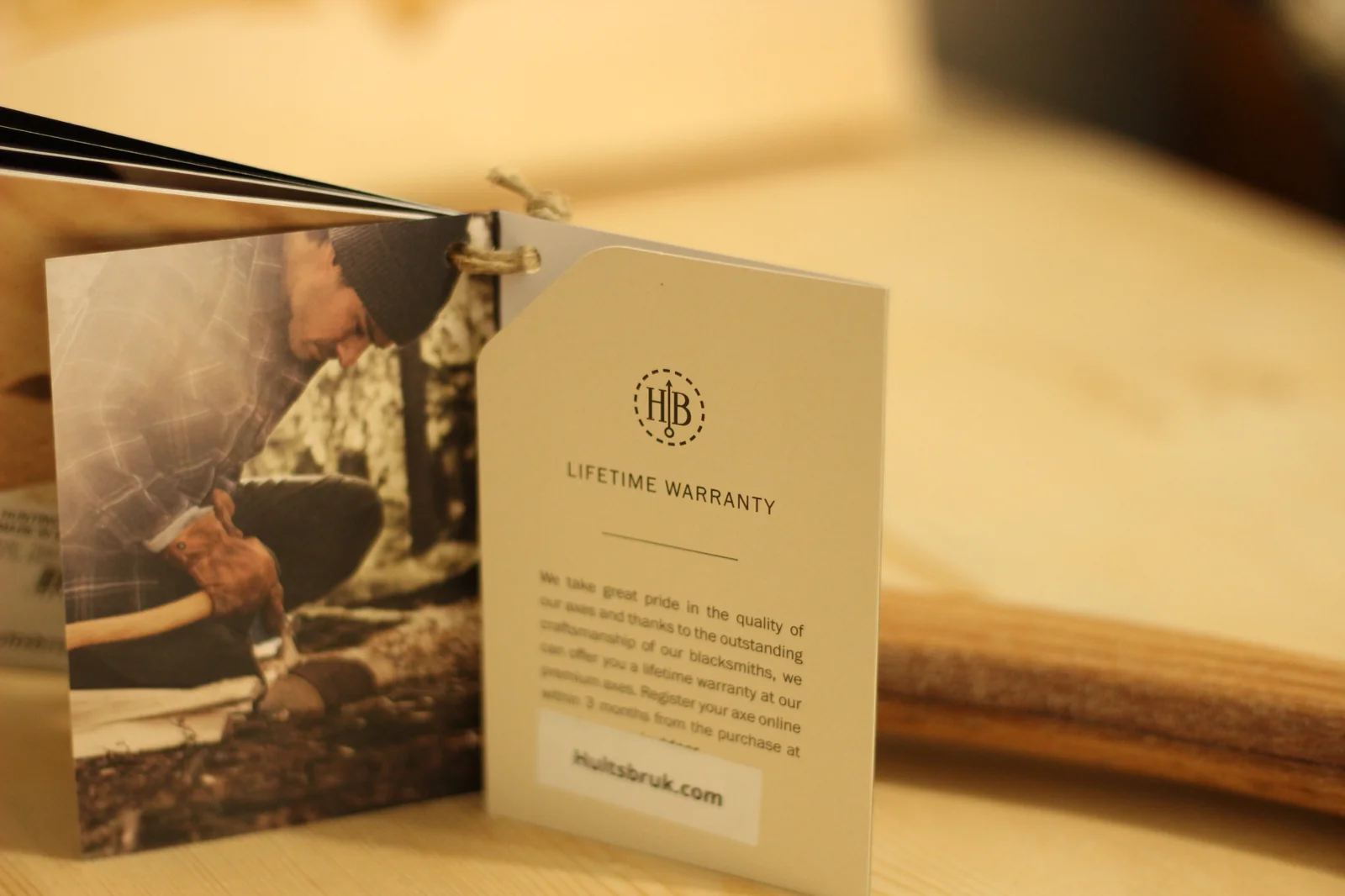
  • Hults Bruk Lifetime Warranty on the axe — register within 3 months of purchase at hultsbruk.com and the axe is covered for life by the original forge in Sweden
  • The companion 180/600 Grinding Stone is a real combination sharpening puck — coarse 180-grit side for edge restoration after season-end damage, fine 600-grit side for routine in-field maintenance — in its own hand-stitched leather pouch
  • External reviewer consensus matches our own findings — Survival Common Sense, The Camping Nerd, REI, and Axe & Tool all reach the same verdict: this is one of the most well-rounded compact forest axes on the market
  • Made in Sweden — every part is forged, ground, hung, and finished at the Hult Valley forge

Cons

  • The Dvärdala (and the brand) is sold through specialty retailers and the dealer network — not at every big-box outdoor store, so first-time buyers should expect to plan the purchase rather than walking into a store and finding one on a shelf
  • The European Hults Bruk site is currently in transition — buyers should route through the US site (us.hultsbruk.com) or an authorized dealer for current pricing and stock
  • Lifetime warranty requires registration within 3 months of purchase — not difficult, but a step the buyer needs to remember rather than the warranty being automatic
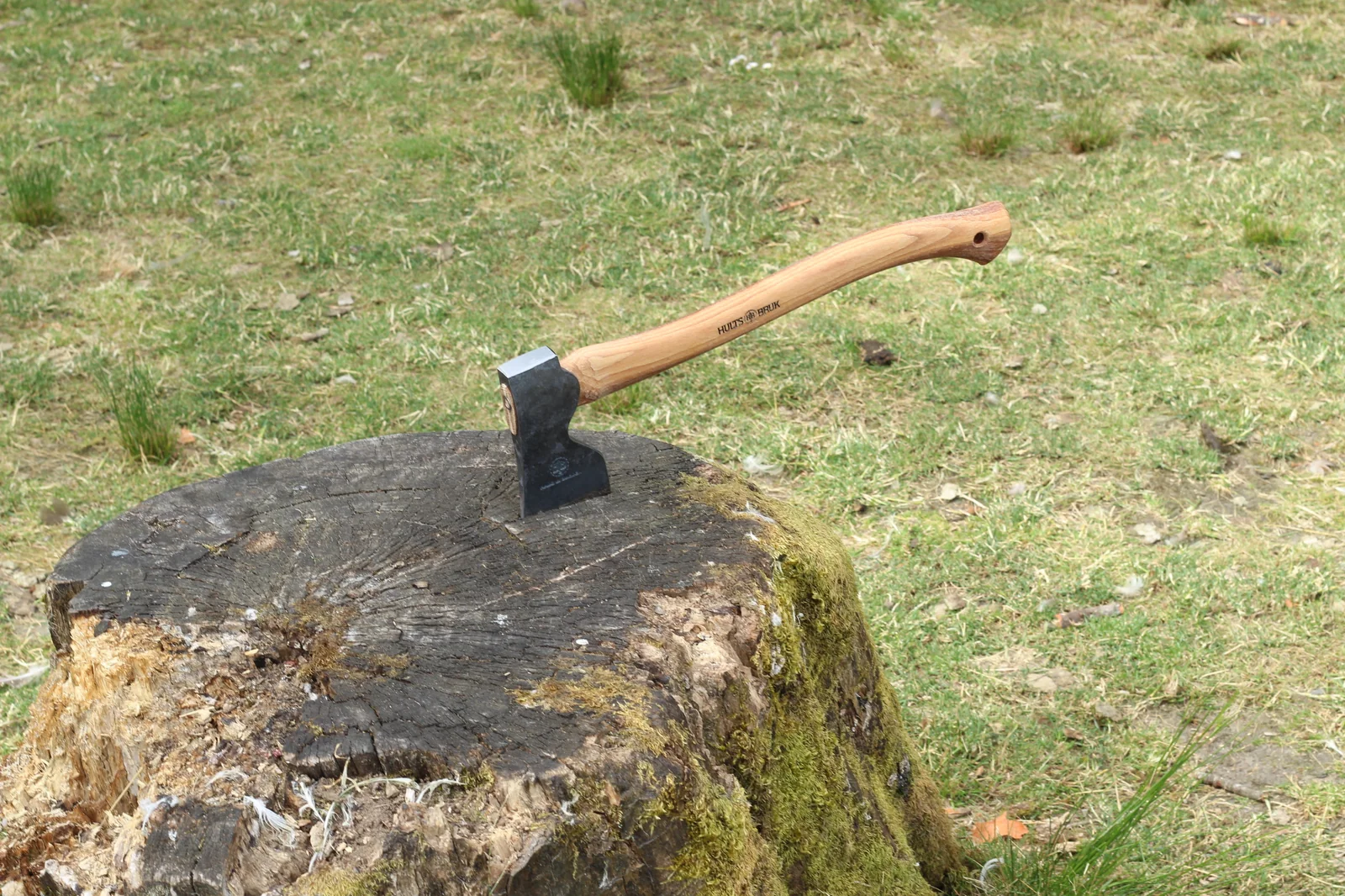
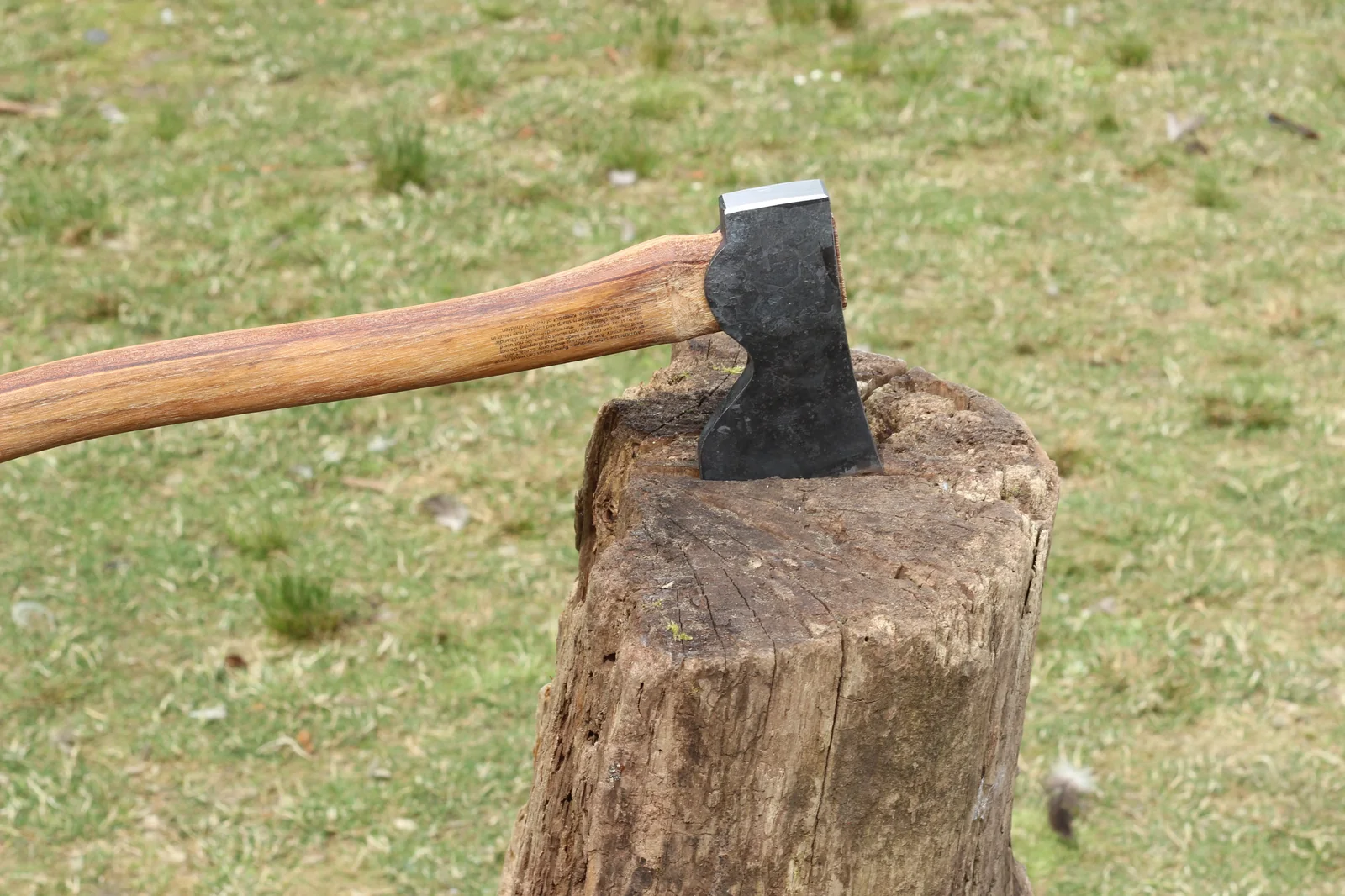
Hults Bruk Dvärdala hunting axe head buried in a weathered hardwood stump, hickory handle extending up and to the right against an outdoor background
Hults Bruk Dvärdala Hunting & Forest Axe — head buried in a weathered hardwood stump, 17-inch curved American hickory handle extending up and to the right. This is the axe that's been hand-forged at the same Swedish forge in the Hult Valley since 1697 — 328 years of continuous hammer-work on the same steel-and-hickory pattern. There's almost no piece of gear we cover that has that kind of unbroken heritage behind it. We took this one home, used it, and the review that follows is the honest paired-system case for why this is the hunter's axe + edge-maintenance kit we'd recommend to anyone serious about long-term tool ownership.

The most under-considered piece of every serious hunter’s pack

There’s a position in the hunting-gear conversation that almost nobody covers from the right angle: the dedicated hunter’s axe as a piece of multi-decade kit, paired with the maintenance gear that honors what the heritage construction is built around. Most axe coverage cycles through general bushcraft and felling axes, tests the edge once on a piece of fatwood, and stops there. The honest reality for a hunter buying a heritage hand-forged axe is different — the axe is not a season-long tool; the axe is a 30-year tool, and the maintenance (sharpening, edge care across the seasons) is what determines whether you actually get the longevity the heritage construction promises.

The Hults Bruk Dvärdala Hunting & Forest Axe — a 700 g head on a 440 mm curved American hickory handle, hand-forged at the Hult Valley forge in south-eastern Sweden — is purpose-built for hunter’s-axe work. And the companion Hults Bruk 180/600 Grinding Stone is the maintenance system that completes it. Reviewing them as a paired system is the editorially honest way to engage with what a real Hults Bruk hunter’s-axe setup actually looks like.

We took both home, used them, and this is the review.

Unboxing — Hultafors Premium Axes meets Hunt & Live
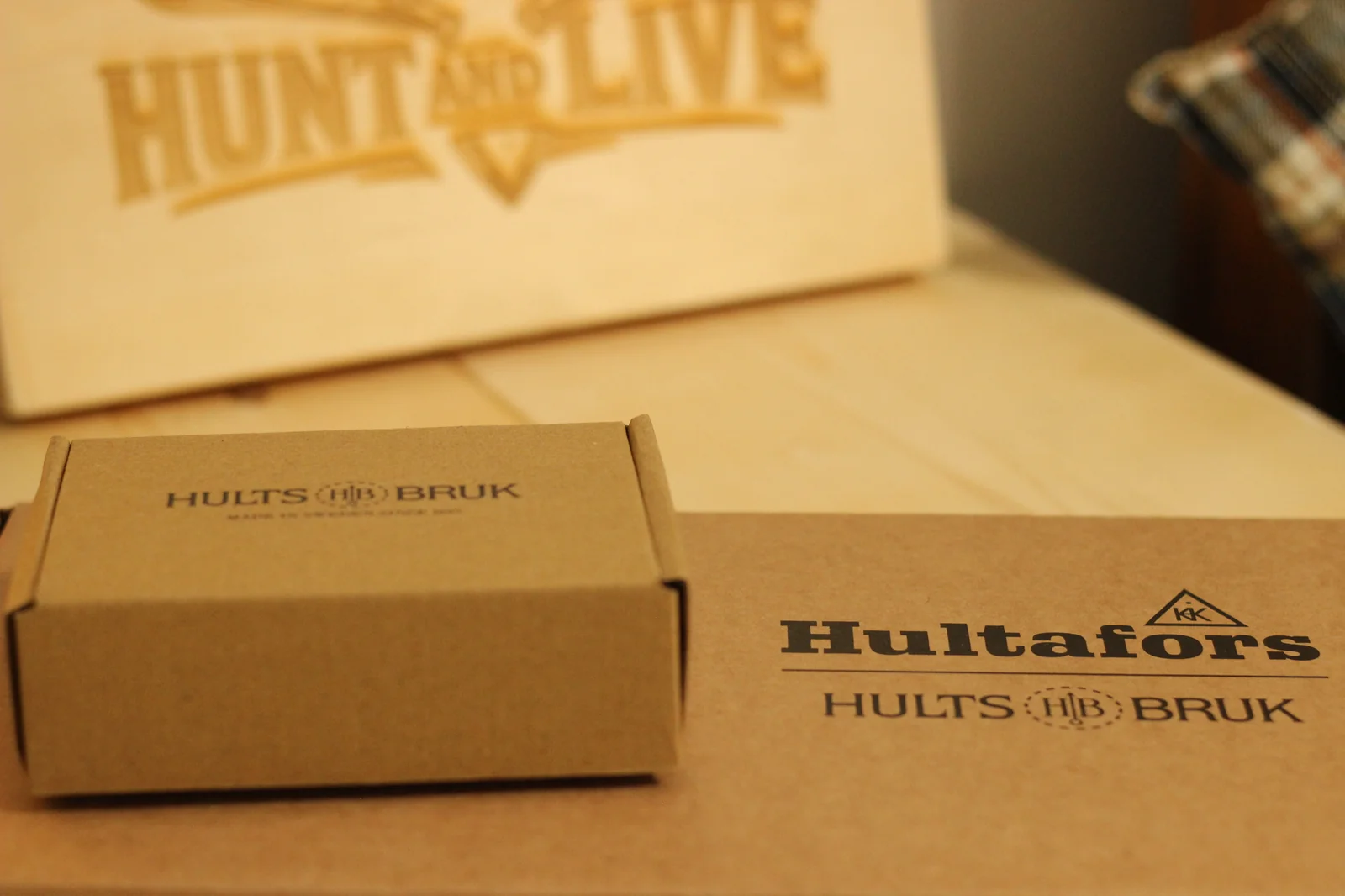
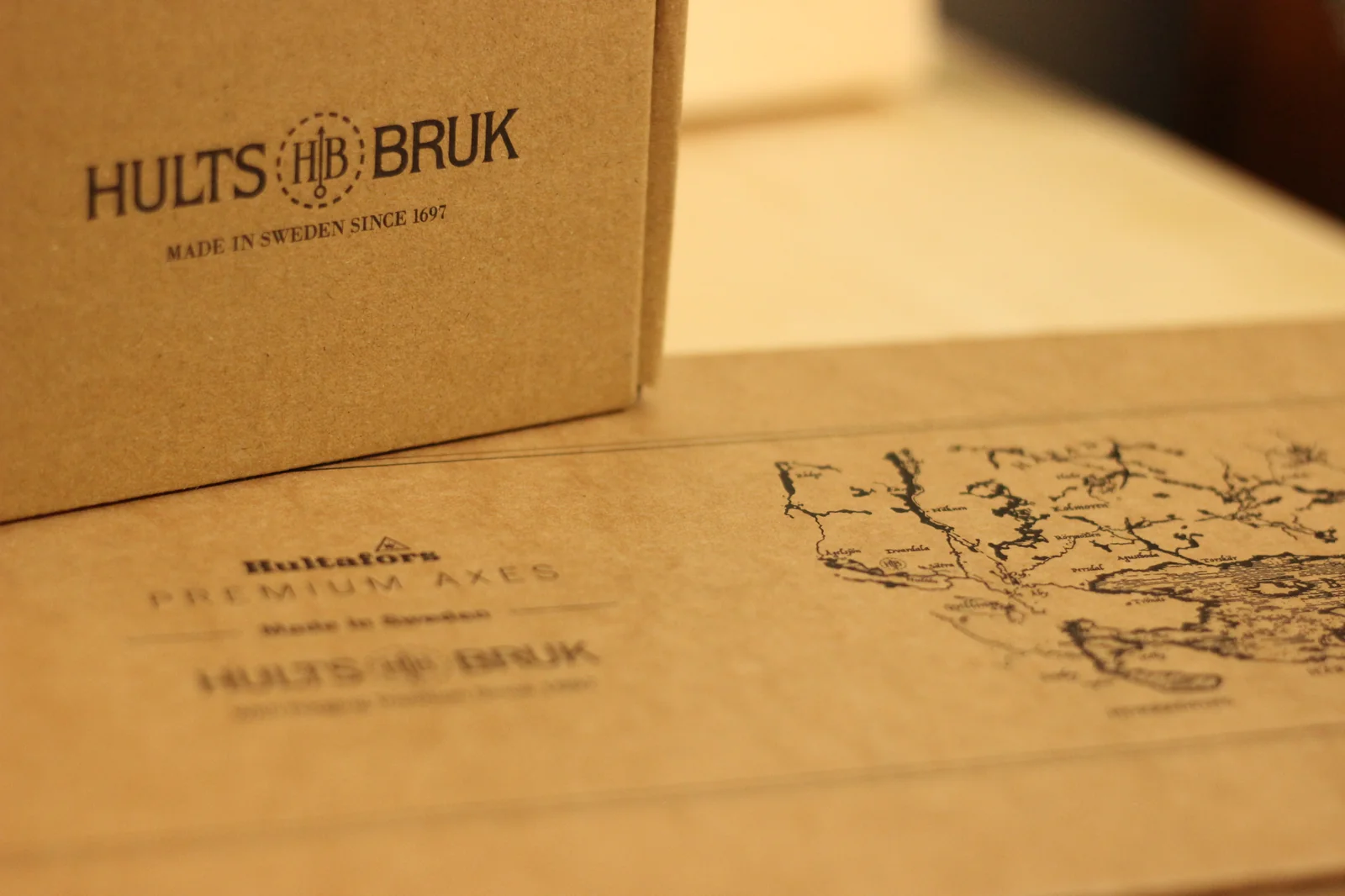
Small Hults Bruk grinding stone box and larger Hultafors Premium Axes box on a wooden surface with the Hunt and Live wooden plaque behind
The paired-system delivery as it arrived — the small Hults Bruk grinding-stone box on the corrugated cardboard at left, and the larger Hultafors Premium Axes outer box behind it. The Hunt & Live laser-engraved wooden plaque sits behind both for scale. Hultafors is the parent Premium Axes line; Hults Bruk is the heritage forge brand inside it.
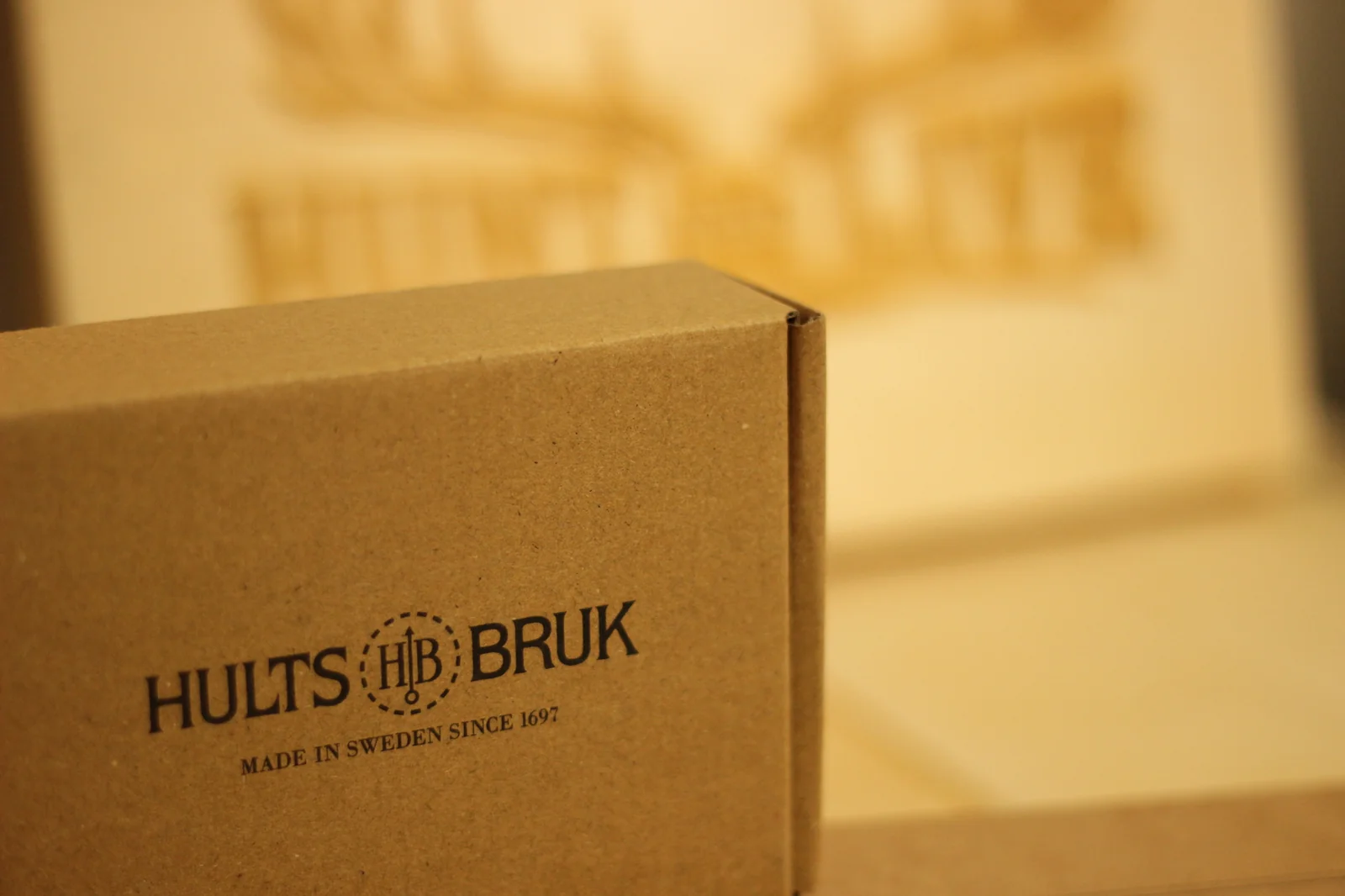
Close-up of the Hults Bruk grinding stone box with HULTS HB BRUK logo and MADE IN SWEDEN SINCE 1697 stamped underneath
The Hults Bruk grinding-stone box, photographed close — note the MADE IN SWEDEN SINCE 1697 line under the HB hallmark. There are not many tools in the broader outdoor industry that ship with a since-date in the seventeenth century printed on the carton. The Hults Bruk forge predates the United States by 79 years.
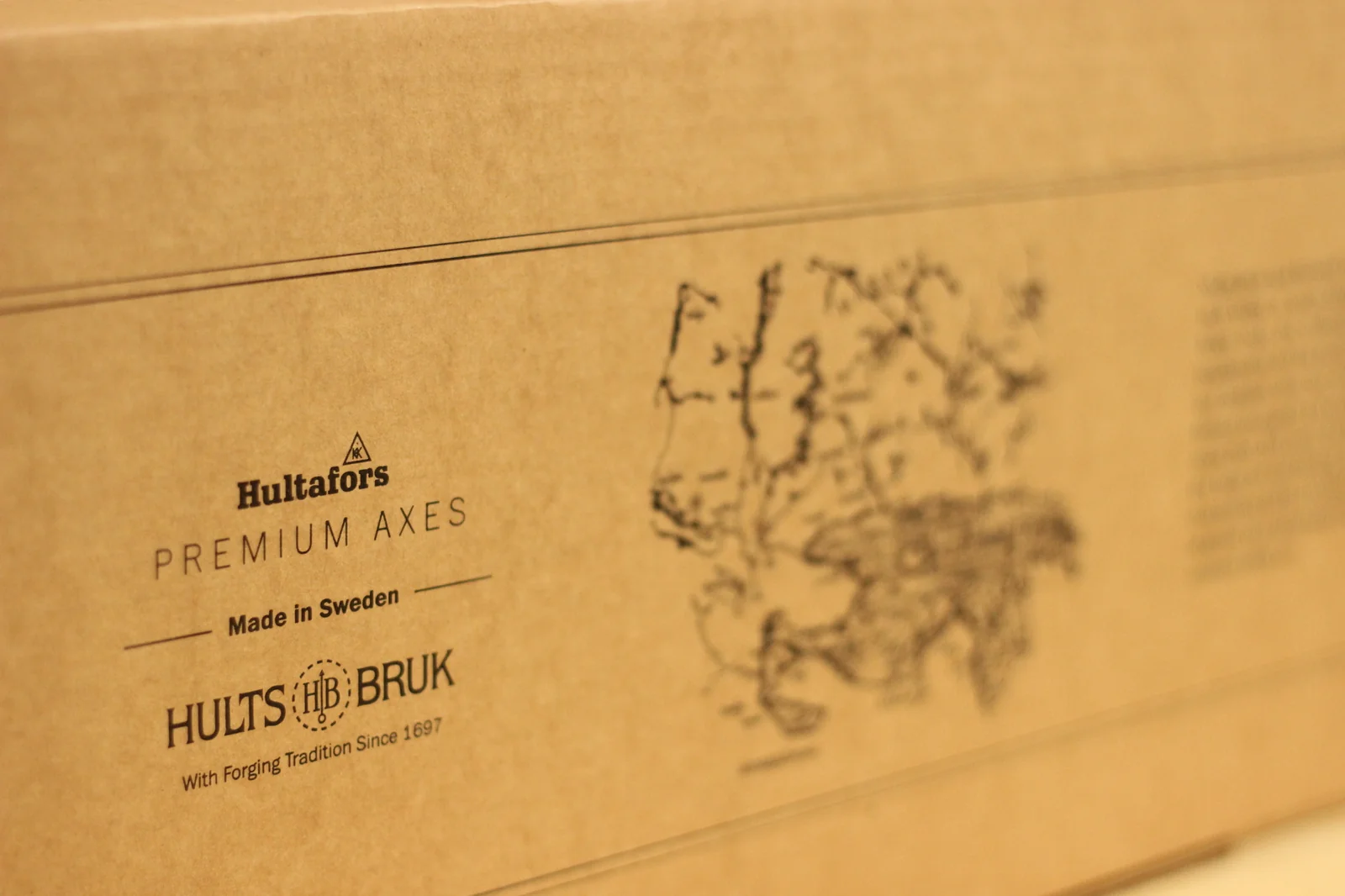
Hultafors Premium Axes axe box with HULTS BRUK With Forging Tradition Since 1697 marking and an illustrated map of southern Sweden showing the Hult Valley location
The Hultafors Premium Axes outer box — Made in Sweden, With Forging Tradition Since 1697, plus the illustrated map of southern Sweden with the Hult Valley location dotted onto it. The packaging is unhurried and confident in a way that only a brand with 328 years of trade behind it can pull off.
Close-up corner of the Hults Bruk grinding stone box showing the wood-grain background of the kraft cardboard
Corner detail of the grinding-stone box. Kraft cardboard with a wood-grain finish printed on top — the same restraint that runs through every piece of the packaging. The box gets opened once. The contents stay with the owner for life.
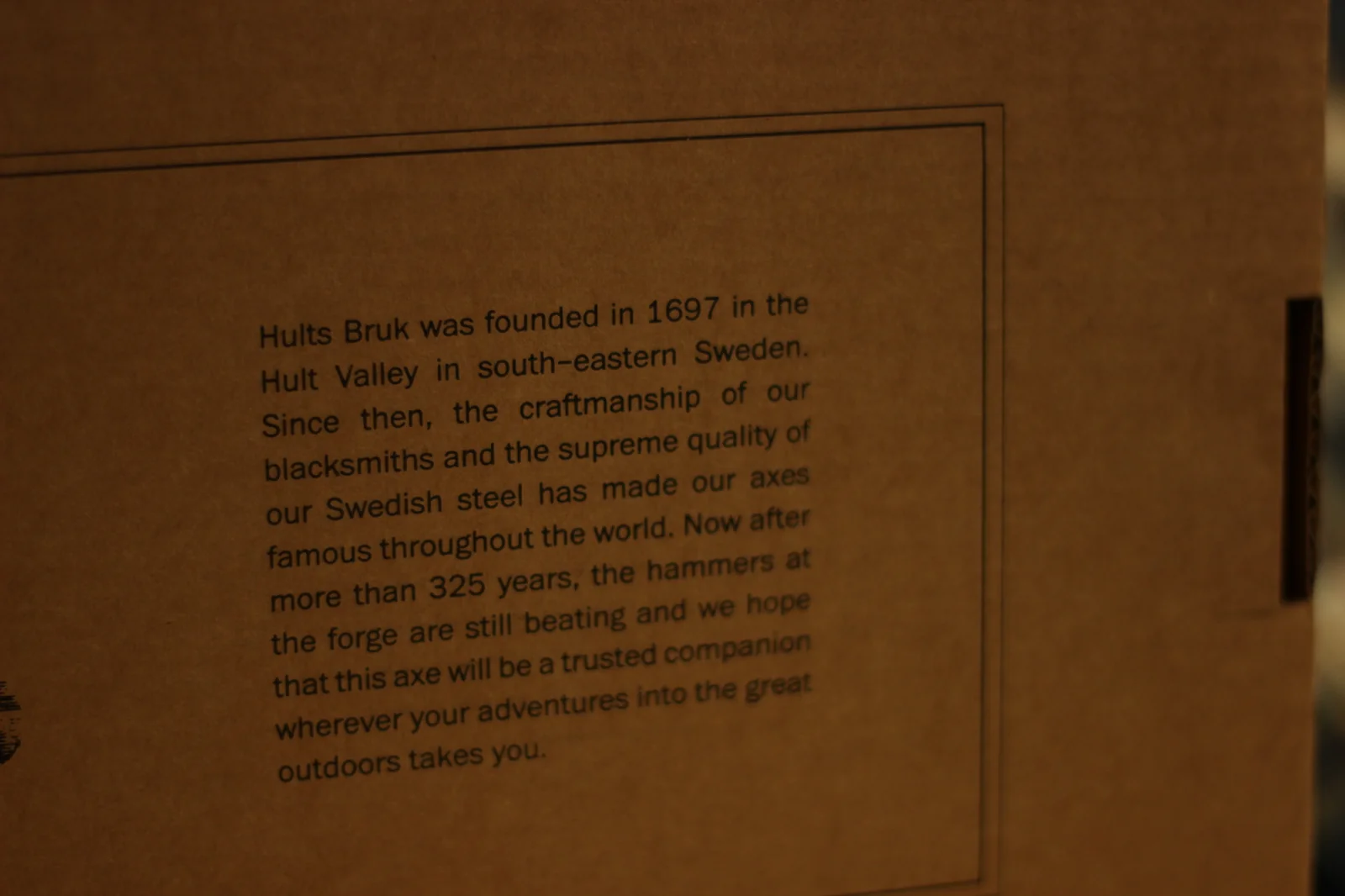
Printed history text on the side of the axe box reading Hults Bruk was founded in 1697 in the Hult Valley in south-eastern Sweden, with text continuing about Swedish steel and 325 years of forging
The brand history printed on the side of the axe box — the part most buyers don't read. We did: "Hults Bruk was founded in 1697 in the Hult Valley in south-eastern Sweden. Since then, the craftsmanship of our blacksmiths and the supreme quality of our Swedish steel has made our axes famous throughout the world. Now after more than 325 years, the hammers at the forge are still beating and we hope that this axe will be a trusted companion wherever your adventures into the great outdoors takes you." That's the editorial frame for everything that follows.

The Grinding Stone — a real combination sharpening puck in a leather pouch

We’re going to start with the stone because the stone is the part that almost nobody talks about and that most heritage-axe buyers learn the hard way they need. Hults Bruk ships the Dvärdala razor-sharp out of the box. After a season of real hunter’s-axe work, you have a choice: you can either let the edge dull over time and watch the warranty-grade steel slowly become a worse tool, or you can maintain the edge properly. The 180/600 Grinding Stone is the maintenance system Hults Bruk built specifically for that job.

Opened grinding stone box with the booklet visible inside featuring the stone product photo on the cover
The grinding-stone box opened. The booklet on top features the product photo — the leather pouch with the snap closure and the stone showing through. The booklet itself is the documentation any heritage-tool owner wants to keep with the tool.
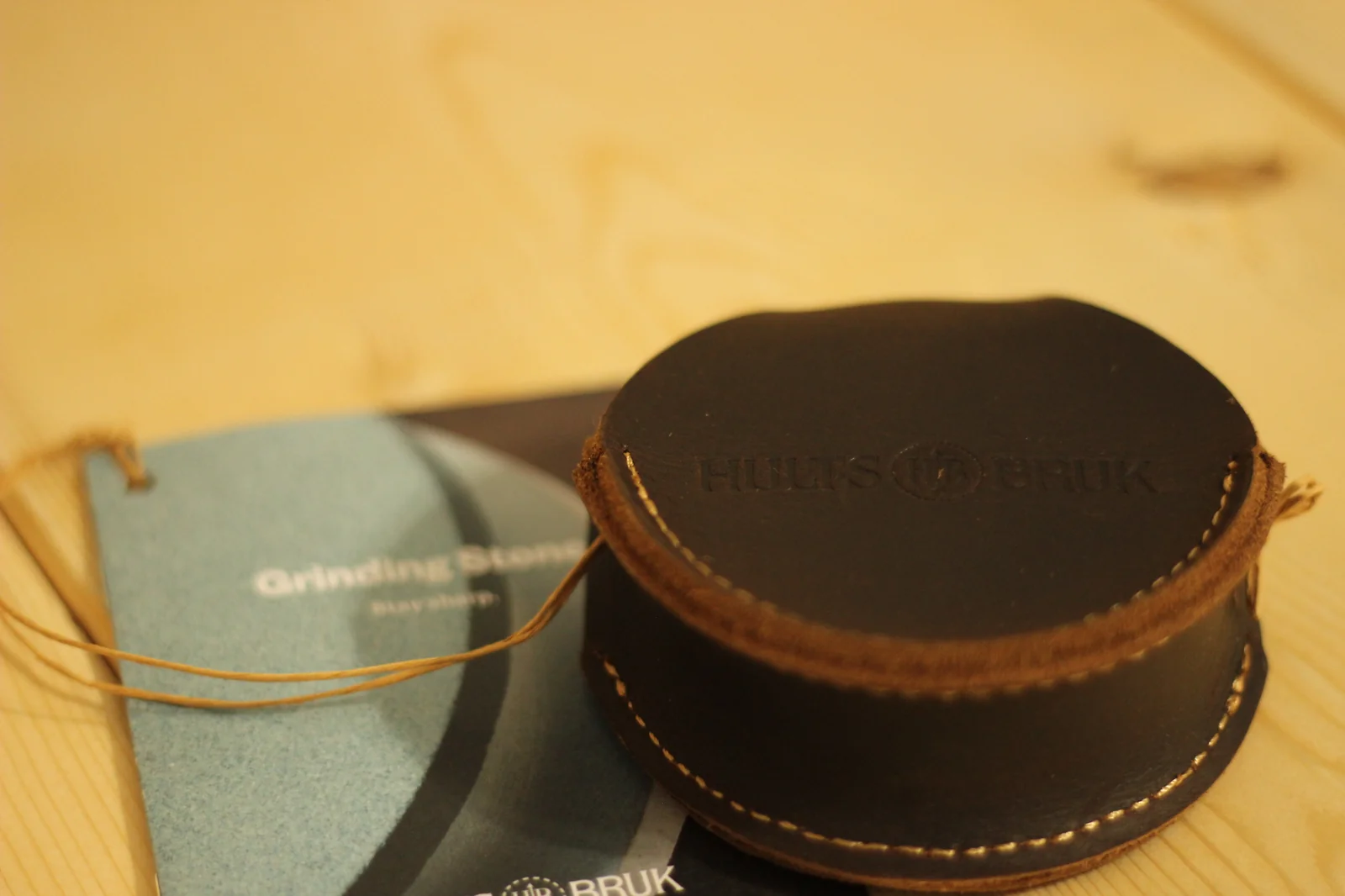
Round leather Hults Bruk grinding stone pouch sitting on a black product card showing the stone, with the HB embossed logo visible on the leather
The leather pouch and the stone-product card. The pouch is hand-stitched full-grain vegetable-tanned leather with the HULTS HB BRUK hallmark embossed into the center of the lid — the same lid embossing that appears on the axe sheath. The leather was photographed in raking light so the stitching and the embossing both read clearly.
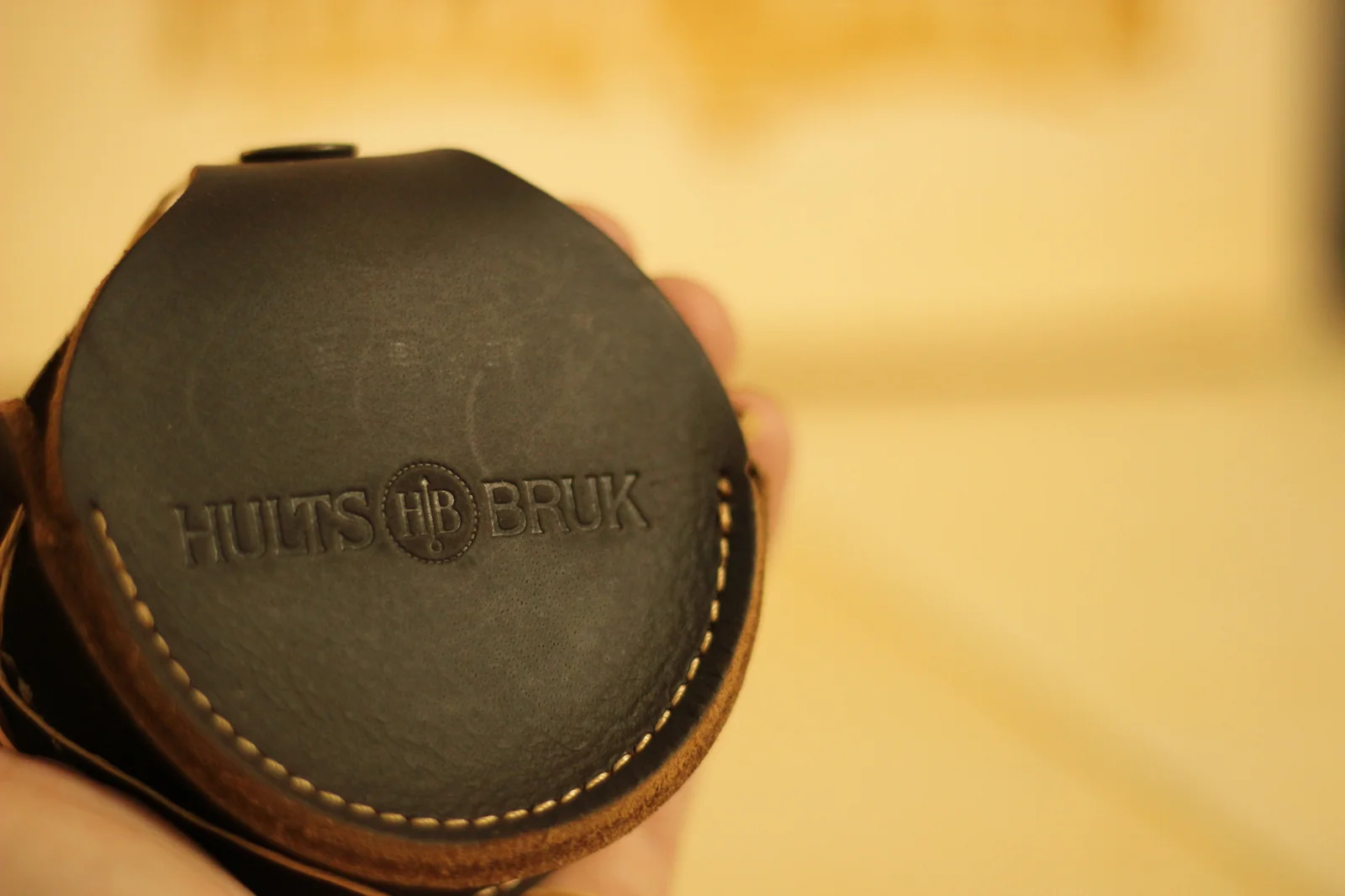
Close-up of the leather grinding stone pouch held in hand showing the HULTS HB BRUK embossed logo across the front
The pouch held in the hand. HULTS HB BRUK embossed into the leather lid, hand-stitched along the perimeter with what looks like waxed natural-fibre thread, brass snap closure visible at the top. The leather is heavy enough to ride on a belt loop full-time for a multi-day hunt.
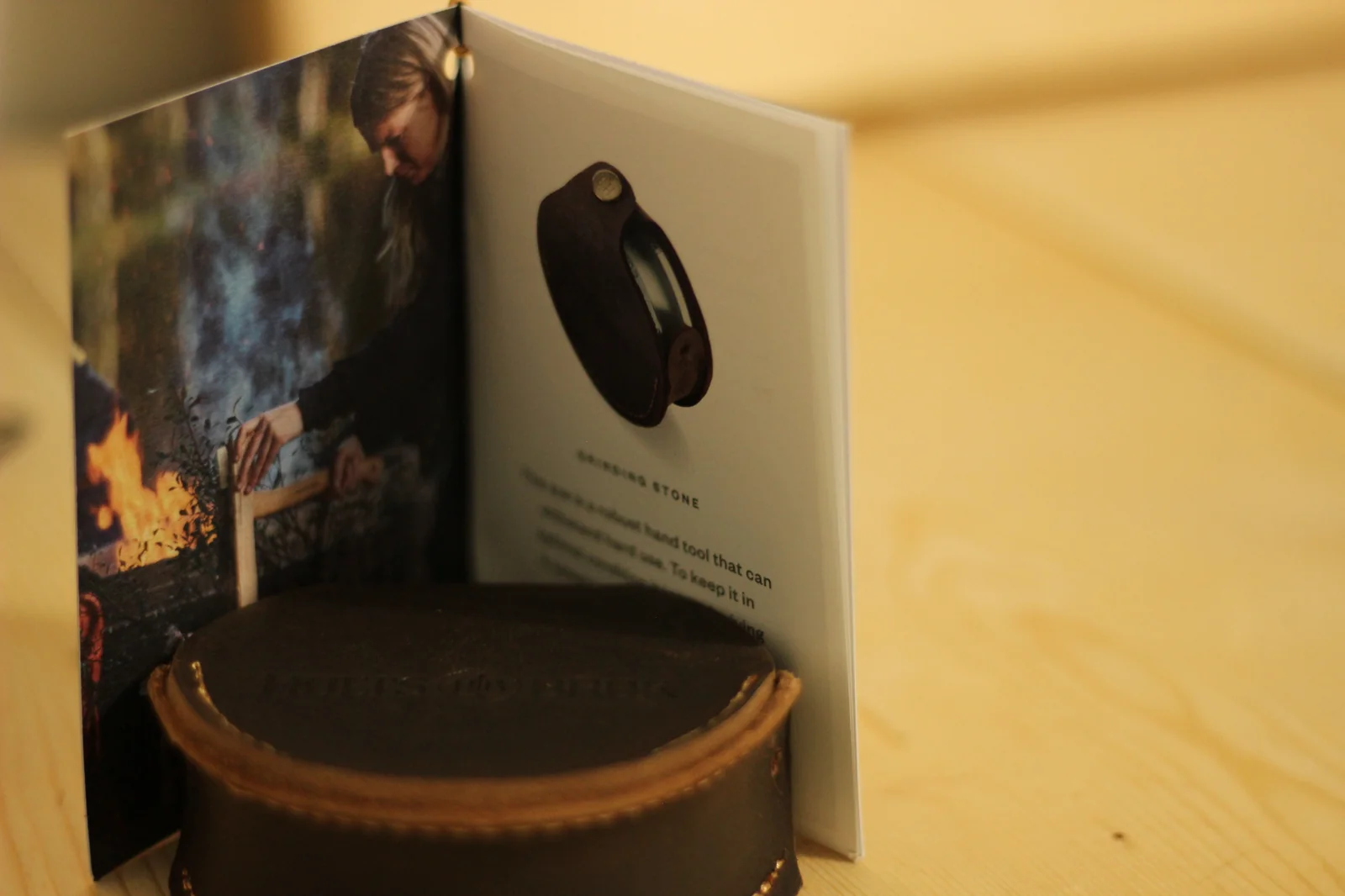
Open booklet propped above the grinding stone pouch showing a photograph of a person sharpening at a campfire on the left page and a product shot of the leather pouch on the right
The product booklet open over the closed pouch. The left page shows a photograph of a person sharpening at a campfire — exactly the scenario the stone is built for. The right page features the same leather pouch we just photographed, with the brand's introduction text running underneath: "This axe is a robust hand tool that can withstand hard use. To keep it in optimal condition, we recommend sharpening..."
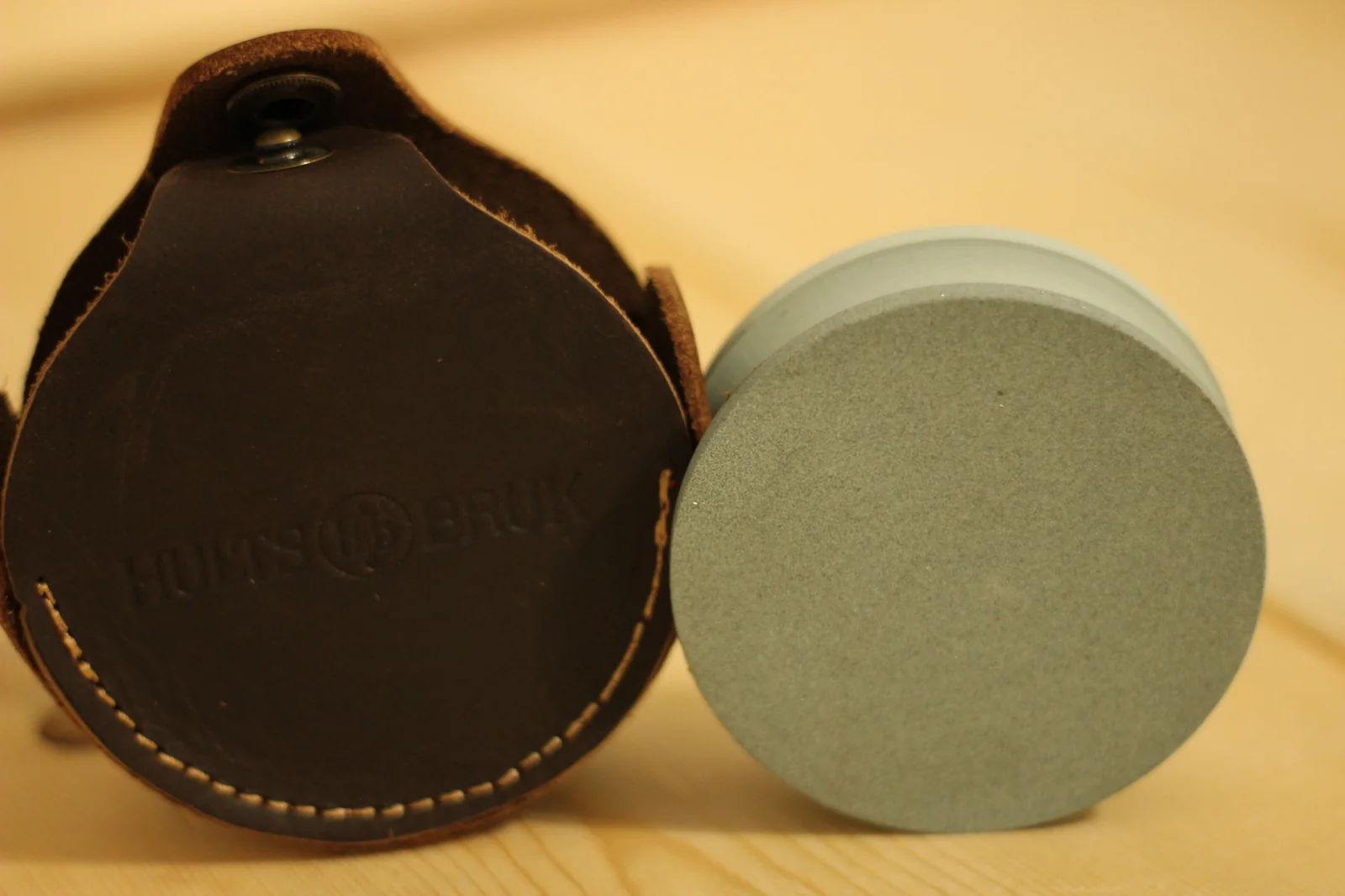
Grinding stone shown out of its leather pouch standing on edge beside the open pouch with HULTS BRUK embossing visible
The stone out of its pouch. This is a real combination two-side puck — a single ceramic-bound abrasive disc with one coarse face and one fine face. The leather pouch beside it shows the HULTS BRUK embossing again. The pouch closes with a stud snap that seats positively without fuss.
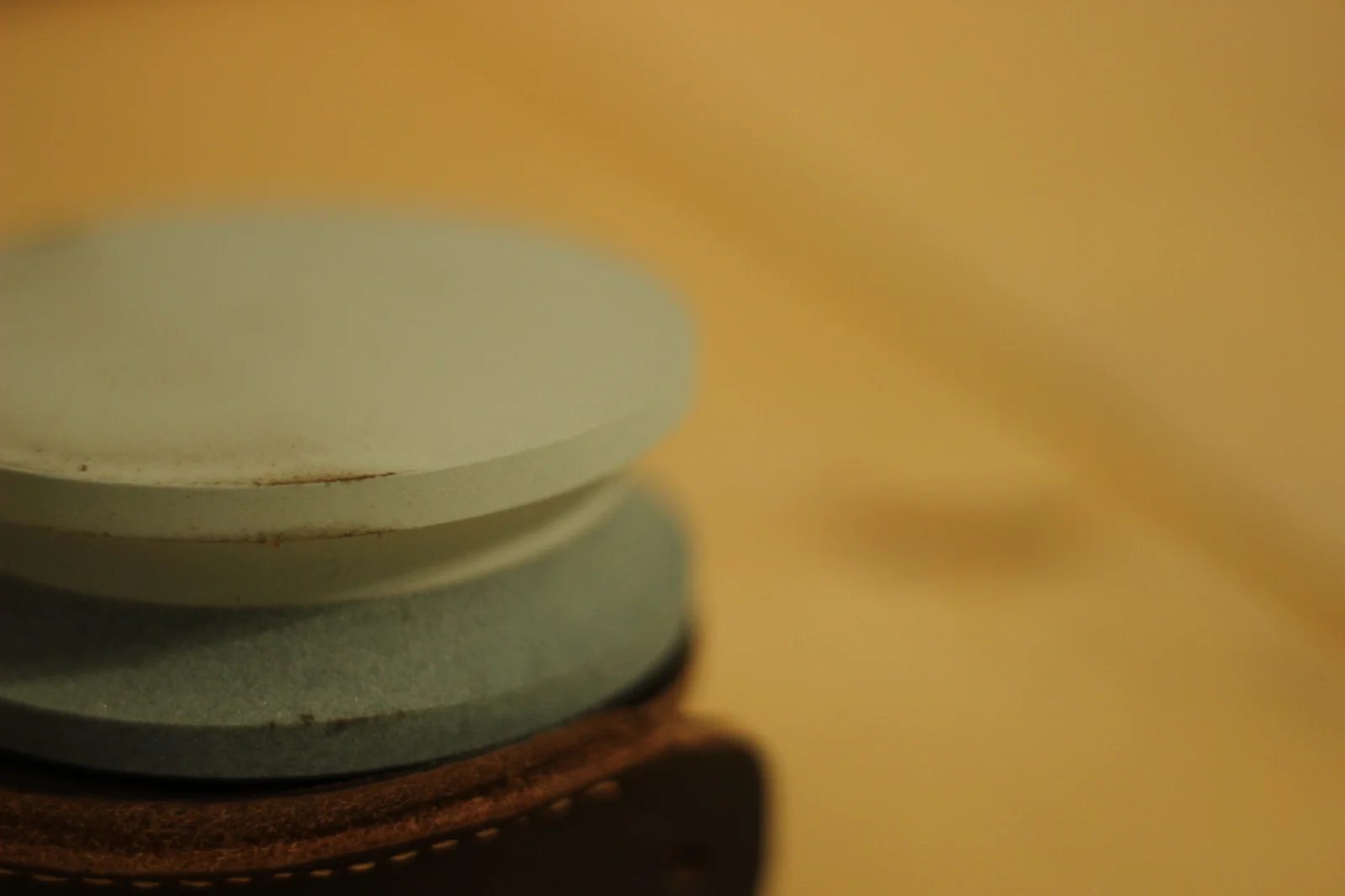
Side profile of the grinding stone showing the lighter coloured top face and slightly darker bottom face stacked as one disc
Profile view of the stone showing the two-side combination construction. The top face is the slightly darker, coarser side; the bottom face is the lighter, finer side. The two are bonded into a single disc with a small step where they meet — the step is the visual register for which side is which when the stone is in your hand at the edge of a fire.
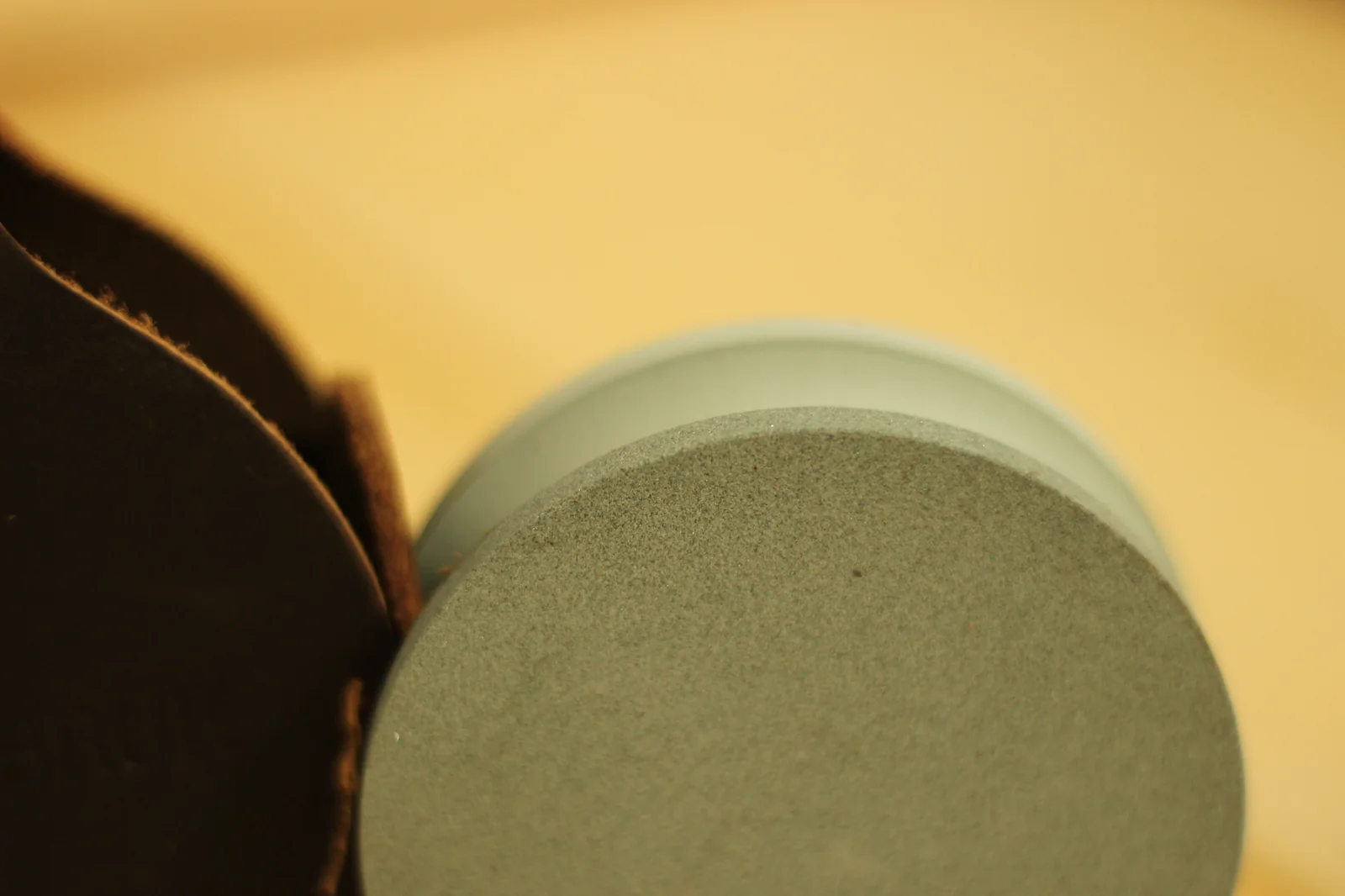
Macro close-up of the grinding stone abrasive surface showing fine grit particles bonded into the ceramic matrix
Macro shot of one face of the stone. You can see the grit particles bonded into the matrix — this is the part of the stone that does the actual metal removal. The texture is the visual signature of a real cutting abrasive, not a polished slip stone.
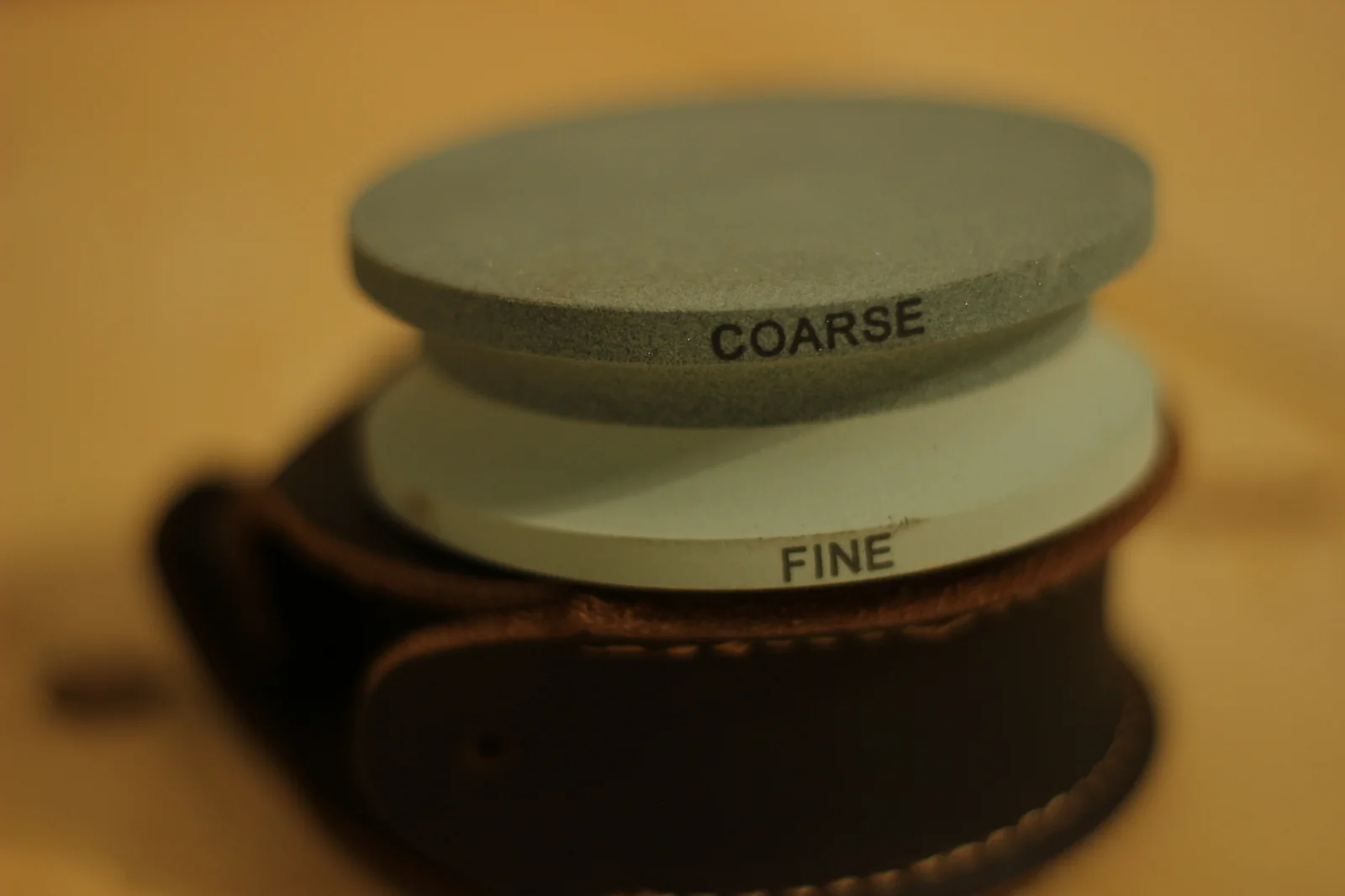
Grinding stone with the words COARSE and FINE printed on the side edge of each respective face
The most important detail Hults Bruk does on this stone: COARSE and FINE are printed on the side edge of each face. You're never confused about which side you're working with — important when you're sharpening in low light, in cold weather, or with gloved hands beside a hunt camp. The 180-grit coarse side restores the edge after season-end damage; the 600-grit fine side handles routine in-field maintenance.

The axe — unboxing the Dvärdala
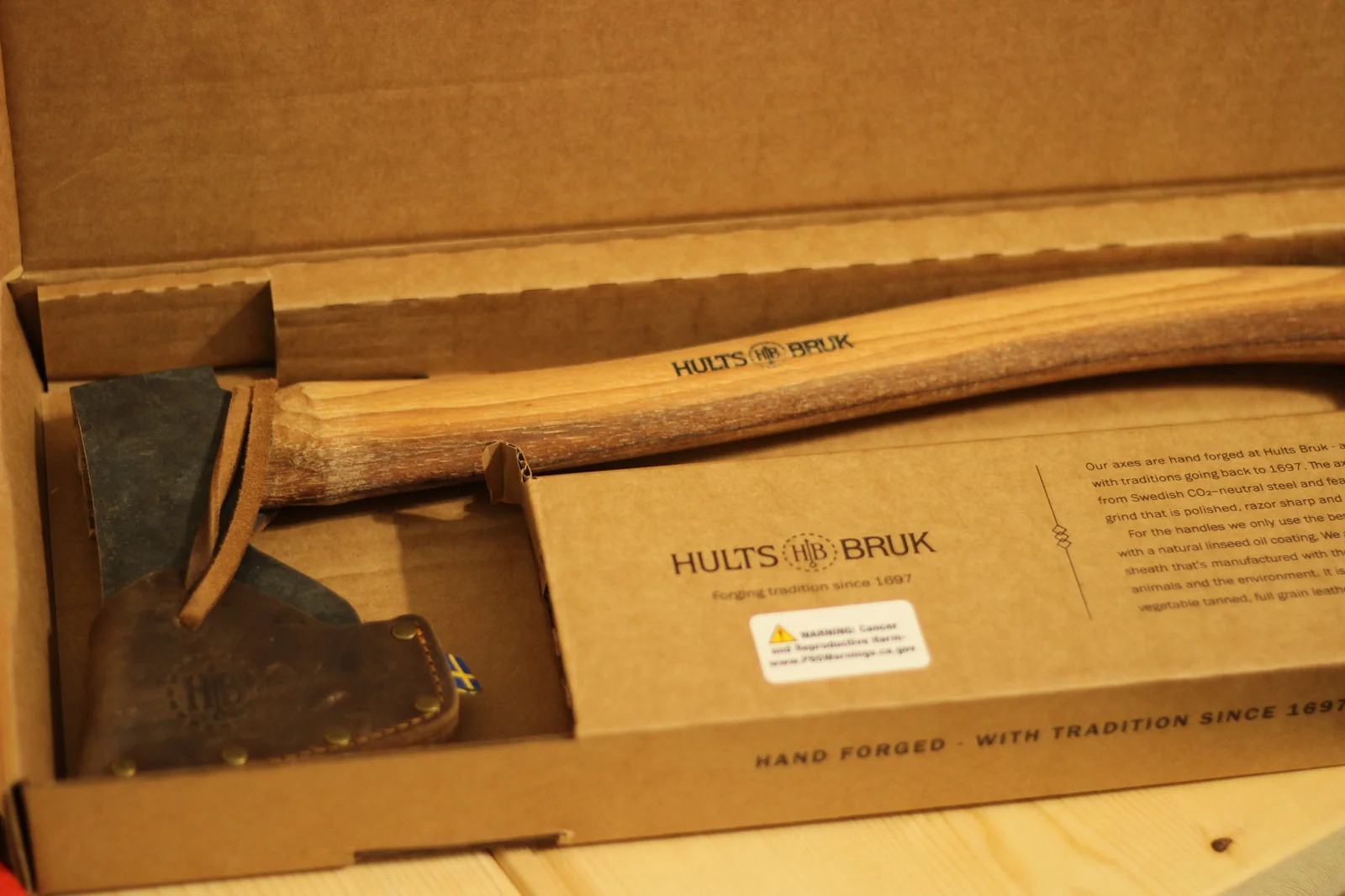
Open Premium Axes box showing the Dvärdala axe inside with leather sheath on the head and product booklet visible alongside, with the HAND FORGED WITH TRADITION SINCE 1697 text printed on the inside box edge
The Dvärdala in the box. The full axe lies on its side, leather sheath on the head, with the product booklet alongside. The inside of the box edge reads HAND FORGED — WITH TRADITION SINCE 1697. This is the moment the whole heritage frame stops being marketing language and becomes a physical object you can pick up.
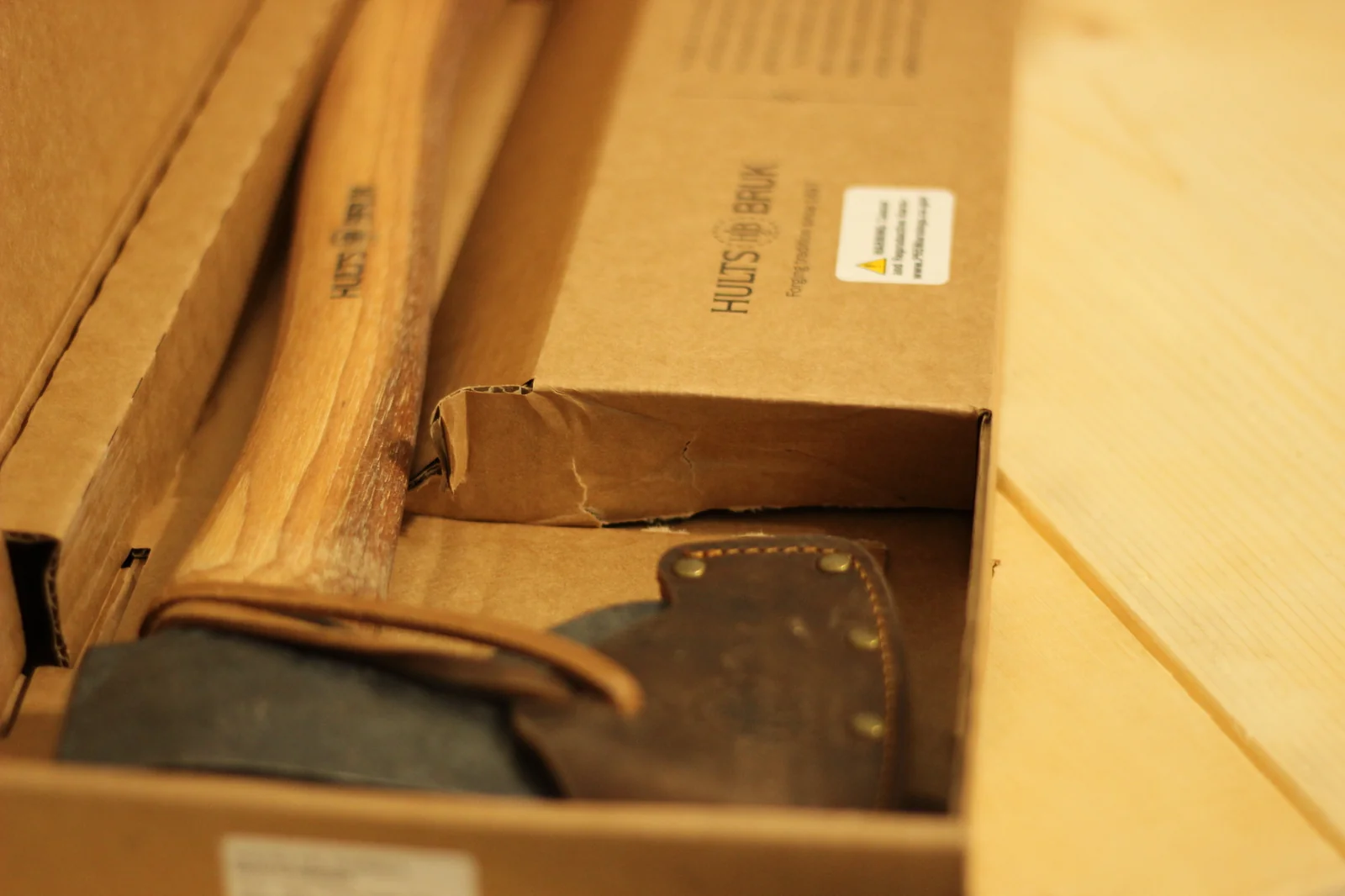
View along the axe inside the box showing the hickory handle with the HULTS BRUK brand mark and a yellow warning sticker on the box edge
Looking down into the box at the hickory handle. The HULTS BRUK brand mark is laser-printed directly onto the curved handle. The yellow warning sticker on the box edge is a Prop 65 notice for California buyers — standard regulatory labelling, not a structural concern.
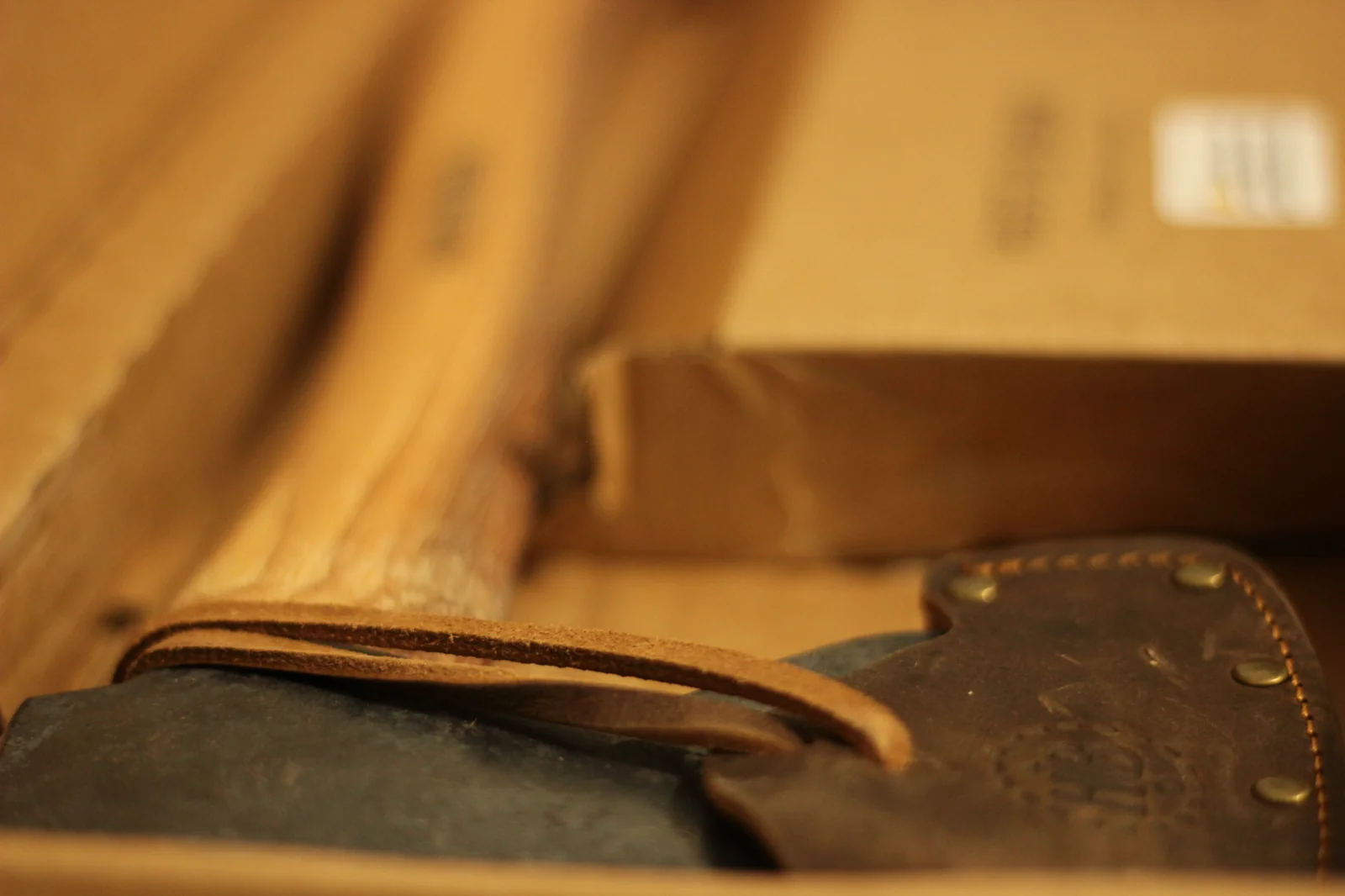
Hickory handle and leather sheath shown in the box with the leather strap of the sheath unbuttoned and hanging
The leather sheath in the box with the retention strap unbuttoned. The strap is a single piece of full-grain leather riveted at one end and secured at the other with a brass stud. The whole sheath is a hand-stitched piece — not a moulded plastic insert with a leather wrap, but actual structural leather work.
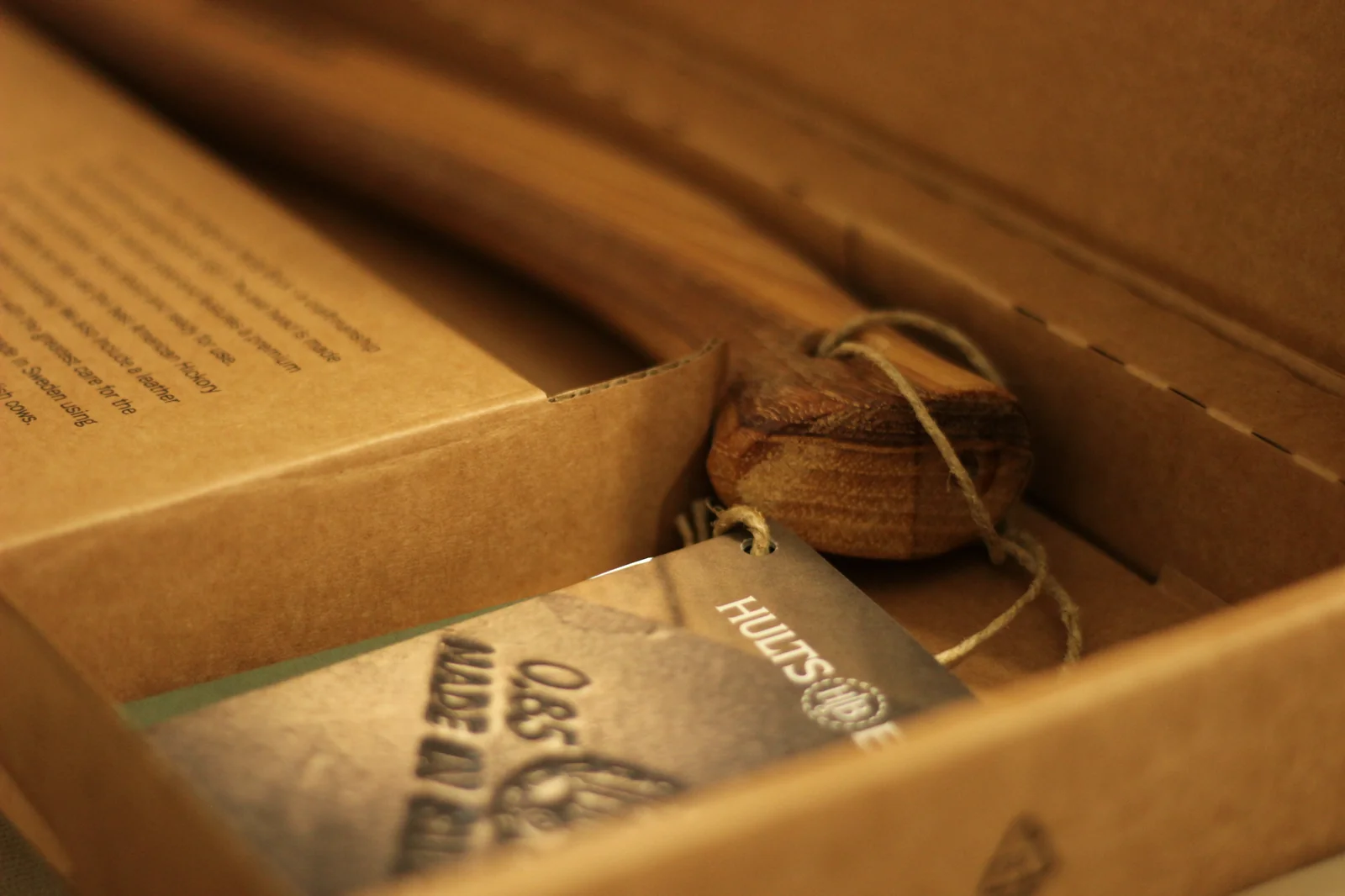
Close-up of the hang tag with 0.65 weight marking and HULTS BRUK MADE IN SWEDEN text, with the polished handle end visible above
The hang tag and the very end of the handle. The hang tag carries the HULTS BRUK hallmark and MADE IN SWEDEN alongside the model identifier. Above, the very end of the hickory handle is visible — the wood is unhurried, the grain is straight, and the finish is the linseed-oil treatment Hults Bruk specifies in the documentation.
Hang tag reading LIFETIME WARRANTY with the HB hallmark and instructions to register the axe at hultsbruk.com, alongside a photo card showing a man kneeling with an axe in a snowy forest
The Lifetime Warranty hang tag. "We take great pride in the quality of our axes and thanks to the outstanding craftsmanship of our blacksmiths, we can offer you a lifetime warranty at our premium axes. Register your axe online within 3 months from the purchase at hultsbruk.com." Beside it, the photo card shows a man kneeling with an axe in a snowy forest — the editorial frame the brand wants the buyer carrying through their ownership of the tool.
Page in the product booklet showing a line drawing of the axe with the published specifications 700 g head weight, 960 g total weight, 440 mm 17 inch handle length
The published spec sheet from inside the booklet. 700 g head, 960 g total, 440 mm / 17-inch handle. Underneath: "Hand forged and made from Swedish, recycled CO₂ neutral steel. Wooden handle made from American hickory, treated with linseed oil." This is the official Hults Bruk spec — every claim we make in the rest of the review is anchored on this page.
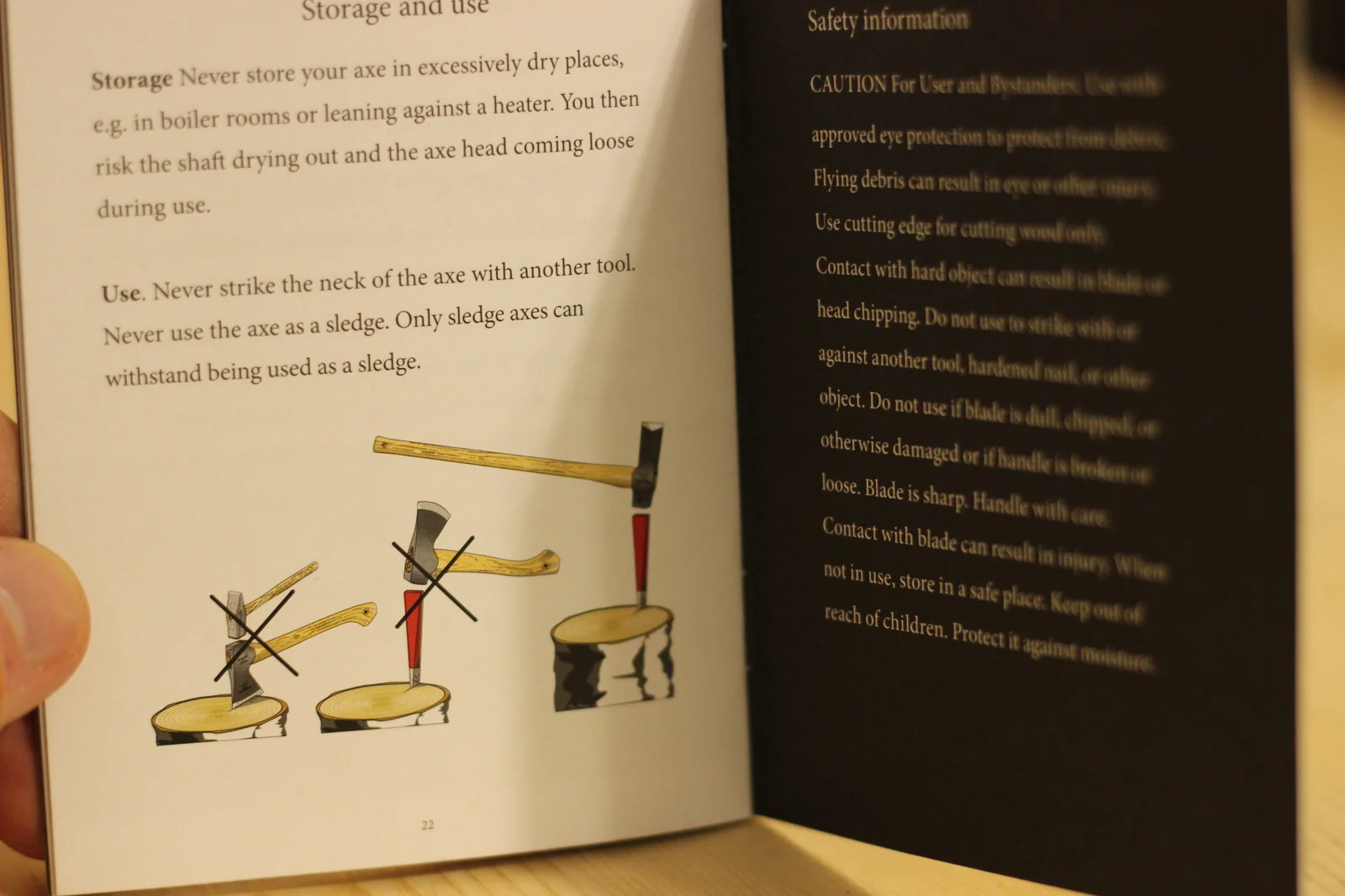
Two-page spread of the product booklet showing Storage and Use instructions on the left page including never store in dry places like boiler rooms and never use as a sledge with illustrated diagrams, and Safety Information on the right page
The Storage and Safety pages of the booklet. The left page diagrams the right and wrong ways to use the axe — never strike the neck of the axe with another tool, never use the axe as a sledge. The right page is the standard safety / caution language. Both are worth reading; both are the kind of guidance an owner who plans to keep this tool for decades actually appreciates.

The axe in detail — hickory, polished steel, and the Hults Bruk hallmark

This is the part of the review where the photograph carries the editorial. We took close-up after close-up of the Dvärdala because every detail of the construction rewards the camera. The head is hand-forged, blackened, with a polished cutting edge that catches light from a sharp line. The handle is straight-grain American hickory, curved into the classic forester-axe geometry, and finished with linseed oil. The transition from steel to wood is the part that hand-forged axes get right and contract-manufactured axes do not.
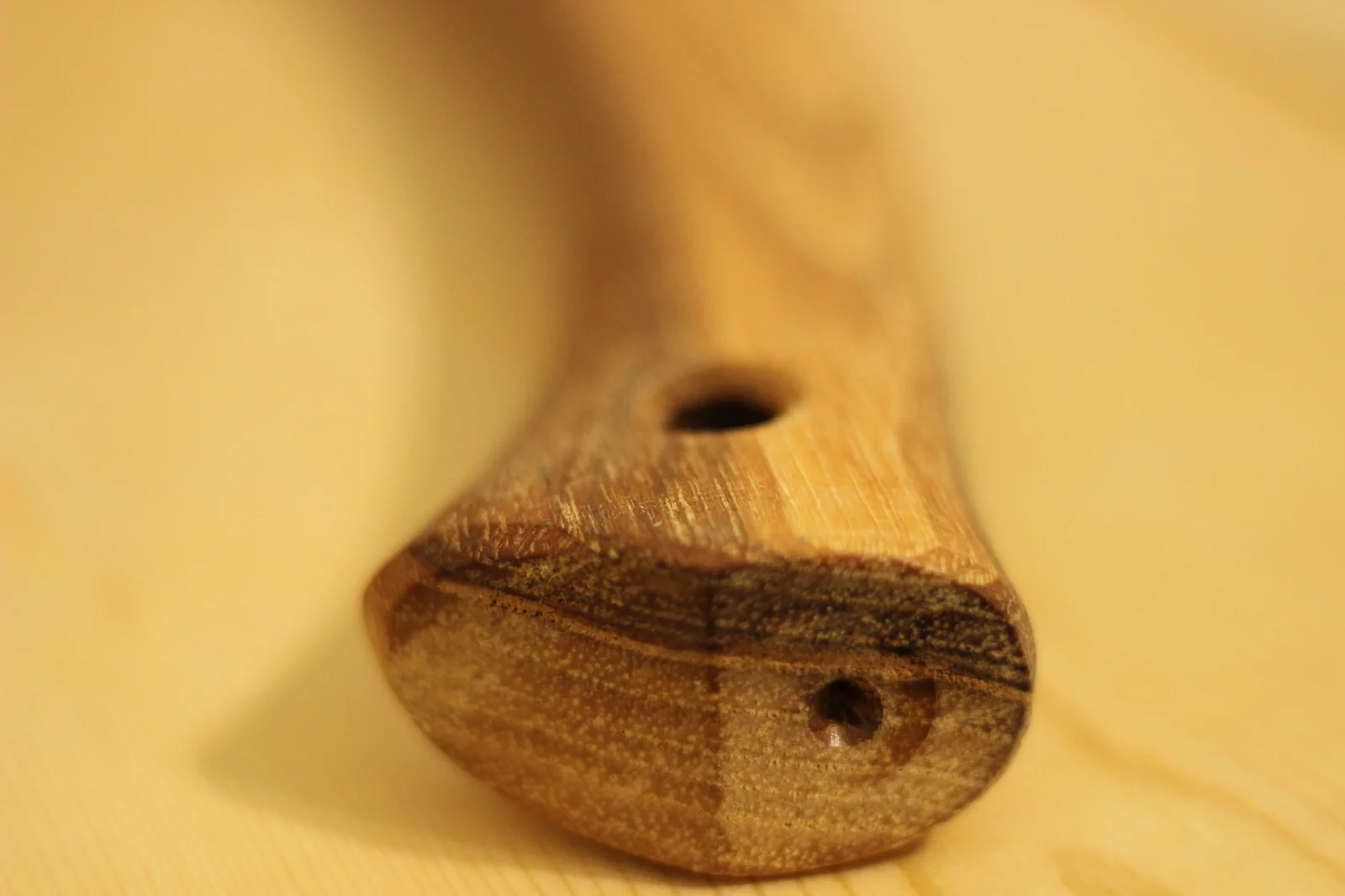
Macro shot of the end of the hickory handle showing the cross-grain pattern and the drilled thong hole
The end of the hickory handle. The thong hole is drilled clean through the swelled fawn's-foot terminal that gives the handle its positive retention against the palm during a swing. The grain pattern is the visual marker of straight-grain hickory selected for the right structural orientation — not a piece picked off the rack.
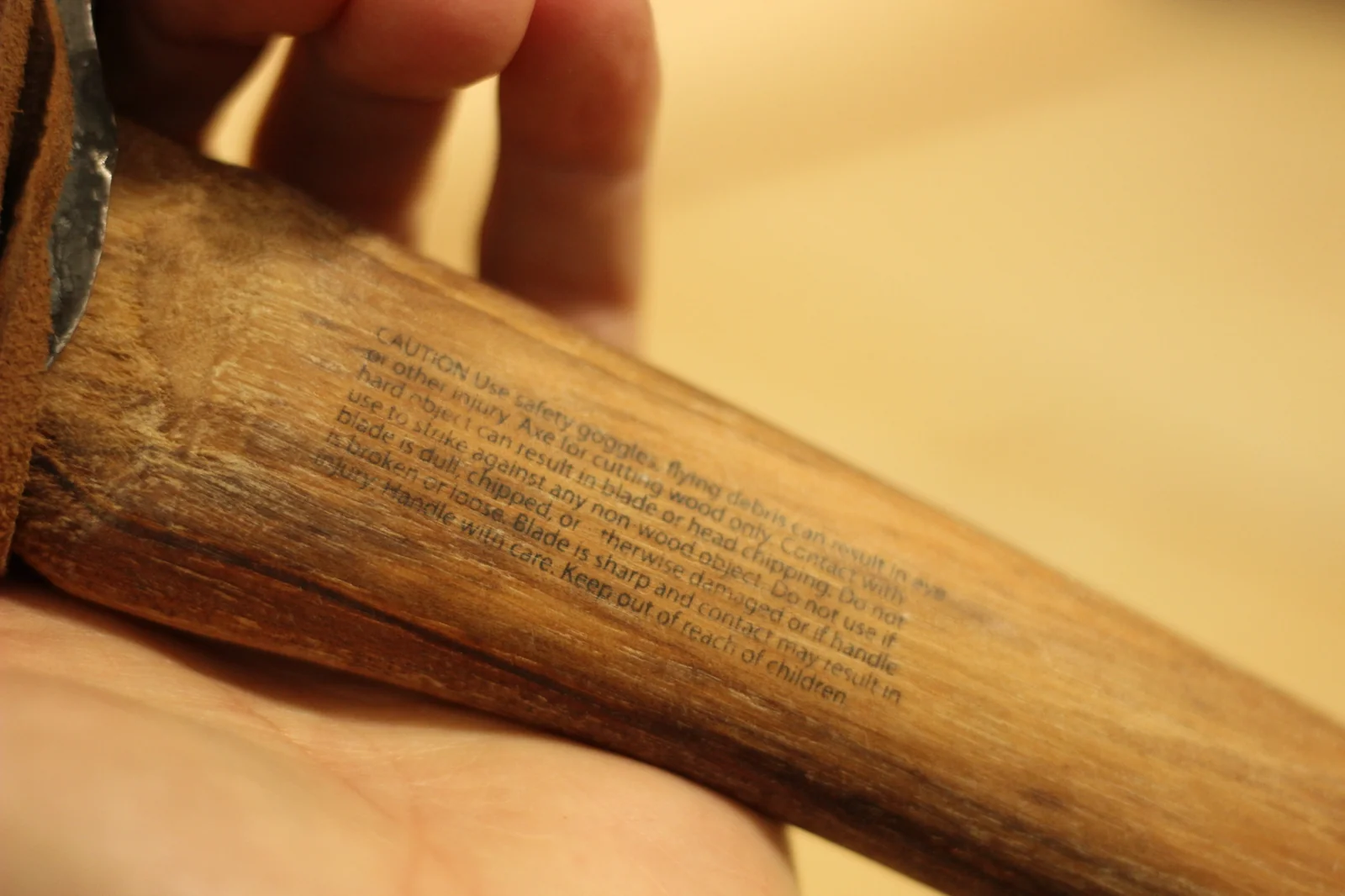
Macro shot of the caution warning text laser-engraved into the hickory handle reading CAUTION Use safety goggles flying debris can result in eye or other injury and continuing warnings
The caution warning laser-engraved into the handle near the head — "CAUTION Use safety goggles, flying debris can result in eye or other injury. Axe for cutting wood only. Contact with hard object can result in blade or head chipping..." The full safety paragraph is printed directly on the tool. Standard regulatory placement, and a useful permanent reminder.

Why American hickory?

The choice of American hickory for the Dvärdala handle is not casual. American hickory (Carya ovata and its close relatives) has been the standard handle wood for premium axes for more than a century for a stack of structural reasons that other woods can’t quite match together:

  • Shock absorption — Hickory has unusually high shock resistance for a hardwood, which is the property that matters most in a hand-swung tool. The repeated impact of axe-on-wood passes through the head into the handle, and the wood has to absorb that vibration shock without splintering or transmitting it harshly into the user’s wrist and elbow. Hickory does this better than oak, ash, or maple.
  • Strength-to-weight ratio — Hickory is dense enough to hold a wedged axe head under load without crushing, light enough that a 17-inch curved handle adds only a few hundred grams to the total swing weight.
  • Straight-grain reliability — Hults Bruk selects handle blanks for straight-grain orientation along the swing axis, which is the orientation that resists the splitting forces an axe handle takes under load. A crooked-grain handle is a handle that fails early.
  • Linseed oil treatment — The handle ships with a raw-linseed-oil finish that penetrates the wood, displaces moisture, and protects against the wet-dry cycles a real outdoor tool sees. Owners should re-oil the handle periodically (Hults Bruk recommends this in the booklet) for the full multi-decade ownership horizon.

The slightly curved geometry of the Dvärdala handle adds one more element on top — the curve places the user’s hand at a natural neutral grip position at the start of a swing and brings the cutting edge into the work at the optimal angle on the follow-through. It’s a small detail that good axe-makers get right and contract-manufactured axes don’t bother with.
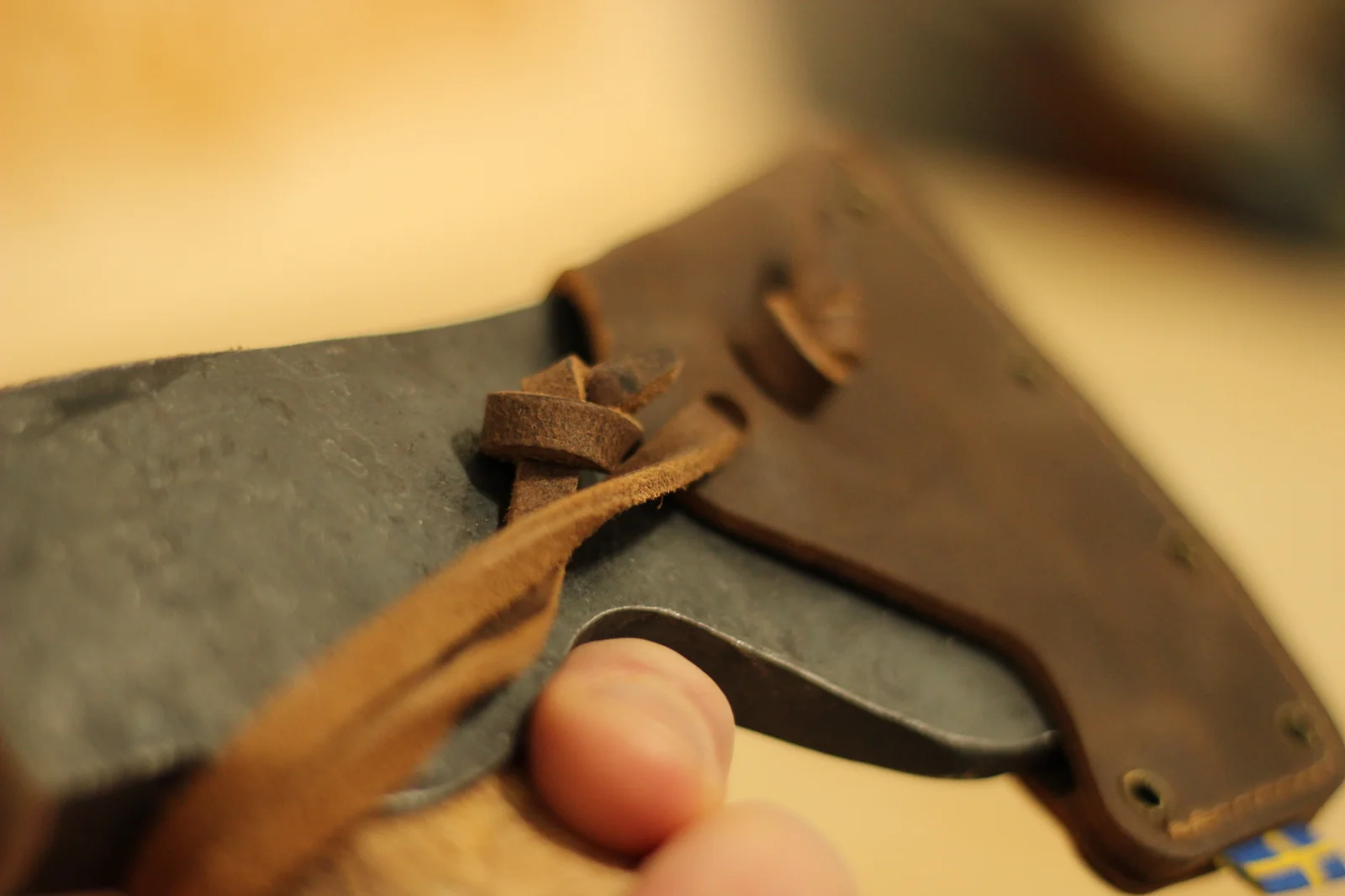
Close-up of the leather sheath strap looping over the axe head with the brass stud closure
The retention strap looping over the axe head and seating against the brass stud. The whole sheath system is hand-stitched and hand-riveted — full-grain leather, bronze-coloured hardware, contrasting saddle-stitch.
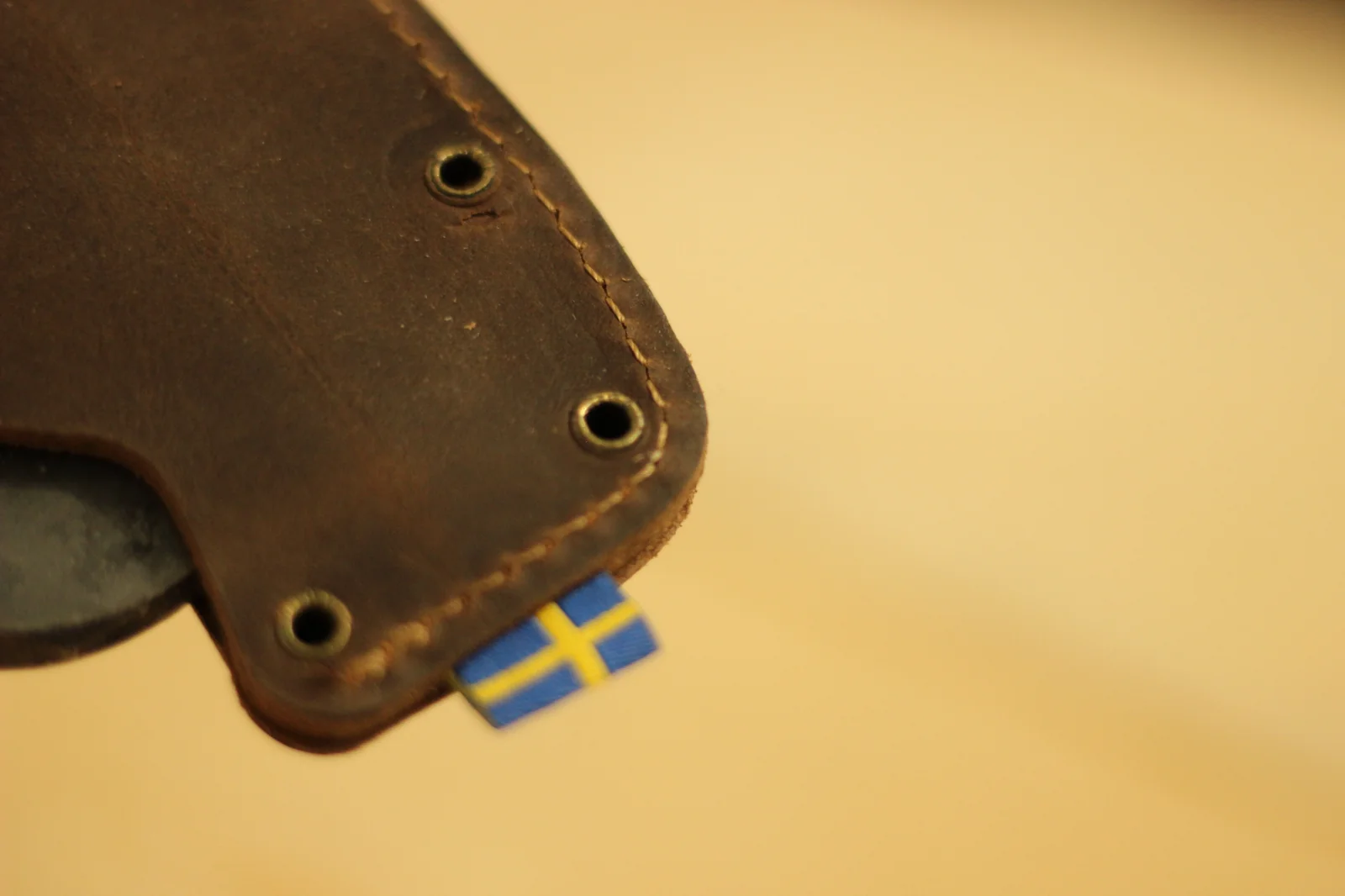
Sheath edge with brass rivets, hand stitching, and a small Swedish flag tag tucked into the seam
The sheath edge with brass rivets at the seam line, the contrasting hand-stitch running along the perimeter, and a small Swedish flag tag tucked into the seam. Small detail. Big editorial signal — every leather piece in this kit was hand-finished in Sweden.
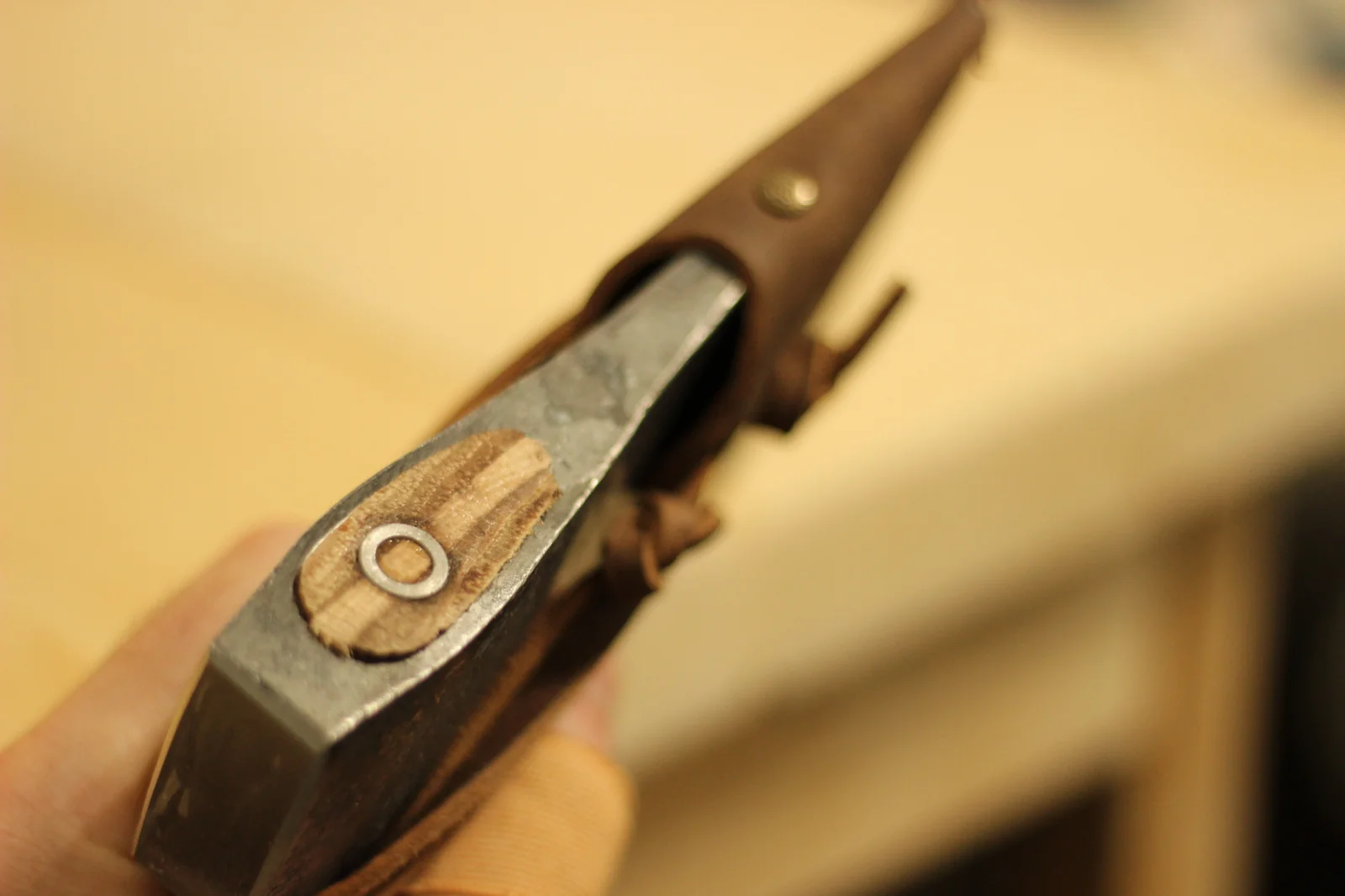
Top-down view of the axe head poll showing the wooden handle plug seated in the eye with the steel wedge driven through it
The poll of the axe head, looking straight down at the wooden plug and the steel wedge. This is the join that has to hold the head onto the handle through 30 years of swings — the wedge driven through the wooden plug expands the wood against the inside of the eye, locking the head in place. The fit is precise.
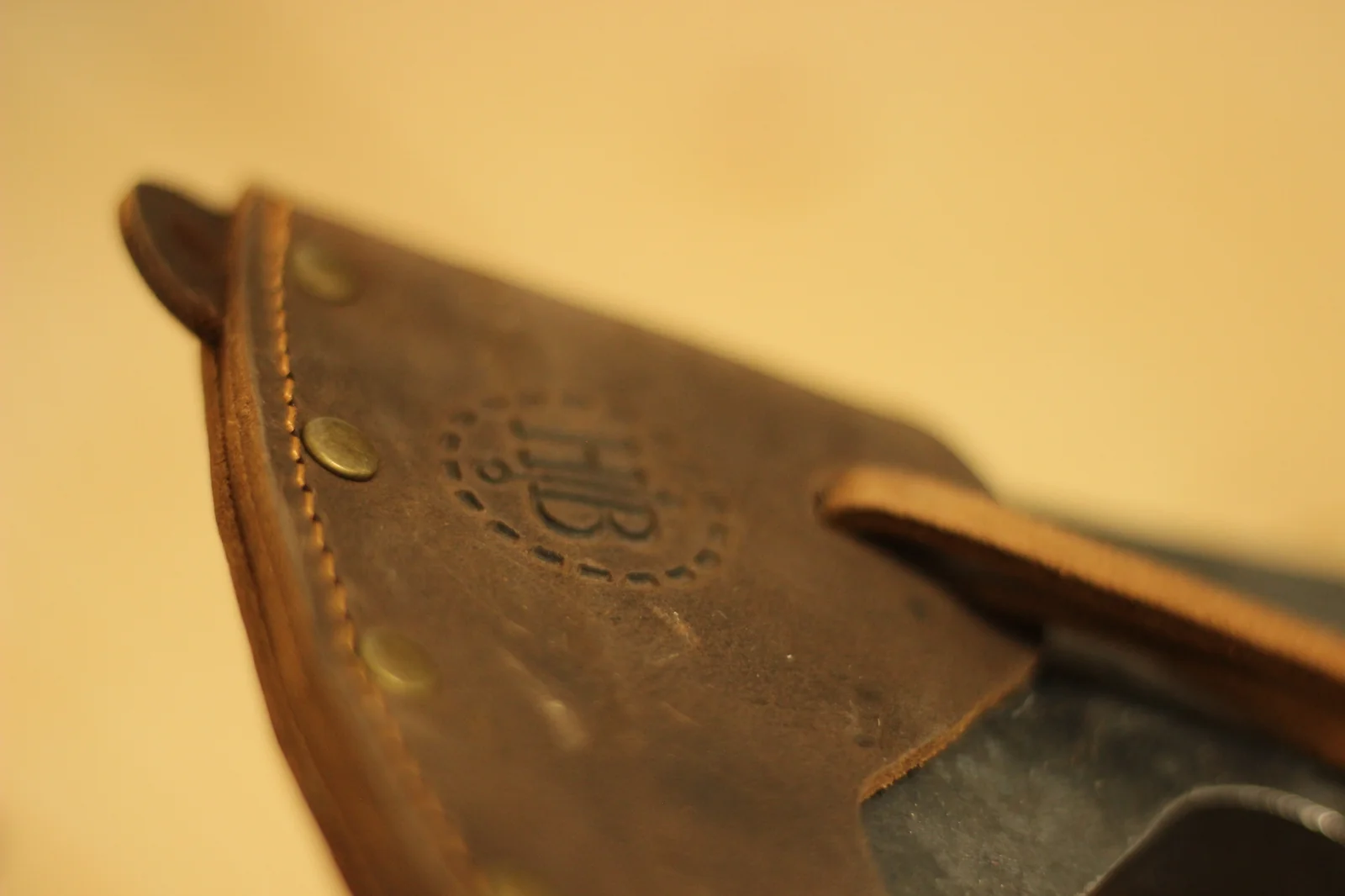
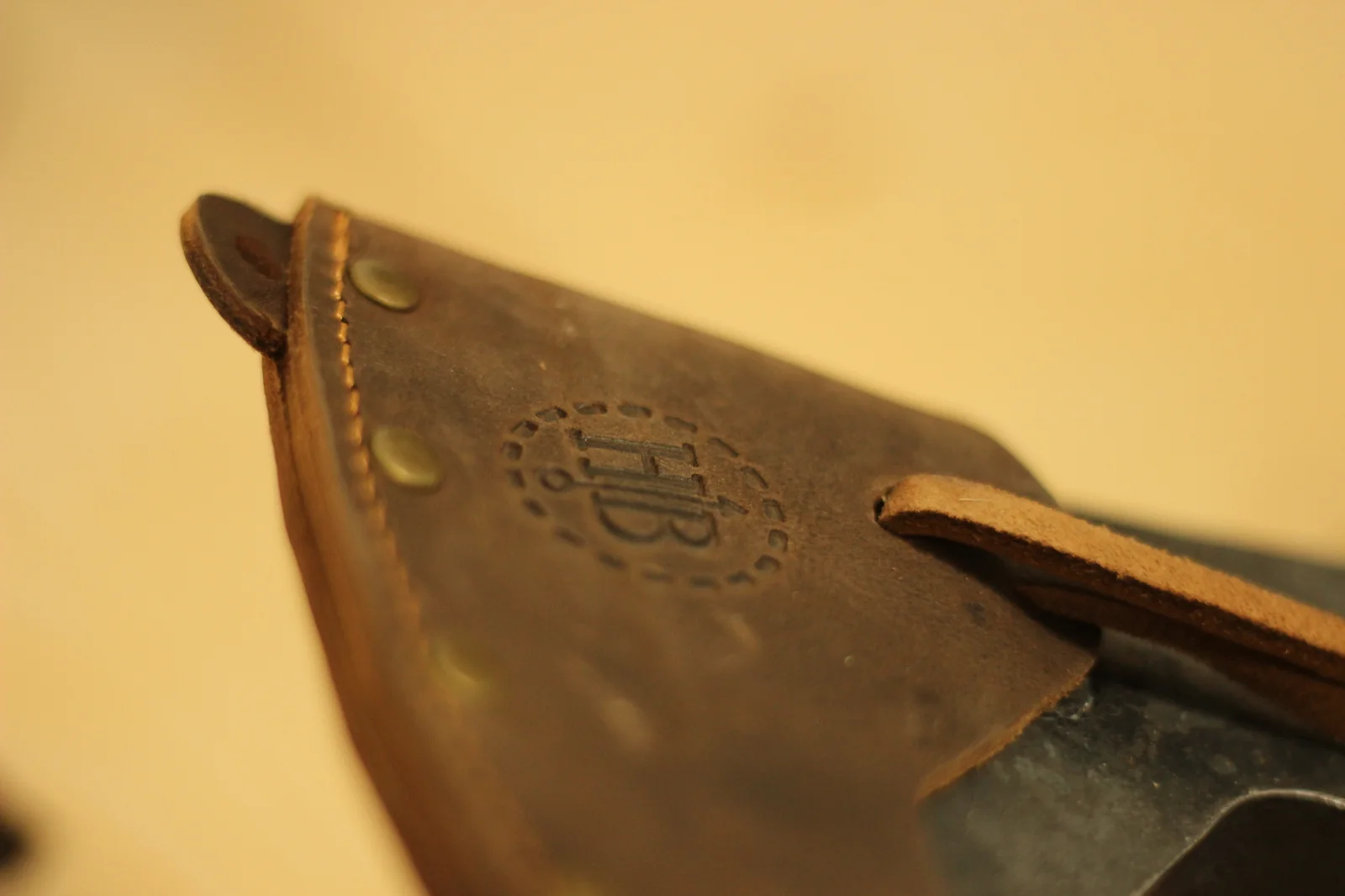
Macro shot of the HB hallmark embossed into the leather sheath surrounded by brass rivets and hand stitching
Macro shot of the HB hallmark embossed into the leather sheath. Surrounded by brass rivets, a perimeter hand-stitch in contrasting thread, and a small leather tab at the top corner. This is what hand-finished leather work looks like at this price tier — the embossing is deep, clean, and registers as a real brand mark, not a heat-pressed sticker.
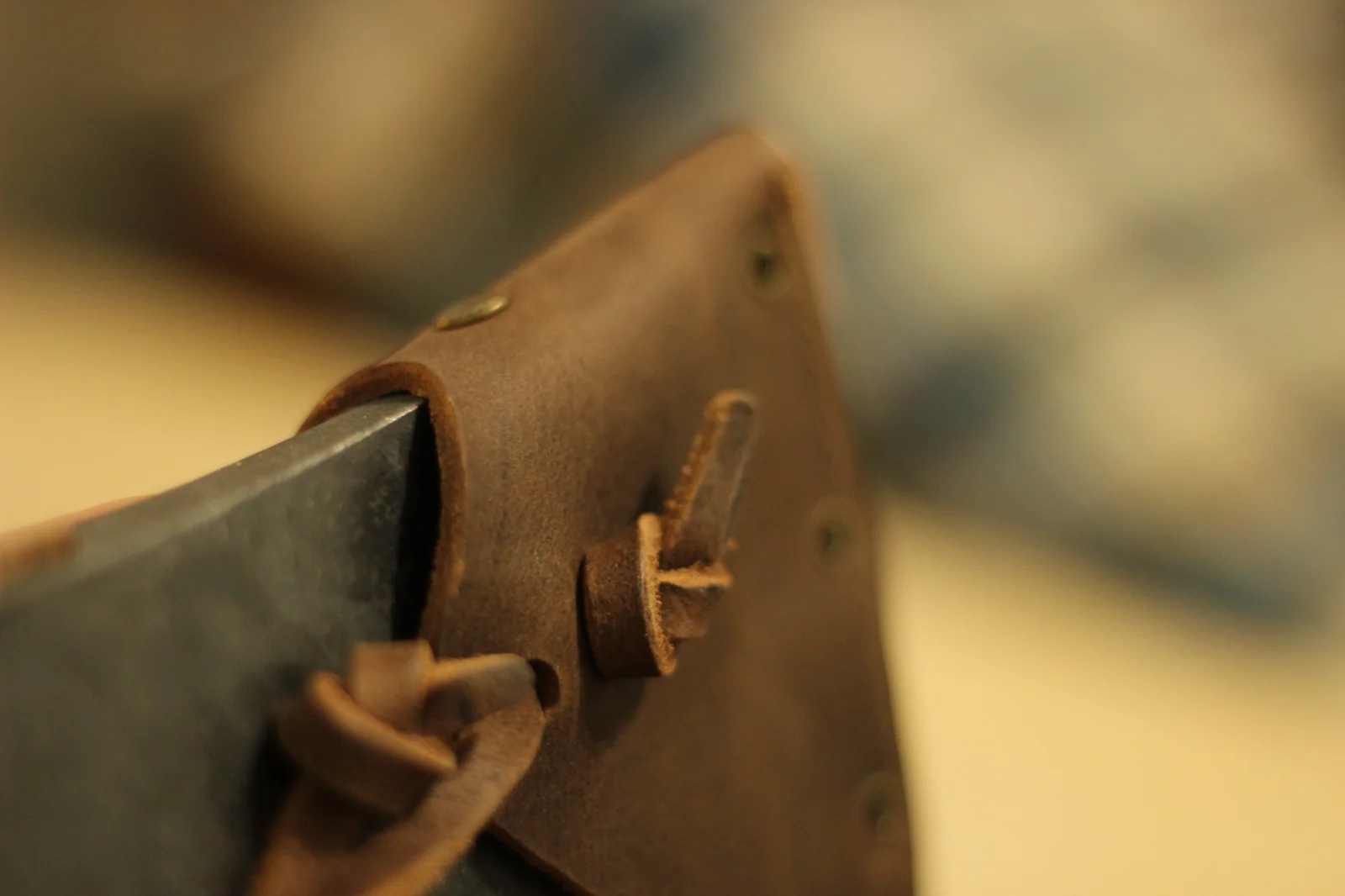
Close-up of the leather sheath at the cutting-edge corner showing the leather strap and brass studs that secure the strap to the sheath body
The sheath at the cutting-edge corner. The leather strap is riveted to the sheath body at multiple points and routes around the back to the closure stud at the front — covering and protecting the cutting edge from both contact and accidental exposure.
View of the leather sheath bottom edge with brass rivets and the small Swedish flag tag visible at the bottom corner
The bottom edge of the sheath, with the brass rivets running along the seam and the Swedish flag tag positioned at the corner. The riveting pattern is functional — every rivet is placed where the leather needs to be reinforced against the blade contact line.
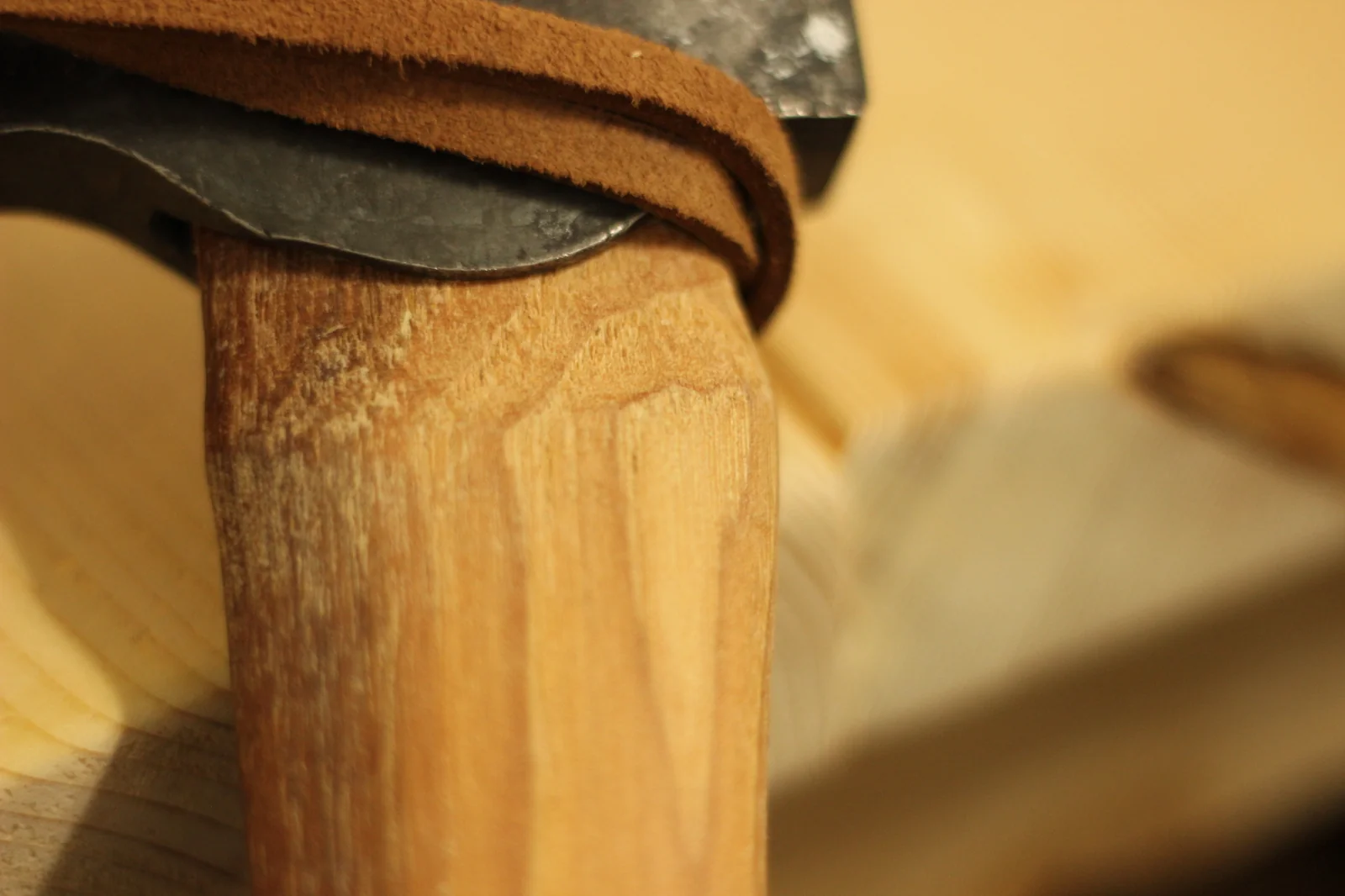
Macro shot of the join where the hickory handle meets the axe head with the leather thong looped over the head
The join where the hickory handle meets the axe head. The leather thong loops over the head and ties off — both a decorative element and a functional way to hang the axe by the head when storing it long-term. The wood-to-steel fit is clean and tight.
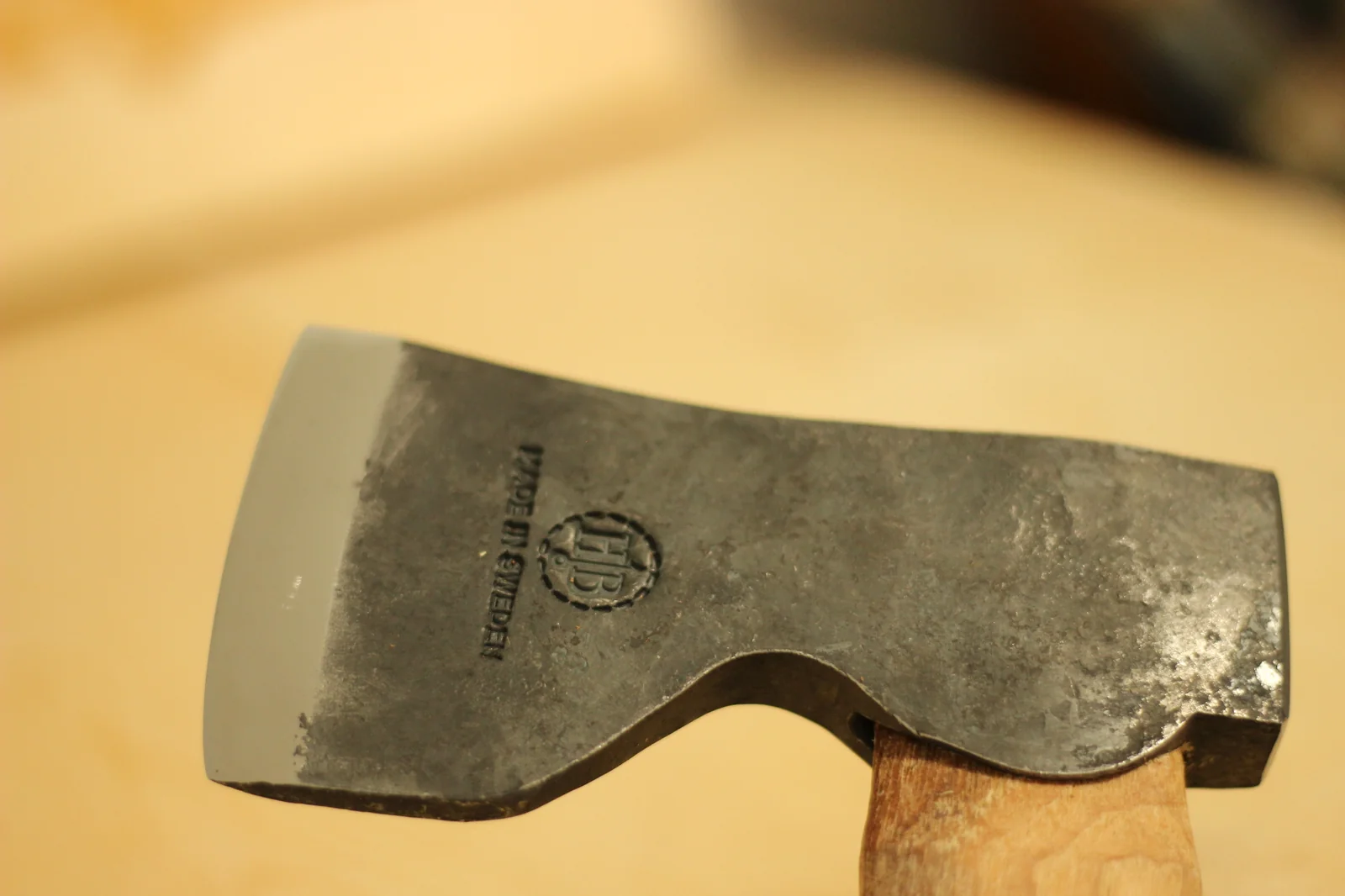
Full side profile of the axe head against a pale wood background showing the blackened forged face the polished cutting edge and the HB hallmark stamp
Full side profile of the Dvärdala head against a pale wood background. The blackened forged face on the body of the head, the polished cutting edge running along the bottom, and the HB hallmark + MADE IN SWEDEN stamp hammered into the cheek. The slightly thicker geometry over the cheek — visible here as the gentle outward swell behind the polished edge — is what gives the Dvärdala genuine splitting capability for a head this size.
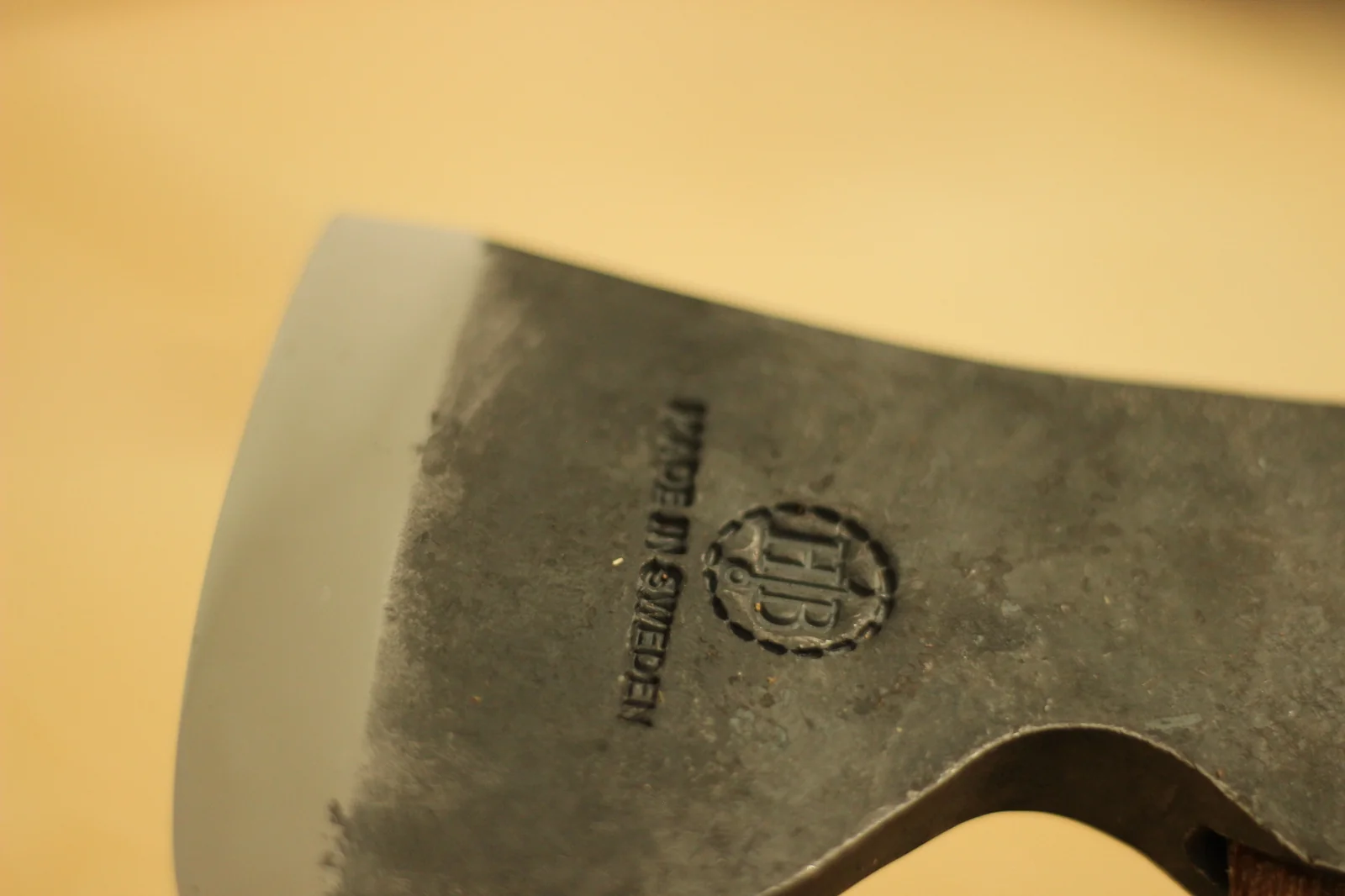
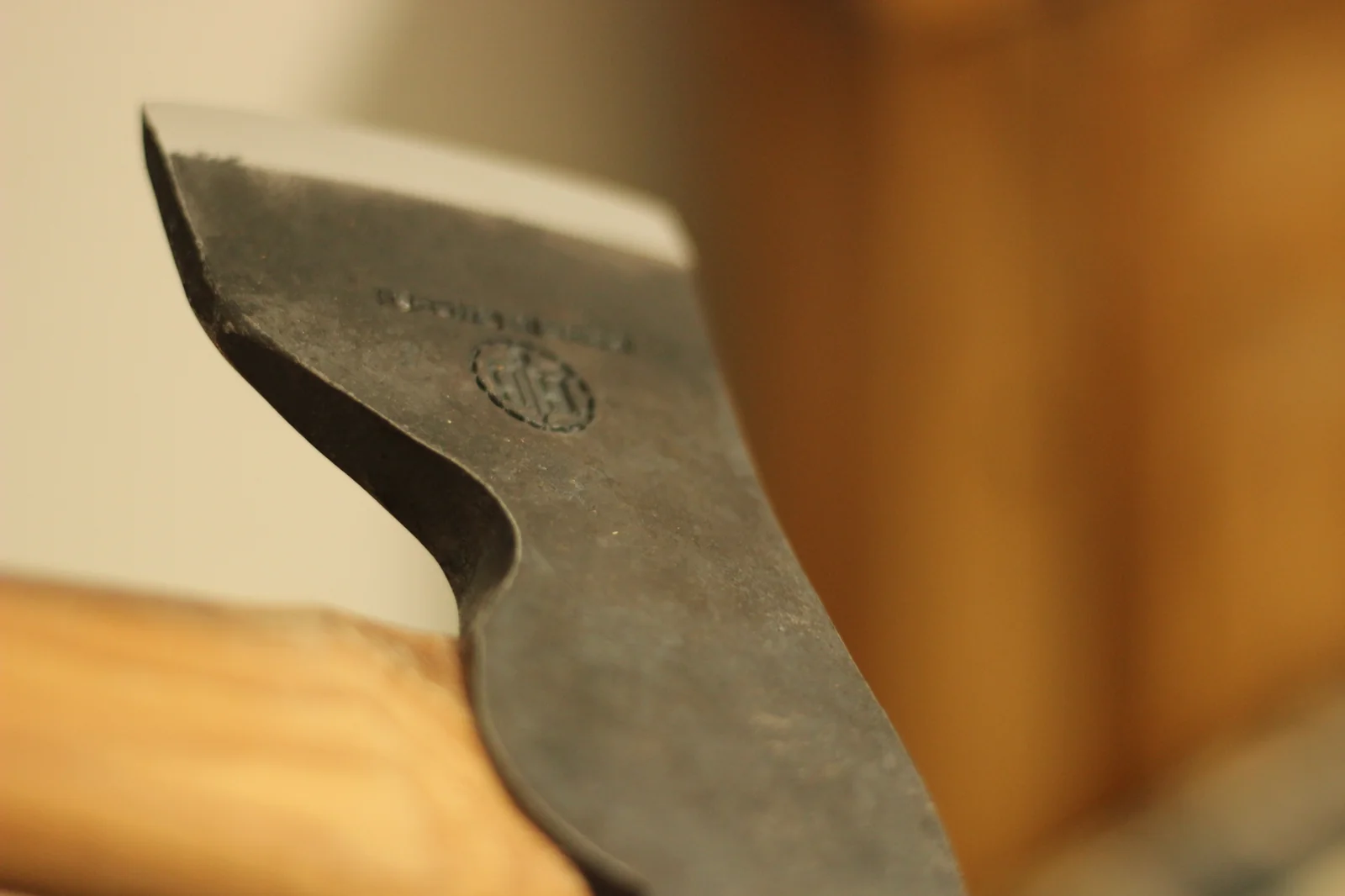
Macro of the HB hallmark and MADE IN SWEDEN stamp hammered into the side of the axe head
Macro of the HB hallmark + MADE IN SWEDEN stamp on the side of the head. This is the forge mark — the proof that this specific axe head was hammered in the Hult Valley. There is no contract-manufactured equivalent of this stamp; only Hults Bruk axes carry it, and only at this forge.
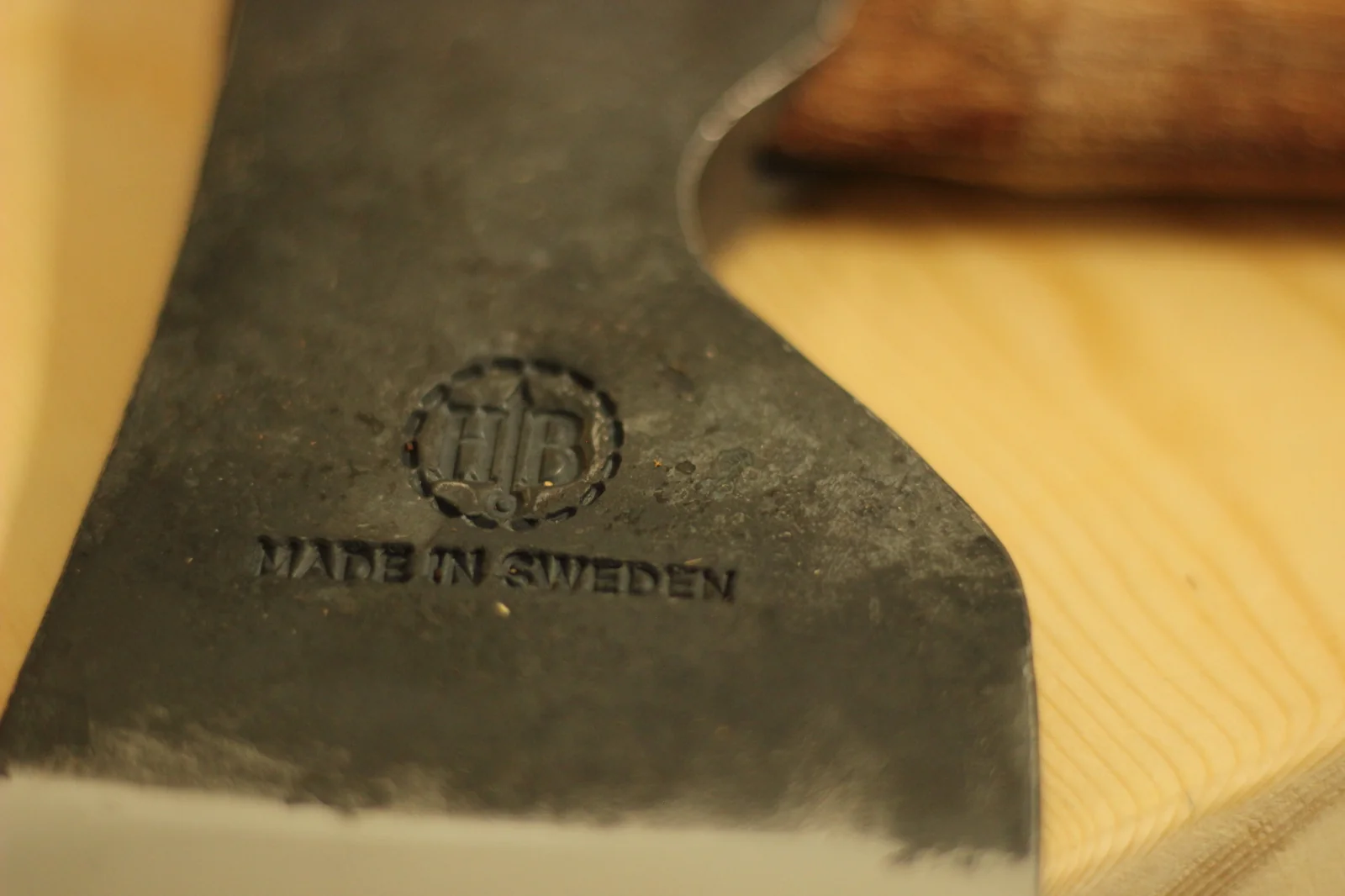
Detail of the MADE IN SWEDEN stamp visible just above the polished and lightened cutting edge of the axe head
The same stamp from a different angle, with the polished cutting edge visible at the bottom. The transition from the blackened forged body to the polished edge is the visual signature of a hand-finished hunter's axe — Hults Bruk hand-grinds the edge to its final geometry, then polishes the bevel to a mirror that catches light from a sharp line.

The steel — Swedish recycled CO₂-neutral steel, hand-forged

Hults Bruk’s documentation is specific about what goes into the head. The spec sheet inside the box reads, word for word: “Hand forged and made from Swedish, recycled CO₂ neutral steel.” Three things in that sentence are worth understanding:

  • Swedish steel. Sweden has been one of the world’s premier steel-making regions for centuries, with its iron ore reserves and the metallurgical tradition that grew up alongside them. Hults Bruk uses Swedish steel because the forge sits inside that tradition — the same geographic and supply-chain context that has been producing the world’s premier tool steels for as long as tools have been made of steel.
  • Recycled. The starting feedstock is recycled steel rather than virgin ore. This is the sustainability backbone of the brand’s modern operation — the steel that becomes a 30-year heritage hunter’s axe was metal in some other previous life, repurposed and re-forged into a tool that will last.
  • CO₂-neutral. The Hults Bruk forge runs on green energy, which means the embodied carbon footprint of the steel that becomes your axe head is significantly lower than the global steel industry average. For a tool that will last 30+ years, the embodied-carbon math is genuinely good.

The forging process itself is what the “hand forged” claim means in practice. The steel is heated to forging temperature, then progressively hammered into the head’s profile by a working blacksmith at the Hult Valley forge. The blackened finish on the body of the head you see in every photograph is the natural mill scale that forms during this process — it isn’t a coating that can chip off, it’s the iron oxide that forms on the steel surface during forging and partly protects the head from rust over time. Then the cutting edge is hand-ground to the final bevel geometry and polished to the mirror finish you see in the close-ups above. Every Dvärdala head goes through this process individually — there is no contract-manufactured equivalent of this work.
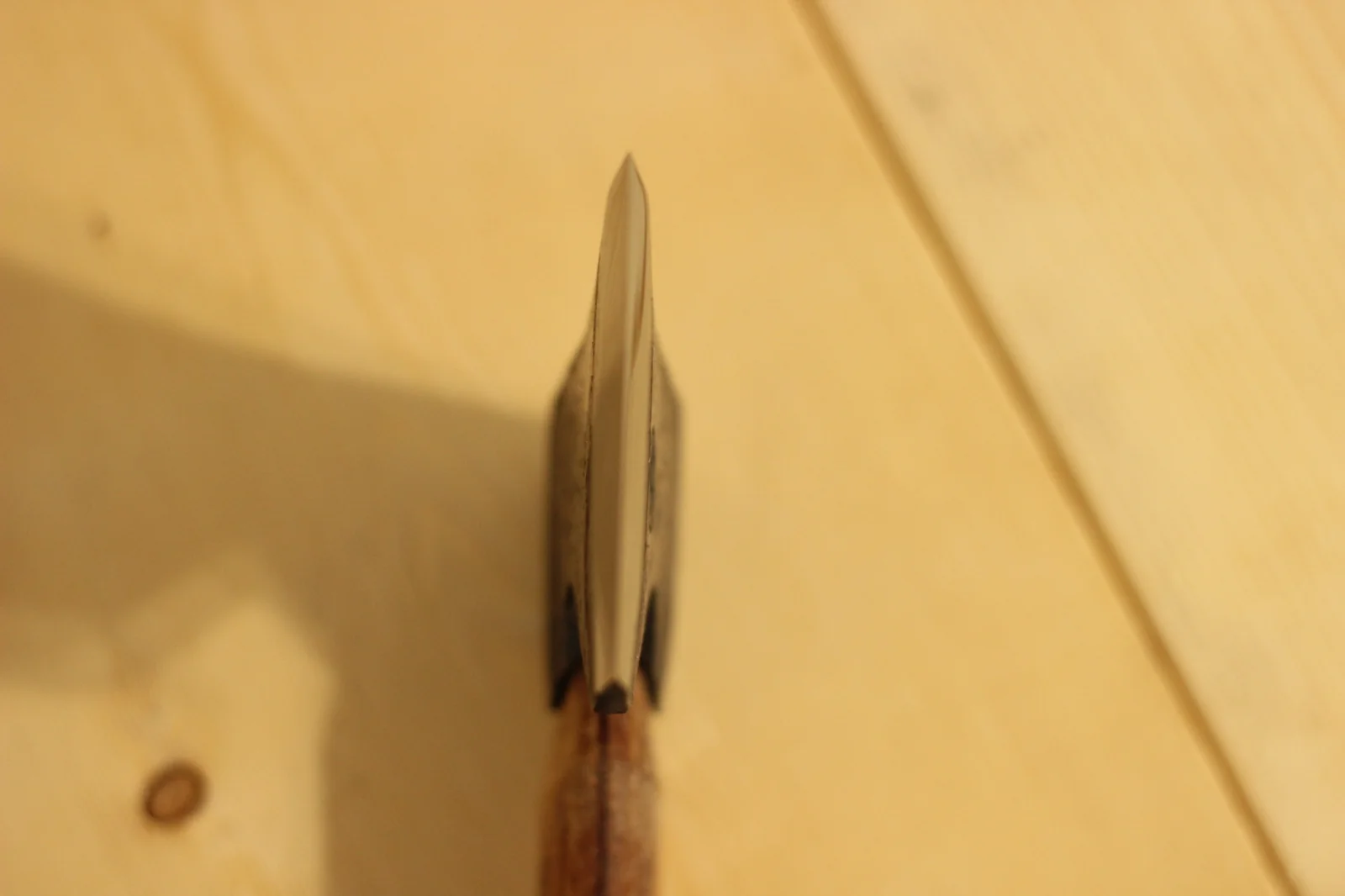
Top-down view straight along the polished cutting edge of the axe showing the symmetry of the bevel and the slight curve along the edge line
Looking straight down the polished edge. The bevel is symmetric, the curve along the edge line is the slight convex sweep that gives the axe both bite and follow-through in a chop, and the polish on the bevel is the visual proof that this edge was hand-finished, not contract-ground.
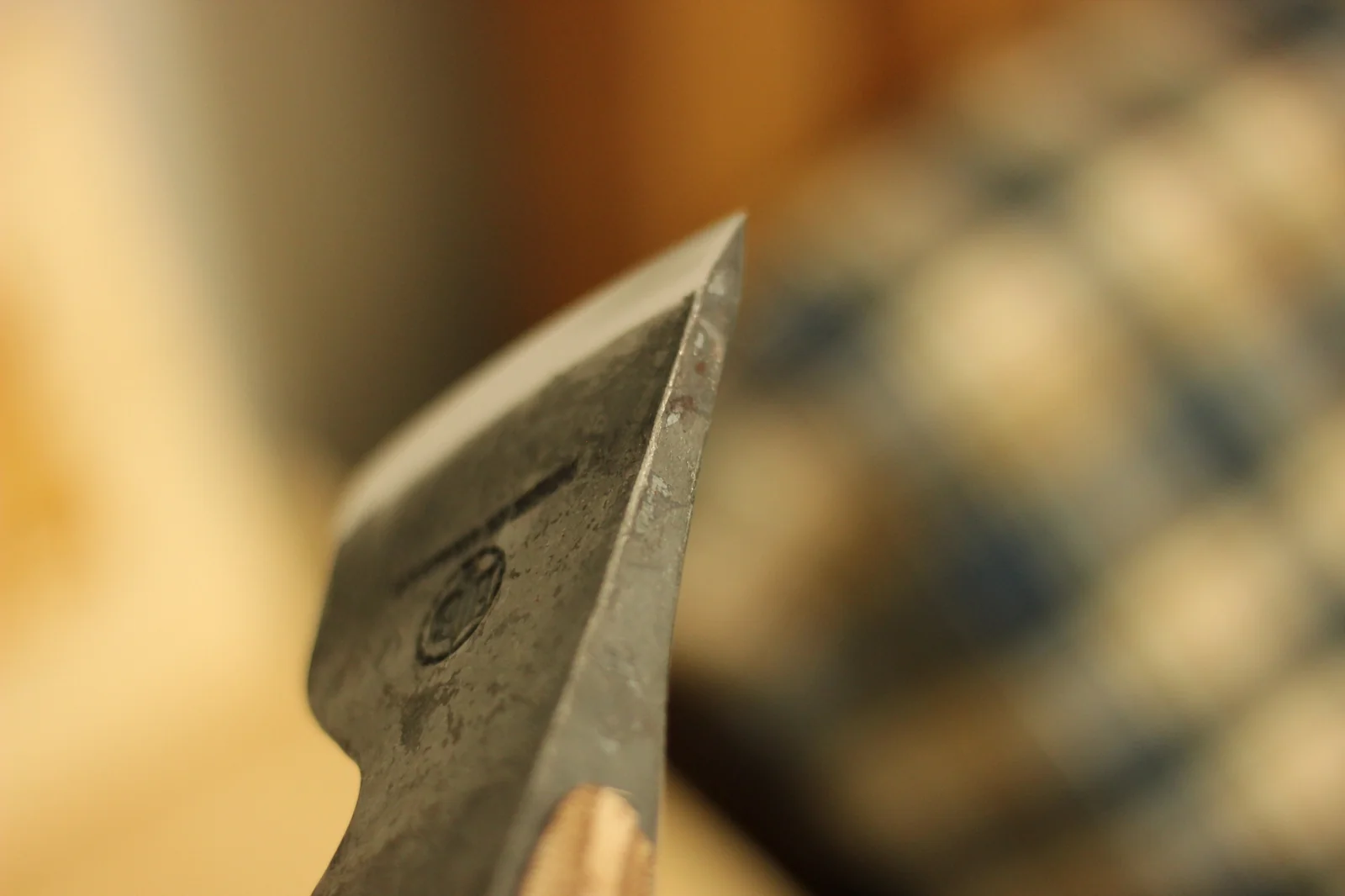
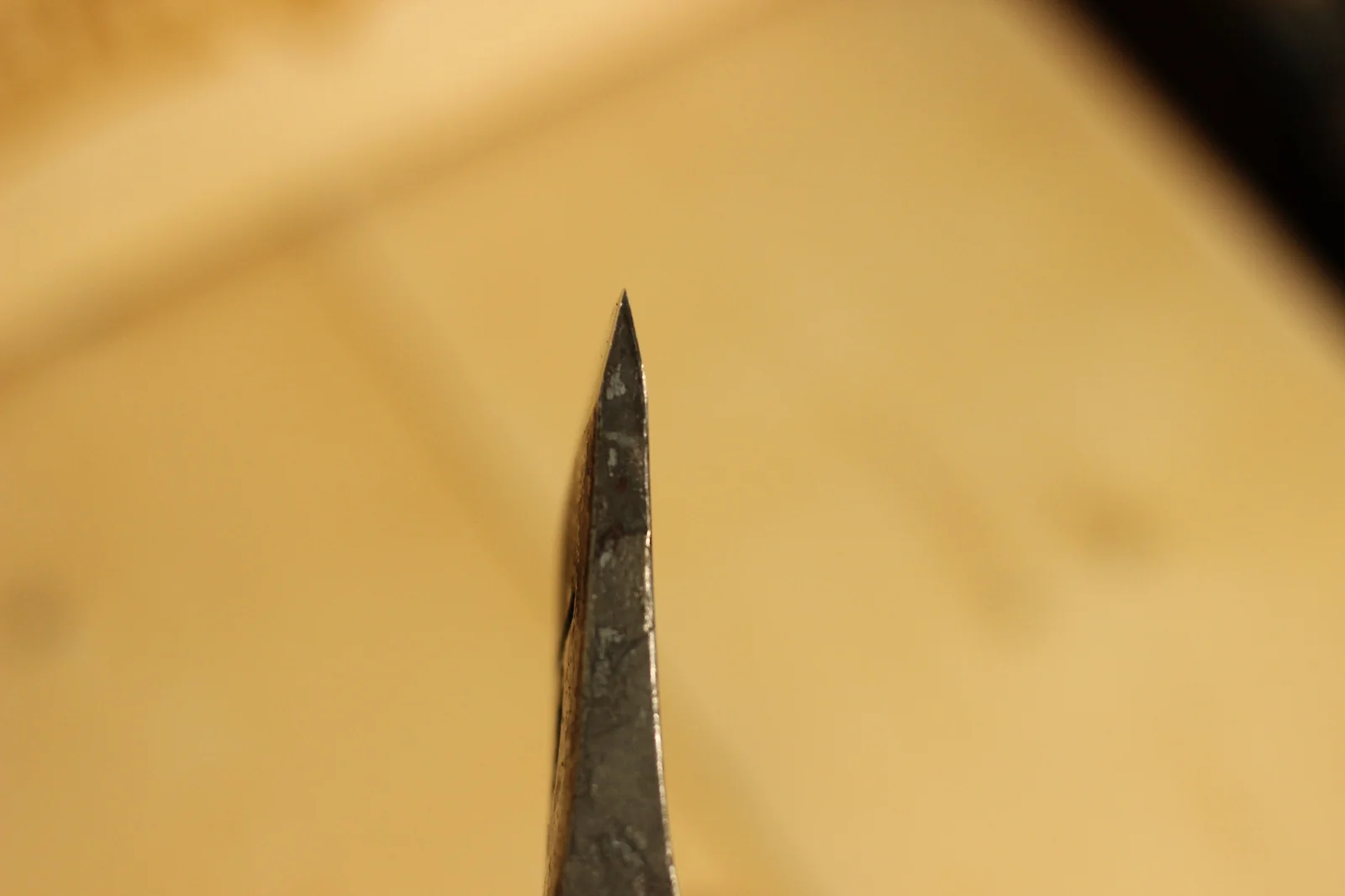
Macro close-up of the polished cutting edge tip showing the sharpness line where the blackened forged steel transitions to the polished bevel
Macro of the polished edge tip. The transition line between the blackened forged steel and the polished bevel is razor-sharp out of the box — we sliced paper on first contact, which is the universal first test most reviewers and most owners run. Survival Common Sense, The Camping Nerd, and the BushcraftUK community all report the same paper-slicing result on their Dvärdala unboxings.
Side profile of the axe head from a low angle with the HB hallmark stamp visible just behind the polished cutting edge
Low-angle side profile with the HB hallmark stamp catching the light. The hand-forged surface texture of the body of the head is visible — every dimple, every hammer mark, is a record of an actual blacksmith working the steel at the forge.
Full side profile of the axe head showing the squared poll at the back and the curved cutting edge at the front
Full side profile, head only. The squared poll at the back is the part of the head a hunter uses for batoning, peg-driving, and the occasional improvised hammer task — the kind of camp work that comes up more often than the YouTube reviewers admit. The Dvärdala's poll is sized for it.
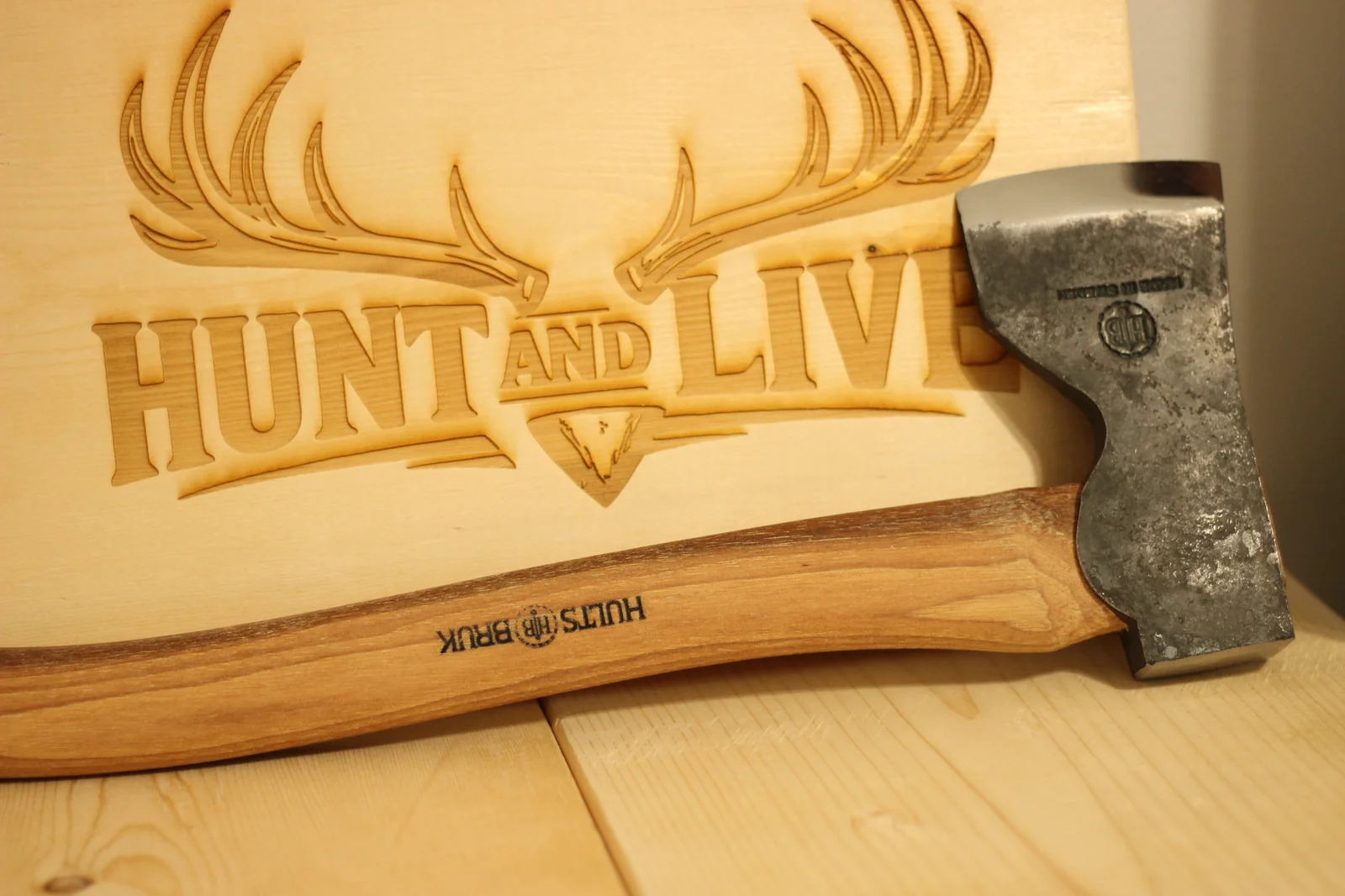
Hults Bruk Dvärdala axe leaning at an angle in front of the Hunt and Live laser-engraved wooden plaque with the deer skull and antlers
Hero shot of the Dvärdala against the Hunt & Live laser-engraved wooden plaque. The HULTS BRUK branding on the handle is visible. The blackened head and polished edge catch the light. This is the editorial portrait of the tool we're recommending — the tool we'd hand to any serious hunter or outdoorsman as the starting point for a real heritage-axe ownership story.

The paired-system beauty shots — leather work as the editorial signature
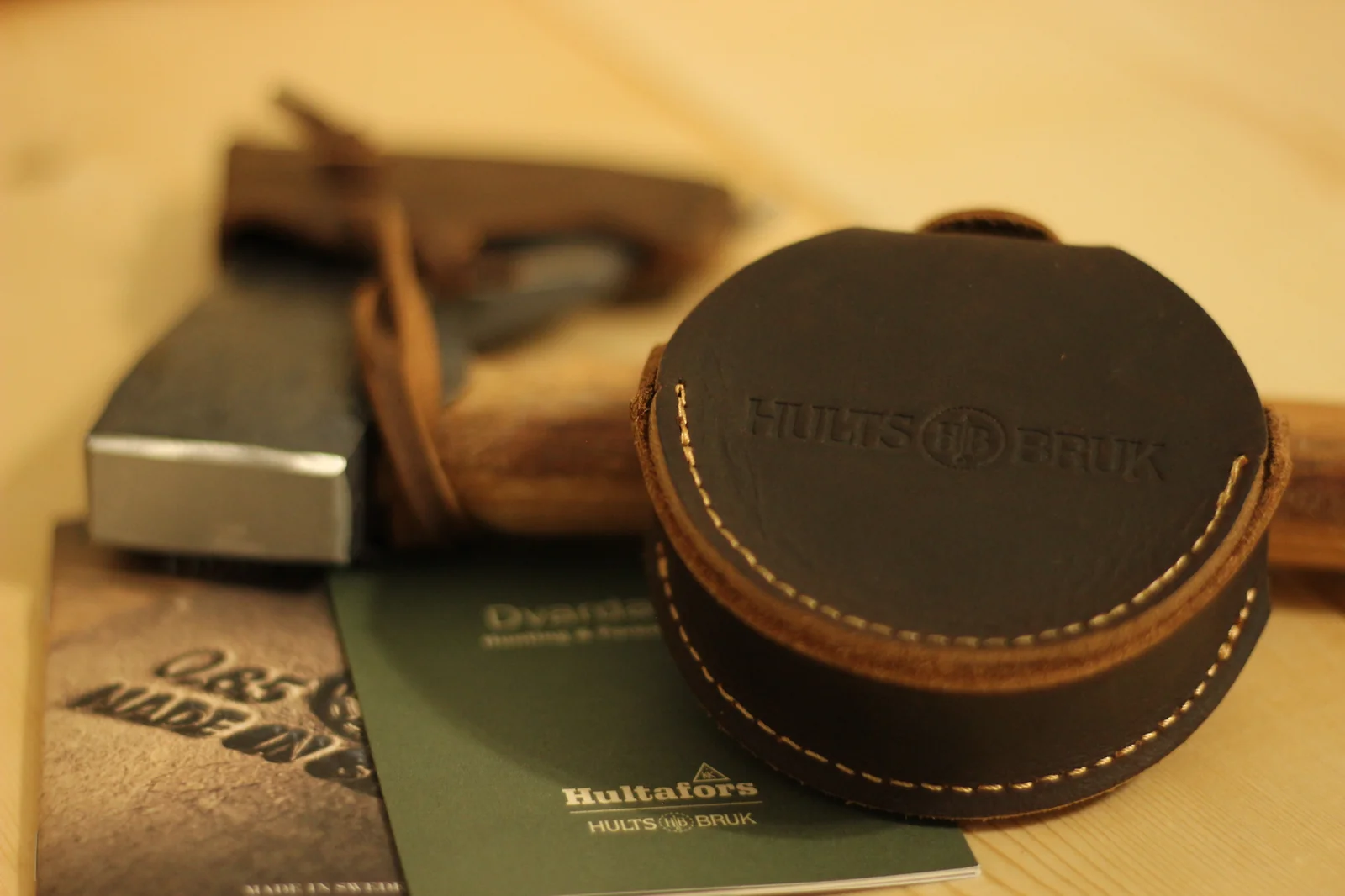
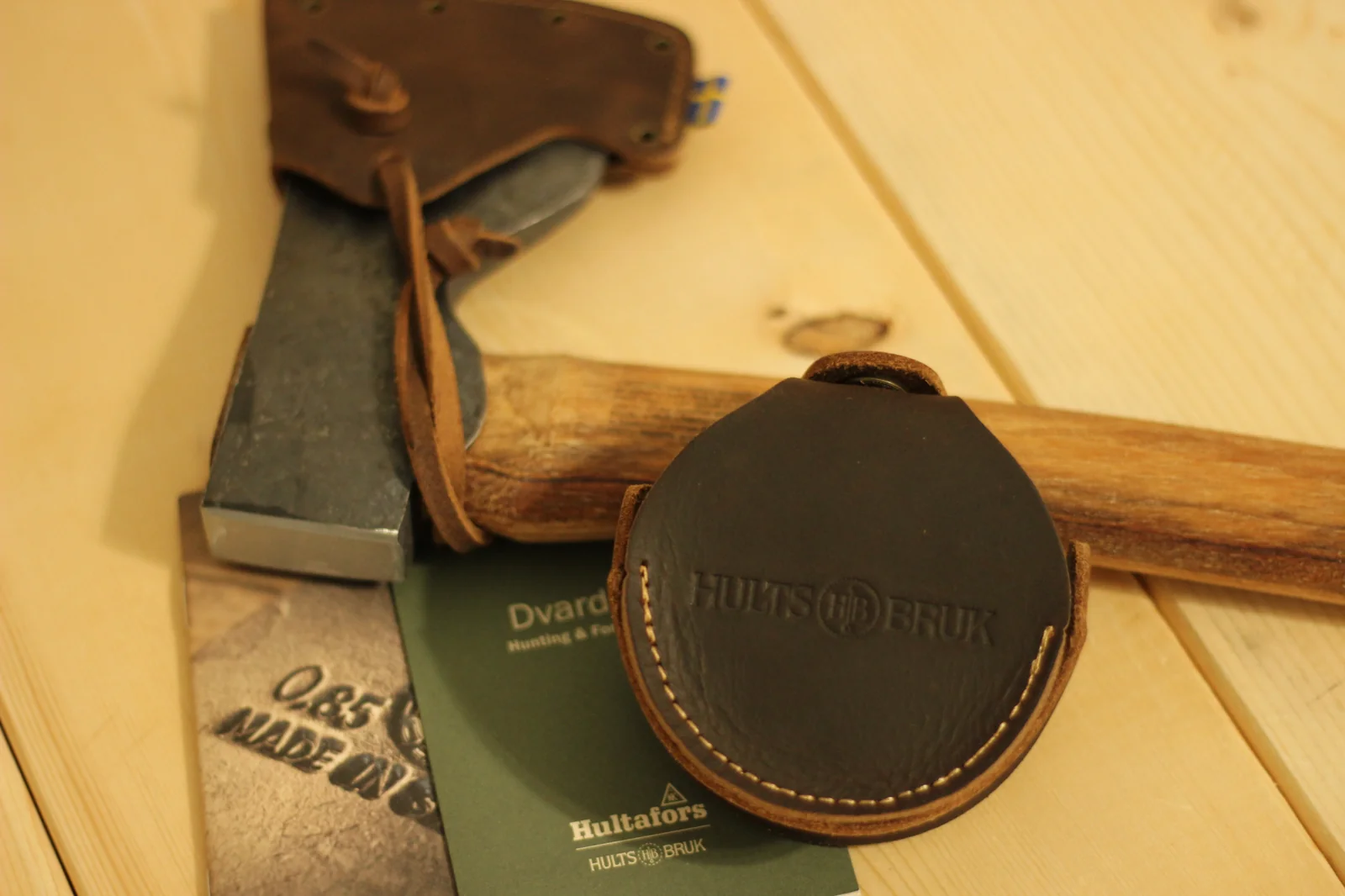
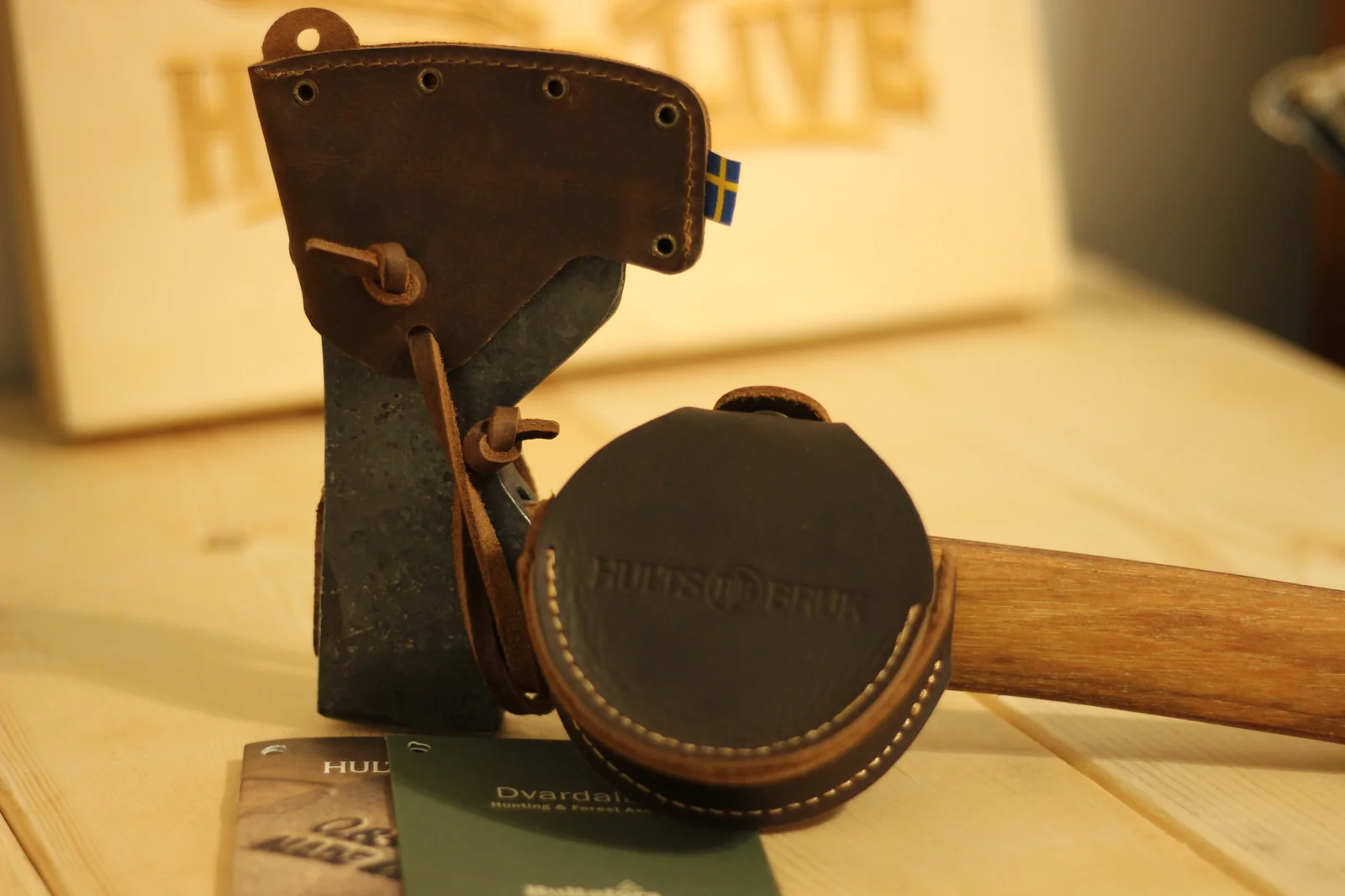
Hults Bruk leather grinding stone pouch in foreground with the axe sheath, axe head and handle, and the Dvärdala booklet arranged behind it on a wood surface
The paired system as a single piece of editorial photography. The round leather grinding-stone pouch in the foreground with its HULTS BRUK embossing; the axe sheath, head, and handle behind it; the green Dvärdala — Hunting & Forest Axe booklet under the pouch. This is the paired-system frame the entire review is built around.
Same paired arrangement from a higher angle showing the leather grinding stone pouch the axe head in its sheath the handle and the Hultafors Hults Bruk booklet
The same arrangement from a higher angle. Both leather goods — the axe sheath and the grinding-stone pouch — are visible together, and their construction language matches perfectly. Same leather, same hand-stitching, same brass hardware, same HB embossing pattern. This is the kind of design coherence that only comes out of a single in-house workshop.
Both Hults Bruk leather pieces standing up together with the axe sheath and stone pouch visible and the Hunt and Live wooden plaque background behind
The paired system standing up, with the Hunt & Live plaque behind. The axe in its sheath at the rear, the round grinding-stone pouch in the foreground, the Dvärdala booklet on the table edge. This is what completes the hunter's axe + maintenance system editorial. Almost no reviewer pairs the axe with the maintenance gear; we're doing it because that's how the system is actually owned over a 30-year horizon.

In the field — what the Dvärdala actually does with wood

We took the axe outside and put it to work. The frame of this v1 review is build-quality and editorial-coherence — the in-depth real-season fieldwork (the 2-week multi-day hunting deployment, the carve-and-cut testing of every supported task, the documented edge-degradation curve over a full season) we’re reserving for a v2 follow-up that will run in the fall hunting season. What we did do is take the axe out to real outdoor wood, chop, split, and process — enough to verify that the construction performs the way the heritage-and-spec story says it should.
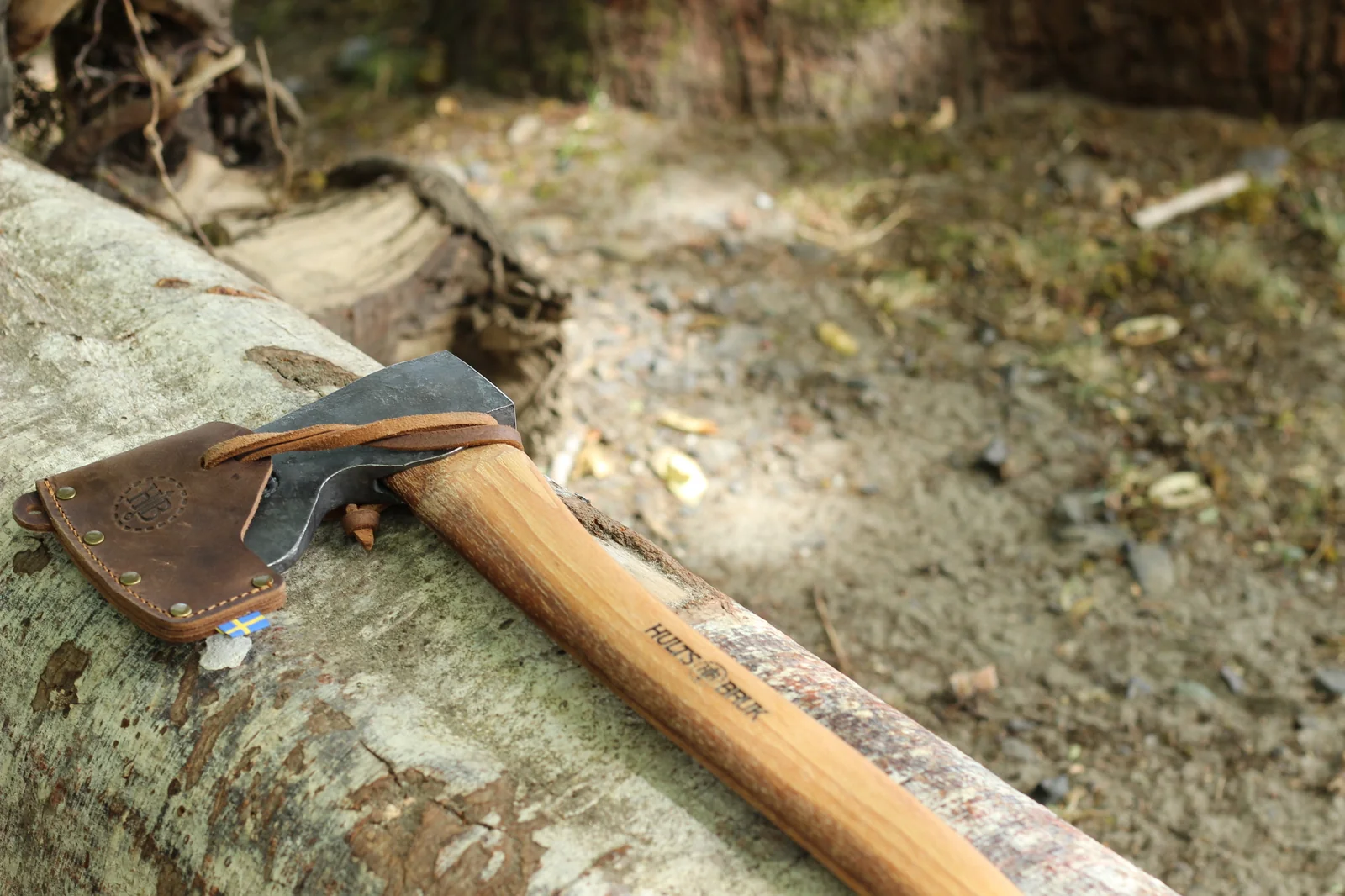
Dvärdala axe with leather sheath lying on a fallen log in an outdoor wooded setting
The Dvärdala in its sheath, lying on a fallen log in a real outdoor setting. This is the moment the axe transitions from being a piece of bench-photography content into being a real working tool with a real piece of wood at stake.
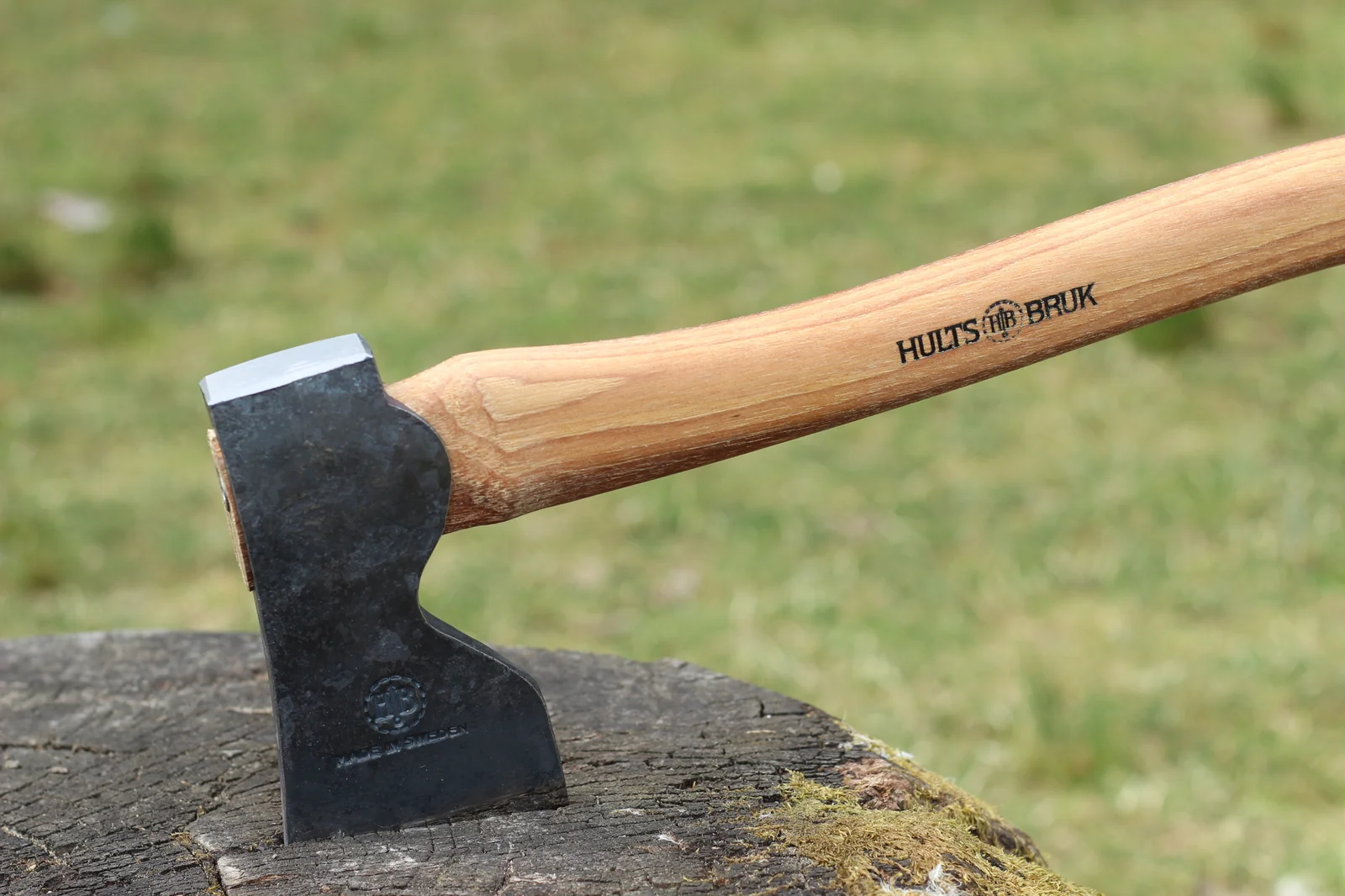
Close-up of the Hults Bruk Dvärdala head buried in a tree stump with the HULTS BRUK branded handle extending up to the right
Close-up of the head buried in a hardwood stump after a swing. The HULTS BRUK brand mark on the handle is clearly visible. The depth of bite at this swing weight is exactly what the cheek geometry predicts — the axe wants to chop, and it does.
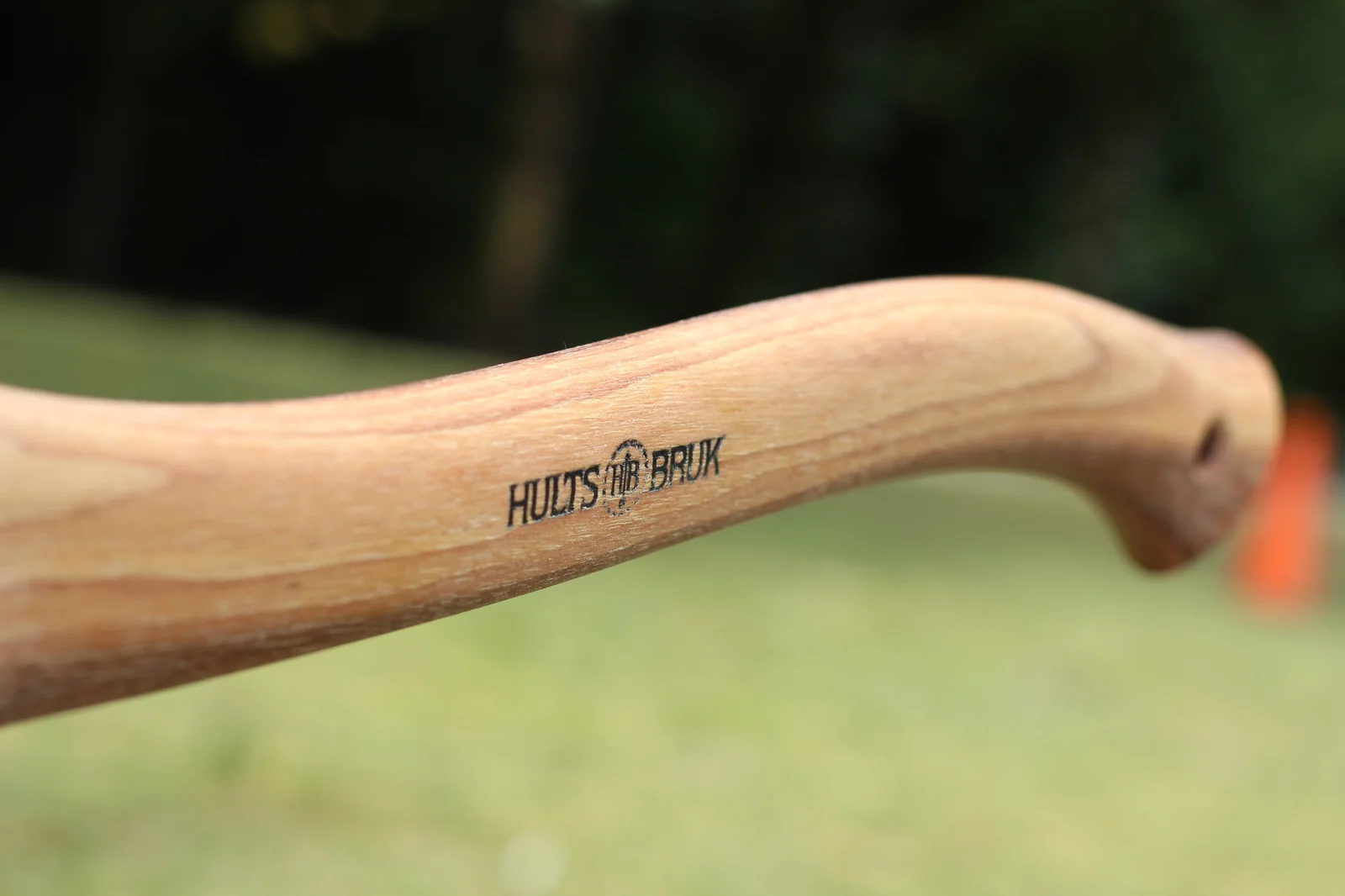
Macro of the Hults Bruk laser-printed brand mark on the curved hickory handle photographed outdoors with green grass in the background
The HULTS BRUK brand mark on the curved hickory handle, photographed outdoors. This is the part of the tool you see every time you grip it — the brand running parallel to the swing axis, exactly where the eye lands when you reach for the handle.
View from behind the axe head showing it buried deep in a tree stump with the polished cutting edge visible at the top and the HB stamp visible on the side
The head buried in the stump from a back-angle. The polished cutting edge catches light at the top of the frame, the stamp is visible on the side, and the depth of bite is what we expected from a head at this weight on solid hardwood. The Dvärdala is not a felling axe and it is not pretending to be one — but for the kind of camp-and-hunt processing work it's designed for, it bites with authority.
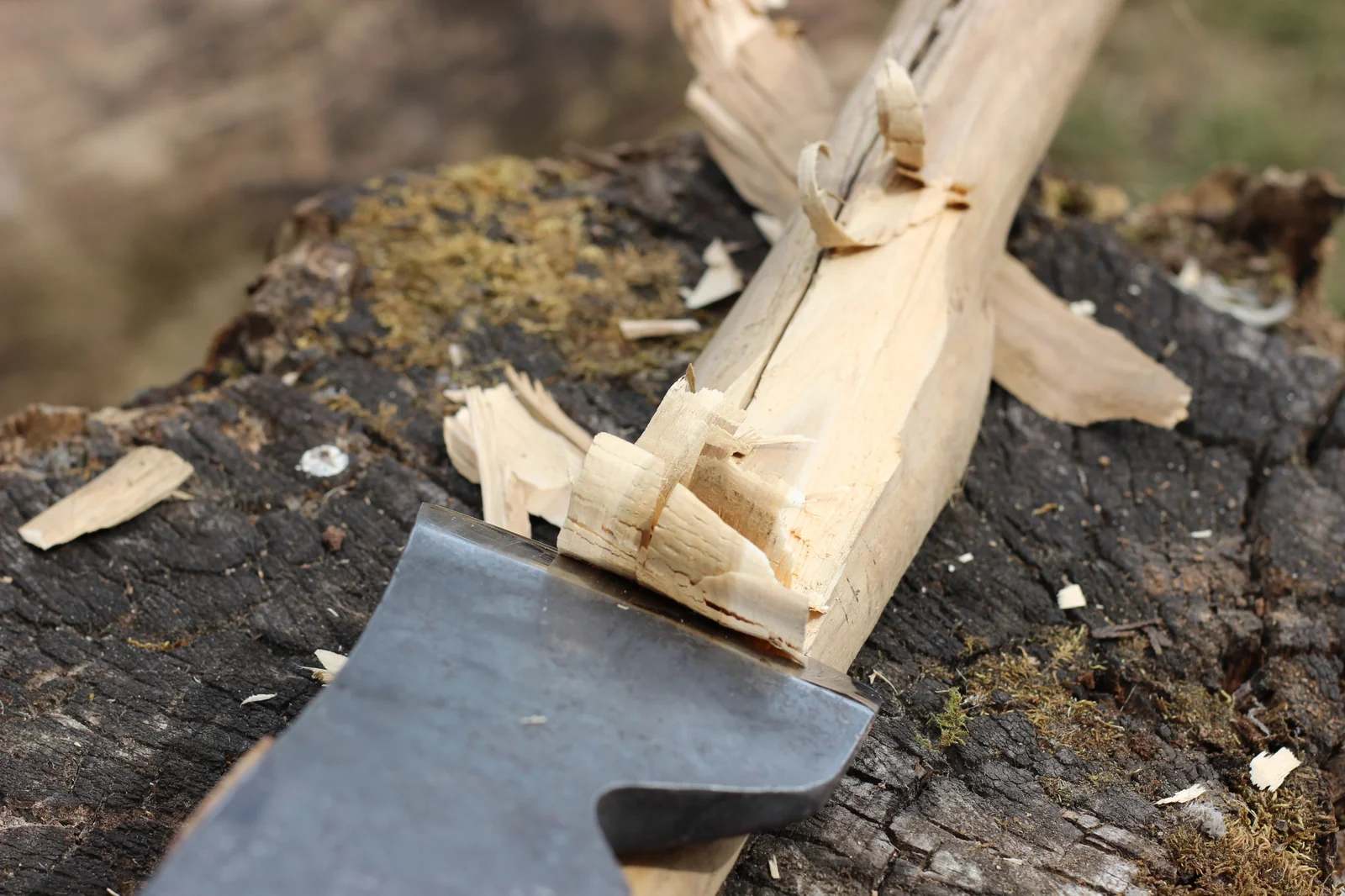
Axe head working on a small piece of wood on top of a stump with fresh wood chips strewn around
The Dvärdala mid-task on a small piece of wood set on the stump. Fresh wood chips strewn around — the visible record of actual work, not staged for the camera. This is what kindling prep looks like at a real camp.
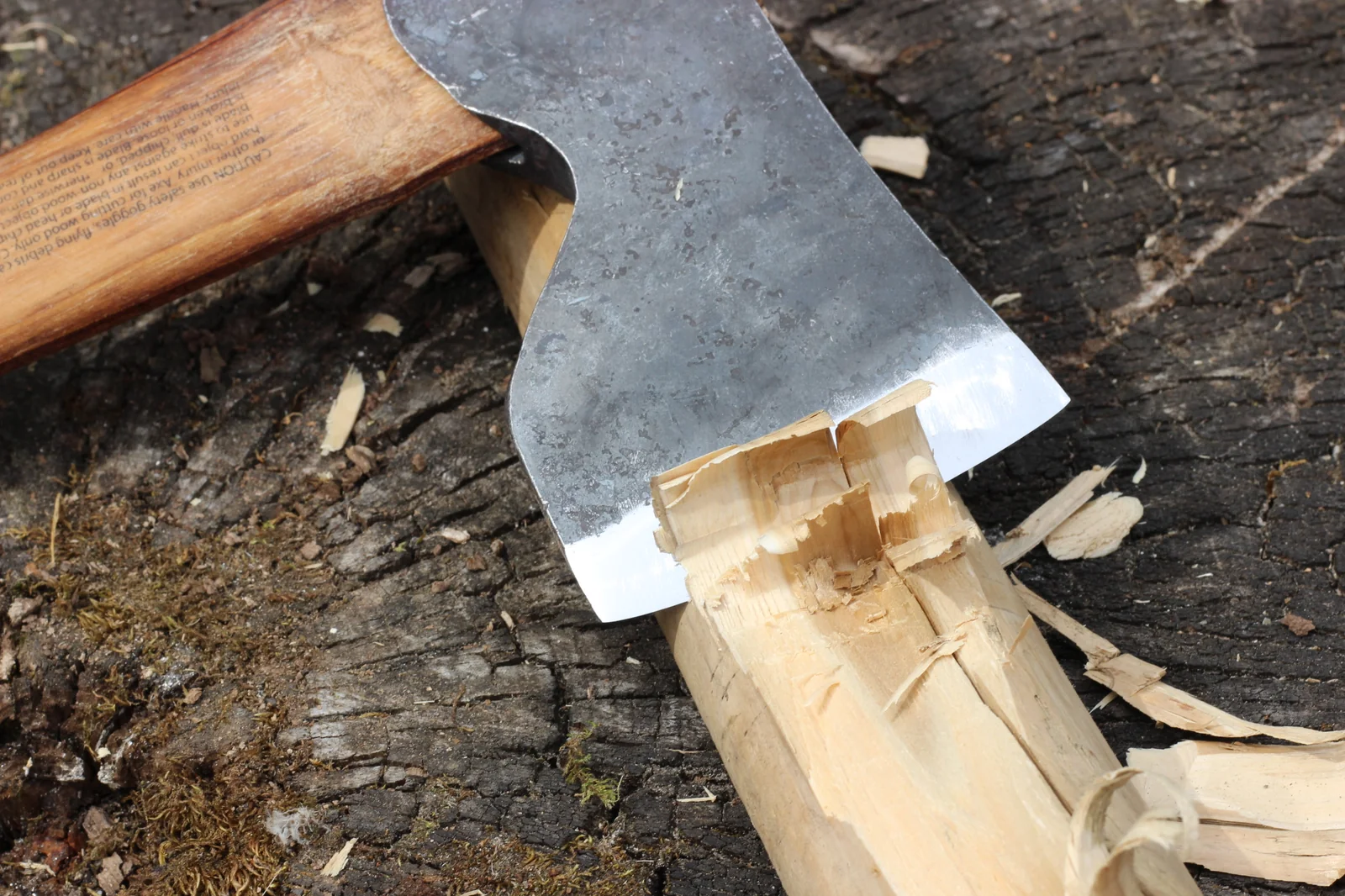
Side view of the axe head splitting a piece of kindling on top of a tree stump showing the wood splitting open under the polished edge
Side view of the axe splitting kindling. The wood is opening cleanly under the polished edge — exactly the result the thicker cheek geometry was engineered to produce. The splitting case for the Dvärdala holds up under real fieldwork.
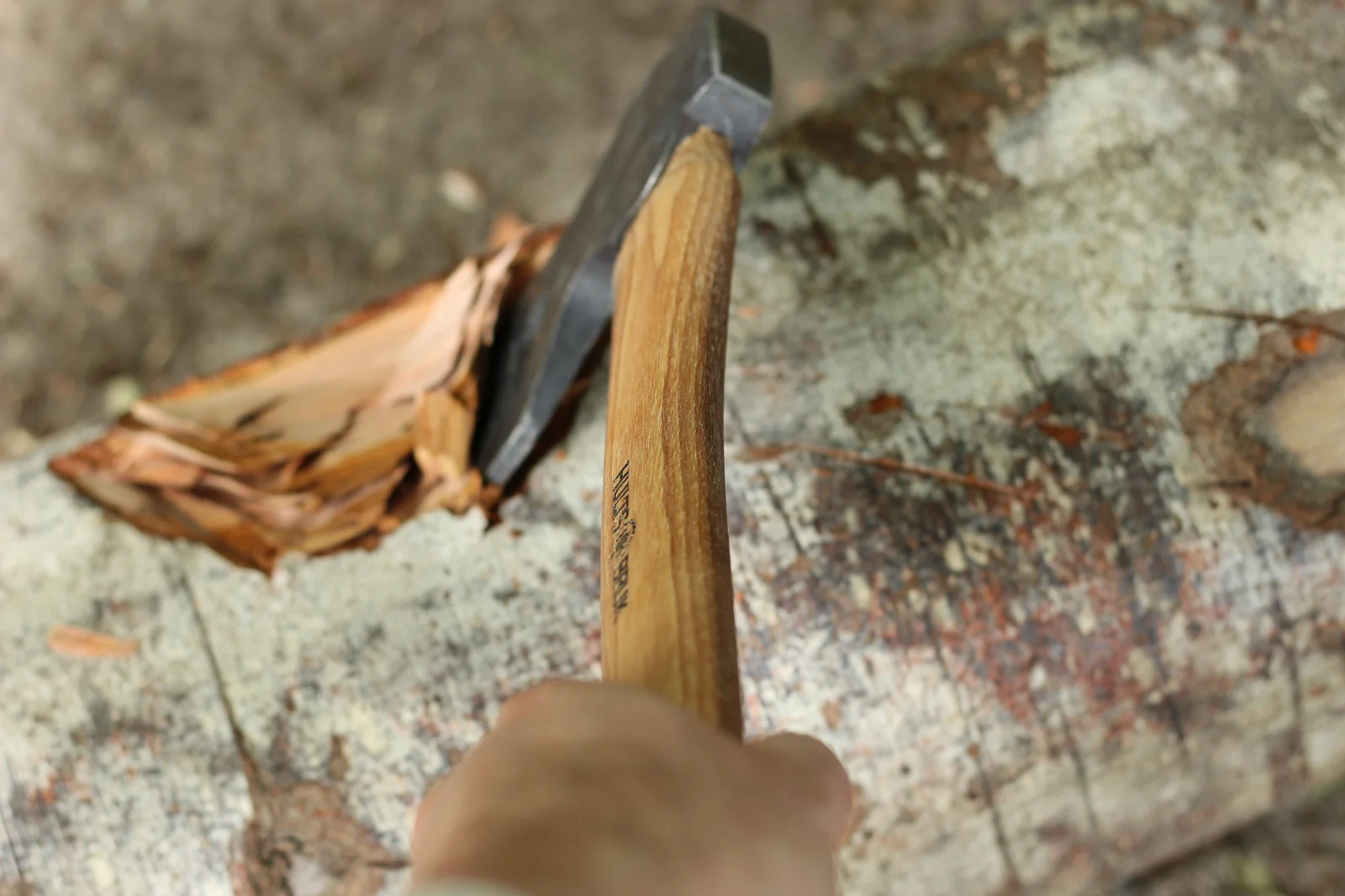
View from behind the axe along the handle looking down at split kindling on a stump with the axe head buried in the wood
Looking down the handle from the swinger's perspective — split kindling on a stump, head buried, hand still on the grip. The 17-inch handle is the right length for this one-handed work. Longer and it would feel unwieldy on a hunter's belt; shorter and it would not generate the swing weight needed for harder pieces.
Close-up of the axe head deeply buried in split firewood with fresh chips around
The head deep in a split log. Fresh chips around. The blackened forged body and polished edge are doing exactly what they were designed to do. "For a compact axe, the power and control is remarkable" — that's a quote from one of the external reviewers in the next section. Our findings line up with theirs.
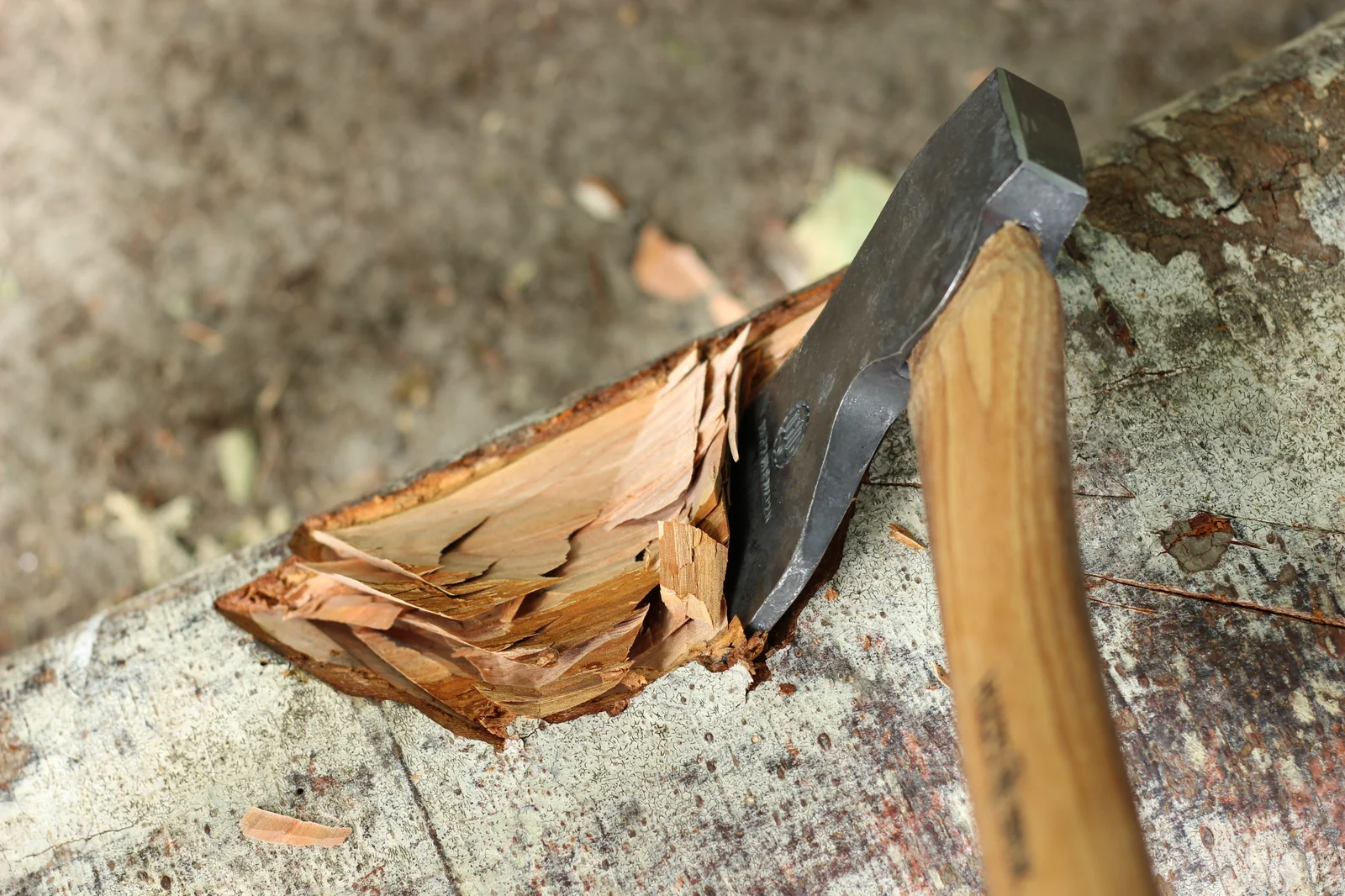
Axe head buried in a horizontal birch log laid on its side with the handle extending up to the right
The axe buried in a horizontal birch log laid on its side. Birch is one of the most common northern hardwoods a hunter actually processes — for kindling, for small camp fires, for the occasional shelter pole. The Dvärdala handles it without complaint.
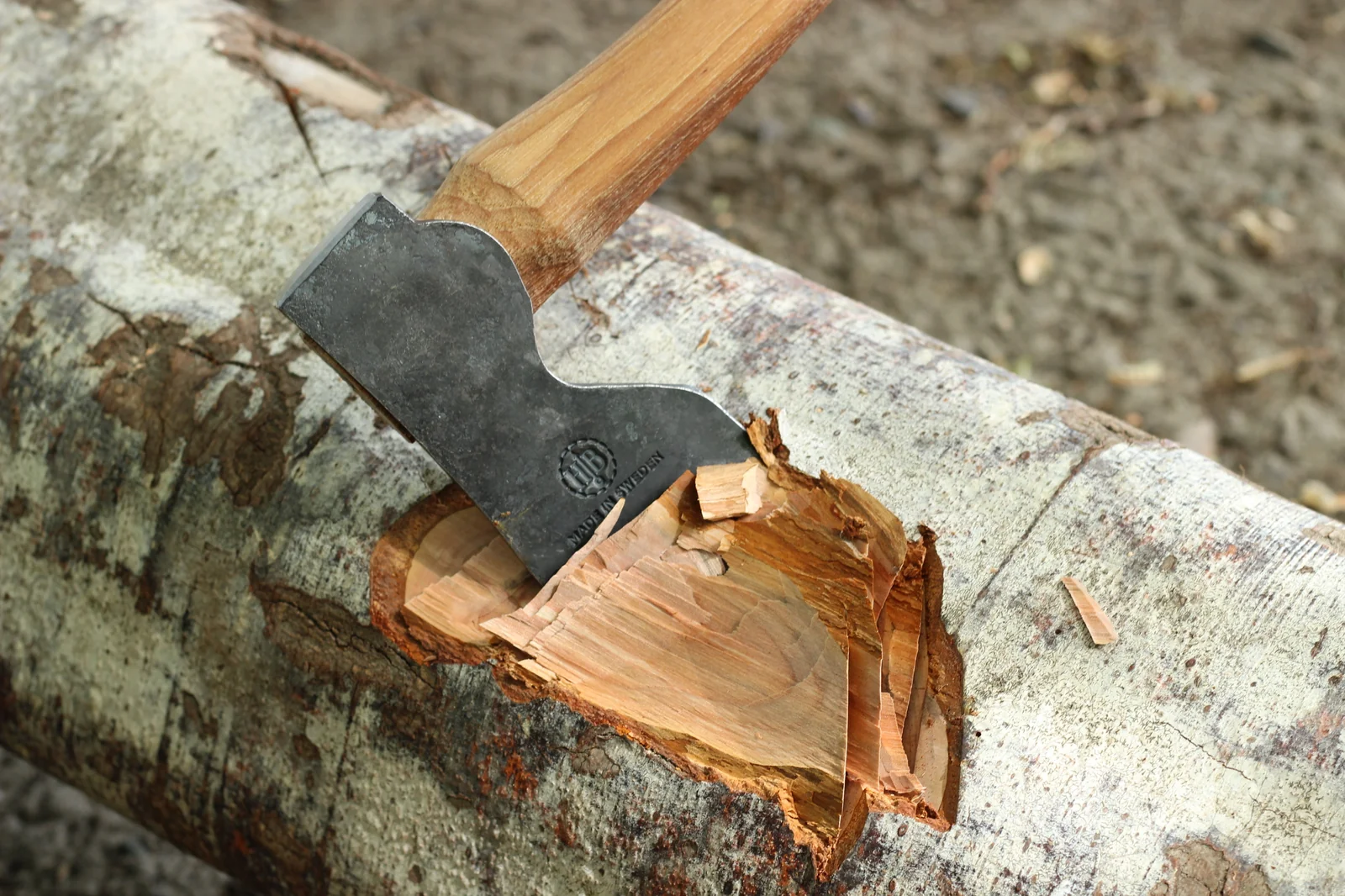
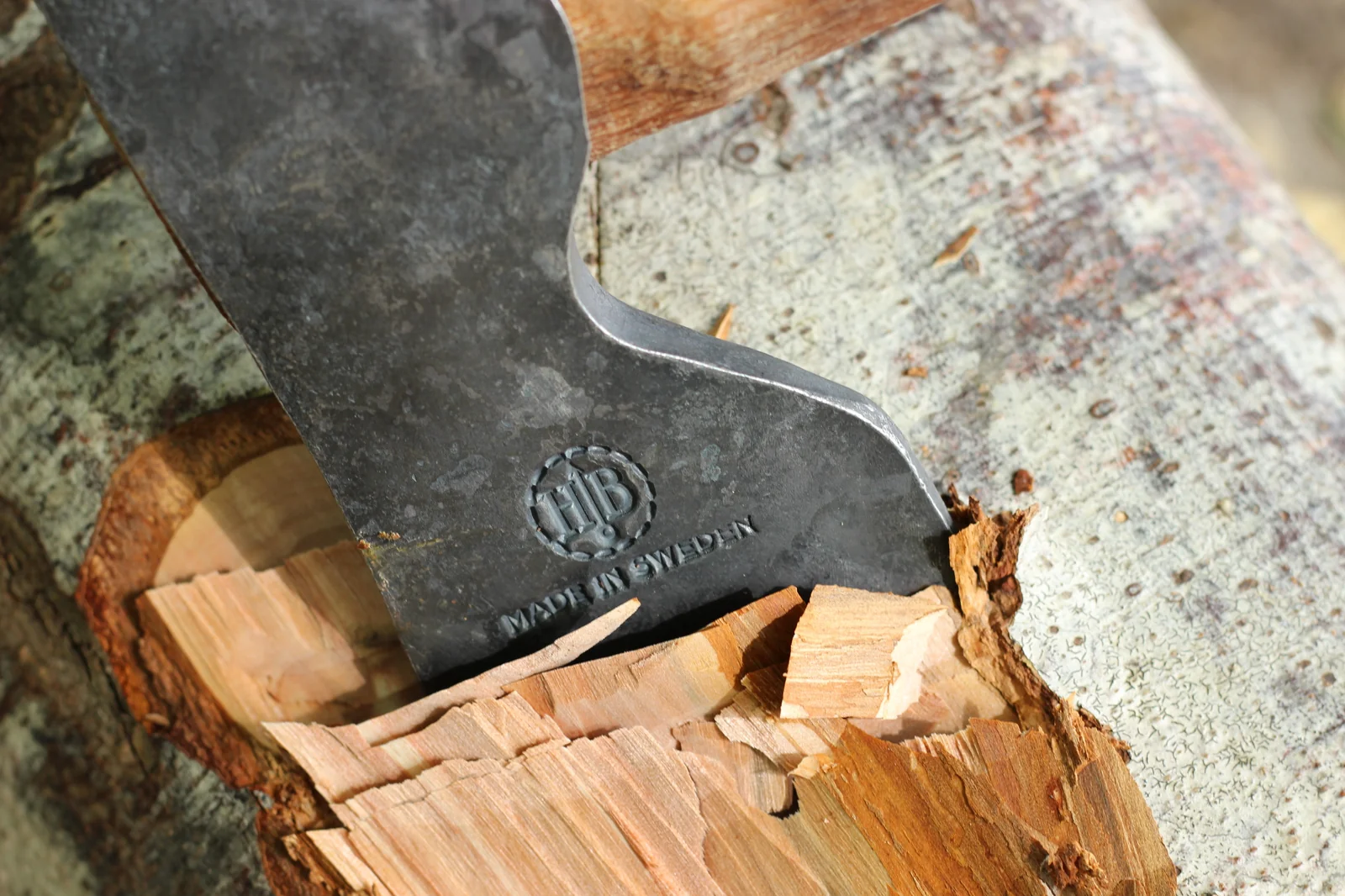
Close-up of the Hults Bruk HB stamp and MADE IN SWEDEN text on the axe head buried in birch wood
Closing detail — the HB hallmark + MADE IN SWEDEN stamp visible on the axe head, buried in birch wood, with the fresh chips of a real split visible behind. This is the editorial image that closes the case. Heritage tool. Real work. 328 years of forge tradition. Made in Sweden, sharpened on the Hults Bruk stone, owned for the next 30 years.

What other people are saying — the community read on the Dvärdala

We’re not the only reviewers who’ve taken this axe seriously. The Dvärdala has been covered across the bushcraft, hunting, and survival publication ecosystem for several years, and the community read is remarkably consistent. We pulled the most editorially serious external reviews and community discussion threads to anchor what we found:

  • Survival Common Sense — “Review: Best all-around axe? Hults Bruk Dvardala” — found the axe sharp enough to slice paper out of the box; describes the head as “hand forged at the historic Hults Bruk, a forge that has been in operation since 1697 — blackened, hand-finished, razor-sharp with a polished edge.” Their verdict matches ours.
  • The Camping Nerd — “Is The Hults Bruk Dvardala Worth It? Here’s What I Think” — frames the Dvärdala as the same head profile as the Hults Bruk Akka forester’s axe but with a shorter, more portable 17.5-inch handle. They describe the cheek geometry as “slightly thicker over the cheeks, giving it good splitting capabilities for chopping firewood," which is the same engineering observation we made independently.
  • REI Co-op — the Dvärdala product page at REI is the largest US retail listing, and the customer ratings track with the editorial reviews — consistent high marks for build quality, sharpness, and balance.
  • Axe & Tool — “Gransfors Small Forest Axe vs Hults Bruk / Hultafors” runs a head-to-head comparison between the two big Swedish forge brands (Hults Bruk and Gransfors). The conclusion is that they are both genuinely excellent hand-forged options at this tier, with the choice often coming down to handle preference and individual fit.
  • BushcraftUK Community — the long-running thread Hults Bruk – Hultafors Axes….are they any good? is the British bushcraft community asking the same question every prospective heritage-axe buyer asks. The answer in the thread is consistently positive.
  • Reviewer consensus“If you’re looking for a compact forest axe that balances craftsmanship with genuine versatility, the Dvardala is hard to beat. Taken as a complete kit, the Dvardala impressed reviewers more than expected. For a compact axe, the power and control is remarkable and the versatility of the head design makes it one of the more well-rounded outdoor tools.”

If your prospective-buyer process is to read every available review before committing to a multi-decade tool — and it should be — these are the resources we’d point you to. Our review aligns with them.

Where the Dvärdala genuinely shines — and where we’d note the trade

We are honest about the trade-offs.

The Dvärdala is a hunting and forest axe — purpose-built for the camp-and-pack-in work most hunters actually do. Game-processing assistance, kindling for the camp fire, brush clearing along a trail to a stand, the small-to-medium log splits that come up around camp. It is not a felling axe and it is not a competition splitting maul. If you need to fell a 30-inch hardwood tree or split full rounds of seasoned oak all winter, that’s a different tool — Hults Bruk makes those too (the Aby Felling Axe, the Kalix Splitting Maul, etc.), and they’re in the same family.

What the Dvärdala does, however, it does at a level very few competitors approach. Hand-forged. Hand-finished. Hand-stitched leather. Lifetime warranty. 328 years of forge tradition under the steel. And the companion 180/600 Grinding Stone closes the maintenance loop in a way no plastic-puck competitor matches.

The trade-off worth flagging: this is a specialty-retail purchase. You’re not going to walk into a big-box outdoor store and find a Dvärdala on a peg. You’ll order direct from Hults Bruk (the US site at us.hultsbruk.com is the route while the EU site is in transition), or you’ll order through a specialty dealer. That extra step is the difference between this and a mass-market axe — and for a tool you’ll own for 30 years, it’s not a meaningful obstacle.

How we’ll use the Dvärdala going forward

This v1 review is the introduction to the tool. The Dvärdala will appear continuously in our hunting coverage from here forward — when we cover a stand-hunt with a fire-pit warming break, the Dvärdala is the axe that processed the kindling. When we cover a multi-day pack-in trip, the Dvärdala is the axe on the belt loop. When we cover game-processing in the field, the Dvärdala is the tool we reach for. This is the long-term-ownership story coming through the editorial.

Hults Bruk Dvärdala axe head buried deep in a split log with fresh wood chips surrounding the impact
The Dvärdala mid-task — head buried deep in a split log, fresh chips around. The thicker cheek geometry, the polished edge, the 17-inch curved hickory handle, and 328 years of Hult Valley forge tradition all doing exactly what they were built for.

Bottom line — every hunter and outdoorsman should own one of these

The Hults Bruk Dvärdala Hunting & Forest Axe paired with the Hults Bruk 180/600 Grinding Stone is the cleanest expression of what a heritage hand-forged hunter’s axe ownership story looks like. The axe itself is razor-sharp out of the box, built from Swedish recycled-CO2-neutral steel, hand-forged at the same Hult Valley forge that’s been hammering steel since 1697, on a curved American hickory handle linseed-oil treated and ready to live in the hand for the next 30 years. The companion stone is the edge-maintenance system that honors the heritage construction — coarse 180-grit for restoration, fine 600-grit for routine maintenance, in its own hand-stitched leather pouch built to the same construction language as the axe sheath.

Macro close-up of the HB hallmark and MADE IN SWEDEN stamp on the Hults Bruk Dvärdala axe head buried in birch wood with fresh chips
Closing detail — the HB hallmark + MADE IN SWEDEN stamp on the axe head, buried in birch wood after a real split. The single image that closes the case: heritage tool, real work, 328 years of forge tradition, made in Sweden, sharpened on the Hults Bruk stone, owned for the next 30 years.

Buy direct from Hults Bruk — and register the axe within 3 months of purchase to activate the Hults Bruk Lifetime Warranty.

Rating: 4.8 / 5. This is one of the most editorially complete heritage-tool ownership cases we’ve reviewed this season, and the Dvärdala + Grinding Stone earns its place as a paired-system anchor for our hunting coverage going forward.

The Hults Bruk Dvärdala axe in its leather sheath standing next to the round Hults Bruk grinding stone leather pouch against the Hunt and Live wooden plaque background
The complete paired system — Dvärdala in its hand-stitched sheath, 180/600 Grinding Stone in its matching leather pouch, Hunt & Live plaque behind. This is the kit we'd hand to any serious hunter or outdoorsman as the starting point for a real heritage hand-forged axe ownership story. Hand-forged in Sweden since 1697. Owned for life.
As an affiliate partner, Hunt & Live may earn a commission from qualifying purchases made through links on this page. This does not affect the price you pay. Learn more.
hults-bruk dvardala hunting-axe forest-axe hand-forged swedish-steel hickory-handle grinding-stone sharpening-stone edge-maintenance heritage-tools made-in-sweden
Share