
Featured Review · Le Creuset · Kitchen
Le Creuset Classic Whistling Kettle Review — The Stainless Steel Stovetop Kettle You Buy Once for the Homestead Kitchen
Our Rating
Current Price
- Material
- Polished stainless steel, no enamel
- Capacity
- 1.6 L (1.7 qt)
- Whistle
- Single-tone, fixed
- Base
- Wide, flat, induction-compatible
Pros
- Polished stainless steel body with no enamel coating to chip, scratch, or stain over decades of use
- Single-tone fixed whistle is genuinely pleasant — not the shrill, two-pitch warble most stovetop kettles produce
- Wide flat base is induction-compatible and contacts gas, electric coil, ceramic, and halogen burners cleanly
- Spring-loaded thumb lever on the spout opens the whistle cover without scalding your fingers
- Heat-resistant phenolic handle stays cool enough to grab without an oven mitt on most stovetop runs
- Iconic Le Creuset shape — the same silhouette they've been making since the original enamel kettles
- Works cleanly on a wood-stove cooktop — the wide flat base sits stable on a wood-stove cooking surface and uses the radiant heat efficiently for off-grid kitchens
- Le Creuset limited lifetime warranty for the original purchaser — covers manufacturing defects in materials and workmanship for as long as you own the kettle
Cons
- $200 CAD puts it well above the $20–$40 stovetop kettles that occupy most kitchens
- Polished stainless finish shows fingerprints, water spots, and mineral deposits — it wants a wipe after every use to keep its showroom look
- Single-tone whistle is quieter than the screaming two-tone whistles on cheaper kettles; if you wander far from the stove you might miss it
- 1.6 L capacity is right for two to four cups of tea or coffee — not a big-batch kettle for canning prep or hot-water-bottle filling
The Le Creuset Classic Whistling Kettle is the kind of object that quietly tells you something about how the household around it is set up. People who buy a $200 kettle have already decided they’re not buying another one for a long time — and Le Creuset has been making stovetop kettles in this exact silhouette for long enough that the shape itself is part of what you’re paying for. The shop name has been on French cast-iron cookware since 1925, and the kettle line is what happens when that same “buy it once” philosophy gets applied to the smallest appliance in the kitchen.
This review looks at the Classic Whistling Kettle in polished stainless steel — the no-enamel version — the way a homestead-kitchen buyer should look at it: as a stovetop tool that has to live on a working stove for years, get hammered by hard water, sit through a power outage where the gas burner is doing all your cooking, and still whistle on cue when the water boils. We’ll go through the build, the materials, the whistle, the spout cover, and how all of it compares to the same household’s previous Le Creuset — a blue enamel kettle of the same family that’s still in working order after a decade and a half on the same stovetop.
At a glance
In the Box
Before the kettle, the box. Le Creuset’s packaging for the Classic Whistling Kettle is intentionally restrained — there’s no premium black-and-gold gift presentation here, just a heavy corrugated outer carton printed with the Le Creuset wordmark and a more decorative cobalt-blue inner box showing the kettle line in five languages on the panel: bouilloire, la tetera, teekessel, chaleira, ketel.
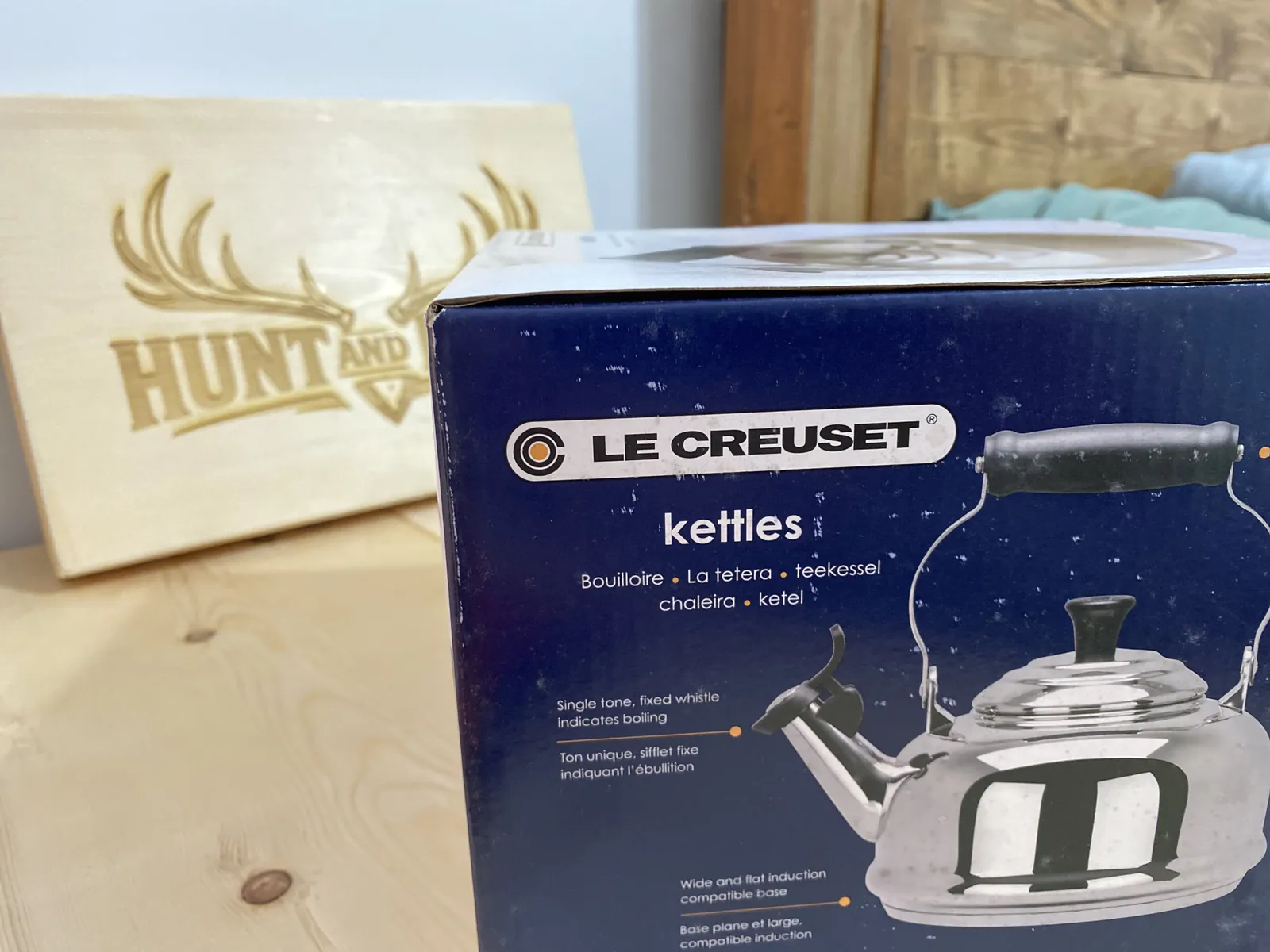
What’s inside is just the kettle and a folded care sheet. There’s no demitasse cup, no fabric pouch, no commemorative pin. The kettle does the talking.
Design and Build
Lifting the kettle out of the box, the first impression is heft. The Classic Whistling Kettle is heavier than it looks — the polished stainless body is built up from a single drawn stainless shell with a wide flat base and a separately-formed lid, lid knob, spout, whistle cover, and looped pivoting carry handle. The construction is welded, not riveted on the outside, which is part of why the body looks so clean: there are no exposed fasteners on the polished face of the kettle.
The body
The body is polished stainless steel — food-grade, and totally uncoated on the inside. There’s no enamel layer, no PFAS coating, no Teflon, no copper plating. Le Creuset doesn’t publish the exact grade of stainless on its product page, so we won’t pretend to know whether it’s 18/8, 18/10, or a proprietary spec — it’s described only as “stainless steel” with no further qualification. What matters in a homestead kitchen is the failure mode: enamel kettles look beautiful for the first few years and then start chipping at the rim, around the spout, and on the base where the kettle meets the burner. Once enamel starts to chip, the only way to keep using the kettle is to accept that it’ll keep chipping. Stainless doesn’t have that failure mode.
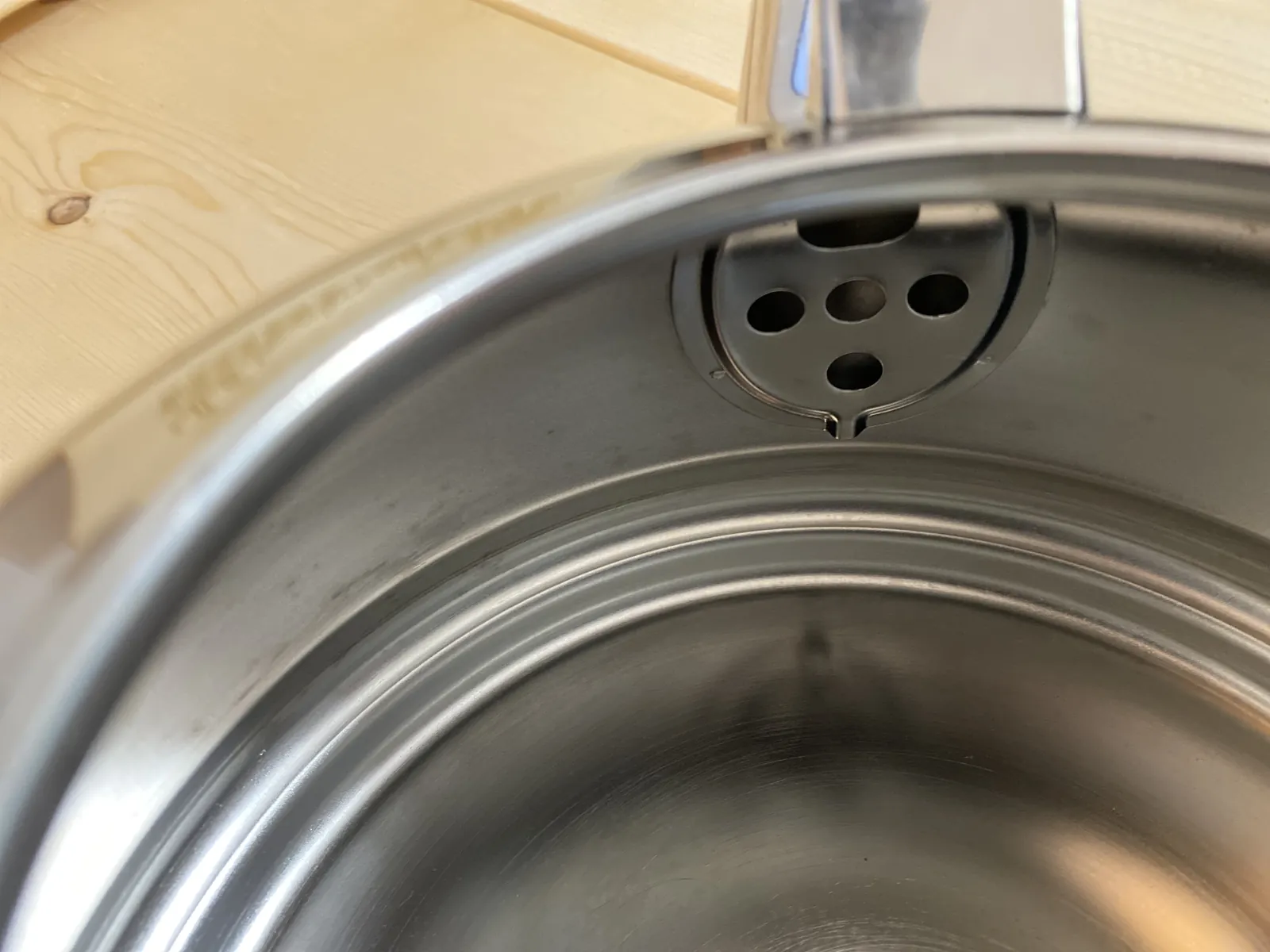
The wide flat base is the second thing worth pointing out. It’s machined flat — not rolled, not stamped with a pattern — and it’s wide relative to the body so that the kettle sits stably on any burner. More importantly, the flat base is what makes the kettle induction-compatible: a magnetic ferritic stainless disc bonded into the base lets the kettle work on a modern induction cooktop the same way it works on a gas burner or a wood stove. Le Creuset’s own spec sheet lists gas, electric, halogen, ceramic, and induction as supported heat sources.
Wood-stove cooktop — the true off-grid case
For an off-grid kitchen, the heat source that matters most isn’t on the spec sheet. A wood-stove cooktop runs as conductive/radiant heat off a flat steel surface — functionally the same energy delivery as an electric coil ring, just powered by a stick of fir instead of a 240-volt circuit. The Le Creuset Classic Whistling Kettle’s wide flat base sits stably on a wood-stove cooking surface and pulls heat efficiently from it, exactly the same way it does on a gas burner. The polished stainless body has no enamel coating to chip or discolour from the higher surface temperatures a wood stove can put out, and the phenolic handle stays cool enough to grab without a kitchen towel as long as the kettle isn’t sitting on a hot stove for hours unattended. For a homestead that might be running off-grid electric one month, a propane camp stove the next, and a wood stove all winter, this is the kettle that quietly works on all of them.
The whistle
The whistle is the headline feature on every stovetop kettle, and Le Creuset’s choice is unusual: instead of the screaming two-tone warble most kettles use, the Classic Whistle is a single-tone fixed whistle — one note, sustained, more flute than train horn.
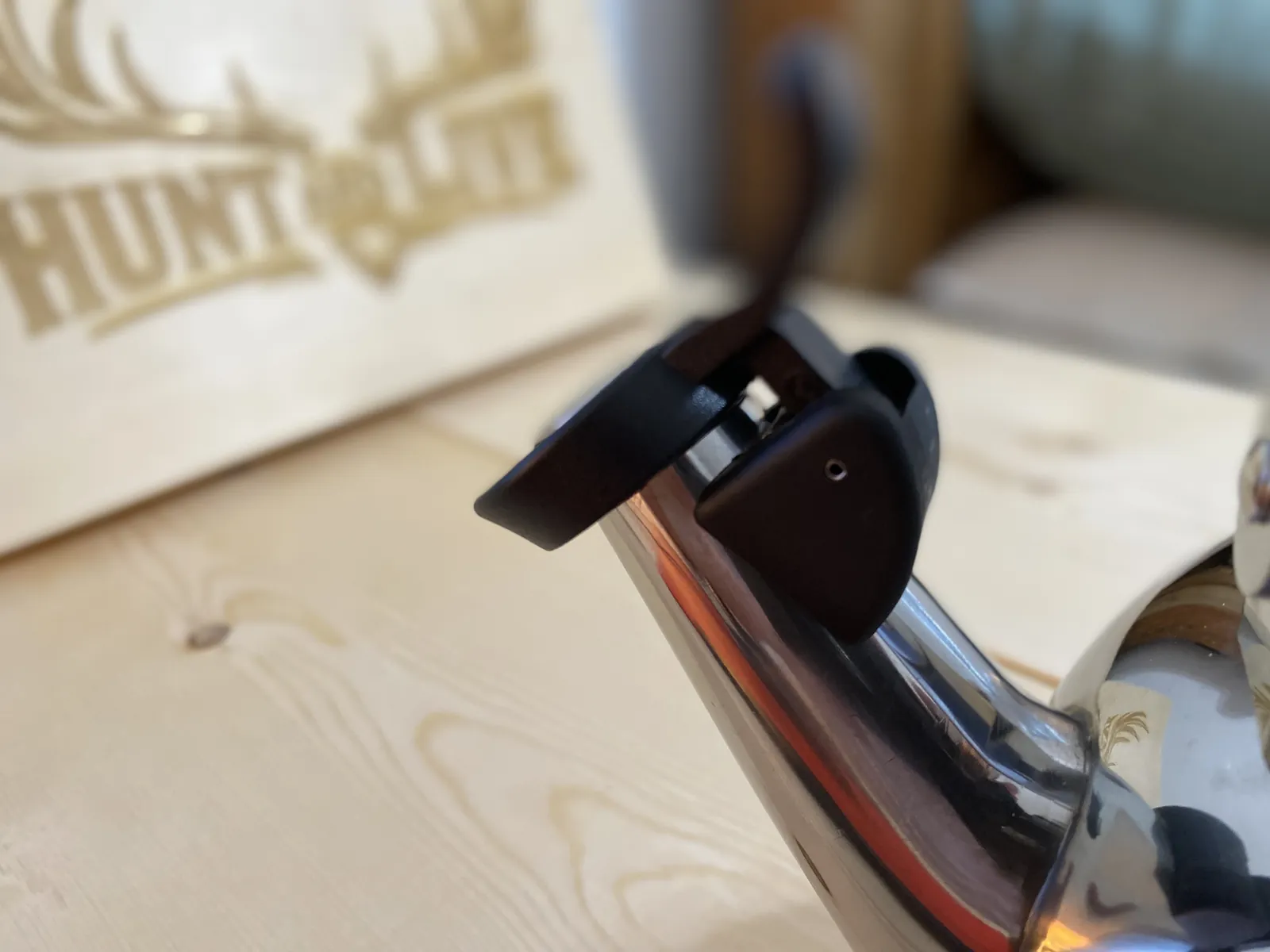
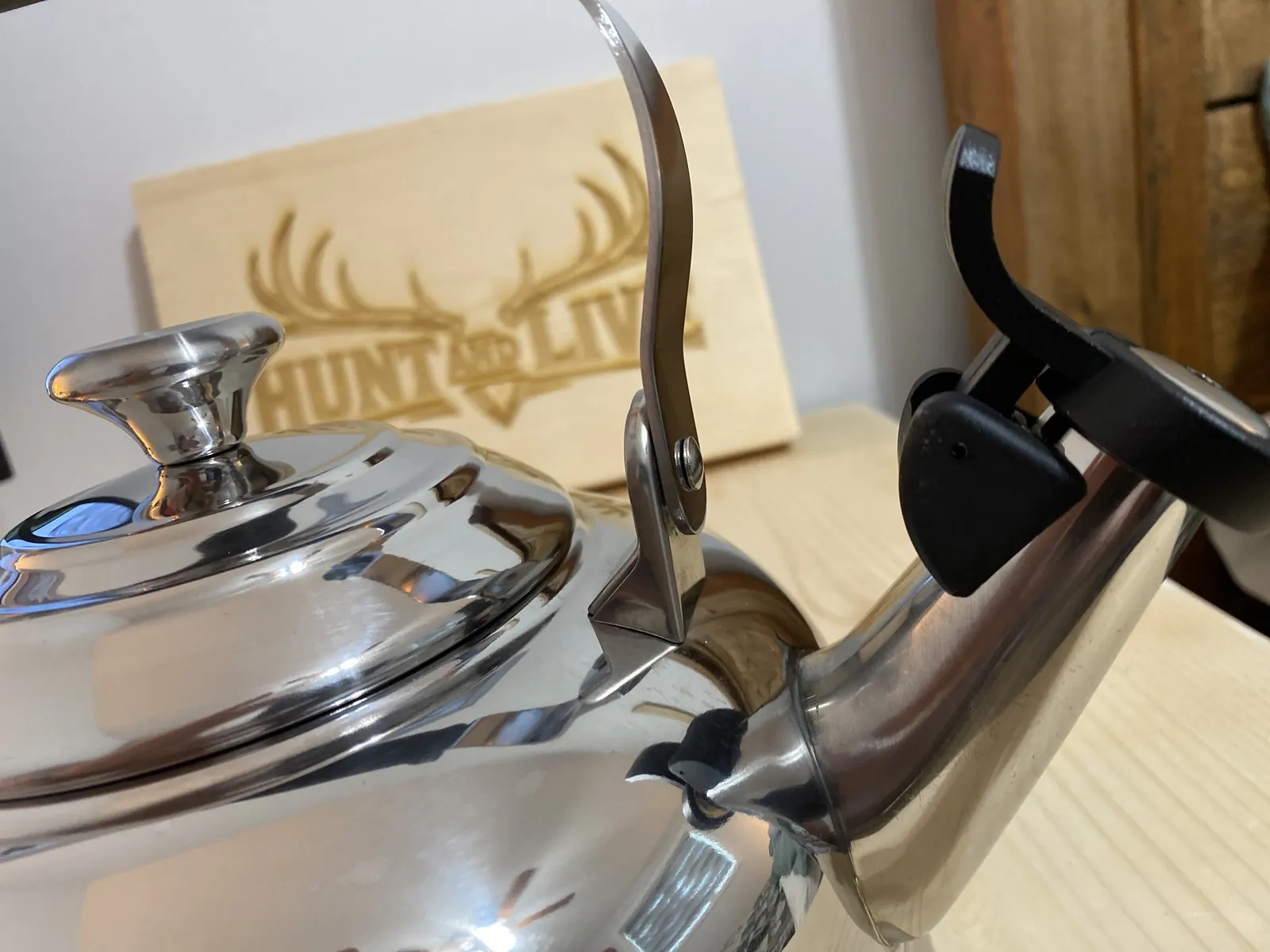
The whistle is mounted on the spout under a hinged cover that springs back closed on its own. The cover is opened by a small black thumb lever on the top of the spout — push the lever forward and the cover lifts away from the spout opening so you can pour. The mechanism does two things at once: it puts a safety distance between your fingers and the steam plume, and it springs the cover closed automatically when you set the kettle down, so the whistle is always armed for the next boil.
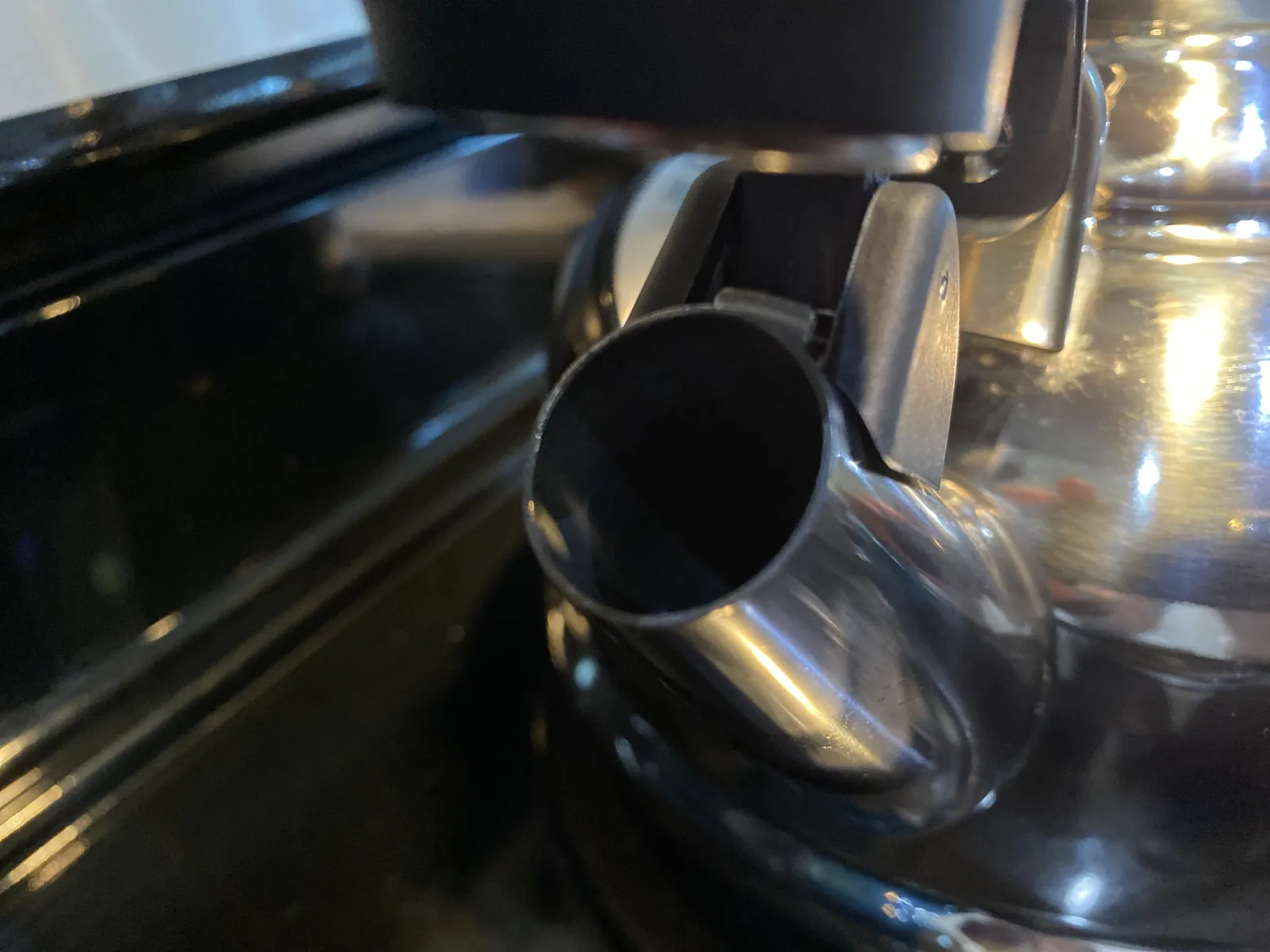
This is an unusually thoughtful detail. Most $30 stovetop kettles use a thumb-press button on the handle that pulls the spout cover open by a wire — those tend to gum up after a few hundred boils, and you eventually end up using a dish towel to lift the cover by hand. The spring-loaded thumb lever on the Le Creuset is the kind of small mechanism that should still be working in fifteen years.
The handle
The pivoting bail handle is a steel armature wrapped in a heat-resistant black phenolic grip. The handle is fixed in the upright position when you pour — it doesn’t drop down loosely the way some pivoting kettle handles do — and the phenolic grip stays cool enough through a full boil that you can lift the kettle off a gas burner barehanded without a dish towel.
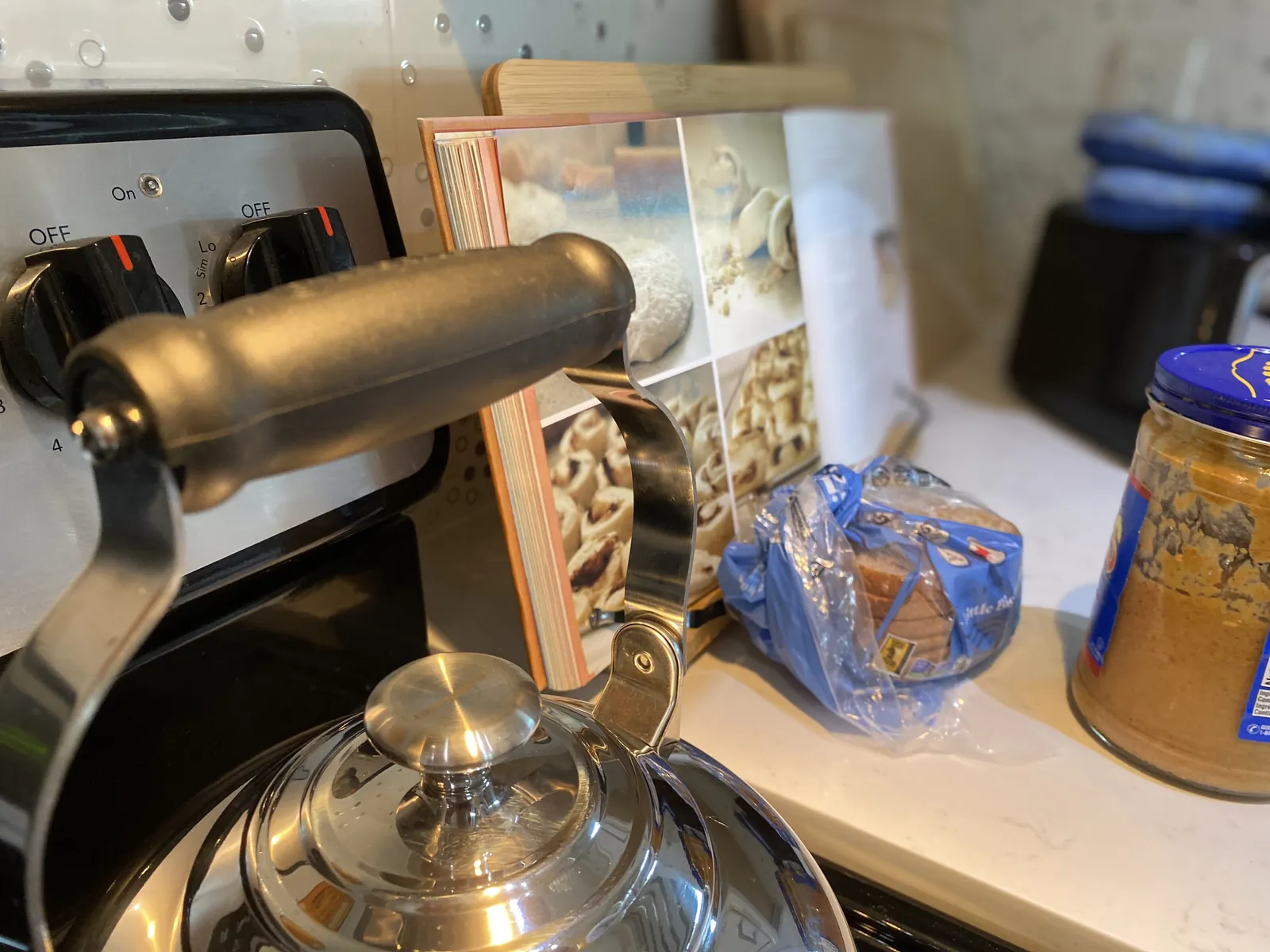
This is one of those small ergonomic decisions that matters more on a busy stovetop than it sounds. With one hand free, you can pour the kettle and tilt a kettle of cream or hold a mug at the same time, which is how morning coffee actually happens.
The Long-Term Comparison
The most useful thing we can say about this kettle isn’t from a single review week — it’s from comparing it to a previous-generation Le Creuset that’s been on the same stovetop for years.
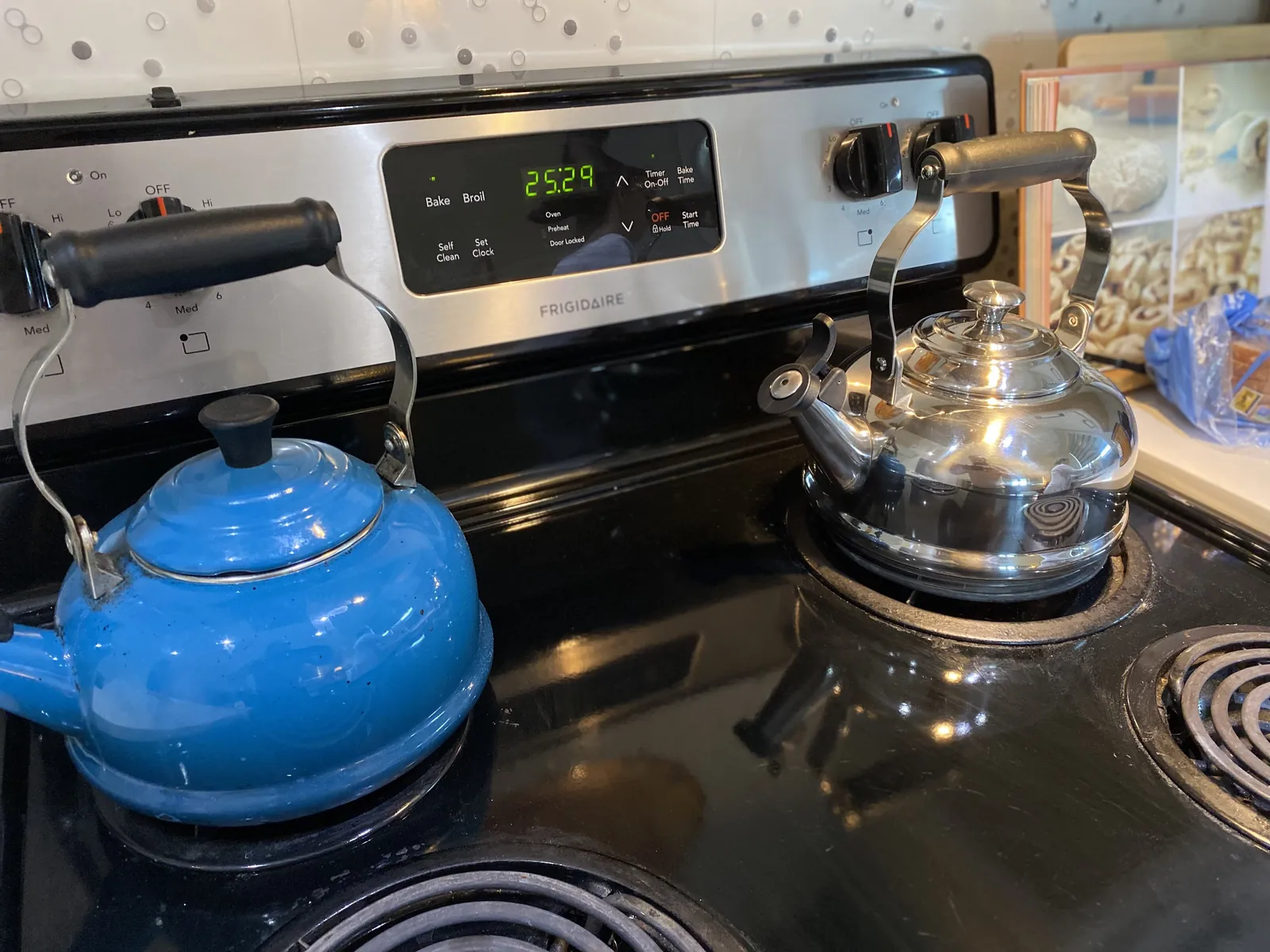
The older blue kettle in the photo is the traditional enamel-on-steel Le Creuset Demi, the same kettle line in its enamel-coated finish, after years of daily use on the same Frigidaire coil-top stove. The enamel finish has held up well overall, but the kettle is starting to show the things enamel kettles inevitably show: a small chip on the rim where the lid sits, faint discoloration under the base from years of heat cycling, and a whistle button that requires a little more thumb pressure than it used to. The kettle still boils water and whistles on cue — Le Creuset enamel is genuinely tough — but the cosmetic patina is the kind of thing that only ever gets worse.
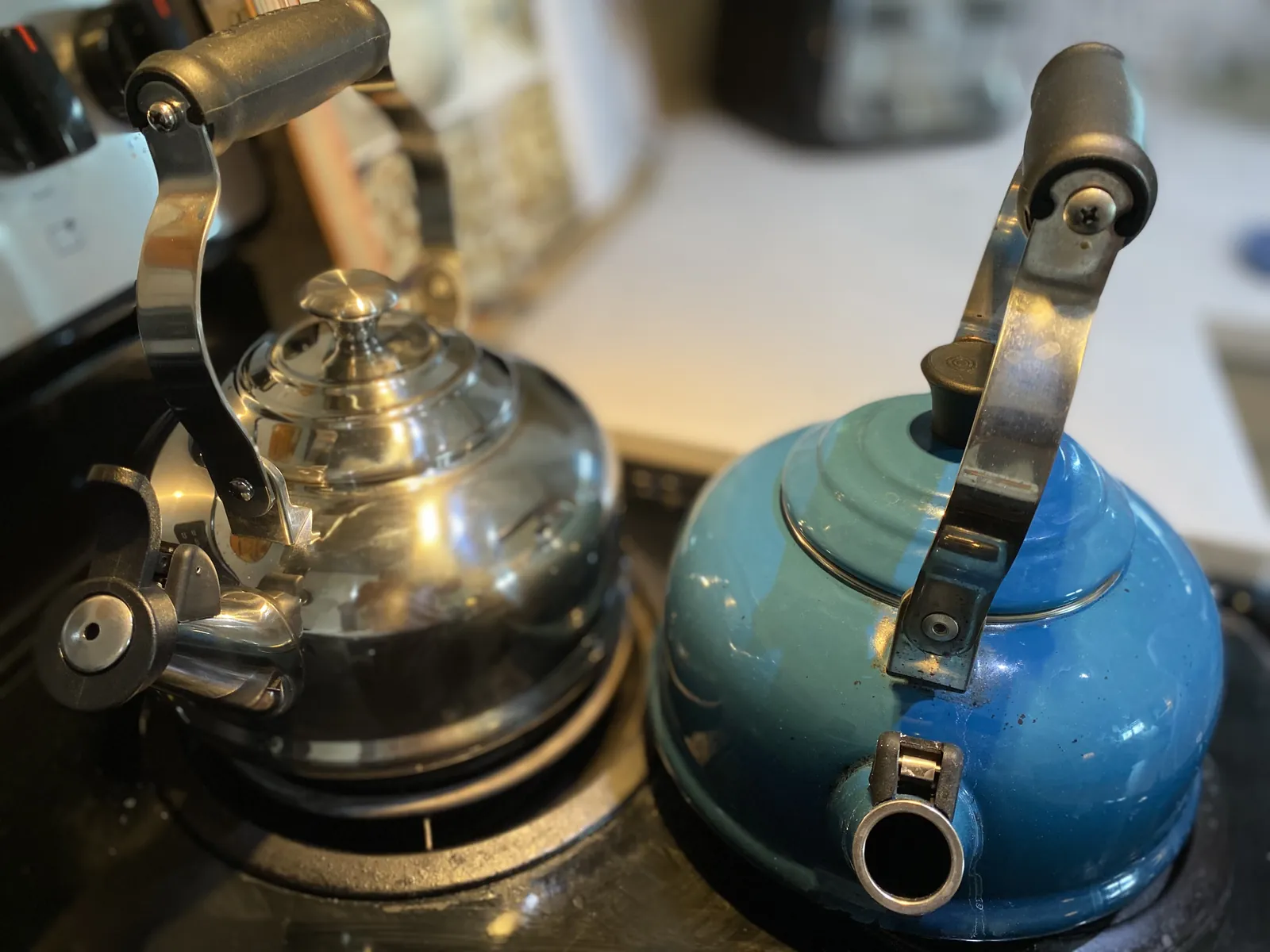
The stainless body of the newer kettle is the answer to all of that. Stainless doesn’t chip, doesn’t discolor cosmetically, doesn’t develop the under-base ring that enamel kettles get over years of heat cycling. The trade-off is that stainless shows fingerprints and water spots more readily than enamel does, so the polished stainless finish wants a quick wipe with a microfiber cloth after every use to keep its showroom look. That’s a maintenance habit, not a flaw — and once the kettle has been in service for six months or so, you’re not chasing fingerprints anymore the same way you do during the first week.
For a kitchen where the kettle has to last decades rather than seasons, the stainless body is the right Le Creuset to buy.
Boiling — and the Whistle in Practice
The Classic Whistling Kettle has a real 1.6 L capacity, which works out to roughly two large mugs of tea or coffee per boil. The “fill line” inside the kettle isn’t marked — Le Creuset’s guidance is to fill below the spout, and the kettle’s interior geometry tells you that visually without needing a stamped line.
Heating time depends entirely on the burner. On a 1500-watt electric coil ring at maximum, a full kettle from cold tap water comes up to a hard boil and starts whistling in around 6 to 7 minutes. On a strong propane stovetop burner the same boil happens in 4 to 5 minutes. On a wood stove or camp stove the time is whatever the stove can give you — the kettle’s wide flat base means it sits stably on a wood-stove cooking surface and uses the available heat efficiently.
The whistle itself is the surprise. The single-tone is genuinely musical — closer to a low-pitched flute than the shrill two-pitch warble of a typical stovetop whistler. In a small kitchen this is welcome. In a large open-plan house or a homestead where the stove is on one floor and you might be down by the wood shed, the single-tone is harder to hear from a distance than the screaming two-pitch competitors. For most kitchens this is the right trade-off; for a far-walking household, it’s worth knowing in advance.
Hand-Wash and Care
Le Creuset’s guidance on the Classic Whistling Kettle is straightforward: hand wash with mild soap and warm water; do not put the kettle in the dishwasher. The reason isn’t that the kettle would be destroyed by a dishwasher cycle — stainless steel handles dishwashers fine — but the phenolic handle and the whistle assembly aren’t designed for prolonged hot detergent exposure and will degrade faster if you put the whole kettle through a wash cycle.
For descaling, vinegar and water at roughly a 1:3 ratio brought to a low simmer for ten minutes will clear mineral buildup from the interior. Empty, rinse, and the kettle is back to bare polished stainless inside. This is the same descaling routine the older blue enamel kettle takes — the cleaning protocol carries over.
For the exterior, a microfiber cloth with a small amount of stainless-steel polish (Bar Keepers Friend is the kitchen standard) brings the polished face back to showroom condition in about thirty seconds.
What It Doesn’t Replace
The Le Creuset Classic Whistling Kettle is a stovetop kettle for boiling drinking water. It is not:
- An electric kettle. If you want a 90-second boil from a plug-in countertop appliance, this isn’t that.
- A big-batch hot-water boiler. For canning prep, hot-water-bottle filling, or filling a large coffee press in one pour, 1.6 L isn’t enough. Look at the larger Le Creuset Traditional Kettle (2.1 L) for those tasks.
- A tea infuser. There’s no built-in infuser basket — this is a hot-water source, not a brewing vessel.
- A camping kettle. The phenolic handle is rated for stovetop heat, not open campfire flame.
For its actual job — a stovetop kettle for one to four cups of tea, coffee, oatmeal water, or instant noodles — the Classic Whistling Kettle is among the best-engineered options available at any price.
How Le Creuset Compares to the Alternatives
The stovetop-kettle market splits roughly into three tiers:
Under $40 — the throwaway tier. Whistling kettles in this bracket usually have a stamped stainless body, a plastic handle that softens after a few hundred boils, a two-tone whistle, and a thumb-press spout-cover button on a wire linkage. These work for a couple of years and then either the whistle stops sealing, the spout cover sticks open, or the handle melts loose where it joins the body. You’ll buy several of these over a homestead lifetime.
$50–$100 — the mid-tier. OXO, Cuisinart, KitchenAid, and the better Chantal kettles live here. Build quality is meaningfully better than the throwaway tier — usually a heavier-gauge body, better whistle engineering, and a longer-lasting handle. The Chantal Loop kettle in particular is genuinely good. The honest comparison: a good $70 stovetop kettle and the $200 Le Creuset will both still be working in ten years. What you’re paying for at the Le Creuset tier is the polish, the spring-loaded spout cover, the single-tone whistle, the brand longevity, and the resale-grade build.
$150+ — the heritage tier. Le Creuset, Staub, Alessi, and a handful of higher-end European kettle makers. At this tier you’re paying for design, materials, and brand. Among the heritage-tier choices, Le Creuset’s stainless kettle is the most quietly utilitarian — Alessi’s design pieces win on form, Staub wins on enameled-cast-iron aesthetics, but for a working homestead kitchen where the kettle has to be a tool rather than a sculpture, the Le Creuset stainless is the right pick.
The Verdict
The Le Creuset Classic Whistling Kettle in stainless steel is the right answer to a specific question: what kettle do you buy if you’d rather pay once than buy three? It’s not the loudest whistler in its price range. It’s not the biggest capacity. It doesn’t electrify your countertop with a 90-second boil. What it does is sit on your stove and do its job — for decades, in a finish that won’t chip, with a whistle mechanism that won’t fail, and with the kind of build that lets a household put it in service today and still pour from it when their kids are grown.
For a homestead kitchen, an off-grid cabin, or any household that values gear that lasts over gear that’s cheap, this is the kettle.
Where to buy: Le Creuset Canada — Classic Whistling Kettle (Stainless Steel)