
Featured Review · Ruger · Rifles
Ruger American Ranch Review (.223 / 5.56 NATO) — The Budget Bolt Gun That Punches Far Above Its Price
Our Rating
Current Price
- Action
- Bolt-action, 70-degree throw
- Chambering
- .223 Rem / 5.56 NATO (barrel marked 5.56 NATO)
- Barrel length
- 16.10 in (409 mm)
- Barrel
- Cold hammer-forged, threaded 1/2x28
Pros
- Sub-MOA accuracy out of the box from a rifle that costs around $549
- Power Bedding integral bedding block — free-floated barrel, repeatable bedding, zero gunsmithing
- Ruger Marksman Adjustable trigger breaks clean and adjusts from roughly 3 to 5 lbs with no tools beyond a hex key
- Tang safety, 70-degree bolt throw, and a threaded barrel standard
- Barrel marked 5.56 NATO — runs both 5.56 NATO and .223 Remington
- Compact, light, and genuinely handy in the field — a real truck-and-trail rifle
- Ships with a factory rotary magazine and an integral scope-base/rail setup
Cons
- The factory rotary magazine is a love-it-or-replace-it design — capacity is limited and aftermarket AI-pattern mags need a different bottom-metal setup
- The synthetic stock is functional but flexes and feels hollow — the weakest part of the rifle
- Lightweight thin barrel heats fast — this is not a high-volume bench rifle
- Recoil pad and ergonomics are basic; the trigger guard and grip area are pure utility
The Ruger American Ranch is the rifle you buy when you want a bolt gun that simply works — and when you’ve decided you’d rather spend your money on glass, ammo, and range time than on the rifle itself. Ruger has been building affordable, dependable firearms in the United States since 1949, and the American series is what happens when that practicality gets pointed at the entry-level bolt-action market. Power Bedding, a genuinely good adjustable trigger, a cold hammer-forged barrel, and a tang safety — at a price that used to buy you a rifle you’d want to replace.
This review looks at the first-generation American Ranch in .223 the way a buyer should — as a rifle you’d actually carry and shoot: zeroed from a bench, run with real hunting ammunition, fed from the factory magazine, and judged on whether the budget price comes with budget compromises that matter. We’ll go through the spec sheet, the materials, the build, the trigger, and how all of it lines up at the target.
At a glance
The Rifle in Brief
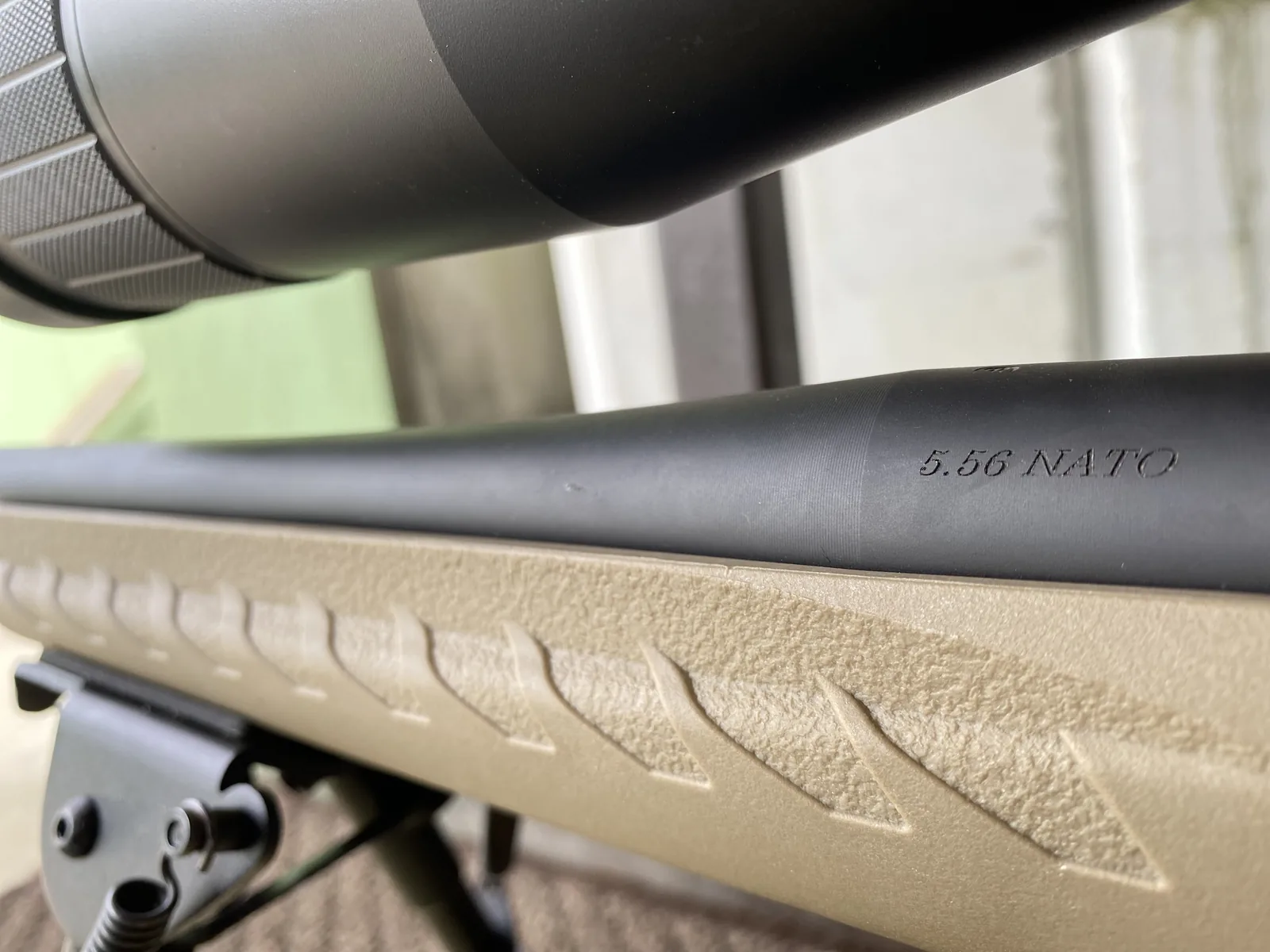
The American Ranch is the compact, threaded-barrel variant of Ruger’s American Rifle line. Where the standard American is built around a 22-inch barrel and a hunting-length stock, the Ranch shrinks the package: a 16.1-inch cold hammer-forged barrel, an overall length of around 36 inches, and a bare weight just over six pounds. It’s chambered here in .223 Remington — and on this particular rifle, the barrel is roll-marked 5.56 NATO, which means it’s built to run both the higher-pressure 5.56 NATO military cartridge and standard .223 Remington. (More on that below — it’s worth understanding, but it isn’t the headline.)
What you’re really buying with the American Ranch is the American Rifle action in a handier wrapper. That action is the reason the rifle has the reputation it does, so it’s worth starting there.
Power Bedding — The Reason It Shoots
If the American series has one genuine engineering story, it’s Power Bedding. Most budget bolt rifles bed the action by simply screwing it down into a plastic stock, and the result is what you’d expect: inconsistent contact, pressure points along the barrel channel, and a rifle whose zero shifts depending on how the stock flexes that day.
Ruger’s Power Bedding uses two integral bedding blocks moulded into the stock that the receiver locks against. The effect is twofold: the action sits in the same place every time it’s torqued down, and the barrel free-floats above the stock channel — no contact, no pressure points. It’s a system that, on more expensive rifles, you’d pay a gunsmith to approximate with glass bedding and a hand-floated barrel channel. Here it comes in the box, on a rifle that costs around $549.
This is the single most important thing to understand about why a sub-$600 rifle can shoot the way this one does. The accuracy isn’t an accident or a lucky barrel — it’s a bedding system doing the job that, historically, separated cheap rifles from good ones.
The Marksman Adjustable Trigger
The second thing Ruger got right is the trigger. The American series ships with the Ruger Marksman Adjustable trigger, and “adjustable” here isn’t marketing — it’s a user-adjustable break weight that ranges from roughly 3 to 5 pounds, set with a single hex key, no gunsmithing and no proprietary tools.
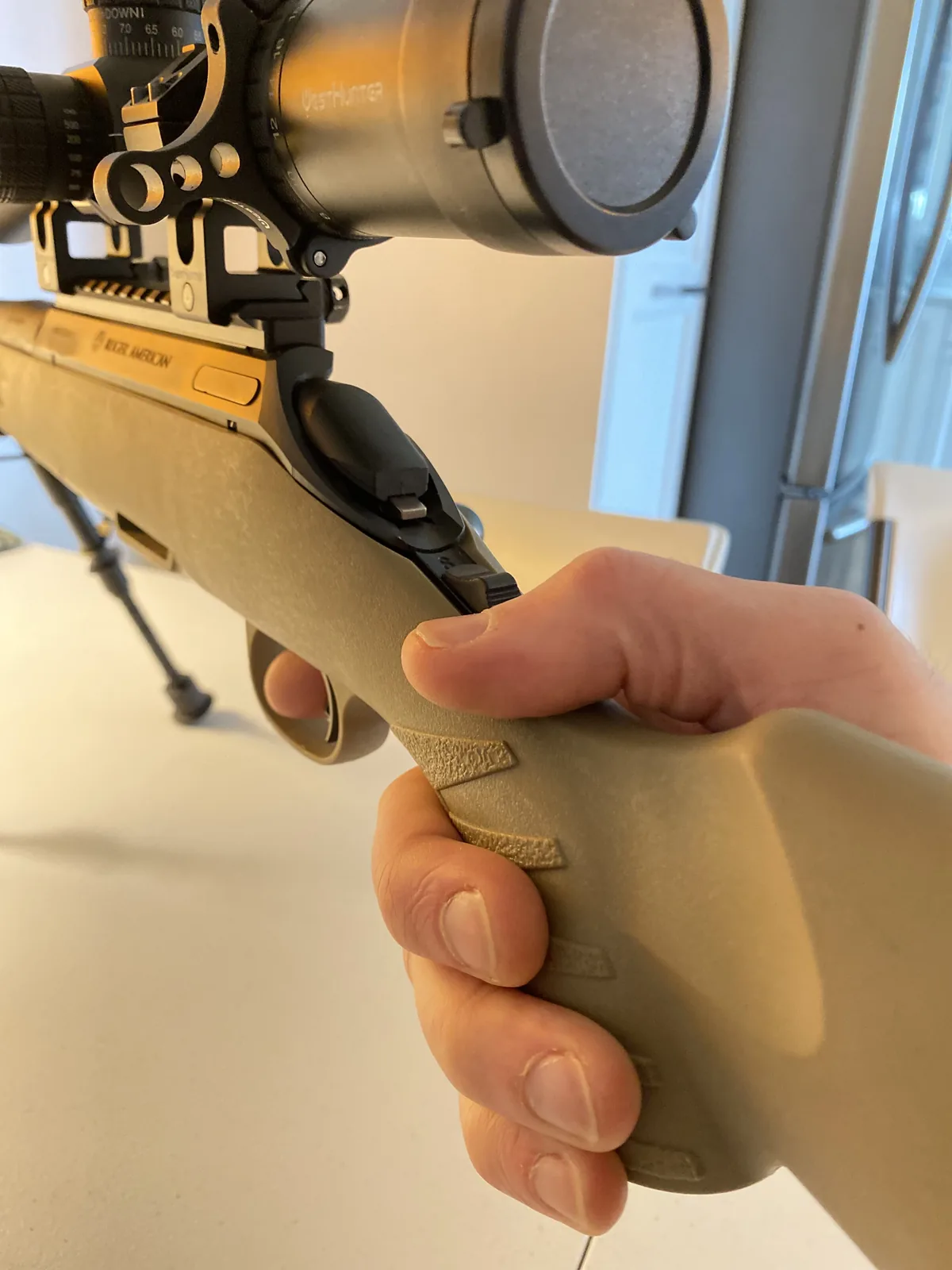
Out of the box, the trigger on this rifle broke cleanly with very little creep and no grittiness — the kind of break that doesn’t fight you when you’re trying to hold a small target. For a budget rifle this is genuinely uncommon. Plenty of entry-level bolt guns ship with heavy, creepy triggers specifically because a good trigger costs money to engineer and tune. Ruger spent that money. Dropping the break weight toward the bottom of its range took a couple of minutes and made an already-good trigger better.
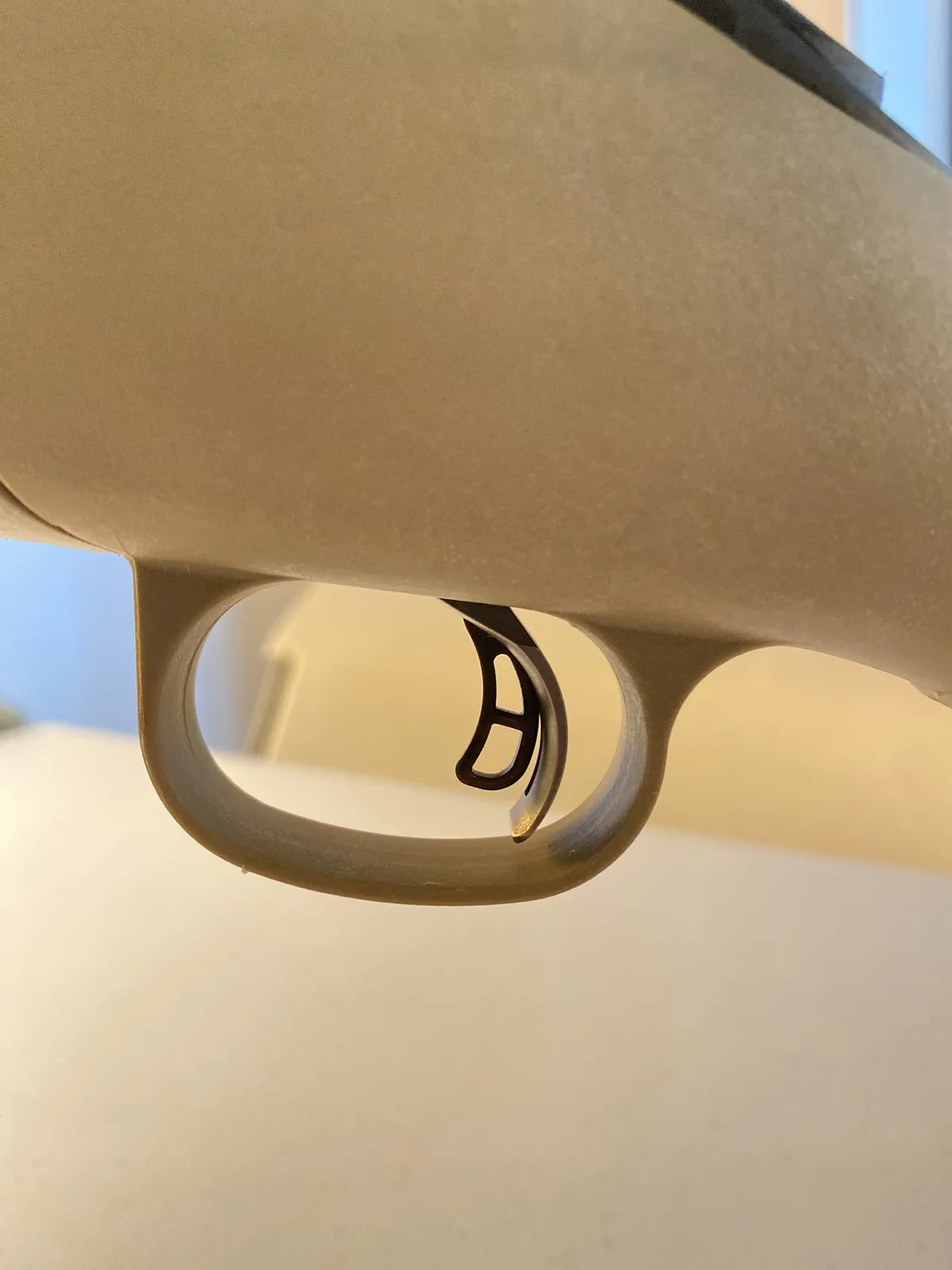
The trigger guard and the surrounding stock area are, to be clear, basic — moulded polymer, no refinement, pure function. But the trigger itself, the part that actually matters when you’re trying to put a bullet somewhere specific, is the rifle’s quiet strength.
The Action, Bolt, and Safety
The American Rifle action runs a 70-degree bolt throw — short enough to clear a low-mounted scope’s ocular bell without your hand fighting the eyepiece, and fast enough for follow-up shots. The bolt itself uses a three-lug design that’s smooth enough once it’s broken in, though, like most budget actions, it has a slightly gritty feel out of the box that smooths with use.
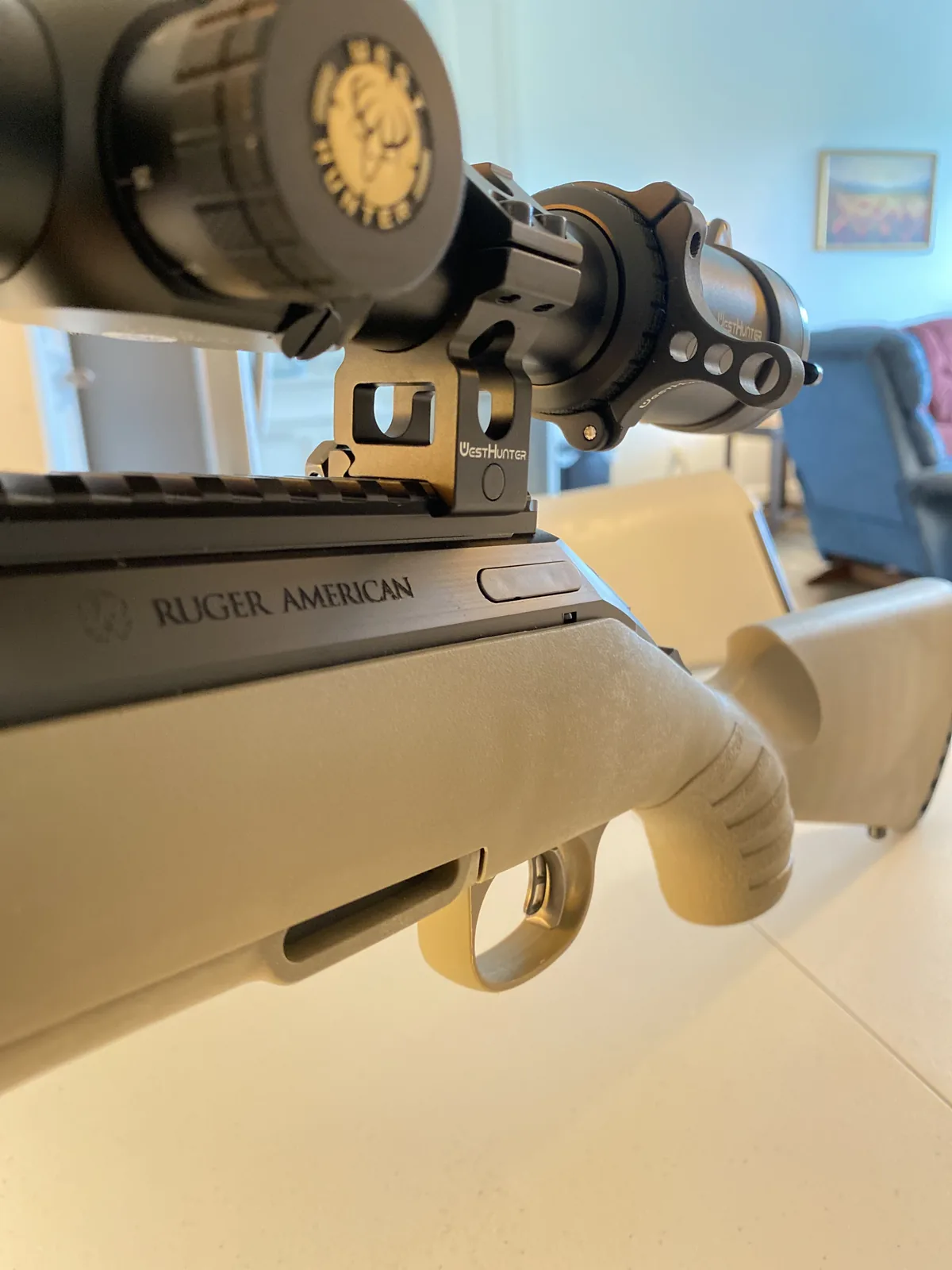
The safety is tang-mounted — sitting on top of the wrist of the stock where your thumb naturally falls — which is a genuinely good ergonomic choice and one of the small details the American series carries over from much more expensive rifles. It’s intuitive, it’s ambidextrous in practice, and you can run it without breaking your firing grip.
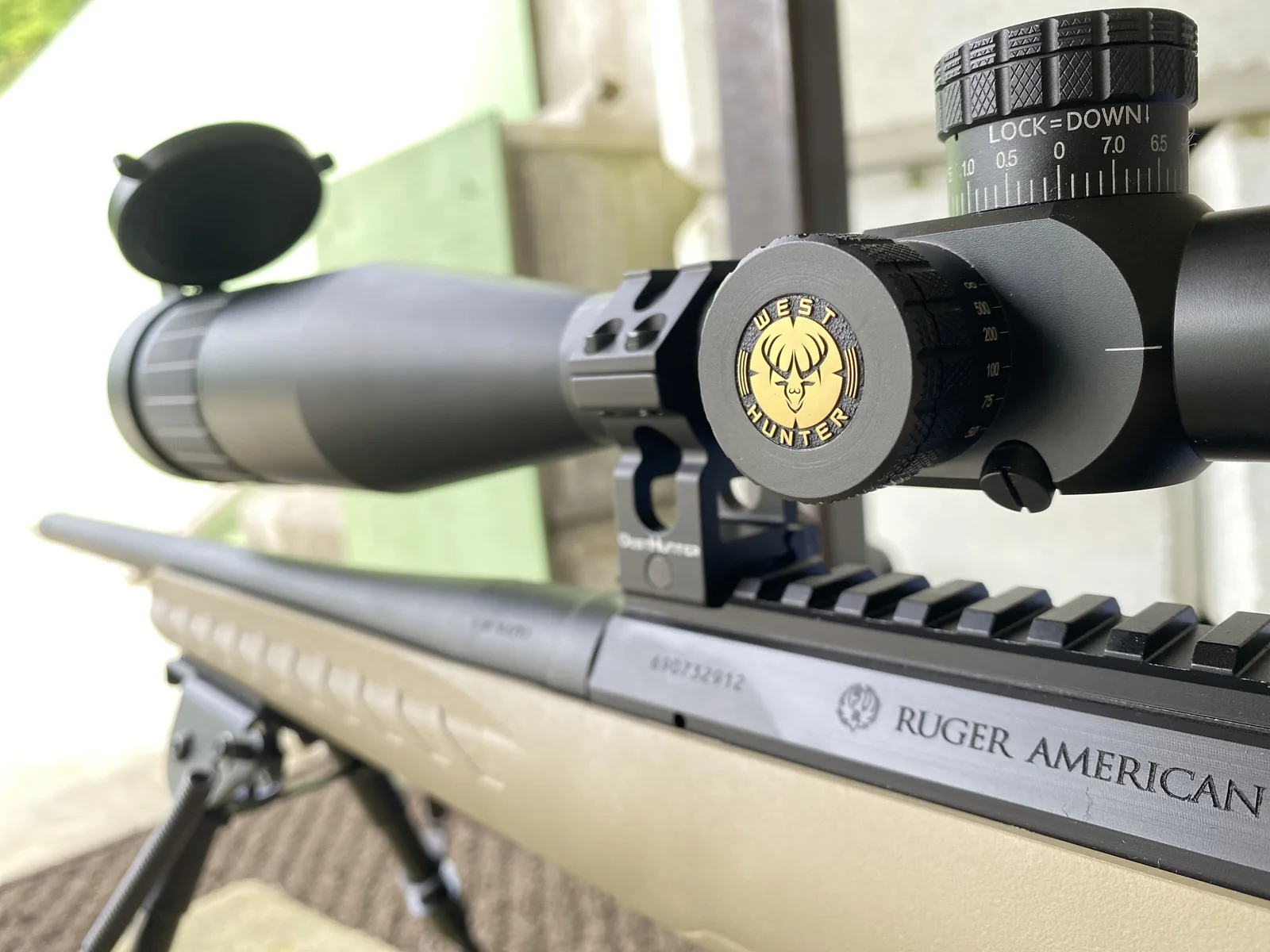
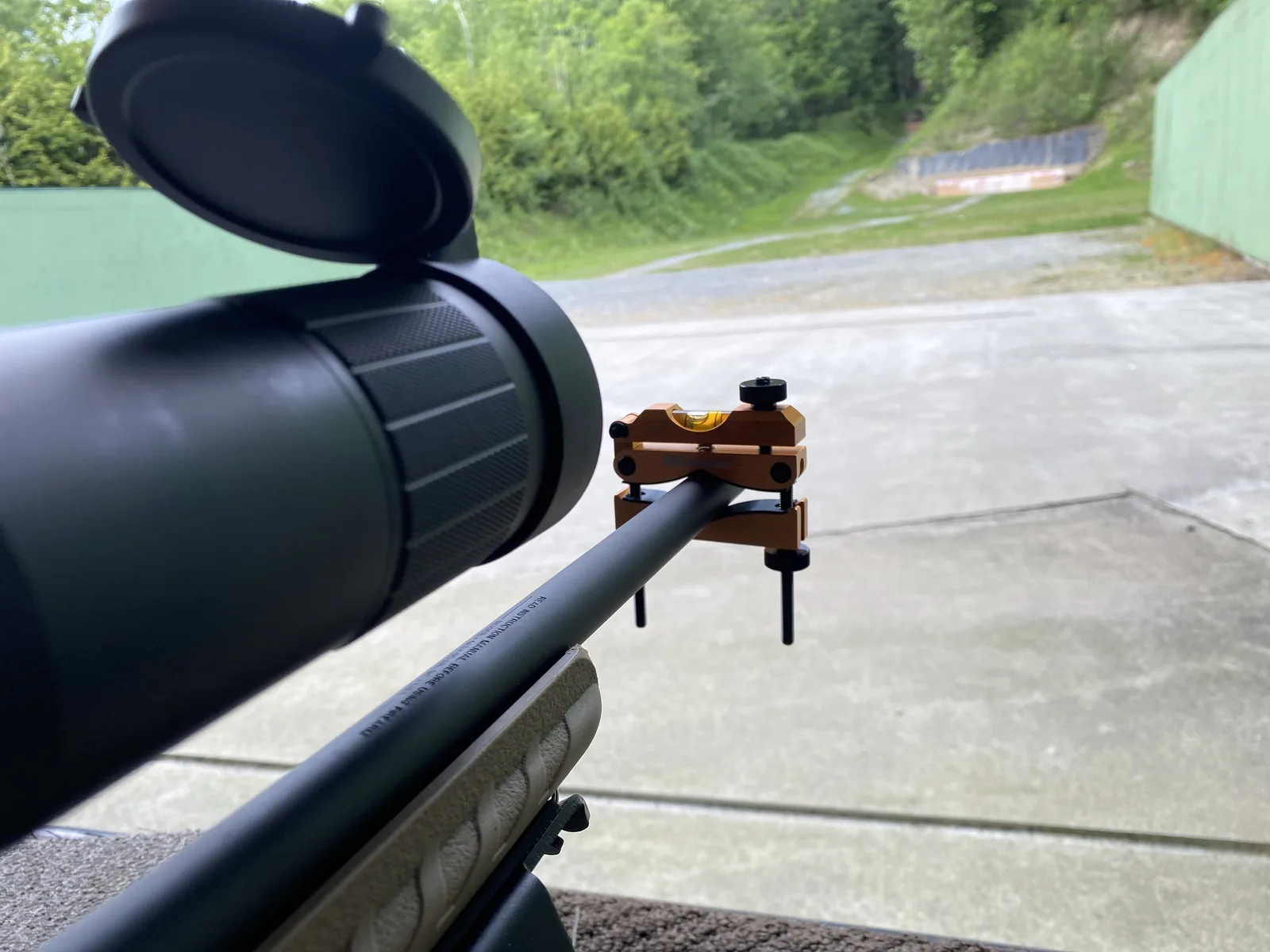
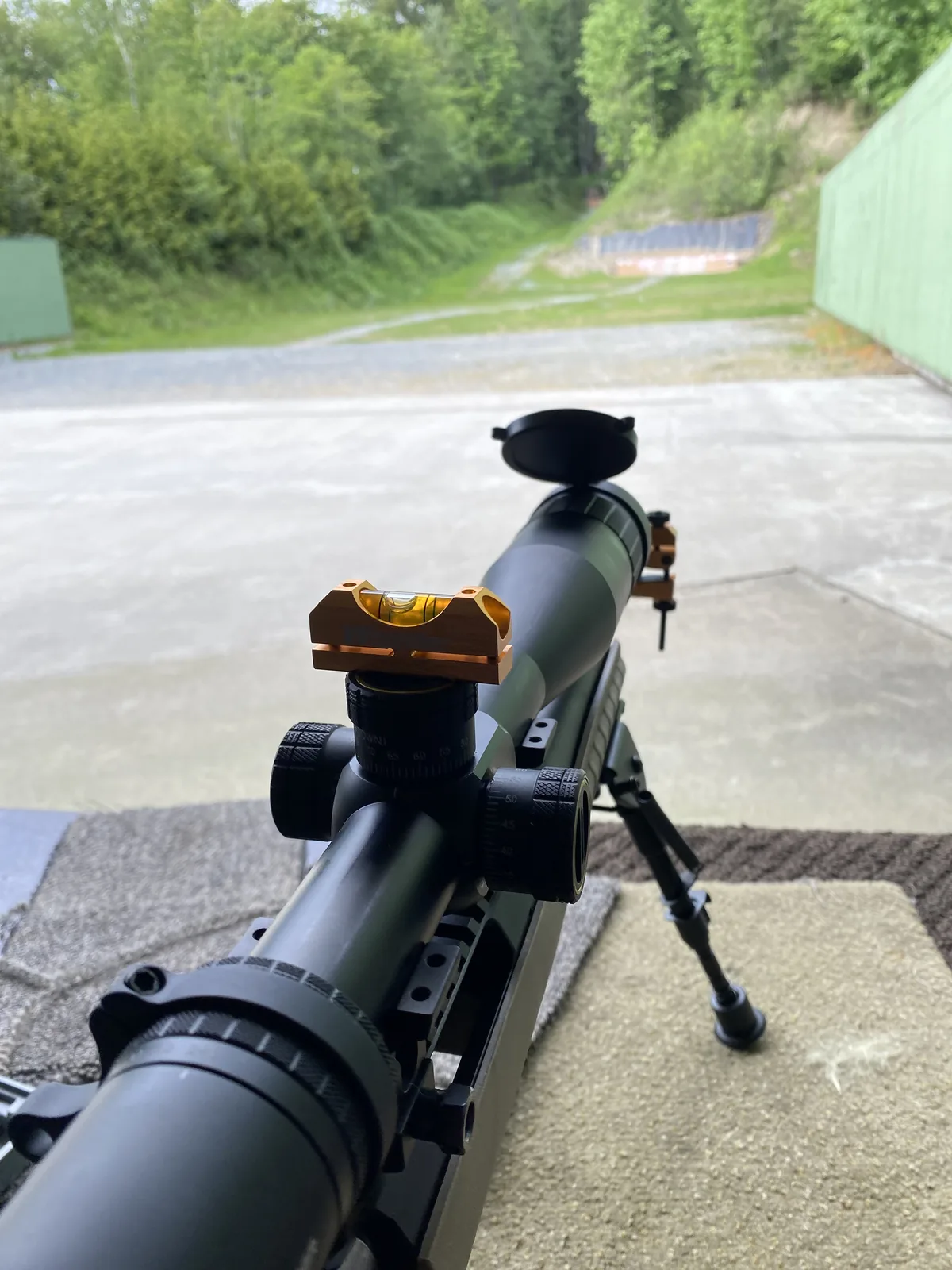
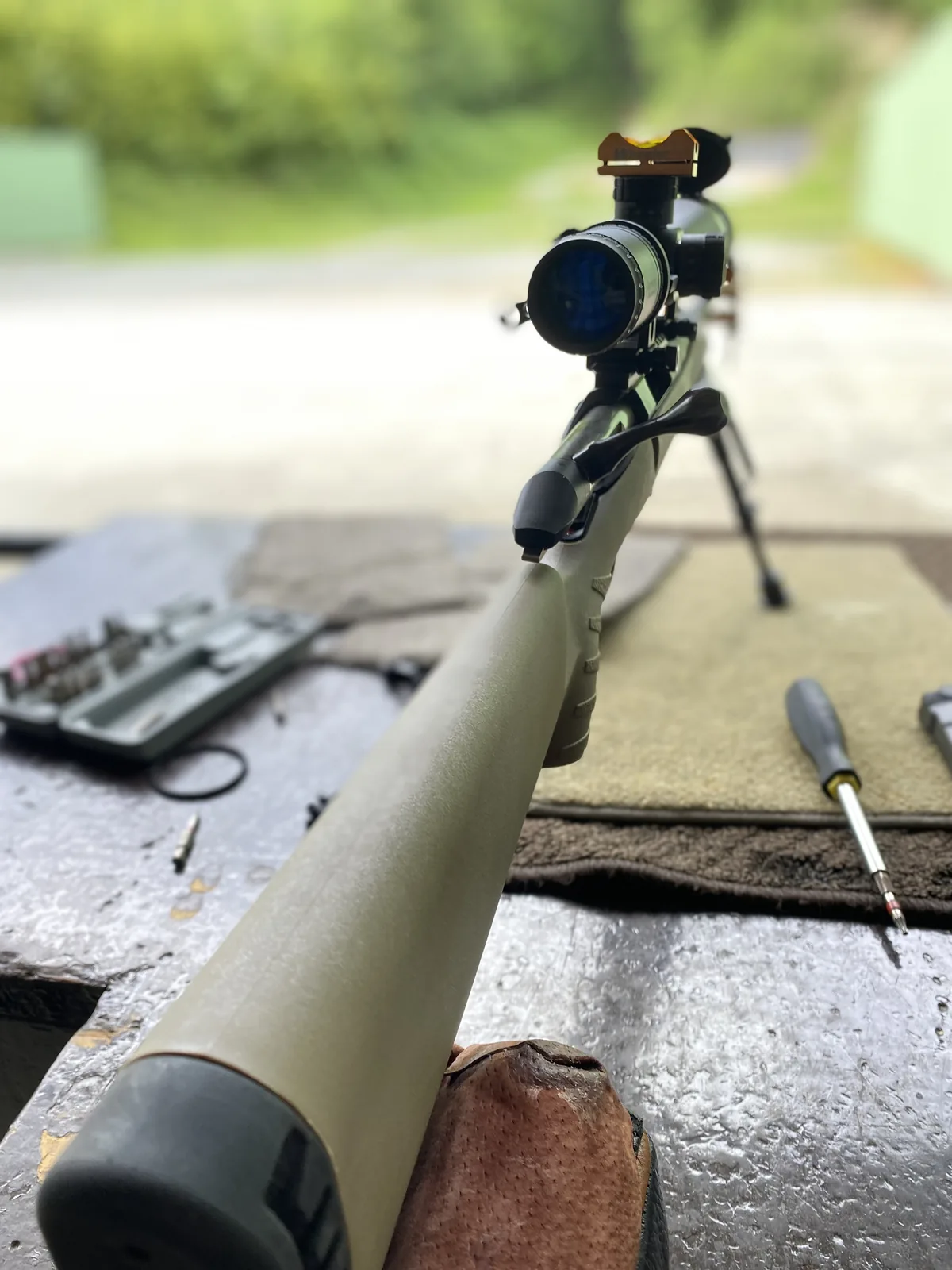
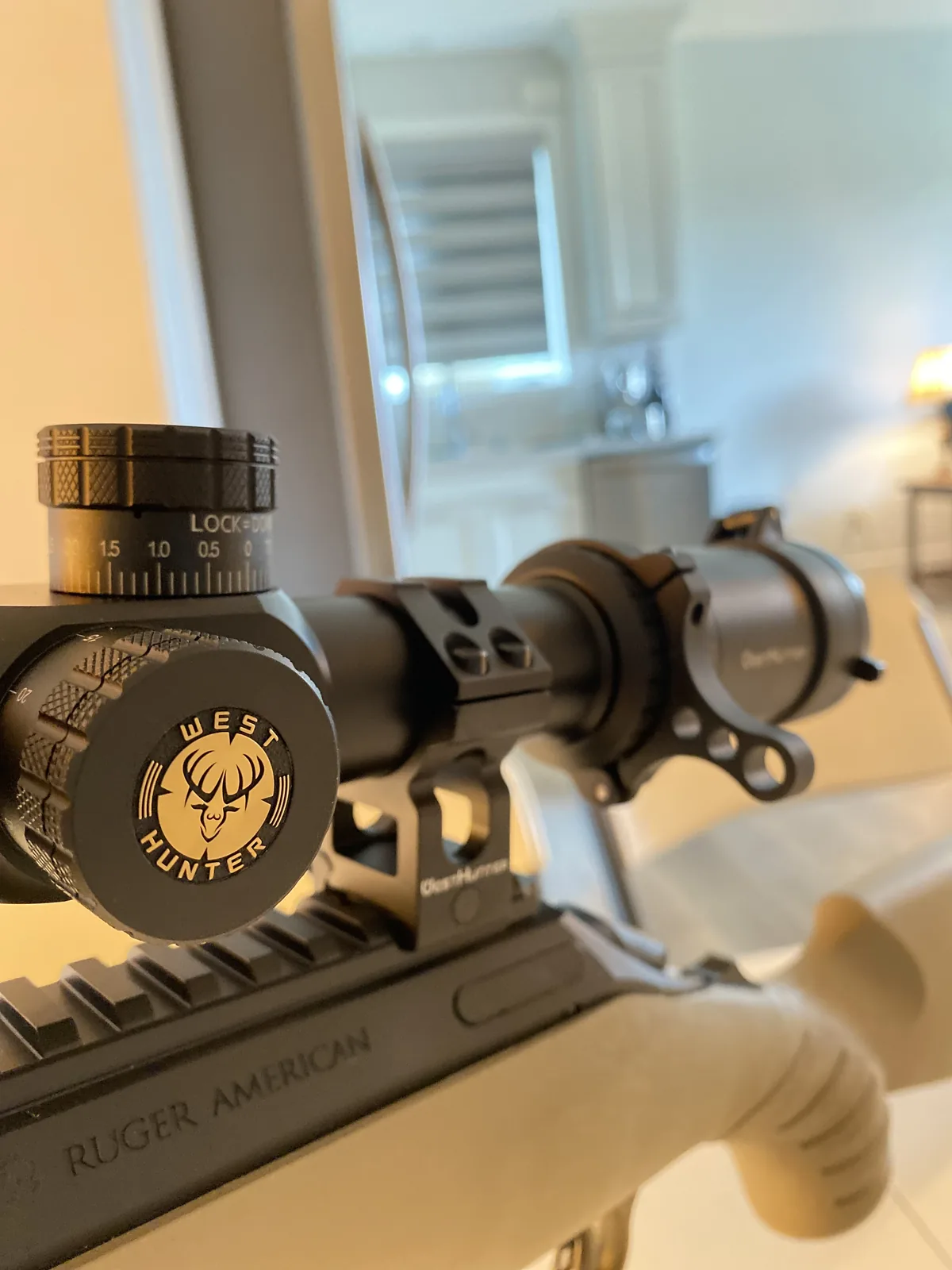
The American Ranch has no iron sights — it’s built to be scoped, and the receiver provides an integral mounting base. On this rifle a one-piece rail and a set of West Hunter rings carry a West Hunter scope. Mounting was uneventful: a Wheeler leveling kit, the rail torqued down, rings lapped and leveled, and the optic on. Nothing about the rifle fought the process.
The Barrel
The barrel is cold hammer-forged — a manufacturing process that produces a strong, consistent bore and a long service life, and another spec that punches above the price class. At 16.1 inches it’s short, which is the entire point of the Ranch variant: it makes the rifle compact and quick-handling, the kind of rifle that rides easily behind a truck seat or moves cleanly through brush.
It’s also threaded — 1/2x28 from the factory — so a muzzle device or a suppressor goes on without a trip to a gunsmith. The barrel comes with a thread protector installed.
The trade-off of a short, light barrel is heat. This is a thin profile, and it warms up quickly under sustained fire. That’s not a flaw — it’s a design choice, and it’s the right one for a field rifle — but it does mean the American Ranch is not a high-volume bench gun. Shoot it in deliberate strings, let it cool between groups, and it rewards you. Run it like a range toy and the groups will open up as the barrel heats. Know which rifle you bought.
The Stock — The Weakest Part of the Rifle
Honesty time. The stock is where the American Ranch shows its price.
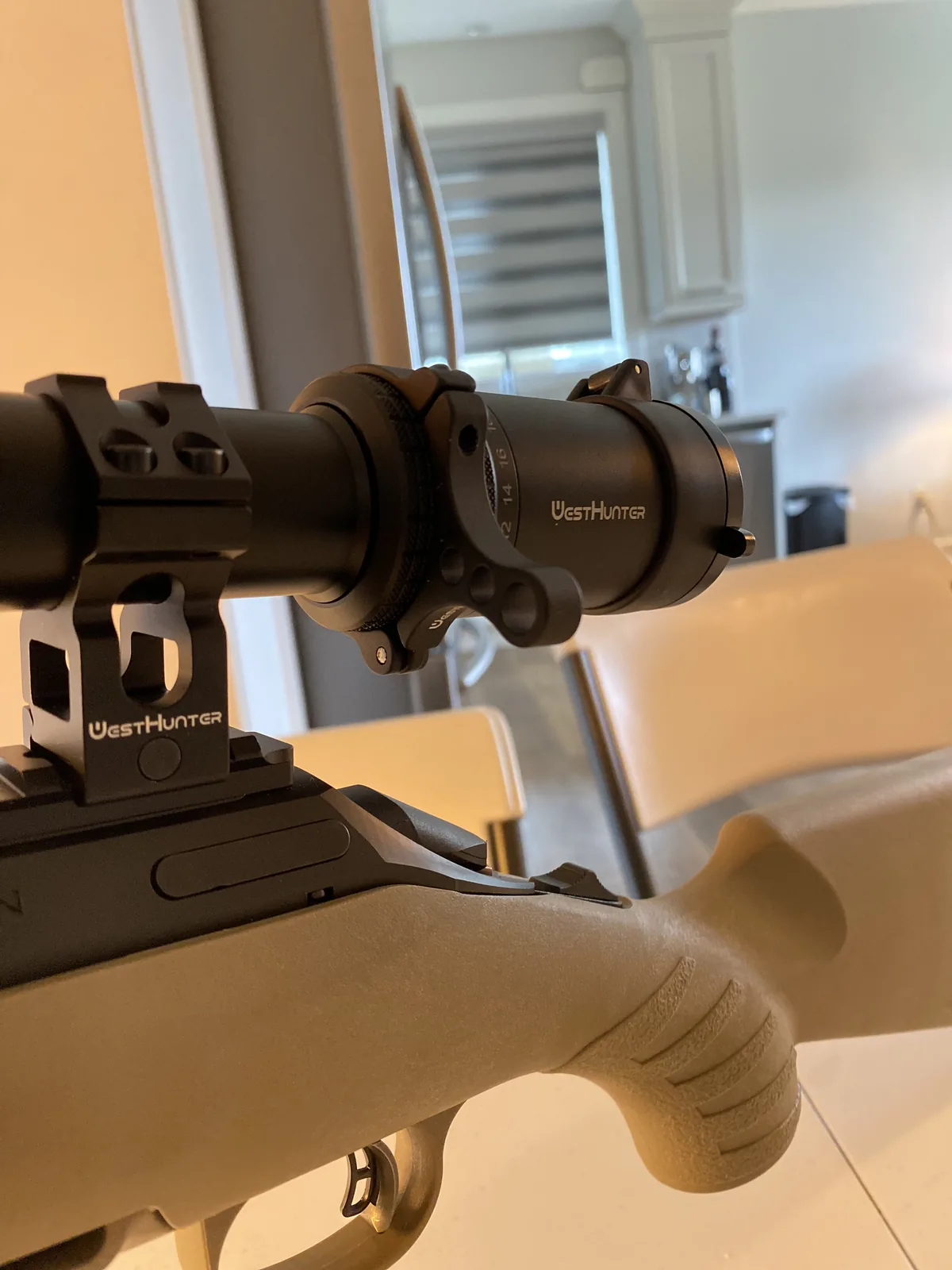
The synthetic stock — here in an FDE/tan finish with textured “wedge” grip panels at the wrist and forend — is functional, and the texturing genuinely helps your grip in wet or gloved hands. But it’s a budget injection-moulded stock and it behaves like one. It flexes if you squeeze the forend. It sounds hollow if you tap it. And under a hard rest or a tight sling it can flex enough that, in theory, the forend could touch the free-floated barrel — which would defeat the entire point of Power Bedding.
In practice, shooting off a bipod and a rear bag, this never caused a problem — the bedding blocks do their job and the barrel stayed free. But it’s the obvious upgrade path. A stiffer aftermarket stock or chassis is the single change that would most improve this rifle, and the fact that the action and barrel are good enough to deserve that upgrade tells you something about where Ruger spent the budget. They spent it on the parts that are hard to fix later, and saved it on the part that’s easy to swap.
The Magazine Question
The first-generation American Ranch ships with a flush-fit factory rotary magazine, and this is the part of the rifle people have the strongest opinions about.
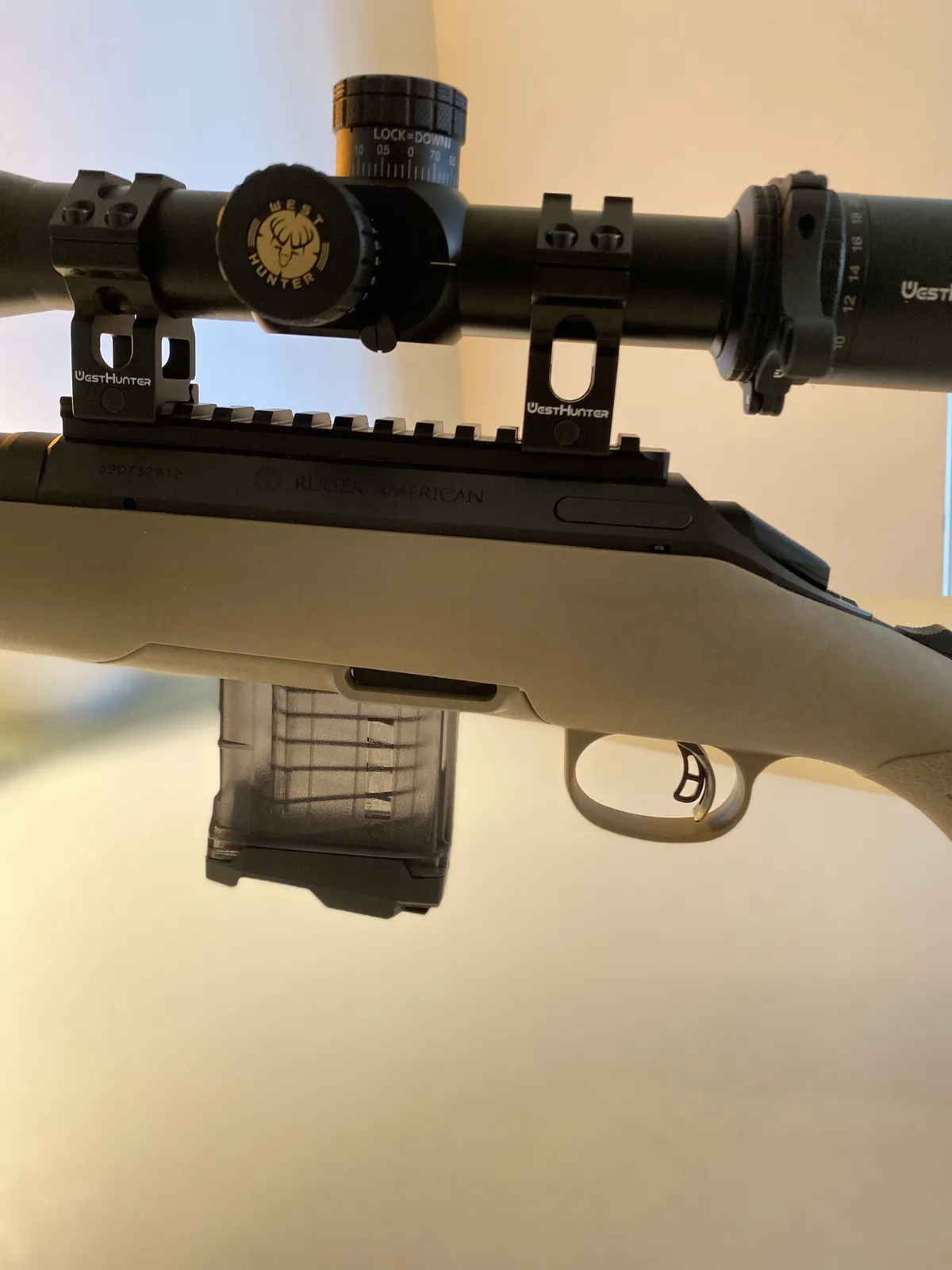
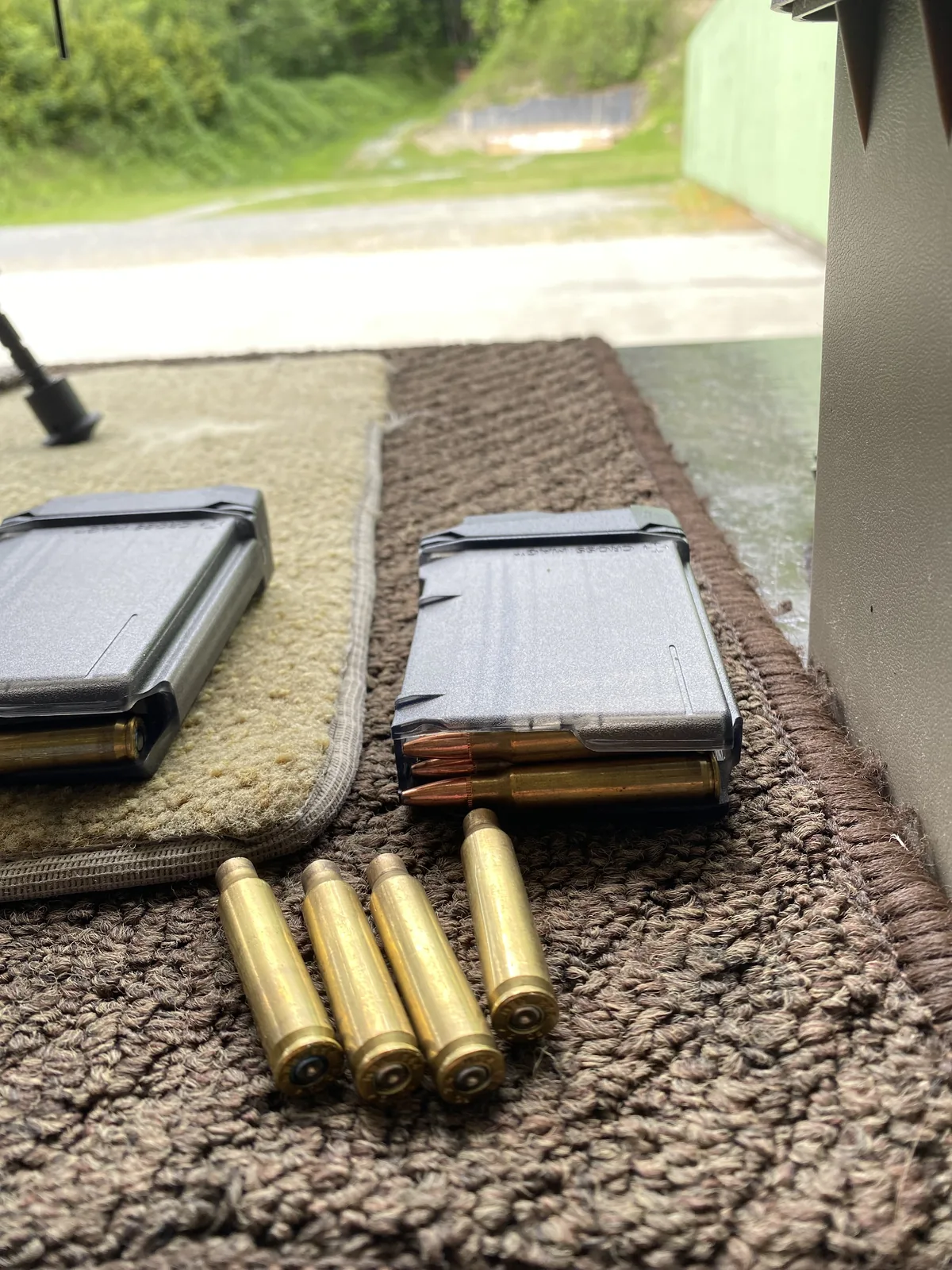
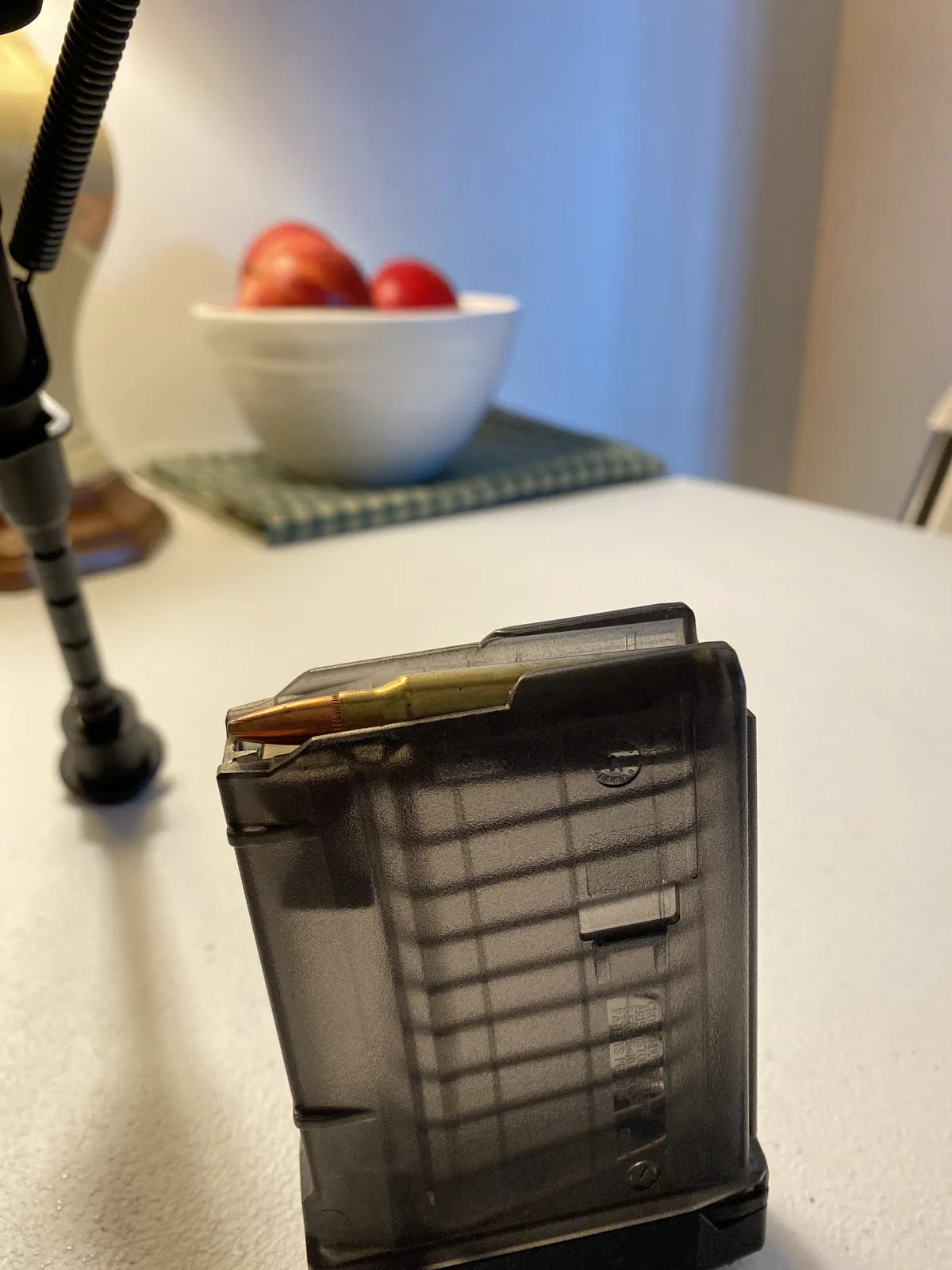
The rotary design is reliable and it sits flush with the stock — no protruding box magazine to snag — but capacity is limited and the rotary magazines themselves are a specific Ruger part. Many owners want to run higher-capacity AI-pattern (AICS-style) magazines instead, and on the first-gen rifle that means a magazine conversion — different bottom metal — rather than a simple swap. It’s a known, well-documented upgrade with good aftermarket support, but it is an upgrade, not a drop-in.
If you’re buying this rifle as a hunting rifle, the factory rotary magazine is genuinely fine — you’re not running drills, you’re loading a few rounds and going. If you’re buying it as a trainer or a high-round-count plinker, budget for the magazine conversion. Either way, go in knowing which rifle you want it to be.
At the Range
A spec sheet only matters when you map it to the target. Here’s how the American Ranch performed.
Zeroing and Setup
Mounting the optic, leveling it with a Wheeler kit, and getting on paper was uneventful — the rifle didn’t fight any part of the process. The integral scope base meant no shimming, no drama. Bore-sight, a few rounds to get on paper, and then the deliberate work of dialing a zero.
Accuracy
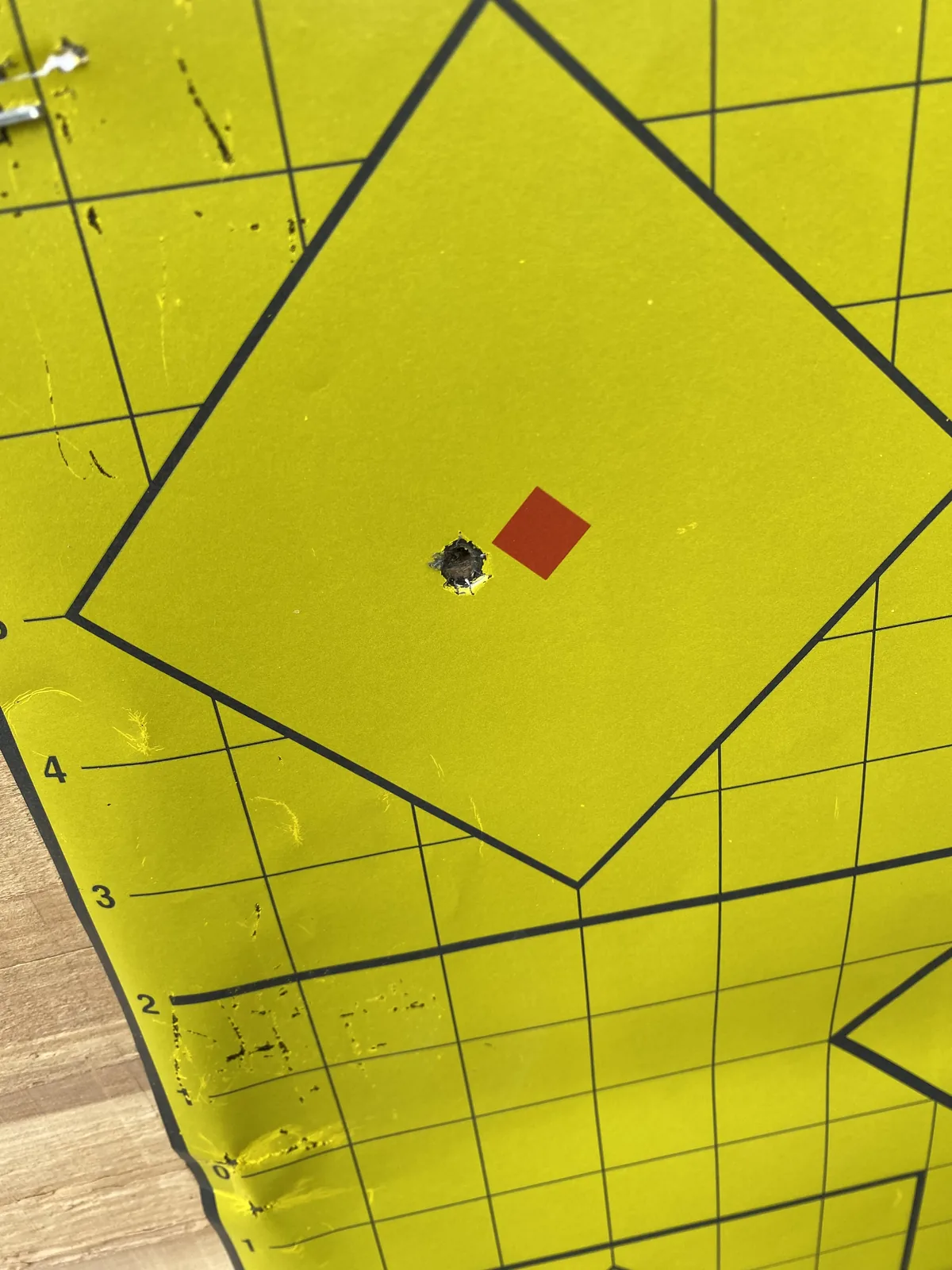
This is where the American Ranch earns its reputation. Fed deliberate, cooled strings of factory .223, the rifle produced the kind of groups that the price tag does not prepare you for.
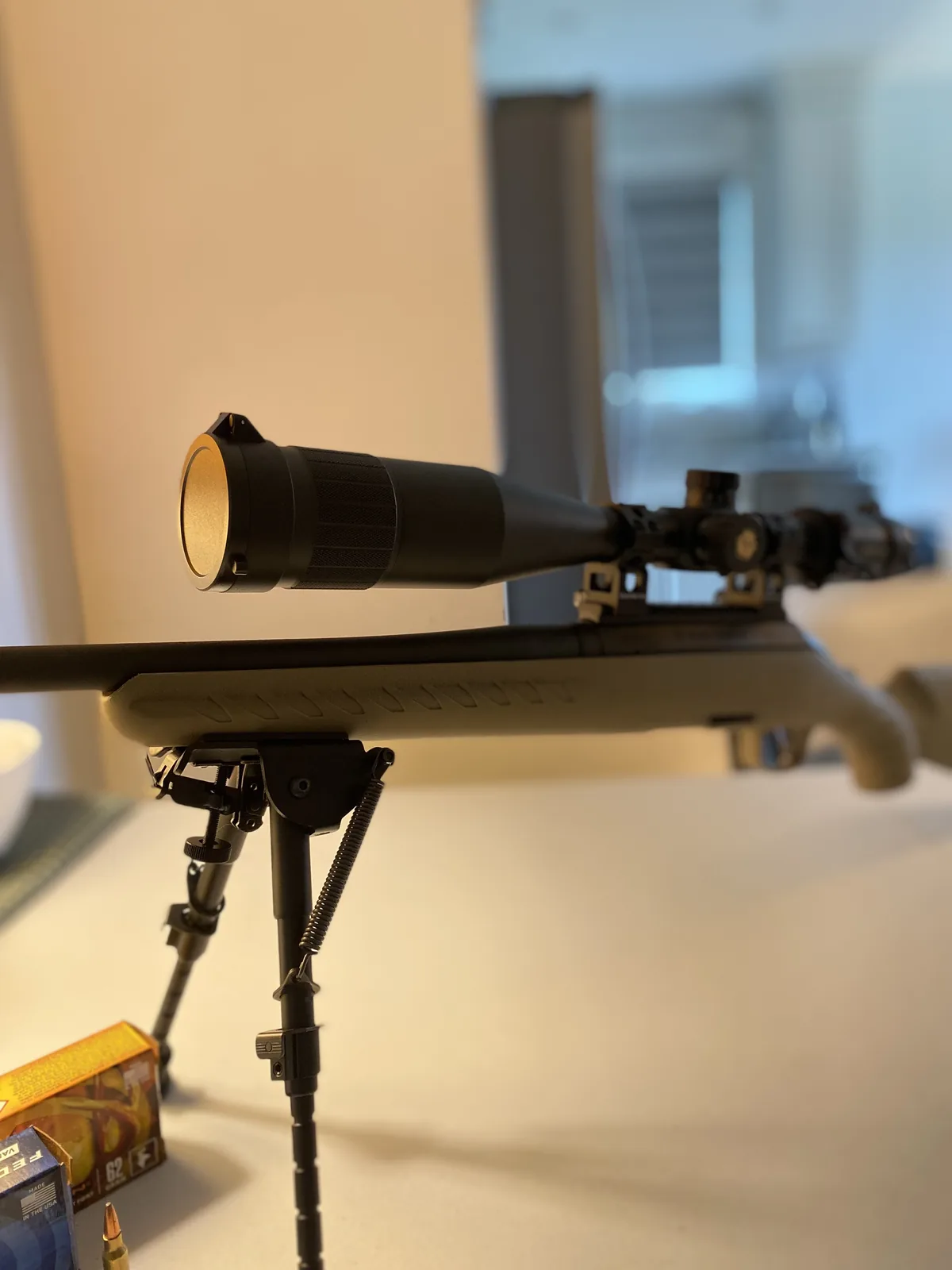
A rifle that prints groups like this, with factory hunting ammunition, off a bipod, is doing exactly what the Power Bedding system is designed to make it do. This is genuinely sub-MOA performance from a sub-$600 rifle — the kind of result that, a generation ago, would have meant a custom action and a hand-bedded stock. Here it’s the floor, not the ceiling, and a careful handloader chasing a node would likely do better still.
The one honest caveat: this is cooled-string accuracy. The thin barrel heats fast, and group sizes will open if you run it hot. Shoot it the way the rifle is built to be shot — deliberately — and it delivers.
Feeding and Function
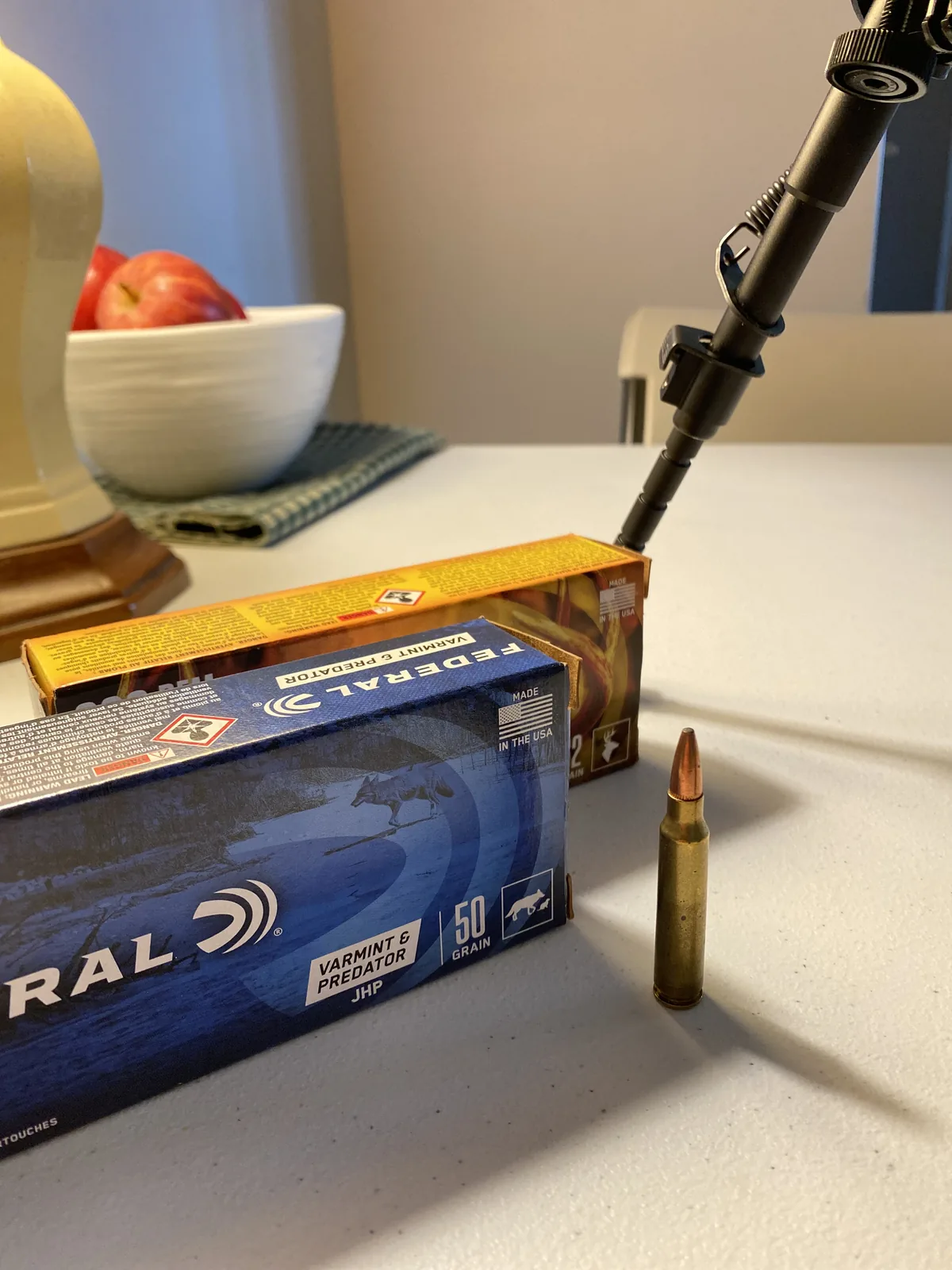
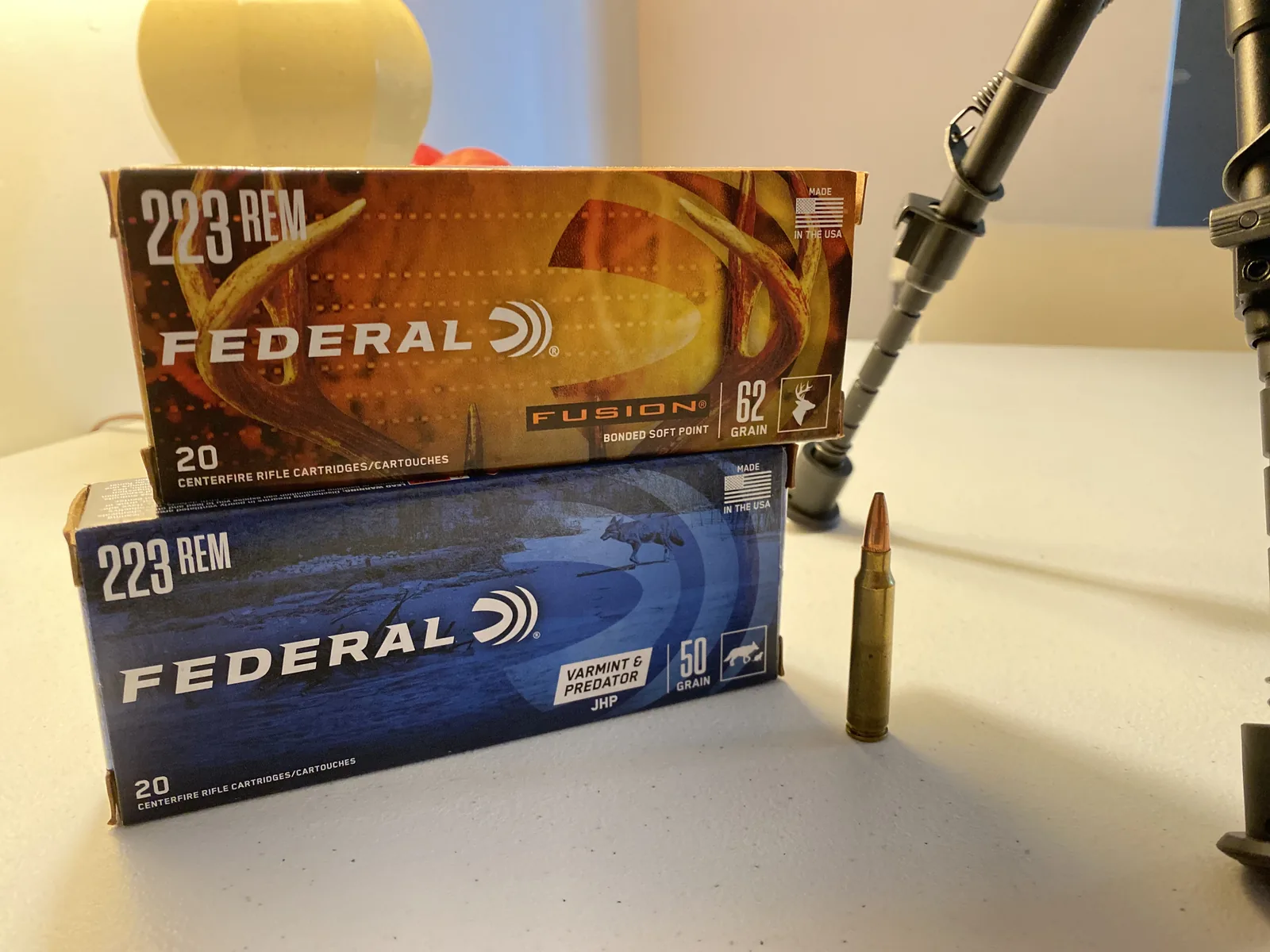
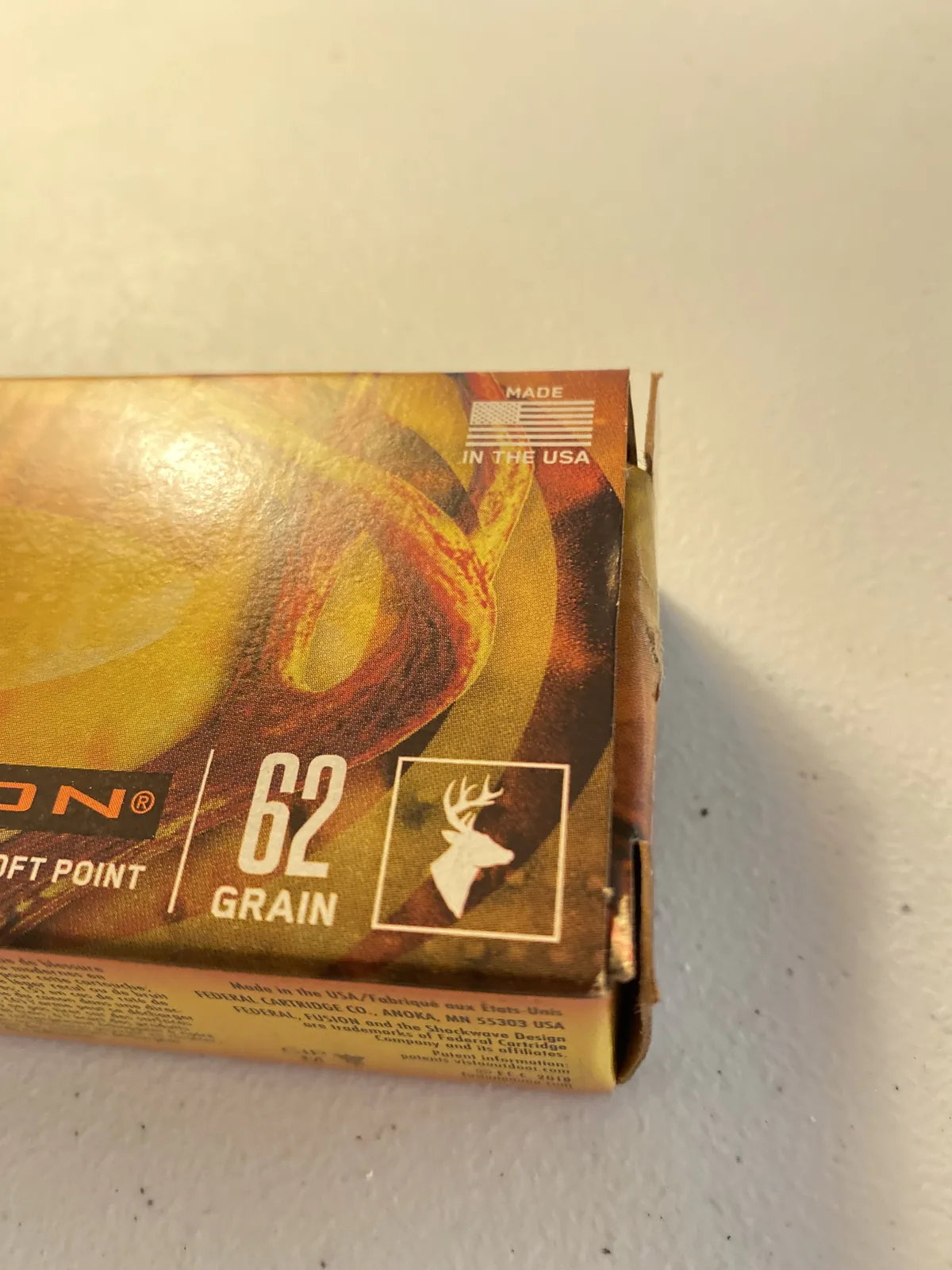
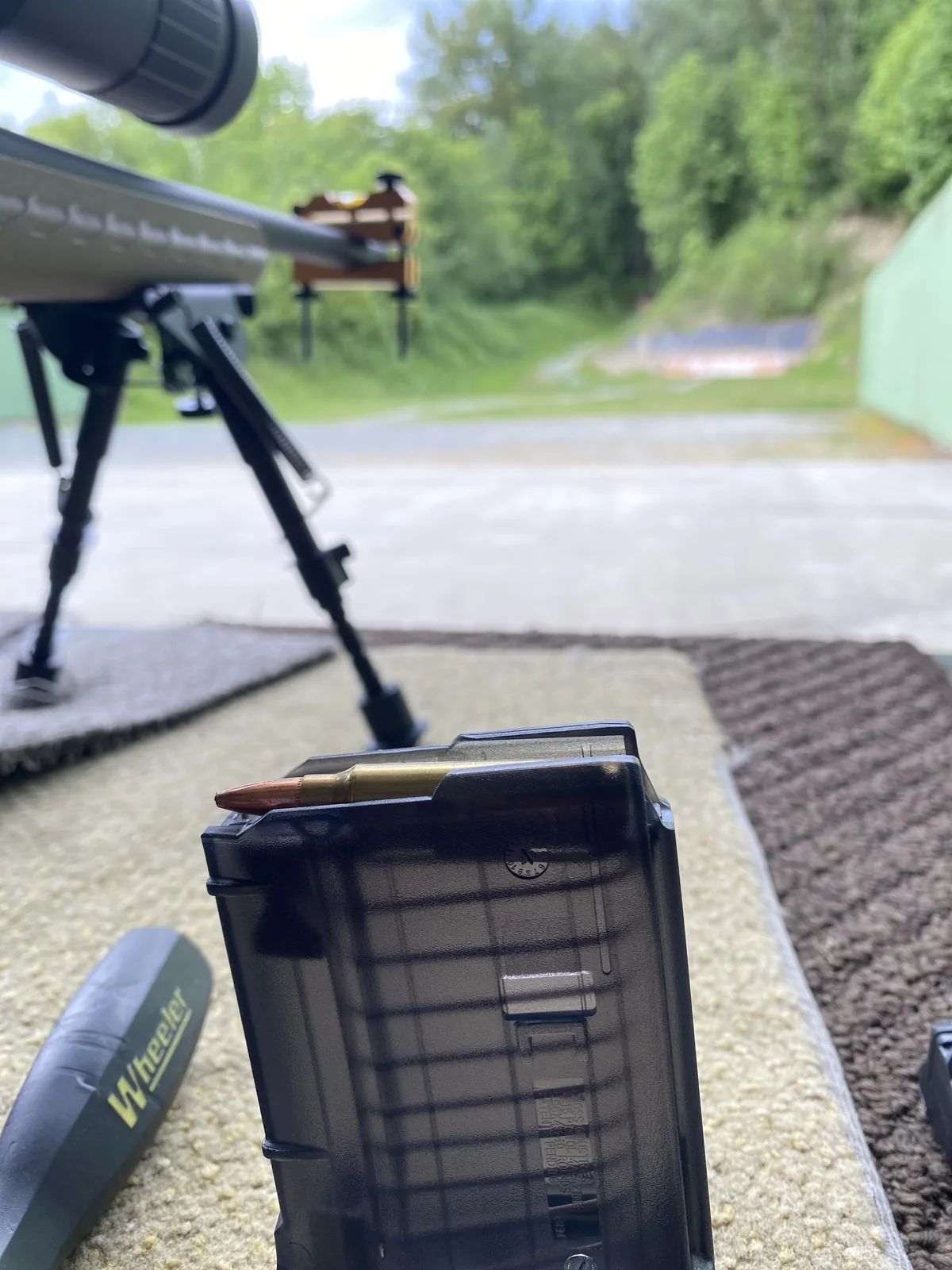
Through the test session the rifle fed, fired, extracted, and ejected without a single hiccup, running both 62-grain Federal Fusion bonded soft points and 50-grain Federal Varmint & Predator JHP. The factory rotary magazine fed smoothly. The bolt, slightly gritty at the start, smoothed noticeably over the session.
Who Was Behind It
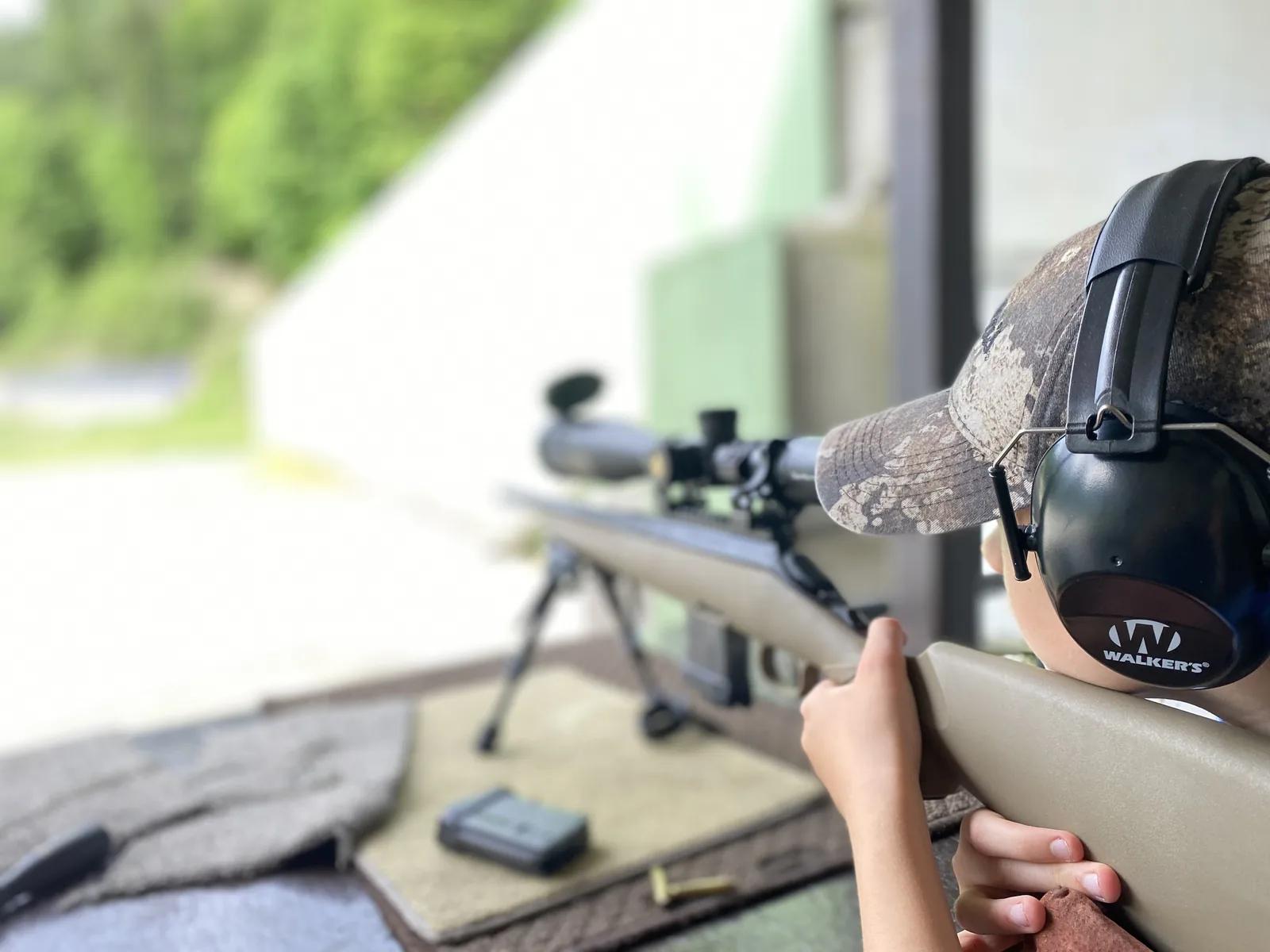
One of the quiet strengths of the American Ranch is summed up by who can shoot it well. The rifle’s light weight, short length, mild .223 recoil, and good trigger make it genuinely approachable — it’s an excellent rifle for a younger or smaller-framed shooter, and an excellent first centerfire bolt gun.
Ammunition and the .223 / 5.56 Note
The rifle was tested with Federal .223 Remington — the 62-grain Fusion bonded soft point (a genuine deer load in .223) and the 50-grain Varmint & Predator JHP (built for coyotes and varmints). Both are .223 Remington cartridges, and both ran perfectly.
A brief, practical note on the barrel marking: this rifle’s barrel is roll-marked 5.56 NATO. In plain terms, a barrel chambered and marked for 5.56 NATO is built to handle the higher chamber pressure of military 5.56 NATO ammunition and will safely fire standard .223 Remington — the .223 is the lower-pressure cartridge of the pair. (The reverse is not always true, which is why the marking matters.) The takeaway for an owner of this rifle is simple and freeing: you can feed it either, which makes ammunition easy to source. It’s a genuine convenience — not a complication.
The 1:8 twist rate is worth knowing too: it’s a versatile, modern twist that stabilizes a broad range of bullet weights — light varmint bullets and heavier 62–77-grain projectiles alike — which is part of why this rifle is as comfortable on coyotes as it is on whitetail-legal .223 loads.
How It’s Built to Be Used
As a Coyote and Predator Rifle
This is arguably the American Ranch’s purest use case. It’s light enough to carry all day on a stand-to-stand predator hunt, short enough to maneuver, threaded for a suppressor or muzzle device, accurate enough to make a precise shot on a coyote at realistic distances, and chambered in exactly the right cartridge for the job. Paired with a 50-grain varmint load, it’s hard to argue with.
As a Light Deer Rifle
In jurisdictions where .223 is legal for deer — and with an appropriate bonded or controlled-expansion bullet like the 62-grain Fusion — the American Ranch is a capable, low-recoil deer rifle inside sensible ranges. The compact length makes it excellent from a blind or a stand. This is a rifle for the hunter who values a light, handy, mild-recoiling package and is disciplined about shot selection and distance.
As a Truck and Trail Rifle
At 36 inches and just over six pounds, the American Ranch is the rifle that actually comes with you. It fits behind a seat, rides easily on a pack, and doesn’t punish you for carrying it. For a working rural rifle — predators, pests, general utility — the size and weight are the entire selling point.
As a First Centerfire Bolt Gun
The combination of mild recoil, light weight, a genuinely good trigger, and a forgiving price makes the American Ranch one of the easiest rifles to recommend to a new or younger shooter. It teaches good fundamentals because the trigger and the accuracy reward them — and it doesn’t cost so much that a beginner’s rifle becomes a financial decision.
How It Compares
vs. Savage Axis II ($450-500). The Axis II is the American Ranch’s most direct budget rival, and it’s a genuinely good rifle — the Savage AccuTrigger is excellent, arguably a touch better than the Marksman out of the box. Where the American Ranch pulls ahead is the action design (Power Bedding vs. the Axis’s more basic bedding), the tang safety, the 70-degree bolt throw, and the threaded barrel as standard on the Ranch variant. It’s close. If you find one meaningfully cheaper than the other, buy the cheaper one and don’t lose sleep. If they’re priced the same, the American Ranch is the slightly more refined package.
vs. Tikka T3x ($800-900). Not really a fair fight on price, but worth stating plainly: the Tikka is a better rifle. Smoother action, better stock, better fit and finish, legendary out-of-box accuracy. It also costs 50-70% more. The honest framing is this — the American Ranch gets you most of the way to a Tikka’s performance for a lot less money, while the Tikka gets you the experience of a premium rifle. If the budget is there and you’ll keep the rifle for decades, the Tikka is worth it. If it isn’t, the American Ranch is not a compromise you’ll regret.
vs. Ruger American Gen 2 ($600-650). Ruger’s own second-generation American addresses several of the first-gen’s weak points — notably a better stock and, on many configurations, a move toward AI-pattern magazine compatibility from the factory. If you’re buying new and the Gen 2 is available in the configuration you want, it’s the logical pick. The first-generation rifle reviewed here, though, is frequently available at a real discount on the used market and as remaining new stock — and the core of the rifle (Power Bedding, Marksman trigger, hammer-forged barrel) is the same. A first-gen American Ranch at a good price, with a stock upgrade and a magazine conversion budgeted in, is still one of the best accuracy-per-dollar buys in bolt-action rifles.
Who Should Buy the American Ranch
Buy it if you want a genuinely accurate bolt rifle and you’d rather put your money into glass and ammunition than into the rifle itself. Buy it as a coyote and predator rifle, as a light deer rifle where .223 is legal, as a compact truck-and-trail gun, or as a first centerfire bolt action for a new or younger shooter. Buy it if you understand and accept the two known compromises — the budget stock and the factory magazine — and you see them for what they are: the easy-to-upgrade parts of a rifle whose hard-to-upgrade parts are already good.
Don’t buy it expecting a premium experience out of the box — the stock and the fit-and-finish are honest budget-rifle territory. And don’t buy it as a high-volume bench rifle; the thin barrel isn’t built for it. Buy it for what it is: a field rifle that shoots far better than it has any right to at the price.
Final Verdict
The Ruger American Ranch in .223 / 5.56 NATO is one of the best accuracy-per-dollar values in the bolt-action world. Ruger spent the budget exactly where it matters — Power Bedding, the Marksman Adjustable trigger, a cold hammer-forged threaded barrel — and saved it on the parts you can upgrade later if you ever feel the need: the stock and the magazine. The result is a compact, light, dependable rifle that prints sub-MOA groups with factory ammunition and costs around $549.
It is not a perfect rifle. The stock flexes, the factory magazine is a known upgrade path, and the thin barrel heats fast. But every one of those compromises is the right compromise — they’re the cheap-to-fix parts, and the expensive-to-fix parts are already right. For a hunter who wants a real working rifle for predators, varmints, and light deer duty — or a parent putting a first centerfire bolt gun in a new shooter’s hands — the American Ranch is exceptionally easy to recommend.
If you’ve been waiting for a budget bolt rifle that doesn’t shoot like a budget bolt rifle, this is it.
Rating: 4.7/5 Stars
Brands sometimes provide samples for review. Hunt & Live writes its honest opinion either way — gear that doesn’t earn its keep doesn’t get a recommendation.