Hunt & Live

Featured Review · Tucktec · Folding Kayak

Tucktec Pro Folding Kayak Review — The Origami Hard-Shell That Tucks Behind Your Truck Seat and Still Paddles Like a Real Kayak

June 26, 2026 By Greg 19 min read
Tucktec Pro Folding Kayak Review — The Origami Hard-Shell That Tucks Behind Your Truck Seat and Still Paddles Like a Real Kayak

Our Rating

4.5 / 5 ★★★★☆

Current Price

$380 USD
Buy on Tucktec →
Length
10 ft (Pro Model)
Capacity
300 lb
Country of origin
USA (Murrells Inlet, SC)
Construction
Solid hard-shell folding hull, puncture-proof, rated for thousands of folds

Pros

  • Truly portable — the folded package rides behind a sedan back seat or in the cargo of a compact SUV with room to spare, no roof rack, no trailer, no garage required
  • Hard shell that actually feels like a hard-shell kayak on the water — not a soft inflatable, not a fragile skin-on-frame, but a rigid hull with the heft of a traditional kayak
  • Genuinely fast assembly — Tucktec rates it as a two-minute set-up with six locking levers, and after the first practice round that figure is honest
  • Z-fold engineering means there are no open folds below the top of the hull, so no waterproof sealing or maintenance is required and the only water inside comes from paddle drip
  • Real 300-lb capacity opens the boat to a hunter wearing waders + a packed pack + a soft-cased shotgun, or an angler with a tackle bag + cooler + rod loadout
  • Made in the USA — every part of the kayak is manufactured or locally sourced near the Murrells Inlet, SC headquarters per Tucktec, no overseas supply chain
  • 3-year warranty on the original owner with kayak registration and a 90-day return policy
  • Includes a fold-down adjustable seat back, a snap-on stabilizer pontoon, and a skeg for tracking (note: paddle is sold separately — Tucktec offers a SeaSense Xtreme II 2-part paddle add-on, or the buyer can use any standard kayak paddle)
  • More than 1,400 published reviews on the Pro Model with a 4.77/5 aggregate — this is not a new or untested platform
  • Featured originally in the July 2005 Field & Stream as the 'TOTE-N-BOAT' — 20 years of design iteration on the same fundamental folding-hull concept

Cons

  • First assembly takes longer than two minutes — count on 10-15 minutes the first time before the muscle memory of the six locking levers and the seat-back install develops
  • The hard-shell-but-foldable construction means there are visible seams and creases in the hull that, while structurally sound and waterproof, will not look like a traditional one-piece kayak
  • Storage and roll-up after a day on the water takes a bit of practice — the kayak benefits from being folded a few times at home before the first real outing
  • The Pro Model is purchased direct from Tucktec; there is no Canadian retail presence, so Canadian buyers should account for cross-border shipping and duty in addition to the $35 USD shipping
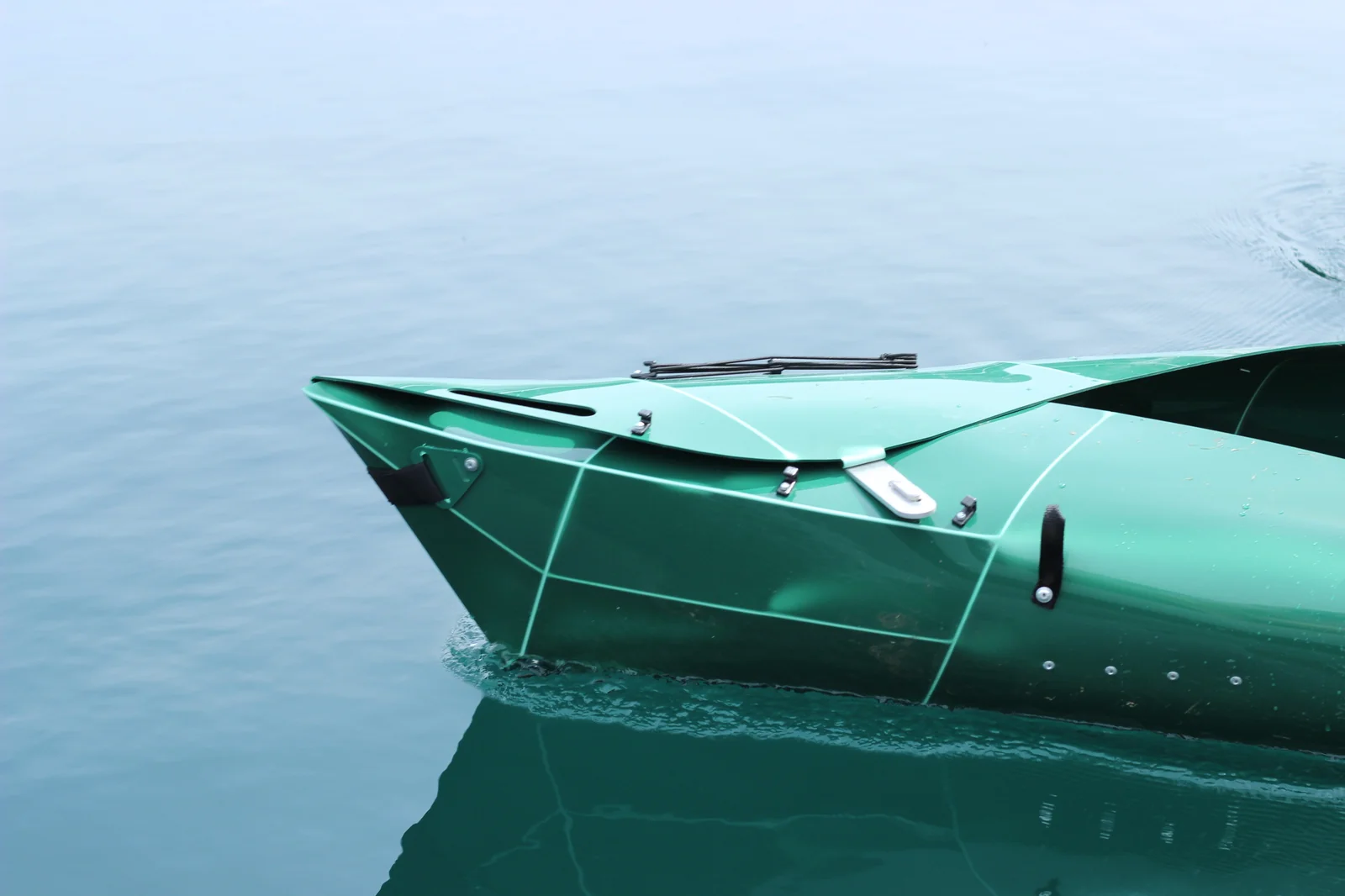
Tucktec Pro folding kayak bow gliding silently on calm reflective water
Tucktec Pro Folding Kayak — the boat we just unfolded out of a flat package small enough to ride behind the back seat of a sedan, on the water and tracking straight in under five minutes from "open trunk" to "first paddle stroke." This is what the editorial question of this review actually hinges on: does the origami hard-shell hold its shape and paddle like a real kayak, or is the portability a trade you'll regret? Spoiler — the hull looks and behaves like a hard-shell on the water.

The most under-discussed piece of three-domain outdoor gear

Of all the gear in a serious hunter / off-grid / angler kit — rifles, optics, knives, packs, sleeping systems, power stations — the one that almost nobody talks about is the boat. The kayak. The “how do I get to that water” tool.

The conversation gap exists for a simple structural reason: traditional kayaks are huge, expensive to transport, and the kind of long-term storage commitment that most people just opt out of. You either dedicate a section of garage to a hard-shell, you bolt a roof rack onto the vehicle, you tow a trailer, or you rent space at a marina or a friend’s barn. For the hunter who’d happily use a kayak to reach a waterfowl spot, the off-grid reader who’d happily store a watercraft if it didn’t displace a workbench, or the angler who’d happily take a boat to a backcountry pond if it fit in the truck, the dedicated kayak is a non-starter. So the question never gets asked.

The Tucktec Pro Folding Kayak — a $380 USD, 10-foot, 300-lb-capacity Z-fold hard-shell kayak made in Murrells Inlet, South Carolina by Tucktec — is the piece of gear that closes that gap. It folds flat enough to ride behind a sedan back seat. It assembles in about two minutes with six locking levers. It has a real 300-lb load rating. And on the water, it paddles like a hard-shell kayak because it is a hard-shell kayak — just one that’s been engineered around an origami fold pattern that traditional one-piece hulls cannot match.

This review walks through the retail box and the folded form factor, the components and the assembly process, the completed boat on grass, the launch off a real dock, and the first-impressions paddle on calm water. Then — at the end — we step out of the first-impressions context and into the three-domain editorial frame our reader segment actually cares about: the hunter, the prepper, and the angler. A v2 follow-up review is scheduled for either a hunting water-crossing or a backcountry fishing scenario, and we’ll link it from this page when it publishes.

Unboxing — Made in the USA, exactly as advertised
Tucktec retail cardboard shipping box with TUCKTEC logo and MADE IN THE USA printed on the side
The retail box. Plain corrugated cardboard, the Tucktec paddler-silhouette logo, and the only printed claim on the carton: MADE IN THE USA. Per Tucktec's own marketing, every part of the kayak is manufactured or locally sourced near the Murrells Inlet, SC headquarters — no overseas supply chain. The brand has been shipping the folding-kayak concept since the original "TOTE-N-BOAT" version was profiled in the July 2005 Field & Stream.
Folded green Tucktec Pro kayak hull on the ground with black retaining strap
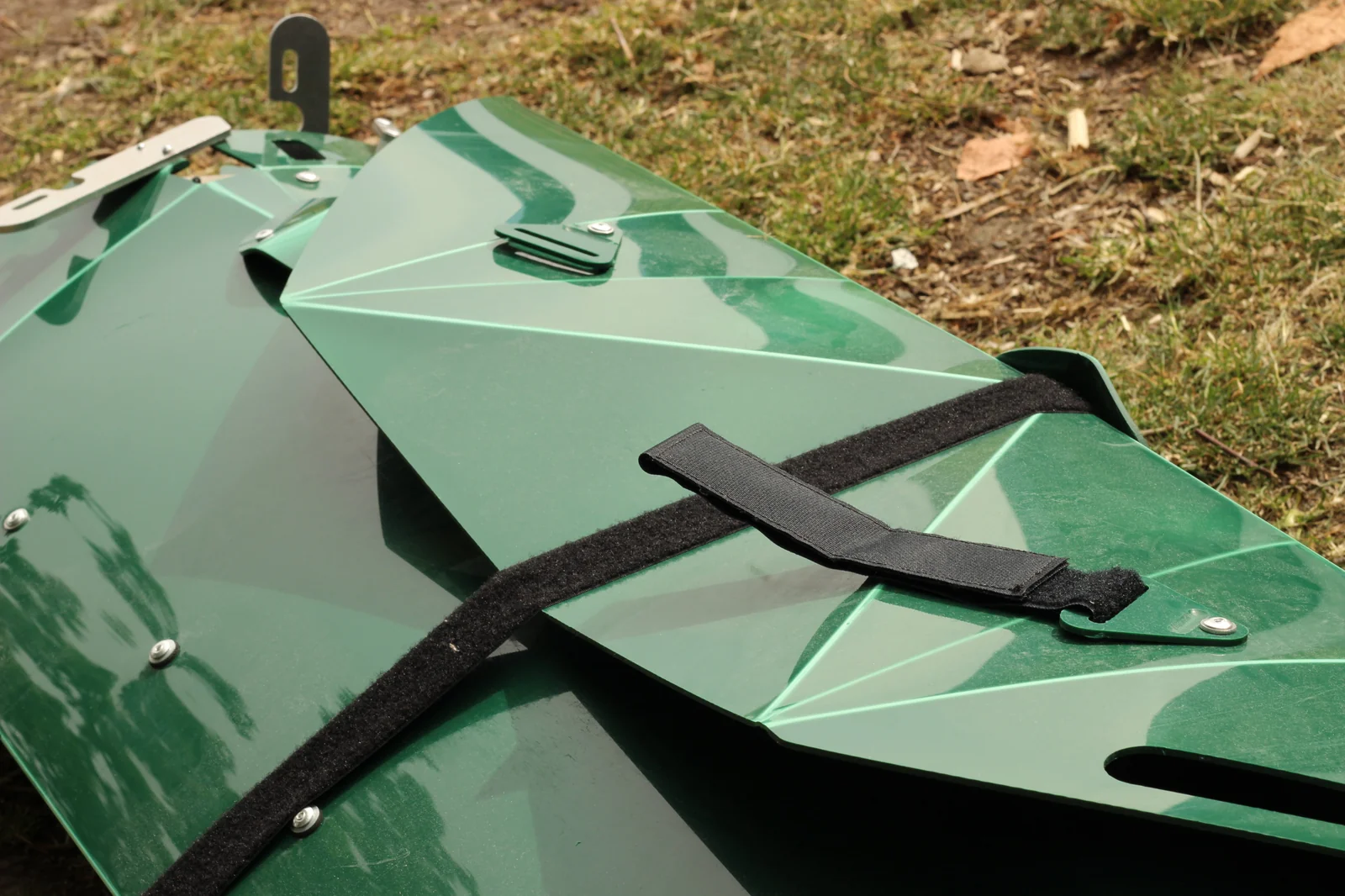
The kayak as it ships — folded flat and secured with a black webbing-and-velcro retaining strap. The green hull panels stack into a flat package that's compact enough to ride in places a traditional kayak simply cannot. This is the form factor that makes the rest of the editorial possible.

The folded transport story — this is the entire point

The single biggest objection to owning a kayak is the storage-and-transport problem. The Tucktec Pro answers it directly. The folded package is small enough that the boat rides inside the vehicle — behind a back seat or in the cargo of a compact SUV — instead of bolted to a roof rack or pulled on a trailer. For our reader base, this is the difference between “I’d love to have a kayak someday” and “I have a kayak in my truck right now.”
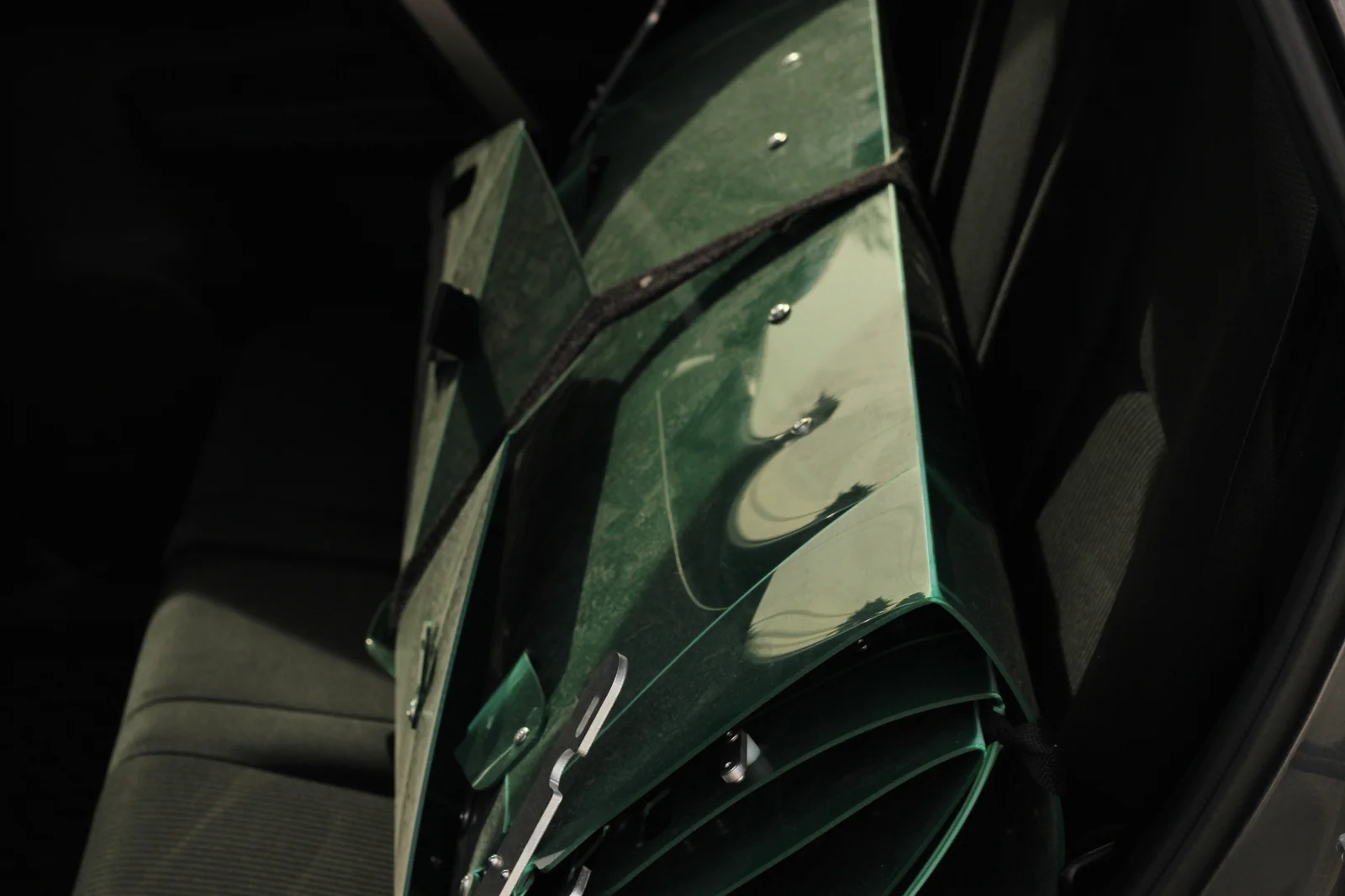
Folded Tucktec Pro kayak standing vertically behind the back seat of a passenger car
The folded Pro Model standing vertically behind the back seat of a passenger car. Strapped, stable, and out of the way of the cargo area. For a single-vehicle household this is the answer to the "where does it live during the week" question: it lives behind the back seat and goes wherever the car goes.
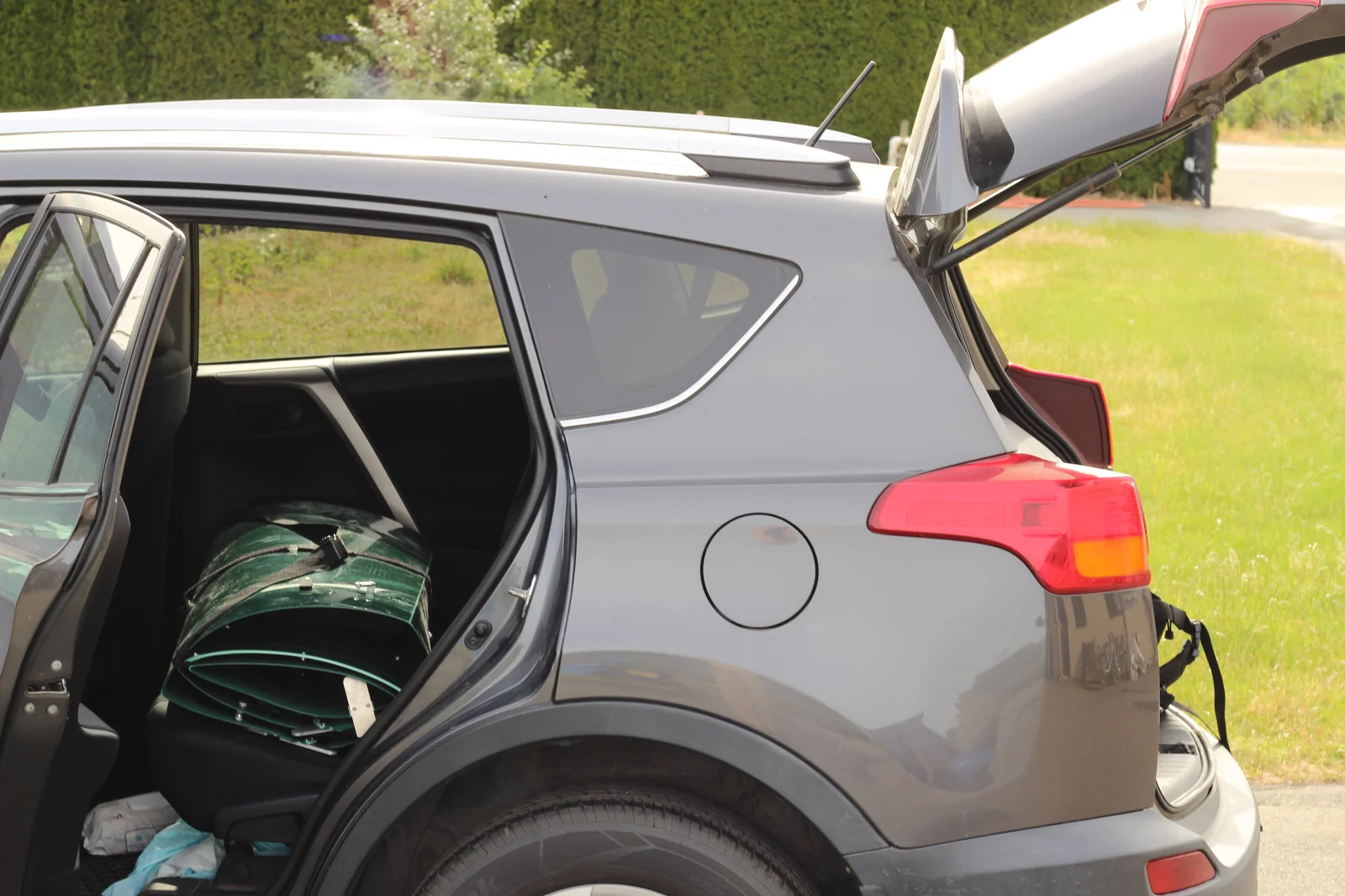
Folded green Tucktec Pro kayak loaded in the cargo area of a Toyota RAV4 SUV with the hatch open
Same folded kayak, loaded into the cargo area of a Toyota RAV4 — a compact crossover, not a full-size SUV. The kayak fits with the rear seats up and leaves room for the rest of the day's gear. No roof rack required, no trailer hitch required, no dedicated kayak vehicle required.
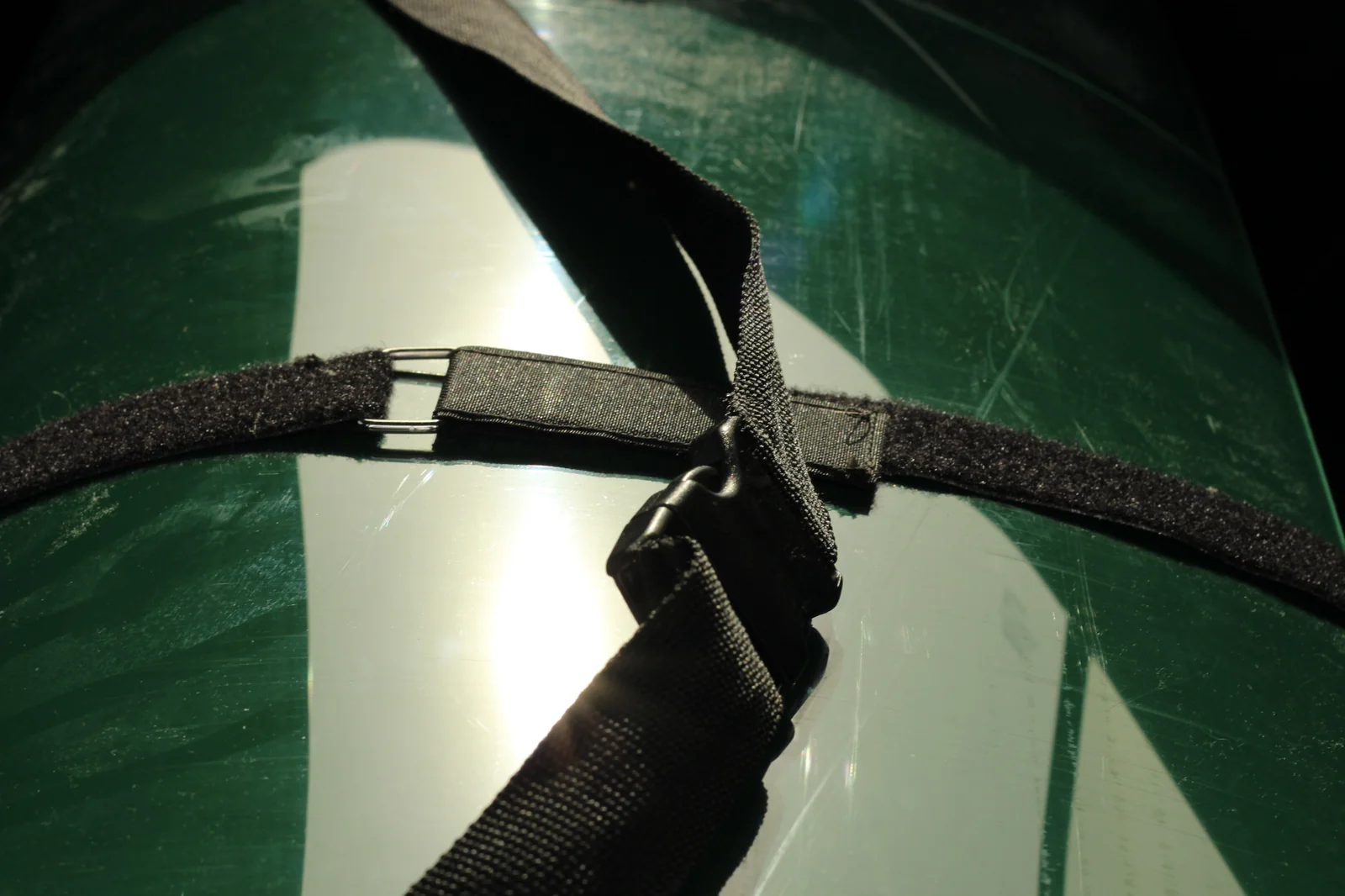
Close-up of the black webbing retaining strap with plastic side-release buckle and velcro keeper on the folded Tucktec hull
The retaining strap is a plain black webbing belt with a plastic side-release buckle and a velcro keeper — the same kind of strap that lives on a thousand outdoor products because it's reliable, replaceable, and unfussy. Velcro keeper keeps the tail from flapping, the buckle locks the folded package, and nothing on this system is going to fail in normal use.
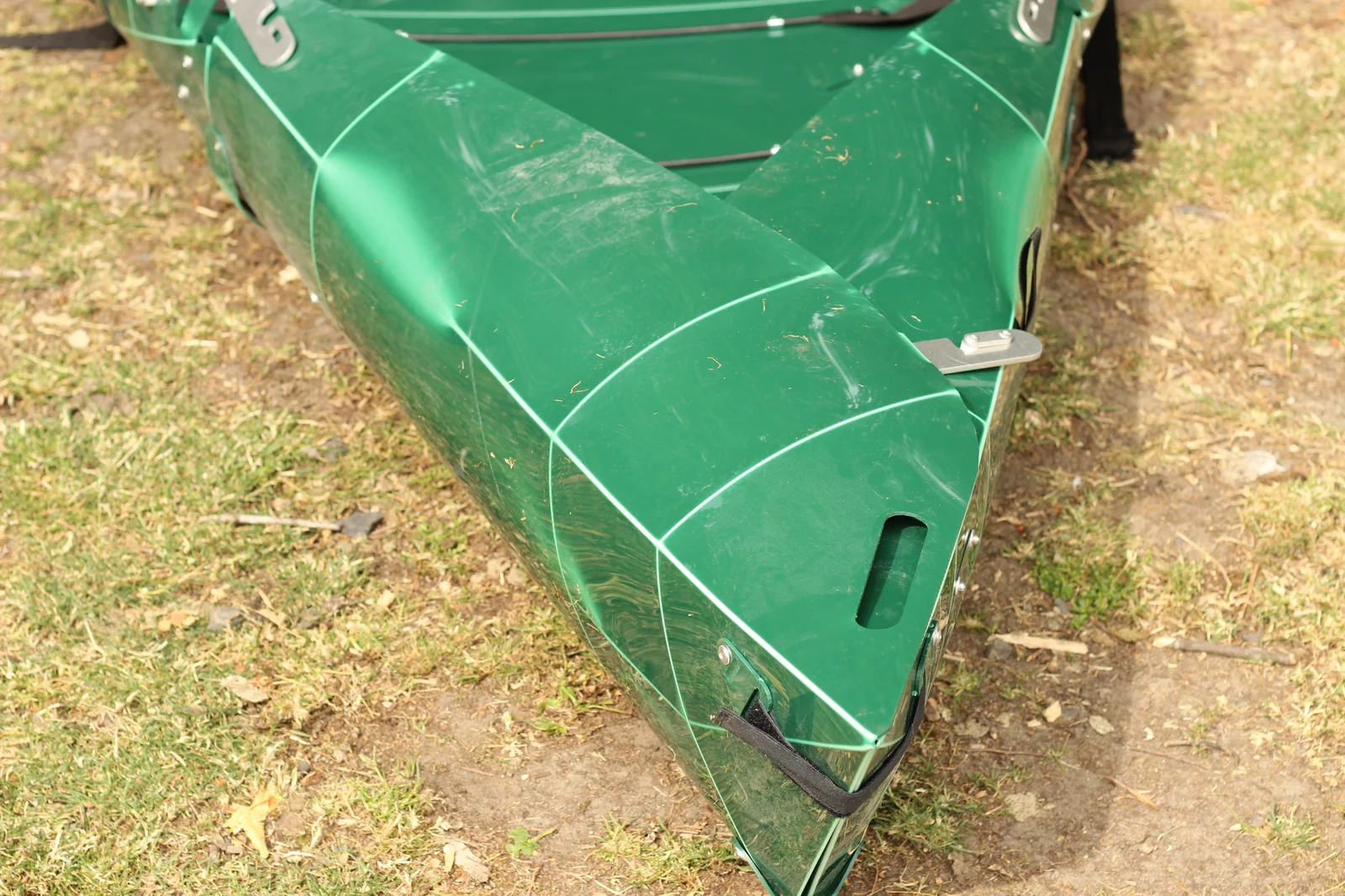
Stern end of the folded Tucktec Pro kayak showing layered hull segments and webbing strap loop
The stern end of the folded package, showing how the hull segments stack. The Z-fold geometry that Tucktec advertises is what makes the boat both compact when folded and watertight when assembled — there are no open folds below the top of the hull, so there is nothing to seal and nothing to leak.

Inside the kit — components, fittings, and frame rails

Folding the kayak open is the first time you actually see the engineering. The hull is a single continuous sheet of solid, thick polymer with the fold geometry pre-formed into it. Inside, black metal frame rails run along the seam lines, riveted in place, with locking points machined into the hull at key positions. The kit ships with everything needed to launch: hull, fold-down seat, snap-on stabilizer pontoon, 2-part paddle, skeg, and the retaining strap.
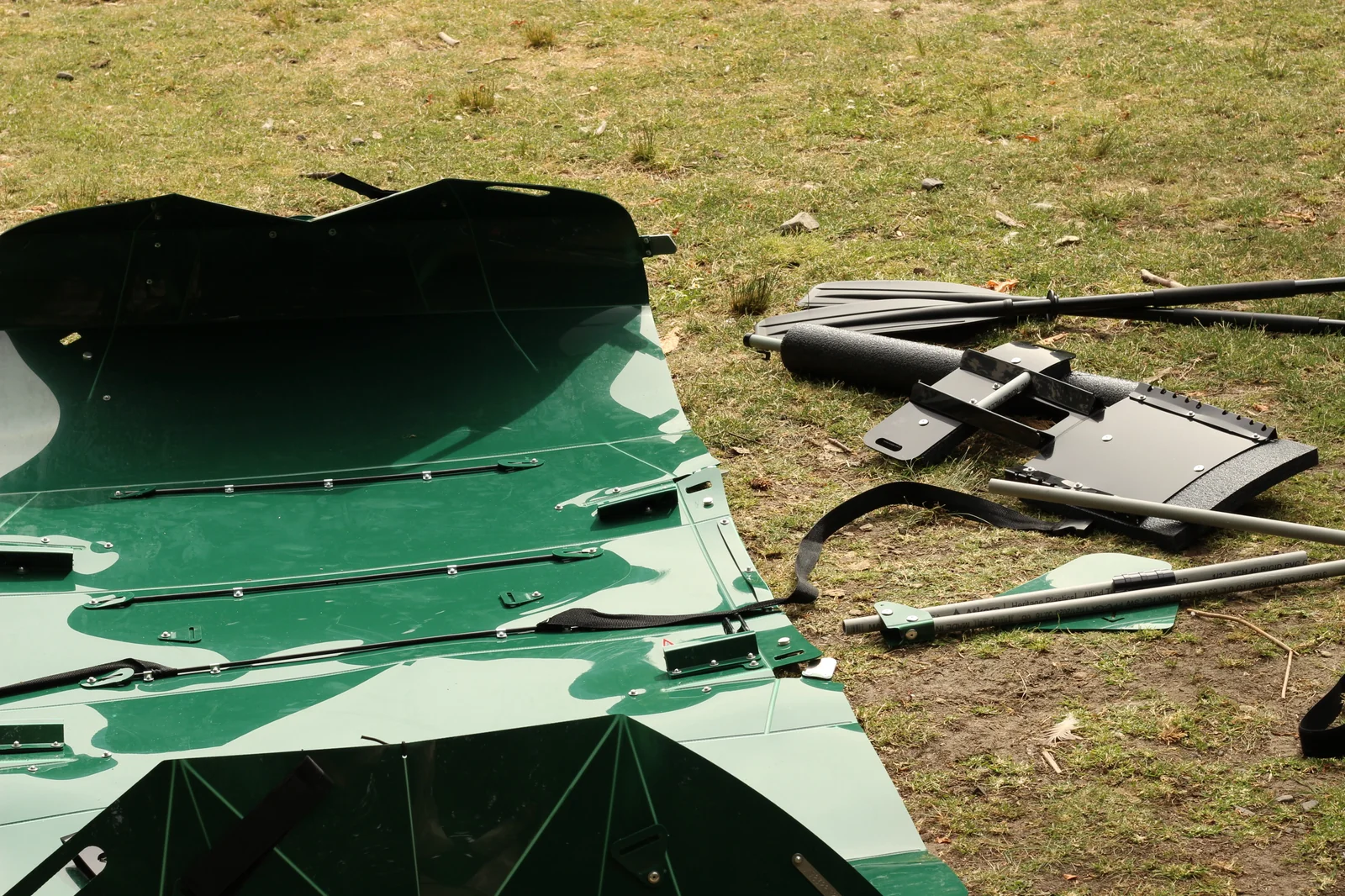
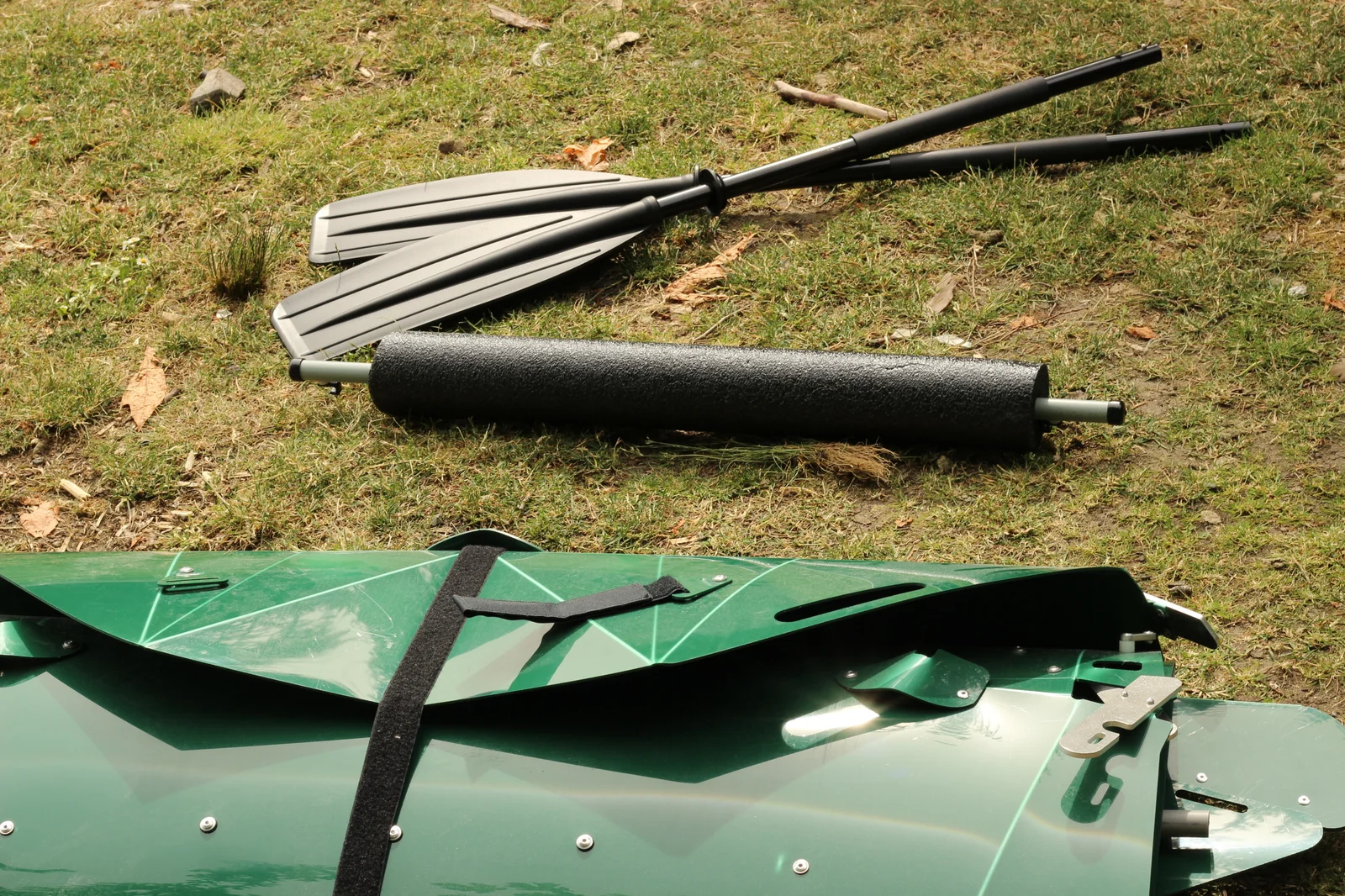
Partially unfolded Tucktec green hull laid out flat on grass next to the separately-purchased paddle, foam stabilizer, and seat-back hardware
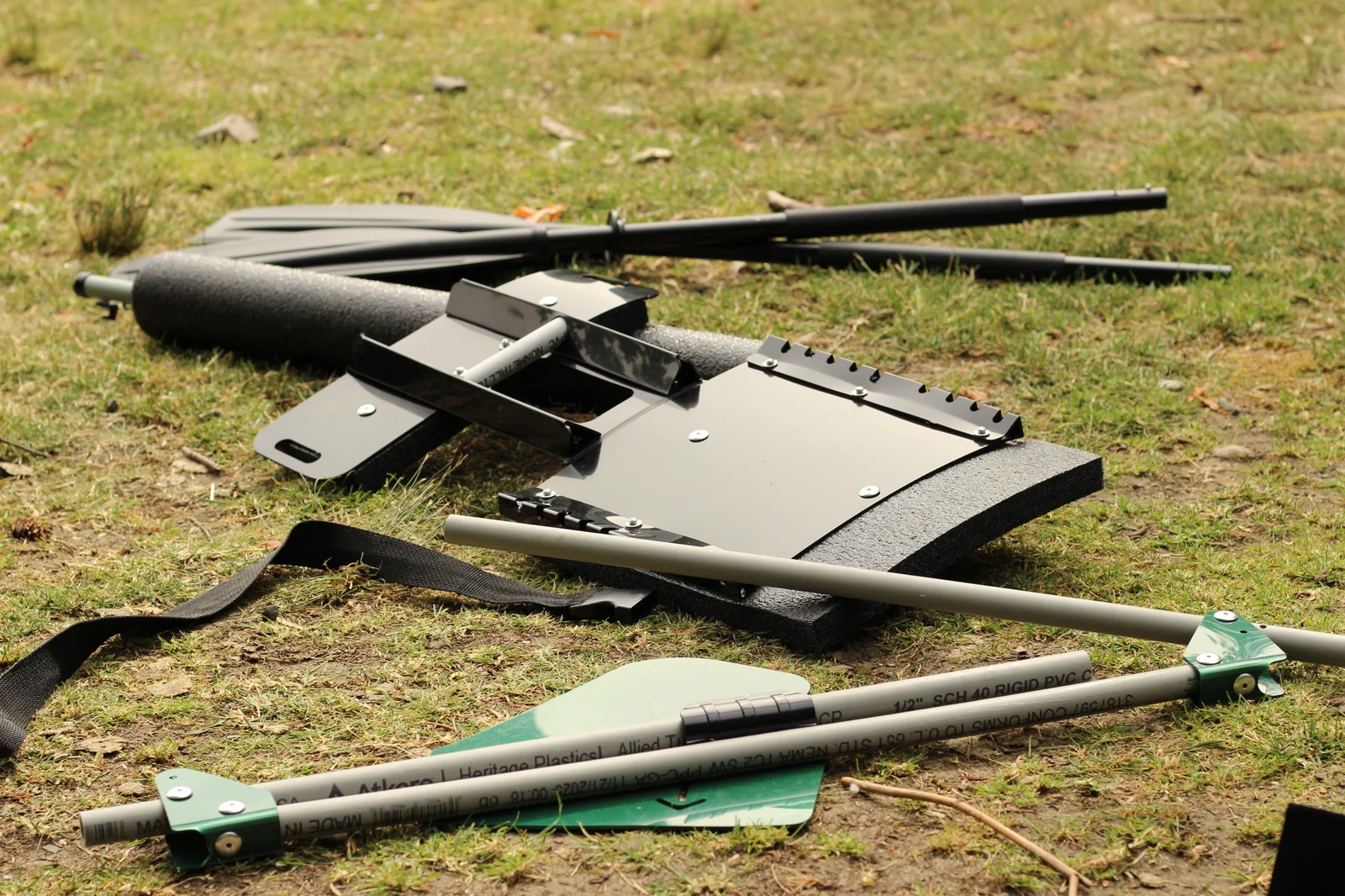
The hull unfolded — laid out flat next to the loose components: the 2-part paddle we used for the review (sold separately), the included foam stabilizer pontoon, and the included black seat-back hardware. The single-sheet construction is fully visible here. This is the moment in the unboxing where the engineering decision becomes obvious: rather than glue or stitch separate panels, Tucktec uses one continuous sheet and lets the fold geometry handle the shape.
Folded Tucktec hull on grass next to the separately-purchased 2-part paddle and the snap-on foam stabilizer pontoon
The shipped kit laid out on grass alongside the paddle we used for testing: the folded hull and the included foam stabilizer pontoon (both shipped with the kayak), plus the 2-part paddle which is sold separately. The skeg/fin and the seat hardware are included in the kit. Plan on either using a paddle you already own or adding a Tucktec SeaSense Xtreme II to the order.
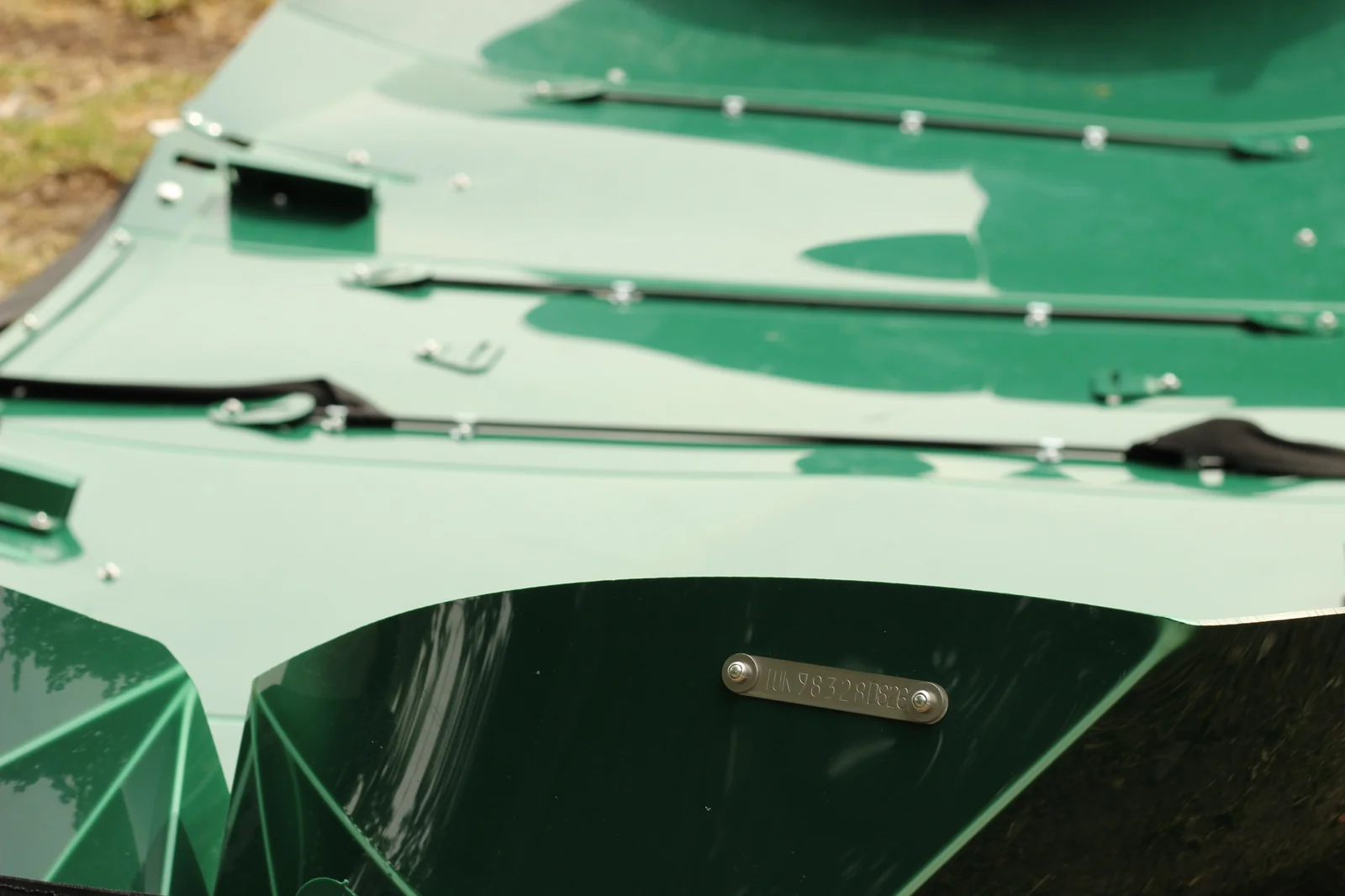
Close-up of the internal black metal frame rails riveted to the green hull panels with a small stamped metal serial number plate
The interior of the partly-unfolded hull, showing the black metal frame rails that follow the seam lines. The rails are riveted to the hull at regular intervals — the rivet pattern is the structural backbone that lets the kayak hold its shape under paddler load. The small stamped metal plate at lower right is the kayak's unique identification number — Tucktec stamps each hull with a serial for warranty registration.
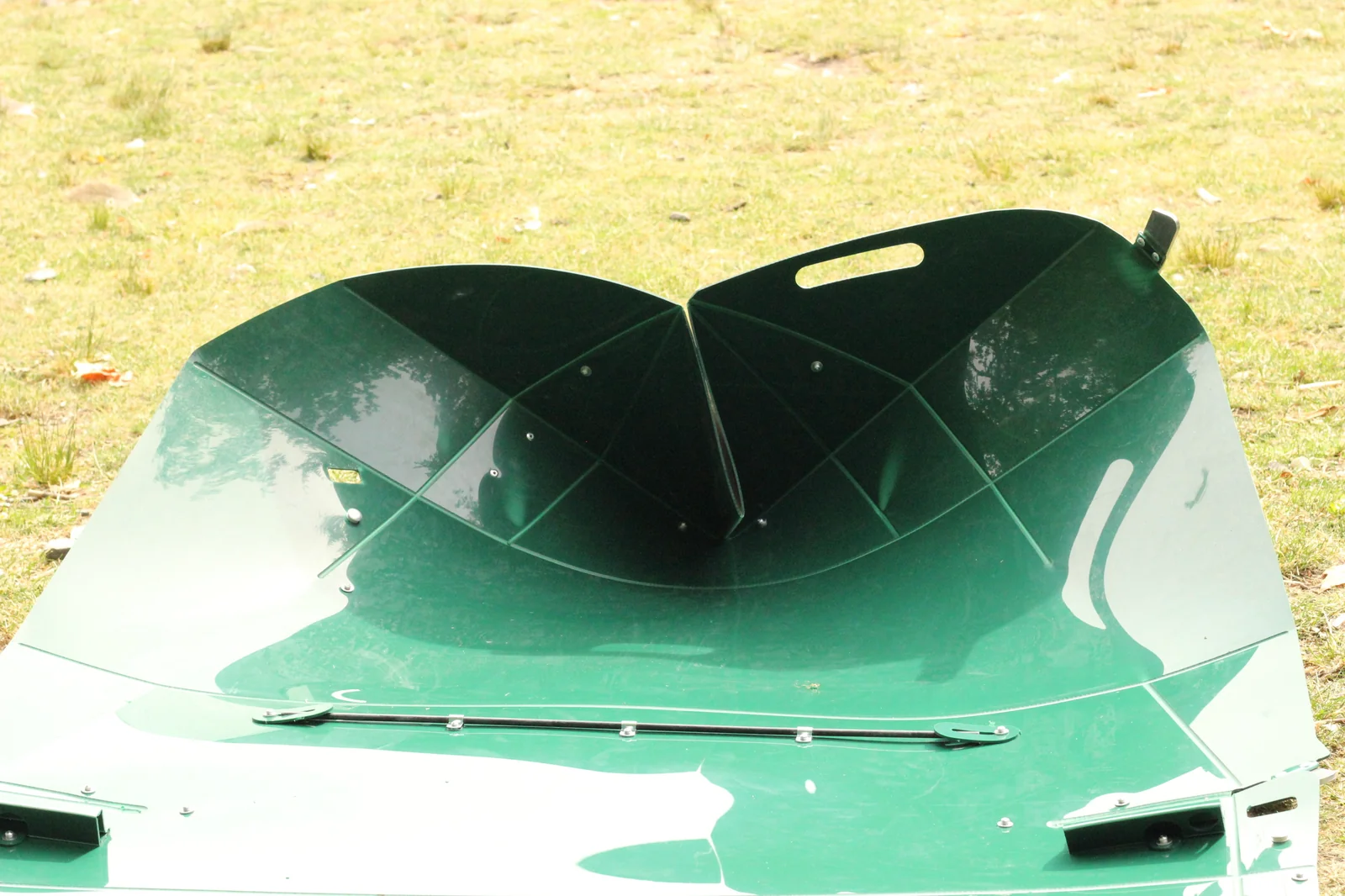
Inside view of the bow of the Tucktec kayak showing two hull panels meeting in a heart-shaped curve with rivets along the seam
Looking forward into the bow of the partly-assembled kayak — the two hull panels curve up and meet at the bow's interior point. The rivet line follows the seam where the panels fold against each other, and the carry-handle slot is visible at the top. This is one of the most visually distinct fold-geometry views in the build: the same single sheet of polymer that forms the deck also forms the bow walls without any joins or seals.

The 2-part paddle and the foam stabilizer

One important note before this section: the paddle is not included with the Tucktec Pro Folding Kayak. It is sold separately. Tucktec offers a SeaSense Xtreme II 2-part paddle as an accessory through their store, and the kayak is fully compatible with any standard kayak paddle the buyer already owns. For this review we used a PROPEL-branded 2-part take-apart paddle, which is the kind of outfitter-grade aluminum-shaft paddle you’d reach for at this price point — fully functional, breaks down to match the kayak’s compact storage, and visible in the on-water photographs that follow.

The foam stabilizer pontoon, on the other hand, is included. It’s a black closed-cell-foam float that snaps onto the side of the cockpit to add lateral flotation and stability — important for the new paddler, useful for the angler who wants extra static stability when working a rod, and removable for the experienced paddler who wants the kayak to feel like a kayak.
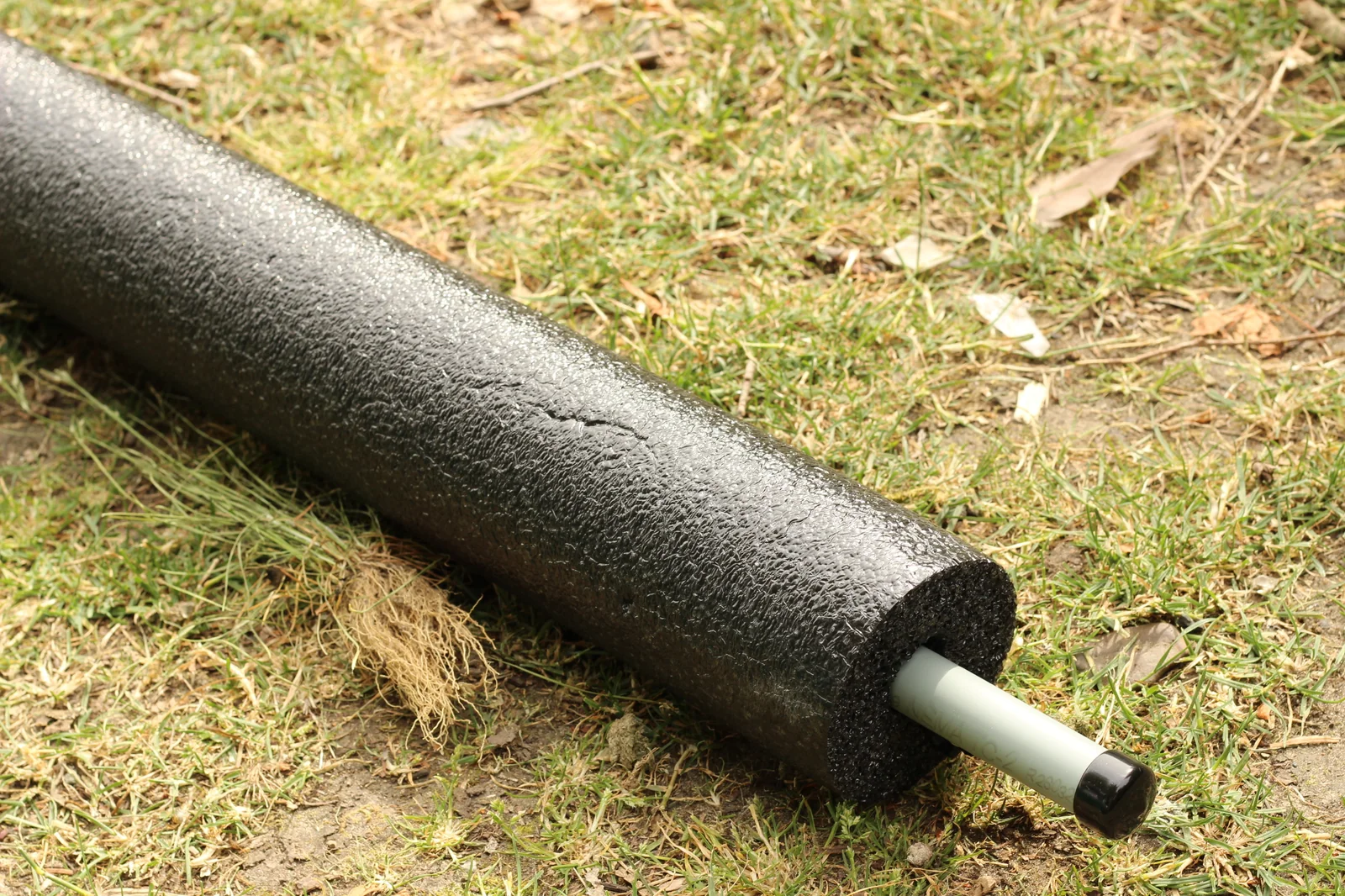
Black foam stabilizer pontoon on grass with the green plastic mounting insert visible at the end
The snap-on foam stabilizer pontoon. Black closed-cell foam over a structural insert, with the green plastic mounting fitting visible at the end. The pontoon clips to the side of the kayak cockpit and rides at the waterline to add lateral stability. For a new paddler this is essentially training wheels — for the angler, it's a permanent stability boost.
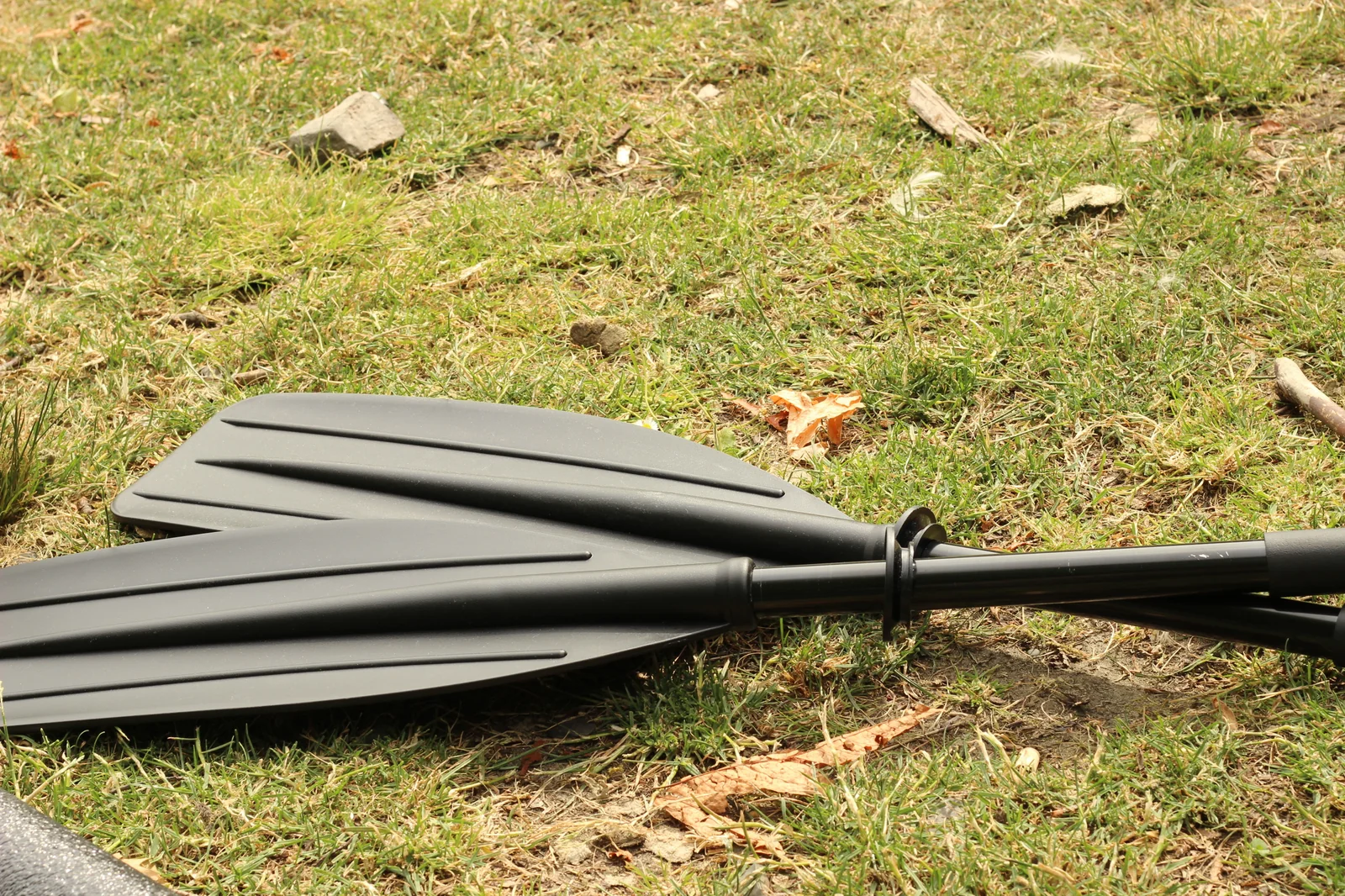
Close-up of the two black plastic paddle blades from the included Tucktec 2-part paddle
The 2-part take-apart paddle we used for this review — black molded plastic blades on an aluminum shaft, the take-apart join visible at right. Note: this paddle is not included with the Tucktec Pro — paddles are sold separately. Tucktec offers a SeaSense Xtreme II as an accessory, and the kayak is compatible with any standard 2-part kayak paddle the buyer already owns.
The complete loose kit on grass — the separately-purchased 2-part paddle shaft and blade, included foam stabilizer pontoon, and the included black seat-back hardware piece with mounting frame
The full loose-component kit laid out on grass: the 2-part paddle (shaft + blade) that we used for the review — sold separately, not included with the kayak — and the included foam stabilizer pontoon and the included black seat-back hardware piece with its mounting frame. Notice the simple, modular design language across the included pieces — every piece is independently replaceable, which is the right engineering decision for a product with a 3-year warranty.

The locking lever system — six points that turn a folded sheet into a rigid hull

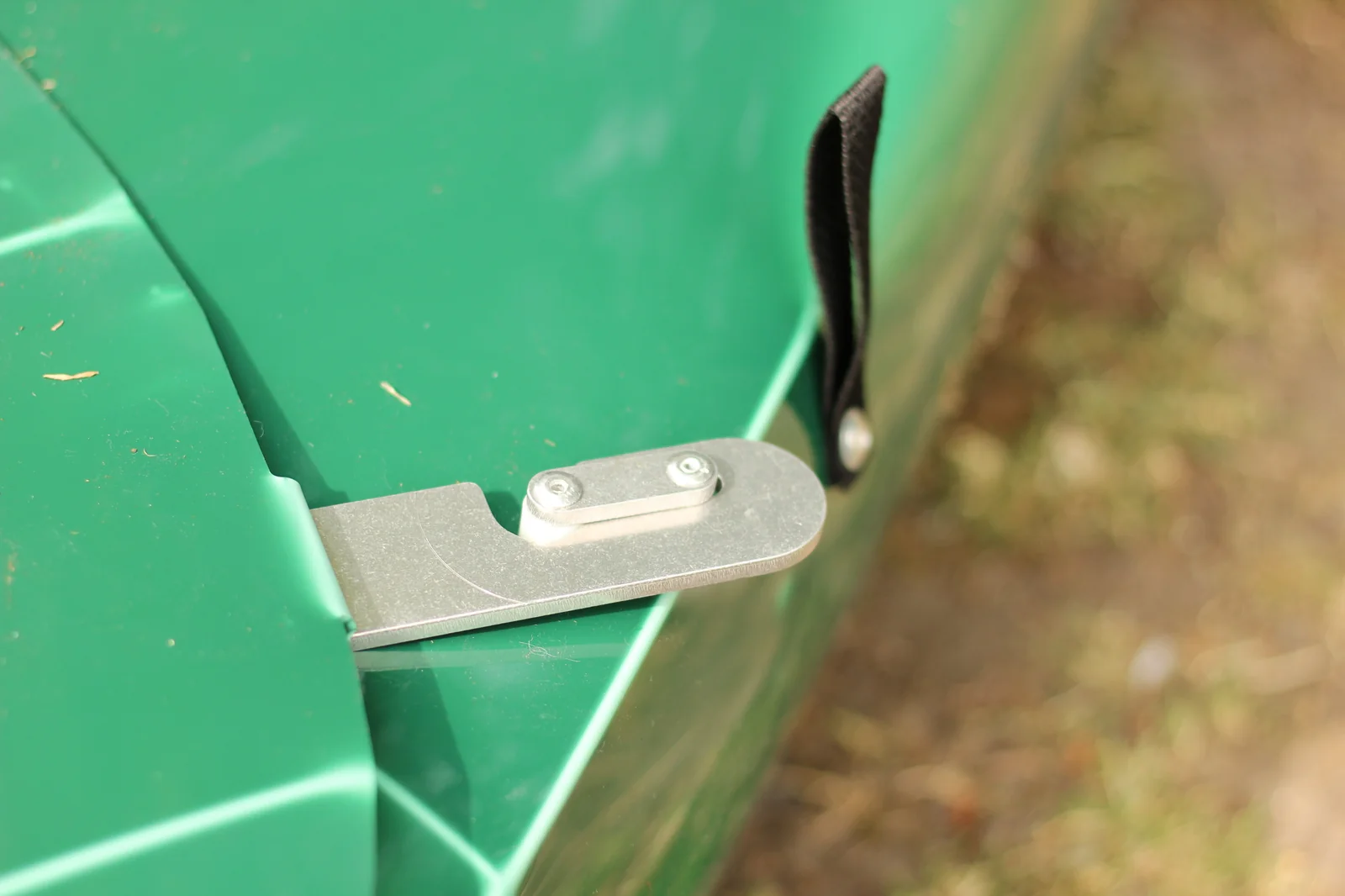
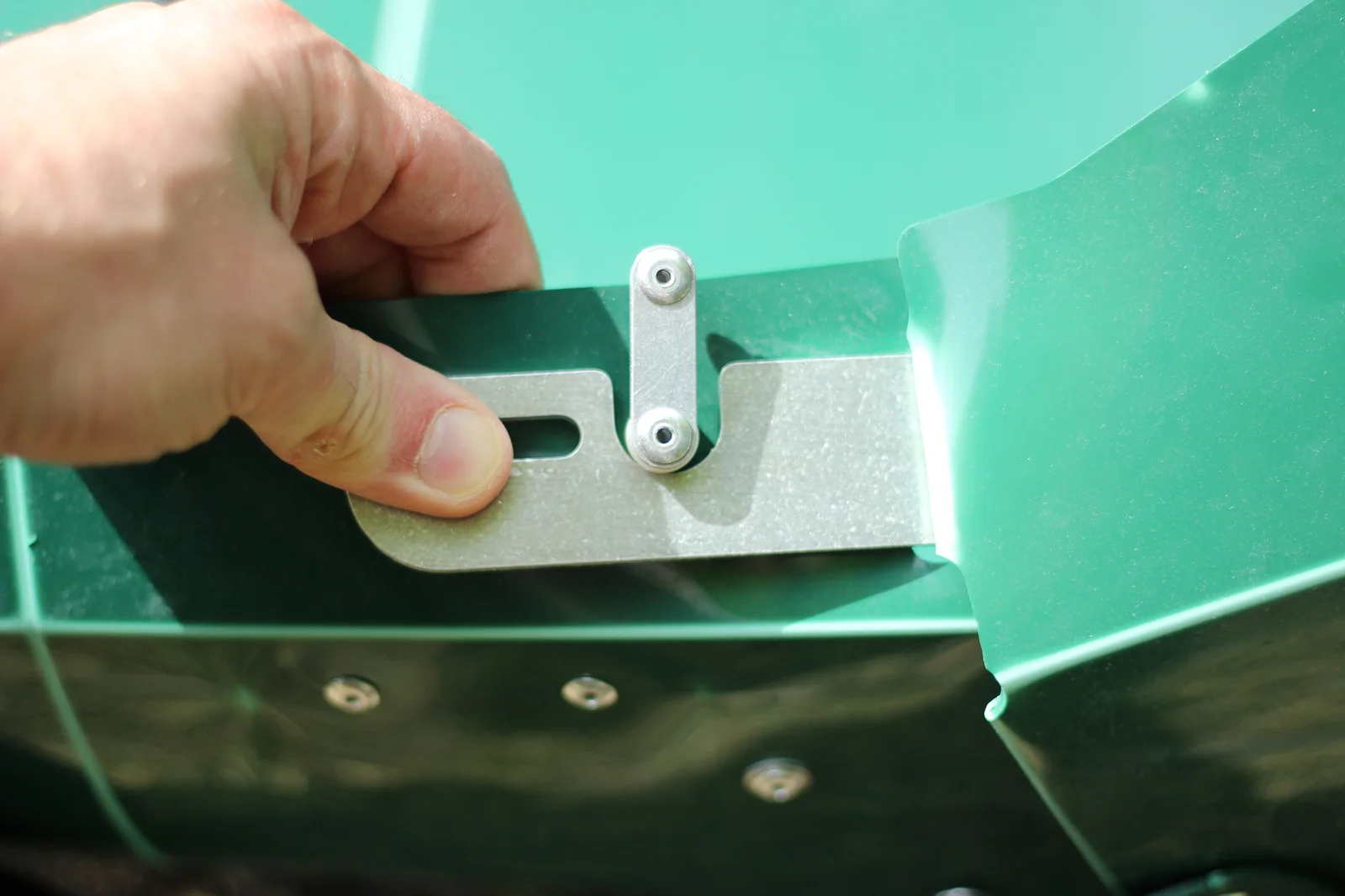
The assembly relies on a small number of clean, well-engineered aluminum locking levers. There are six total. Each lever clips through a slot machined into the hull and locks the fold geometry into place. Once all six are seated, the boat is rigid. This is the part of the design that most folding-kayak skeptics worry about — and after handling the latches, the worry is mostly unfounded. The aluminum is thick, the slots are precise, and the engagement is positive. Tucktec says the hulls are rated for thousands of folds; the latch geometry is consistent with that claim.
Close-up of the aluminum locking lever mounted on the edge of the green Tucktec hull
One of the six aluminum locking levers, mounted on the edge of the hull. The lever is a stamped aluminum piece riveted to a pivot, with a slot at one end that engages a fixed peg on the adjacent hull panel. Rotate the lever, slip the peg into the slot, rotate back — the fold is locked. Mechanical, simple, repairable.
Hand holding one of the aluminum locking levers showing the slot detail with the green Tucktec hull in the background
The same locking lever, held in the hand to show the slot detail. The slot is large enough to engage cleanly even with wet, cold, or gloved hands — a real consideration for the hunter who's setting up at dawn in October or the prepper who's doing a real emergency deployment without the luxury of perfect conditions.

The seat back installation

The fold-down seat back is the last piece to install. It’s a black structural piece with a mounting frame that locates against the rear of the cockpit, and it’s the part of the assembly that takes the longest the first time — not because it’s complicated, but because it’s the only piece that requires a bit of fiddling to seat correctly. After the first build, it’s quick.
Aluminum locking lever being seated at the top of the green hull bulkhead with the mounting frame and rivets visible
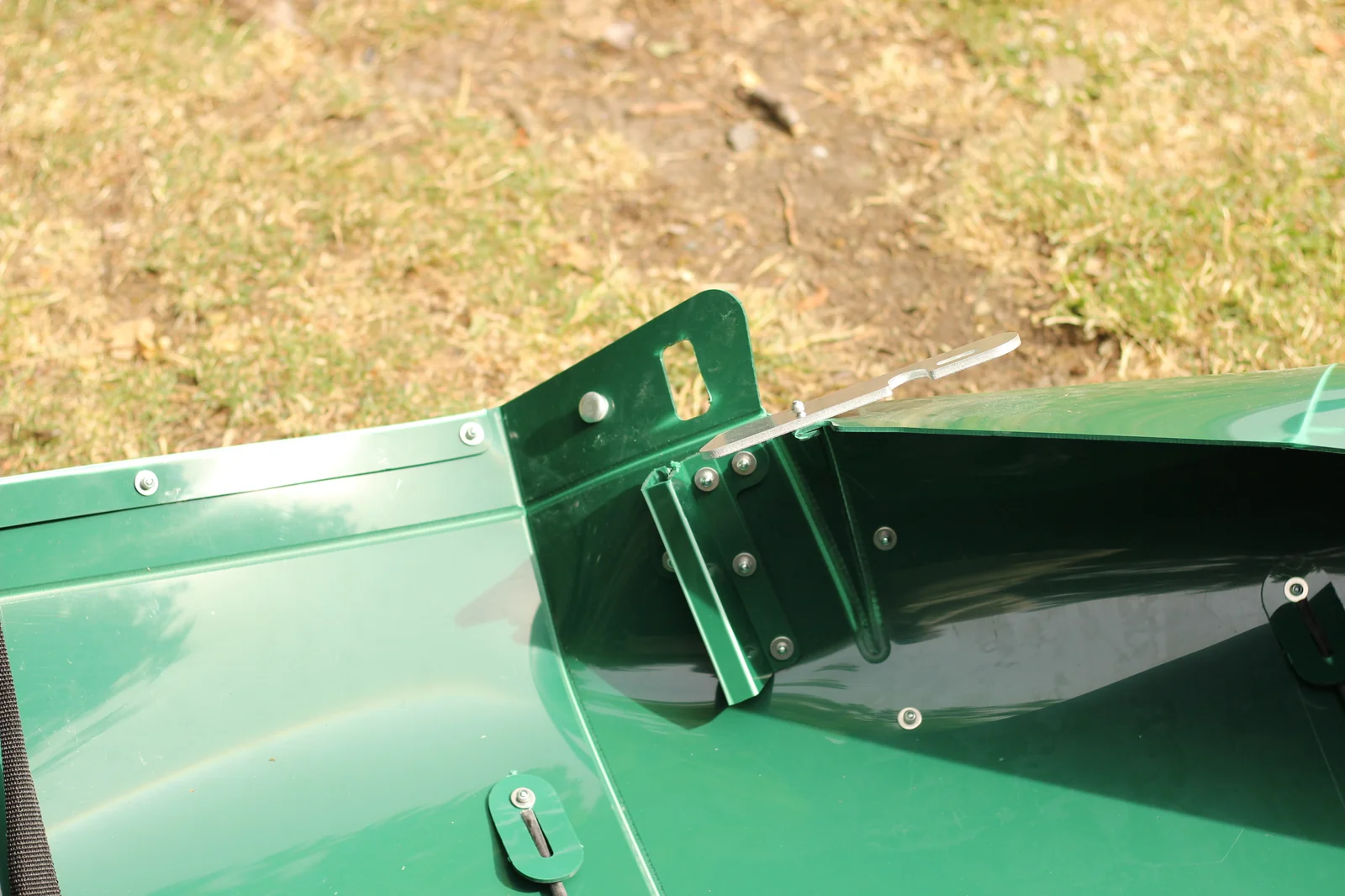
The aluminum locking lever being seated at the top of a hull bulkhead — one of the six lock points that turn the folded kayak into a rigid structure. The vertical green bulkhead carries the carry-handle slot at the top, and the locking lever drops through the slot to lock the geometry into place. Below it, the mounting frame is riveted to the hull panel.
Interior view of the mostly assembled Tucktec Pro kayak showing the cockpit, seat back, and hull fold geometry
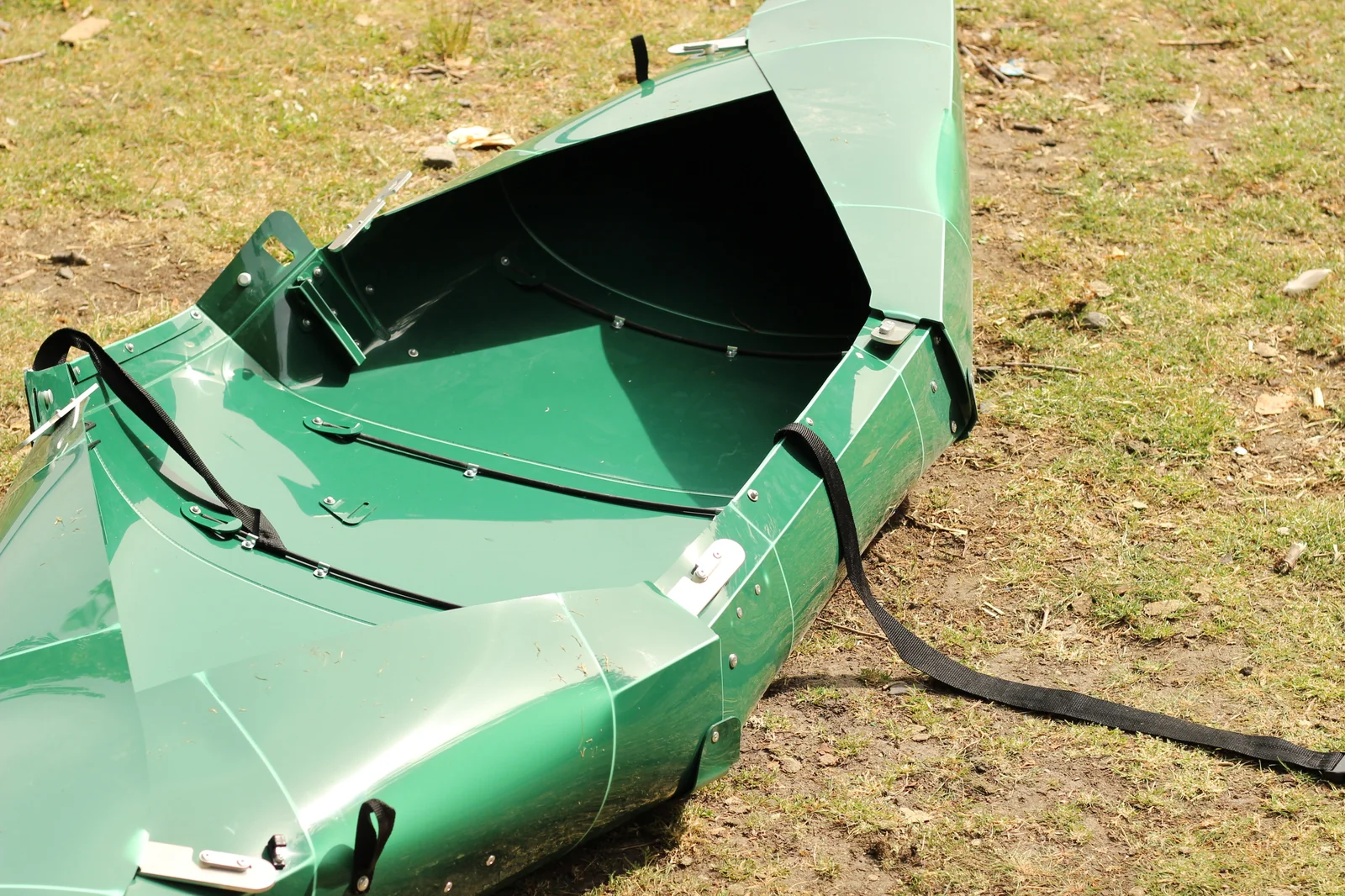
The interior of the mostly-assembled kayak — cockpit open, seat back in place, the fold lines and rail geometry all clearly visible. From this view it's also easy to see the Z-fold engineering: the hull edges that meet at the top of the cockpit form an overlap, not an open seam, so even when the kayak is fully loaded and sitting low in the water, there's no path for water to enter through the fold lines.

Bow geometry and the final-assembly photos
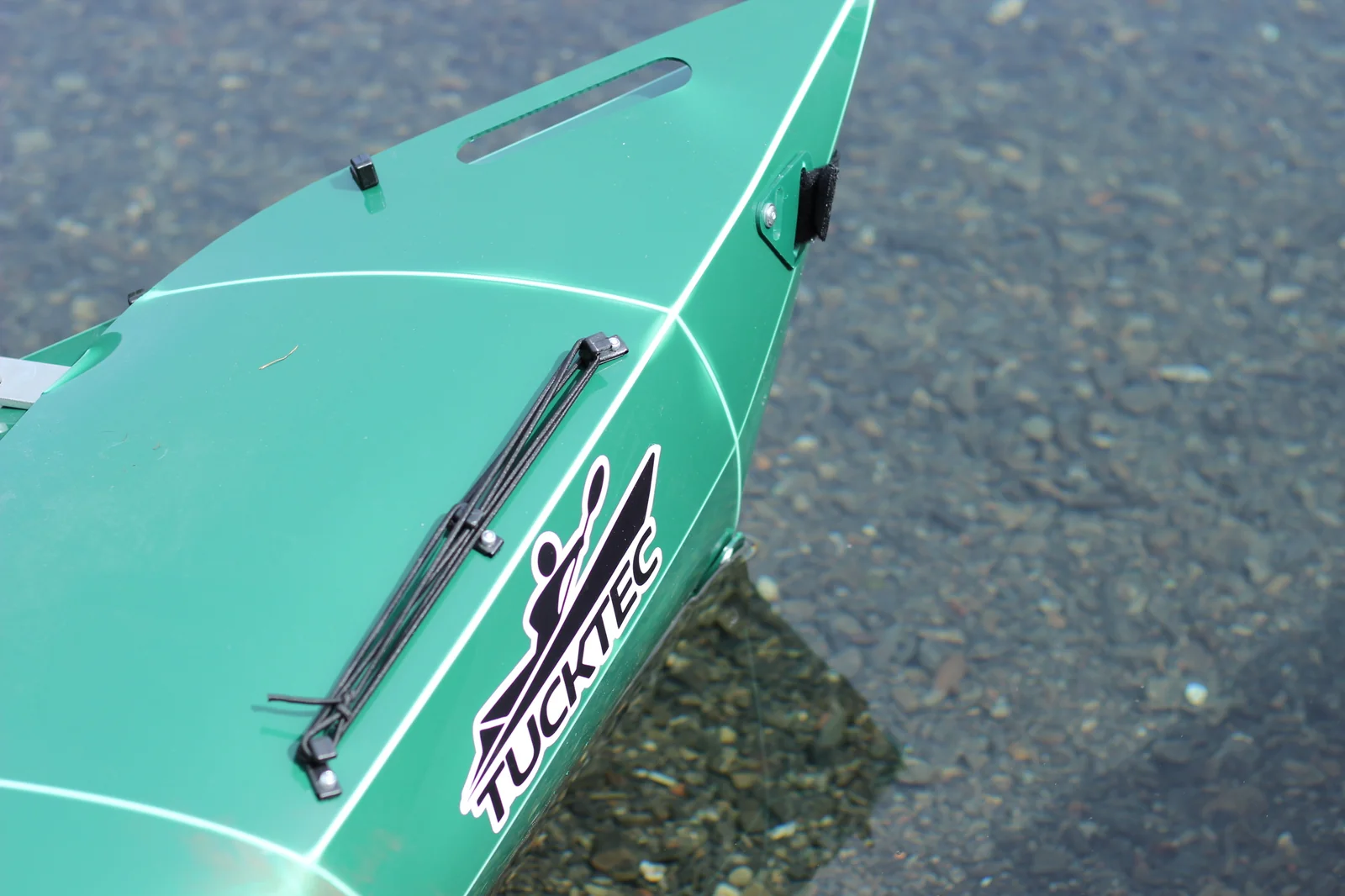
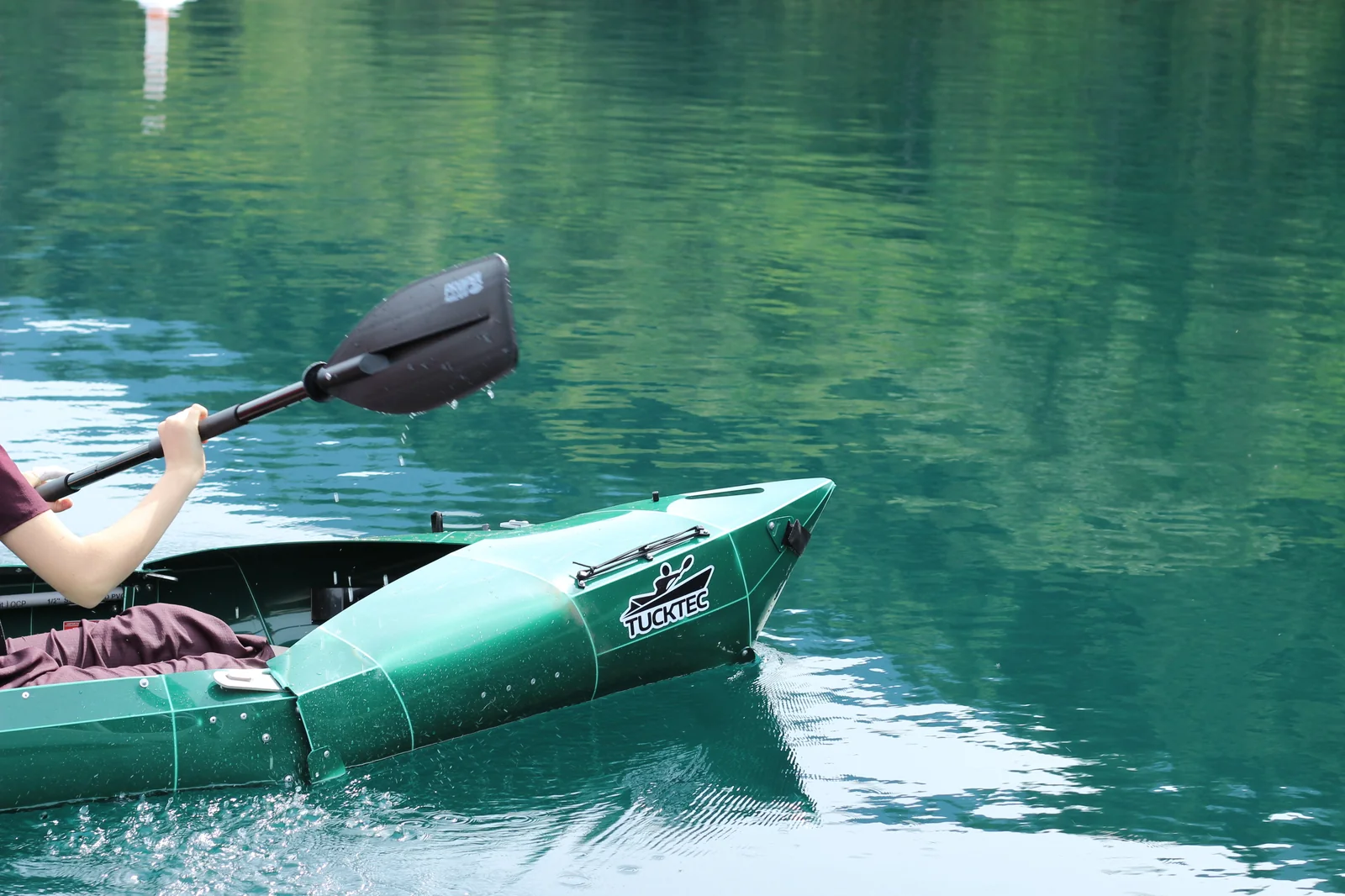
Close-up of the white-and-black TUCKTEC logo decal on the green hull with bungee deck rigging mounted above it
The Tucktec brand decal on the side of the hull, with the front bungee deck rigging mounted above. The decal is the only branding on the boat — clean, restrained, and easy to ignore at the water's edge. The bungee deck rigging is the standard kayak-deck attachment point for securing a dry bag, a paddle leash, or a small piece of cargo on top of the hull.
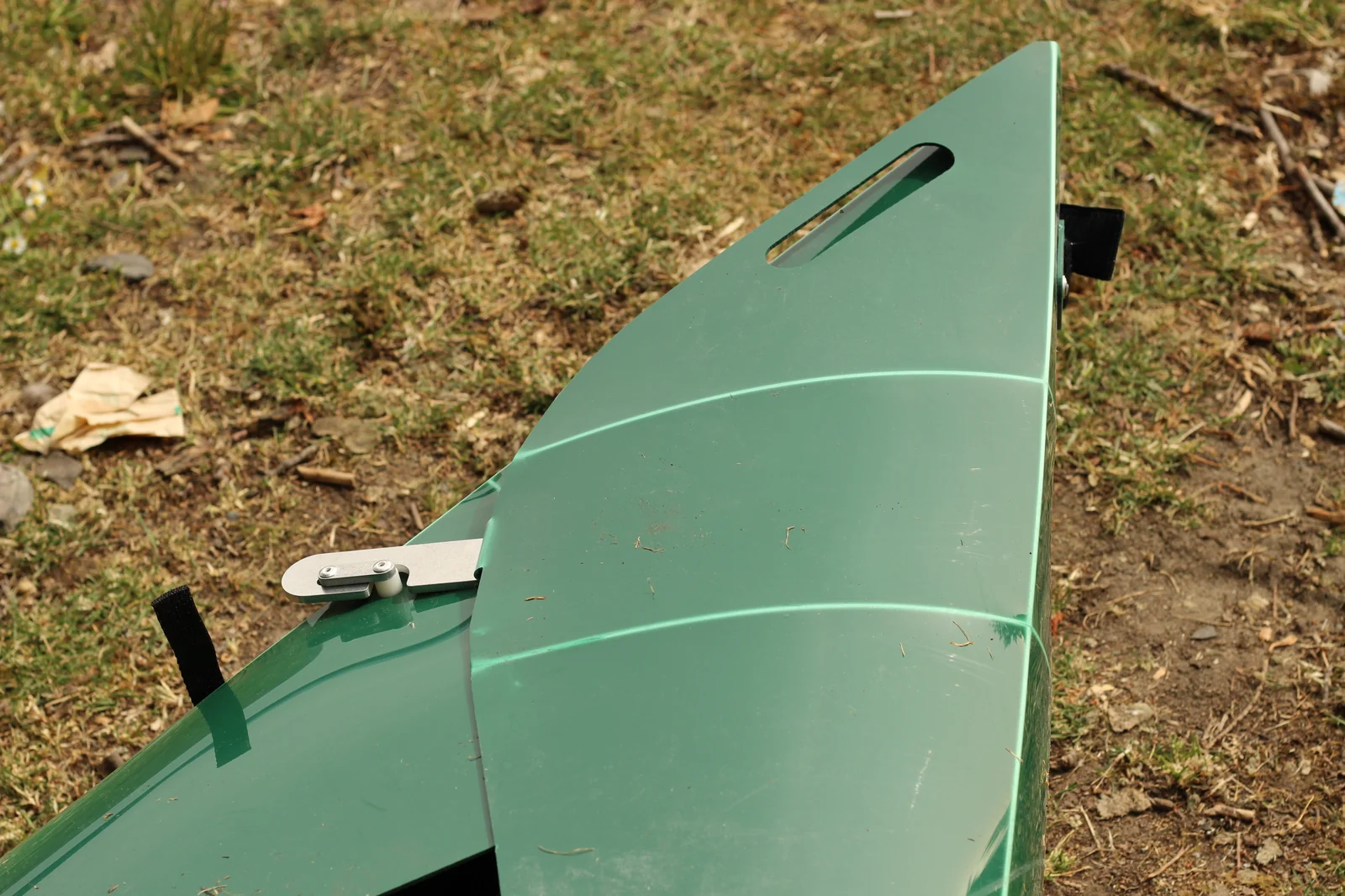
Bow detail of the assembled Tucktec hull showing the pointed geometry with a metal latch visible on the side
The bow geometry from the side. The pointed nose, the sharp keel line, and one of the aluminum locking levers visible on the side panel. This is the bow shape that gives the boat its tracking ability — the keel is continuous from bow to stern once the latches are locked, which is what lets the kayak paddle straight instead of wandering.
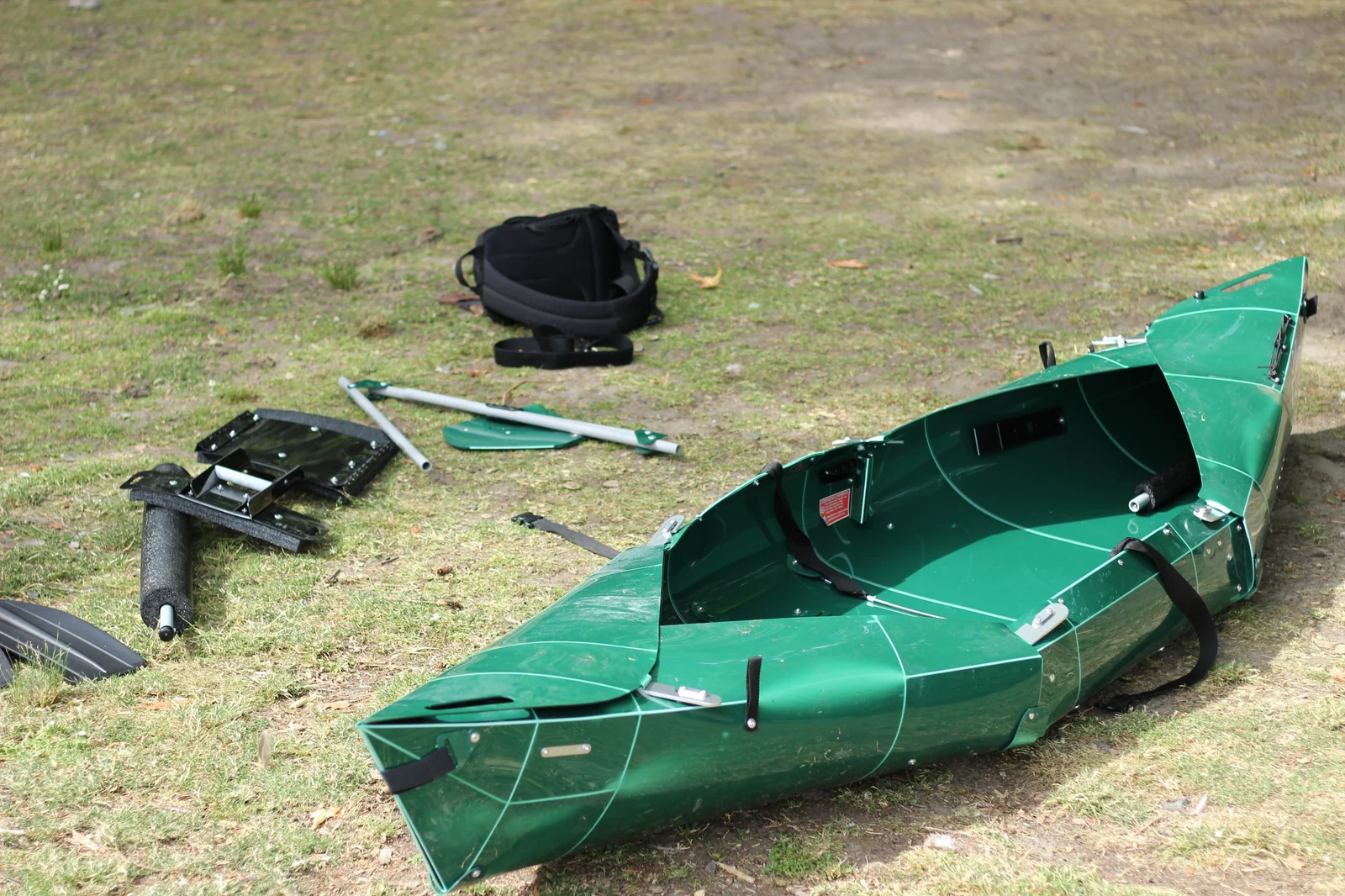
The Tucktec Pro kayak nearly fully assembled on grass with the foam stabilizer, paddle pieces, and a black seat cushion staged beside it for installation
The kayak nearly fully assembled on grass, with the foam stabilizer pontoon, the paddle, and a black seat cushion staged beside it for final installation. From "open the trunk" to this point took roughly 10 minutes on the first build — and dropped to about 5 minutes by the third practice round. Tucktec's two-minute claim is achievable, but only after you've folded the boat a few times.

The completed boat on dry land

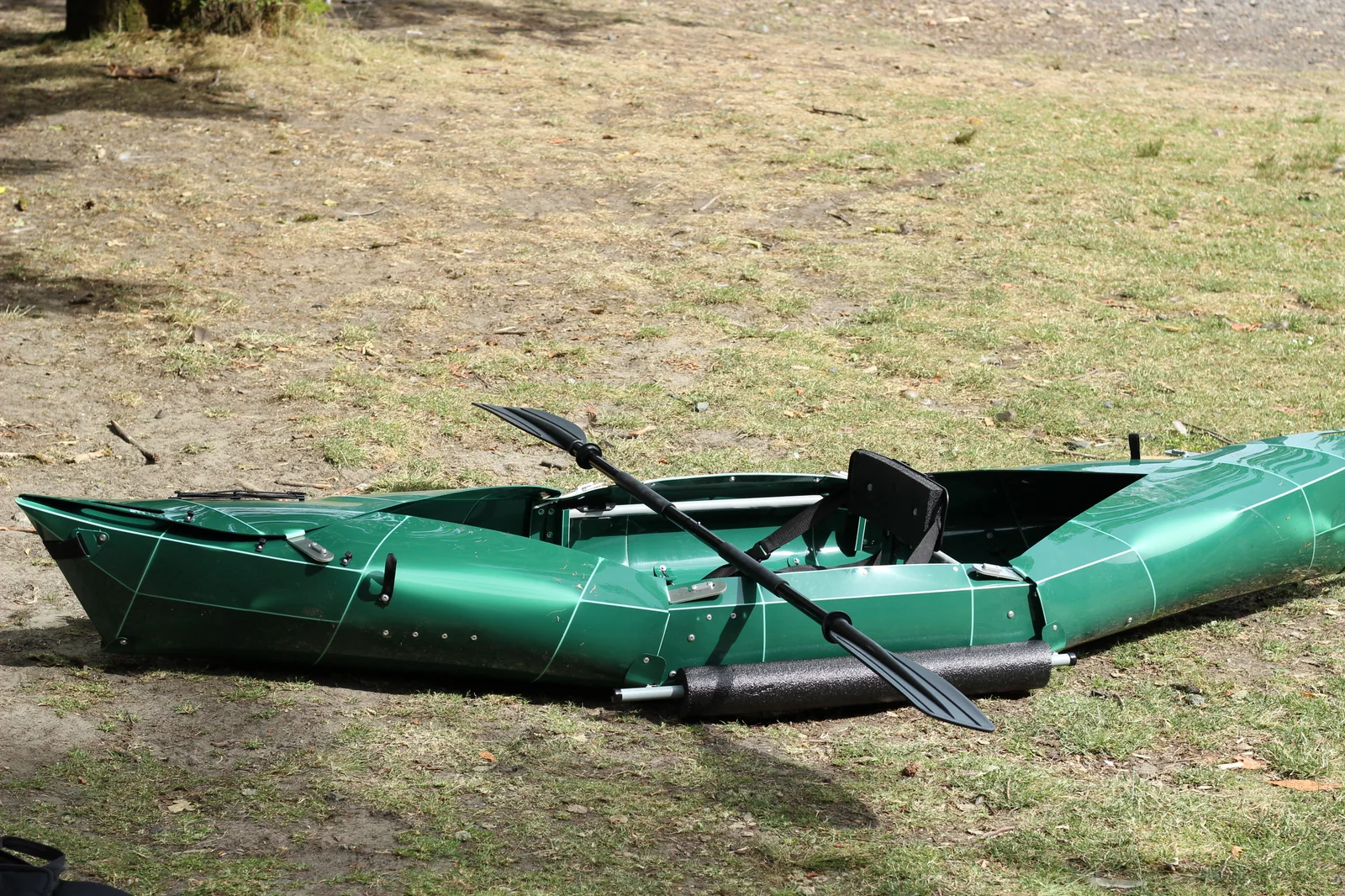
Tucktec Pro folding kayak fully assembled on grass, side view, with the 2-part paddle resting across the cockpit and the foam stabilizer attached
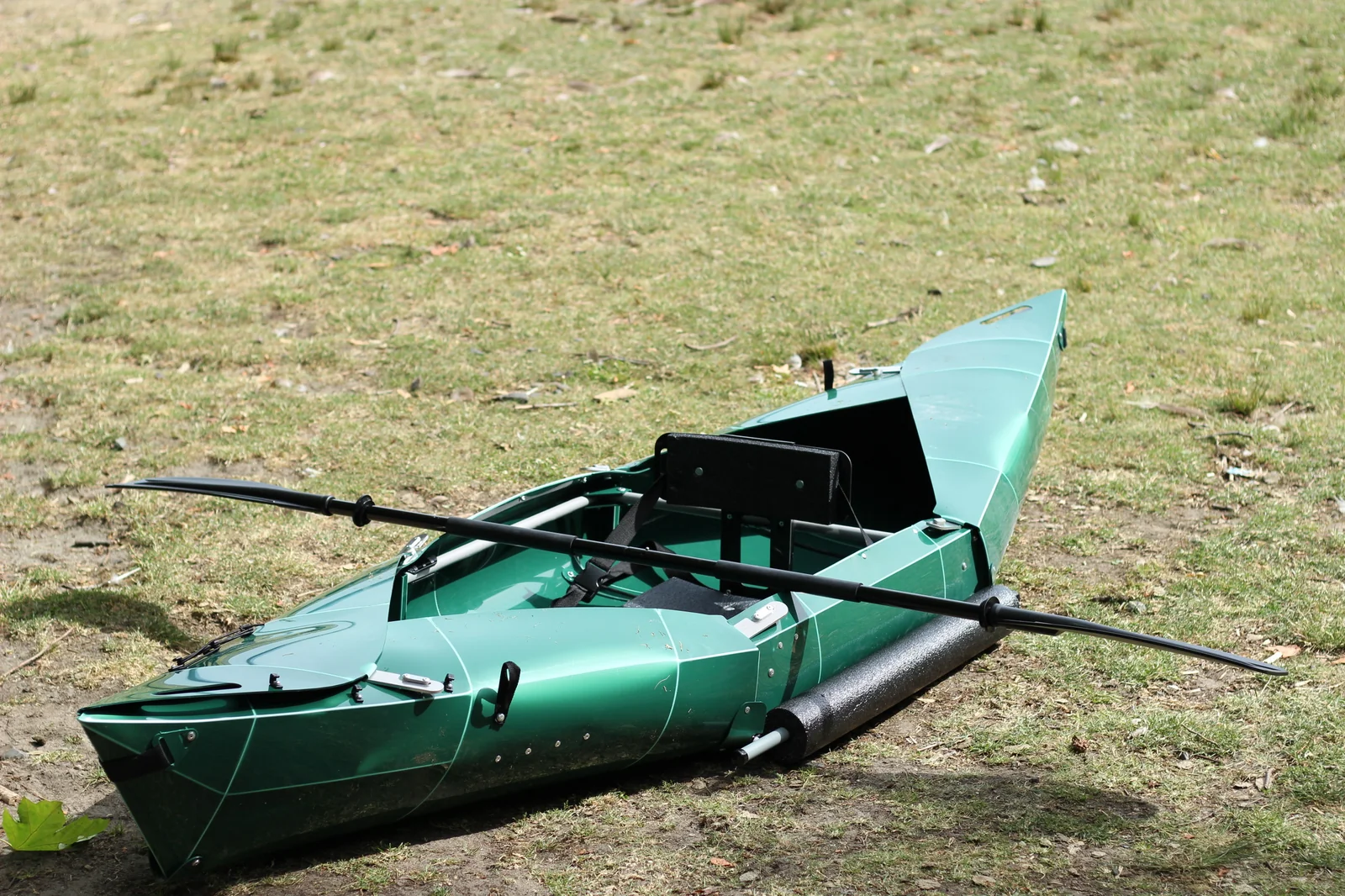
The completed kayak on grass, side view. Paddle resting across the cockpit, foam stabilizer pontoon mounted on the side, seat installed, all six locking levers seated. This is a 10-foot hard-shell kayak, ready to launch, that came out of a folded package small enough to ride behind the back seat of a sedan.
Tucktec Pro kayak fully assembled, three-quarter view from above showing the cockpit, foam stabilizer, and full hull geometry
Three-quarter view of the same boat, showing the full cockpit opening, the foam stabilizer at the bow-side, and the V-geometry of the hull. The fold lines remain visible — Tucktec does not pretend they aren't there — but the boat is structurally one continuous rigid hull at this point.

The launch

The dry-land assembly is the engineering story. The launch is the practical one. The Tucktec carries to the water like any 10-foot kayak — light enough for one person, a bit awkward at the cockpit because of the open shape, but no more so than a hard-shell sit-on-top. At the dock, it floats high, rides level, and looks like a kayak.
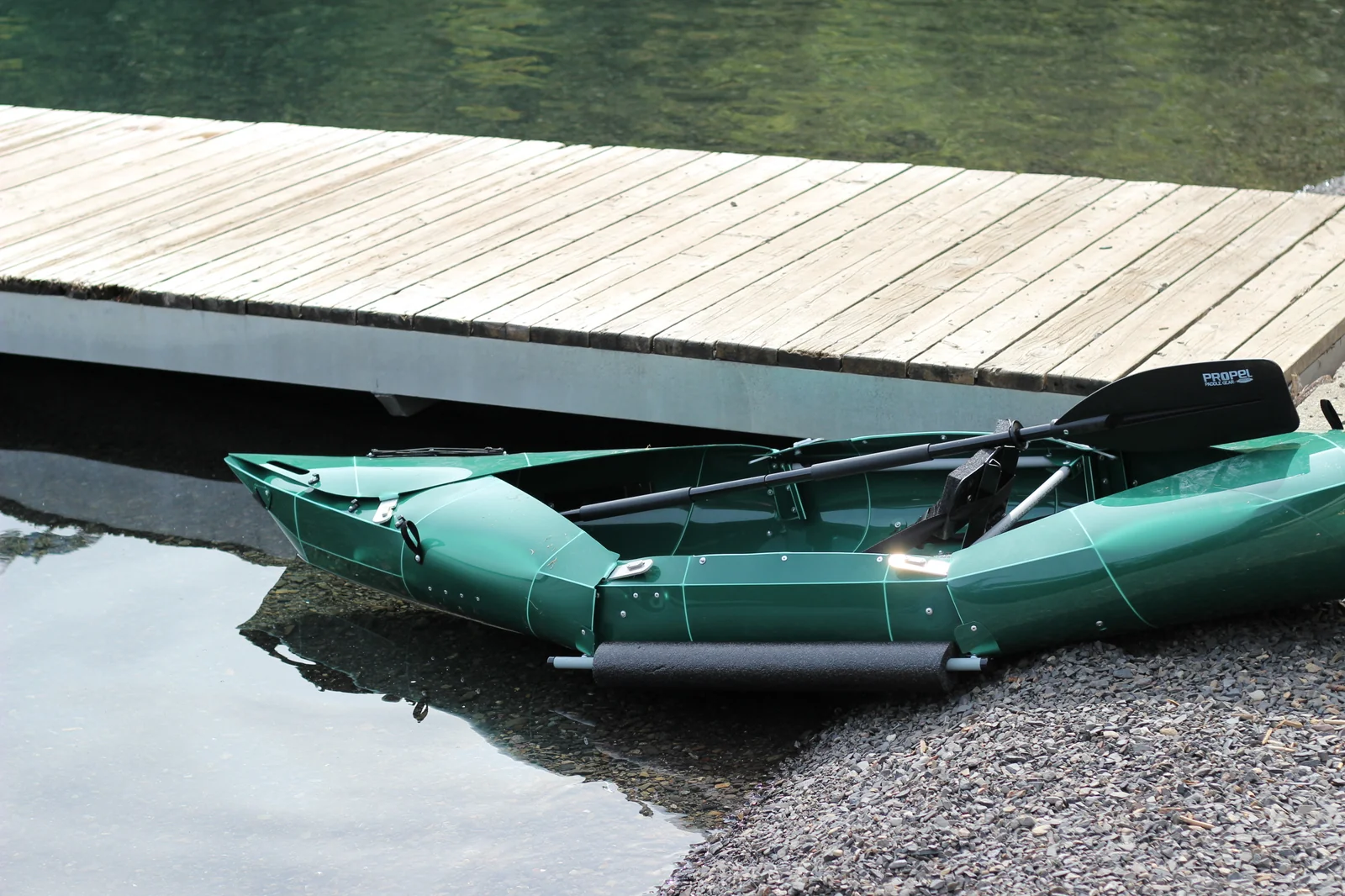
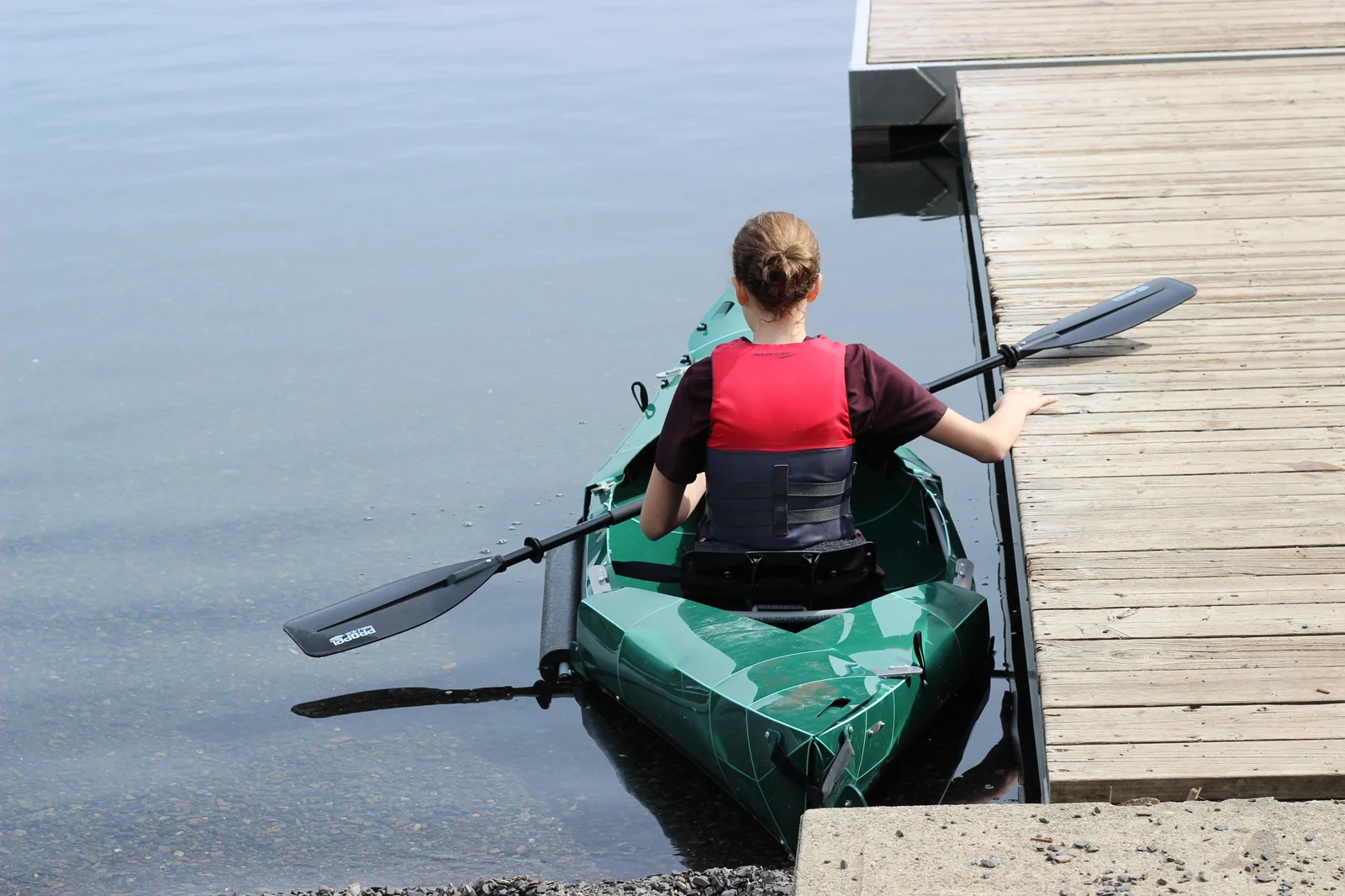
Tucktec Pro kayak staged at the edge of a wooden dock partly in shallow water ready for launch
The kayak staged for launch — partly on the gravel shore, partly in the water beside a wooden dock. The waterline at this stage is just kissing the bottom of the hull. The foam stabilizer is positioned for use, the paddle is laid across the cockpit, and the seat is ready for the paddler.
Woman in a red life jacket boarding the green Tucktec Pro kayak from a wooden dock with the paddle in hand
Launching from the dock. The paddler — in a red life jacket — steadies herself on the dock edge while settling into the cockpit. This is the moment where folding kayaks live or die in user reviews: does the boat feel stable enough for a confident entry, or does it feel sketchy? The Tucktec feels stable.
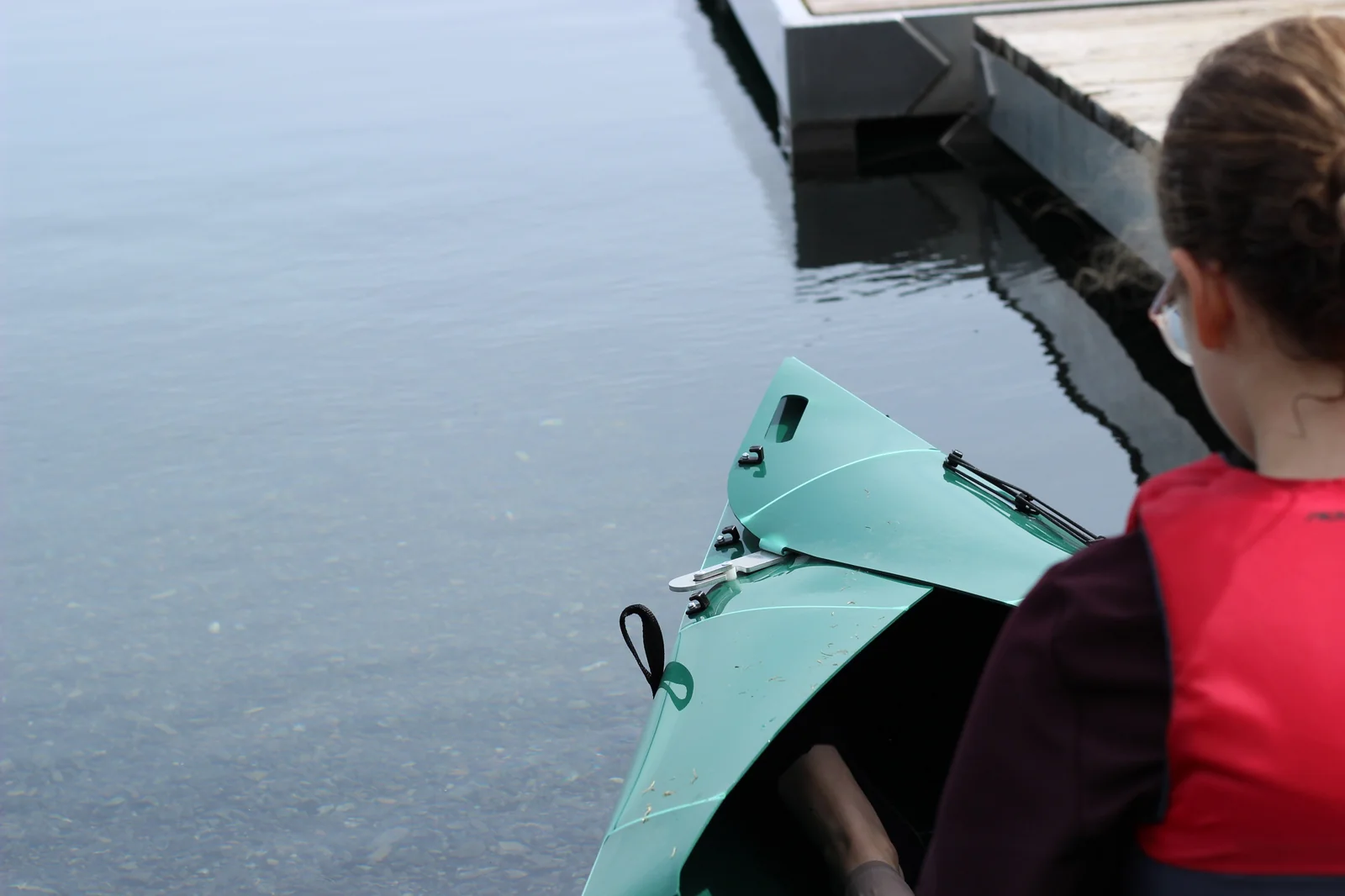
View from the dock looking down at the bow of the Tucktec Pro kayak in shallow water beside a woman in a red life jacket
View from the dock looking down at the bow, with the paddler beside the kayak in shallow clear water. The hull is floating high and the bow line is clean — this is what a hard-shell kayak is supposed to look like at the dock. The teal-water reflections on the green hull color are doing the photo a disservice; in person the green is the same shade as the on-shore assembly photos.
Bow of the Tucktec Pro kayak with the TUCKTEC logo and bungee deck rigging visible, sitting on the pebbled shoreline
The bow at the water's edge — the Tucktec logo decal, the bungee deck rigging, and the keel line all visible. The pebbled shore is exactly the kind of terrain that hard-shell kayaks excel at and inflatable kayaks struggle with: scrape it across rocks at the launch, drag it up out of the water at the end, and the hull does not care. That puncture-proof rated-for-thousands-of-folds claim translates directly to "you can stop worrying about the launch surface."

On the water — the moment of truth

The single editorial question every folding-kayak reviewer has to answer is the on-water one. Does the boat paddle like a real kayak, or does it paddle like a compromise? After the launch, the answer is clear in about the first thirty seconds.
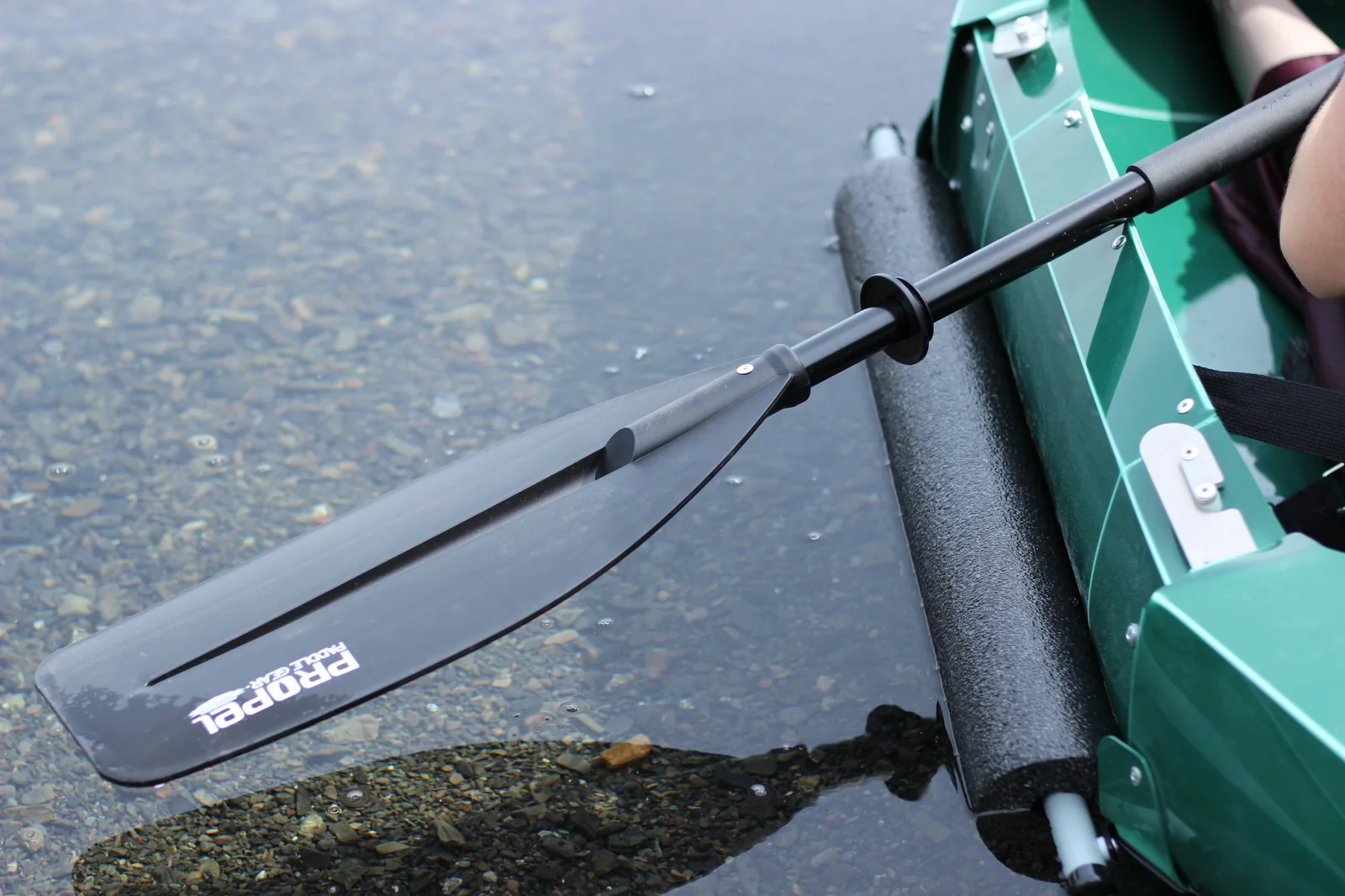
Close-up of the Tucktec 2-part paddle blade in clear shallow water beside the green hull and black foam stabilizer pontoon, with PROPEL branding visible on the blade
The paddle blade in the water beside the kayak. The blade is marked PROPEL — a 2-part recreational paddle we used for the review. Note that paddles are not included with the Tucktec Pro; the buyer either uses a paddle they already own or adds the Tucktec SeaSense Xtreme II to the order. The PROPEL blade pulls cleanly through the water without flutter. The included foam stabilizer pontoon is visible to the right of the blade, riding at the waterline just as it should. The water is clear enough to see the pebble bottom — this is the kind of small water our reader segment actually paddles on.
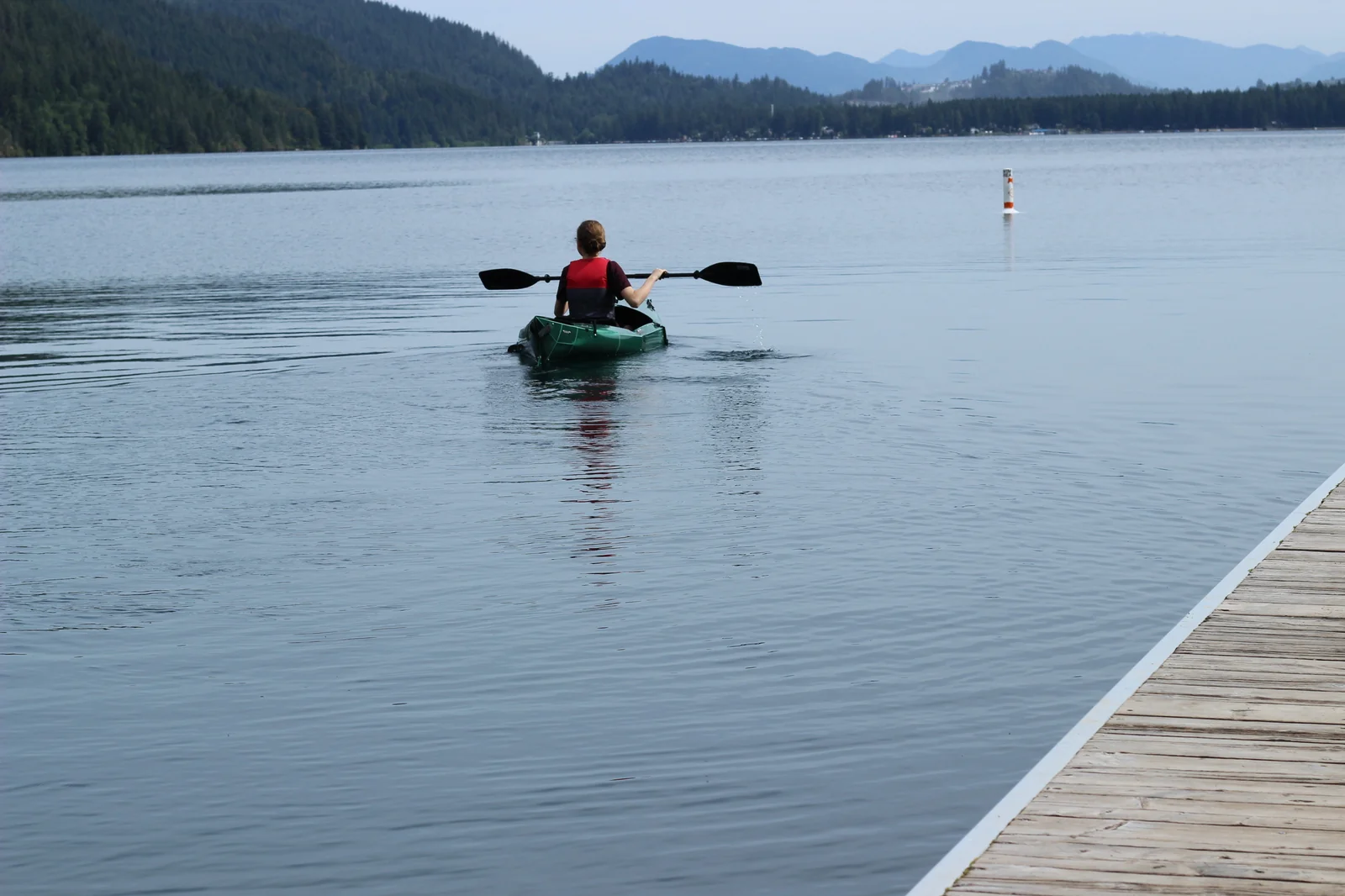
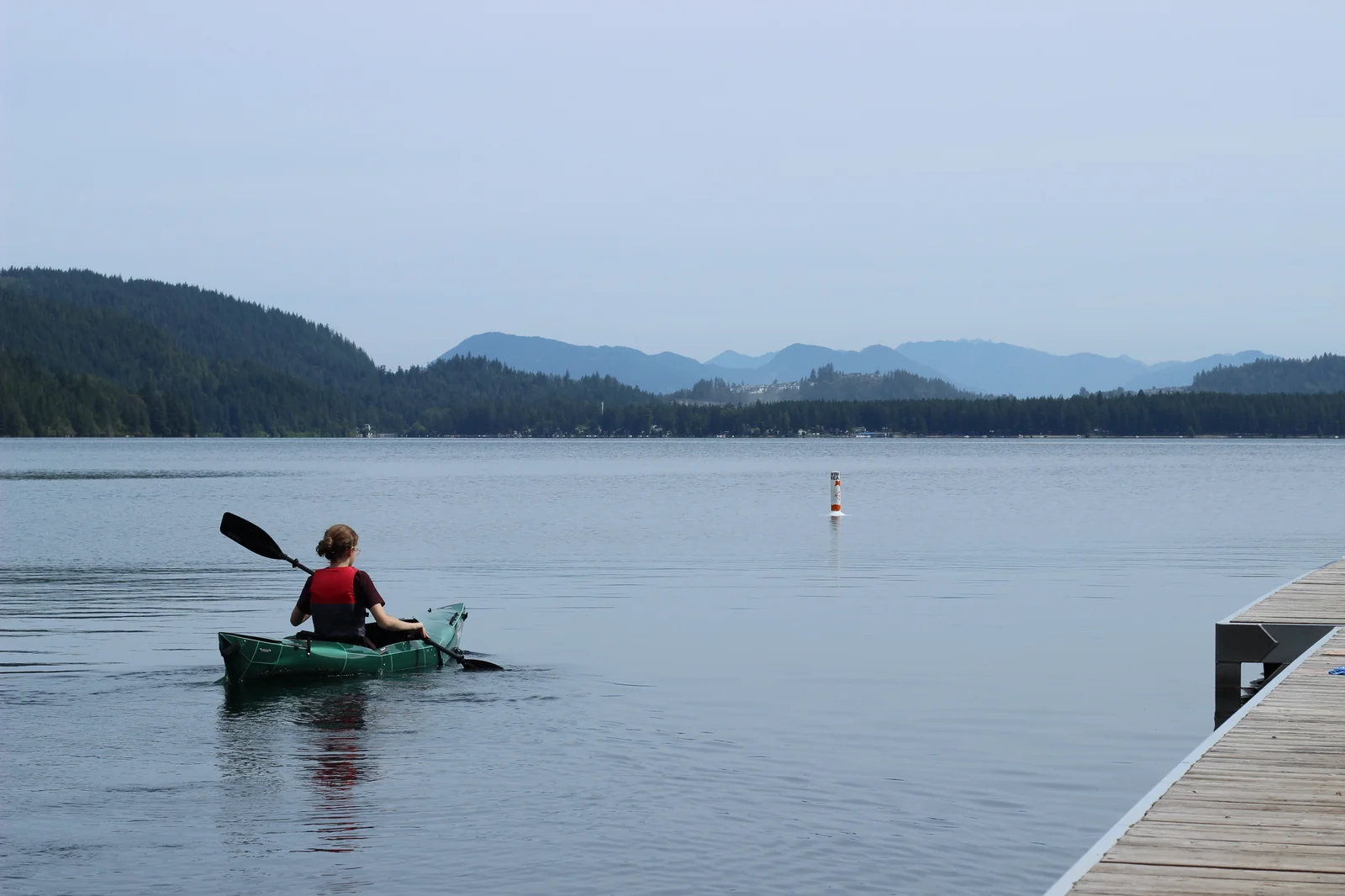
Paddler in a red life jacket paddling the Tucktec Pro kayak away from the dock toward a distant lakeshore with mountains and a navigation marker buoy visible
The paddler underway, heading out from the dock toward open water. Distant lakeshore, blue mountains on the horizon, a red navigation marker buoy mid-frame. The kayak is tracking straight, the paddle stroke is rhythmic, and the bow wake is clean. This is what we wanted to see on a 10-foot folding boat — that it actually moves through the water like a 10-foot hard-shell kayak.
Paddler in a red life jacket paddling the Tucktec Pro kayak away from the dock with mountains and a navigation marker buoy in the distance
Heading out toward the buoy, dock at the right edge of frame, mountain range in the distance. The Tucktec is a 10-foot recreational boat, not a touring kayak, but with a clean stroke and the included PROPEL paddle, it covers water at a respectable rate. Across all the on-water photos in this set, the boat is tracking straight without correction strokes — exactly what the continuous keel line and the included skeg are supposed to deliver.
Side view of the Tucktec Pro kayak on glassy reflective green water with the paddle blade lifting out of the water mid-stroke
The paddle stroke caught mid-recovery, water dripping from the blade onto glassy green water. This is the photograph that, more than any other, answers the question of whether the folding hull holds its line. The Tucktec is gliding here — the wake behind the bow is a clean reflection, not a wobble. Z-fold geometry, locked latches, a continuous keel line: it tracks.

The handling and the tracking

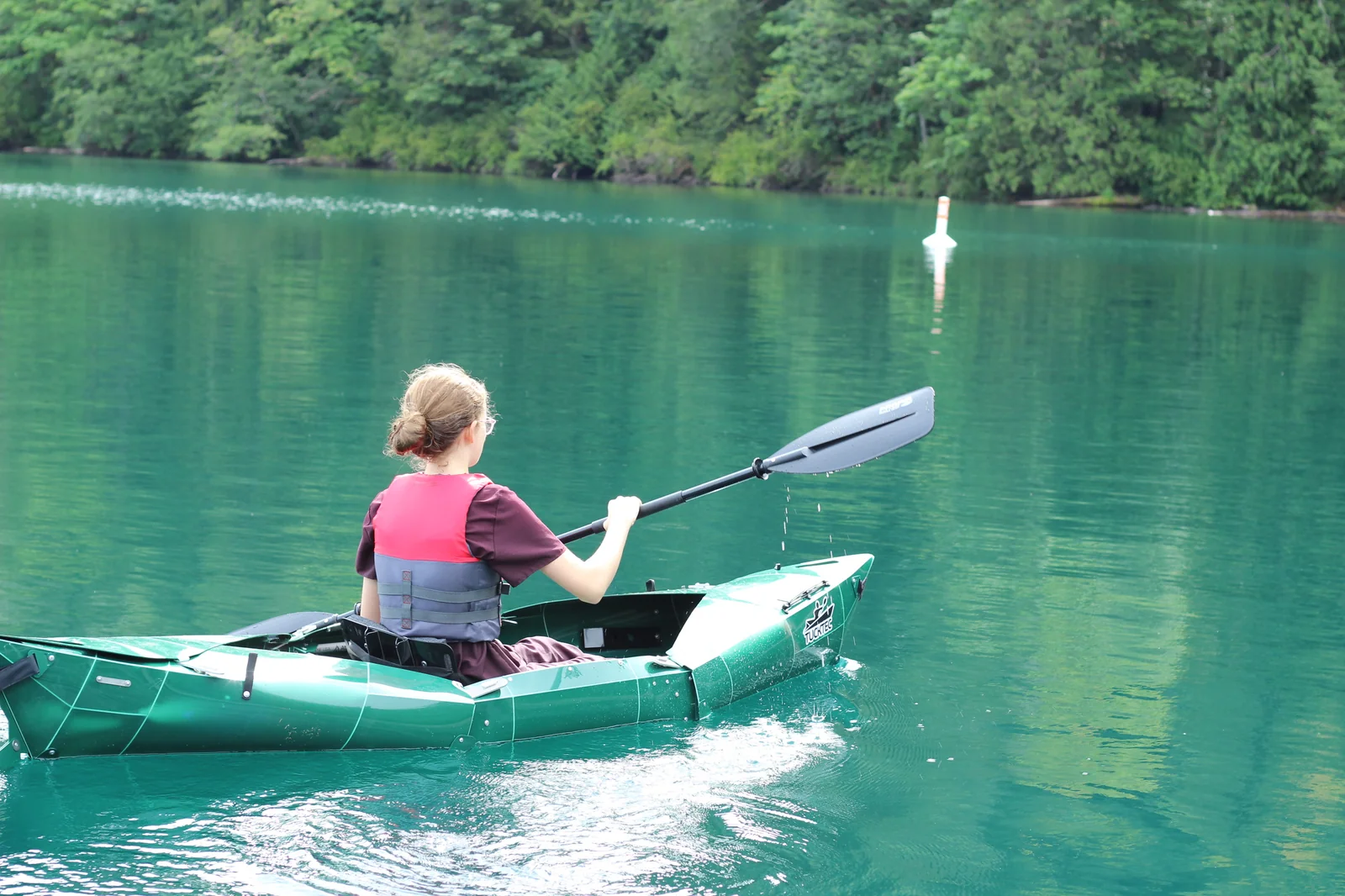
Paddler in a red life jacket on the Tucktec Pro kayak from behind, paddling across green water toward a distant orange navigation marker buoy with forested shoreline beyond
Heading toward the navigation marker buoy — the paddler from behind, paddle stroke mid-recovery, the orange marker mid-distance. This is the practical use-case the boat was designed for: get on the water, get to where you want to be, paddle around, get back. The handling on flat water is what you'd expect from a competent 10-foot recreational kayak.
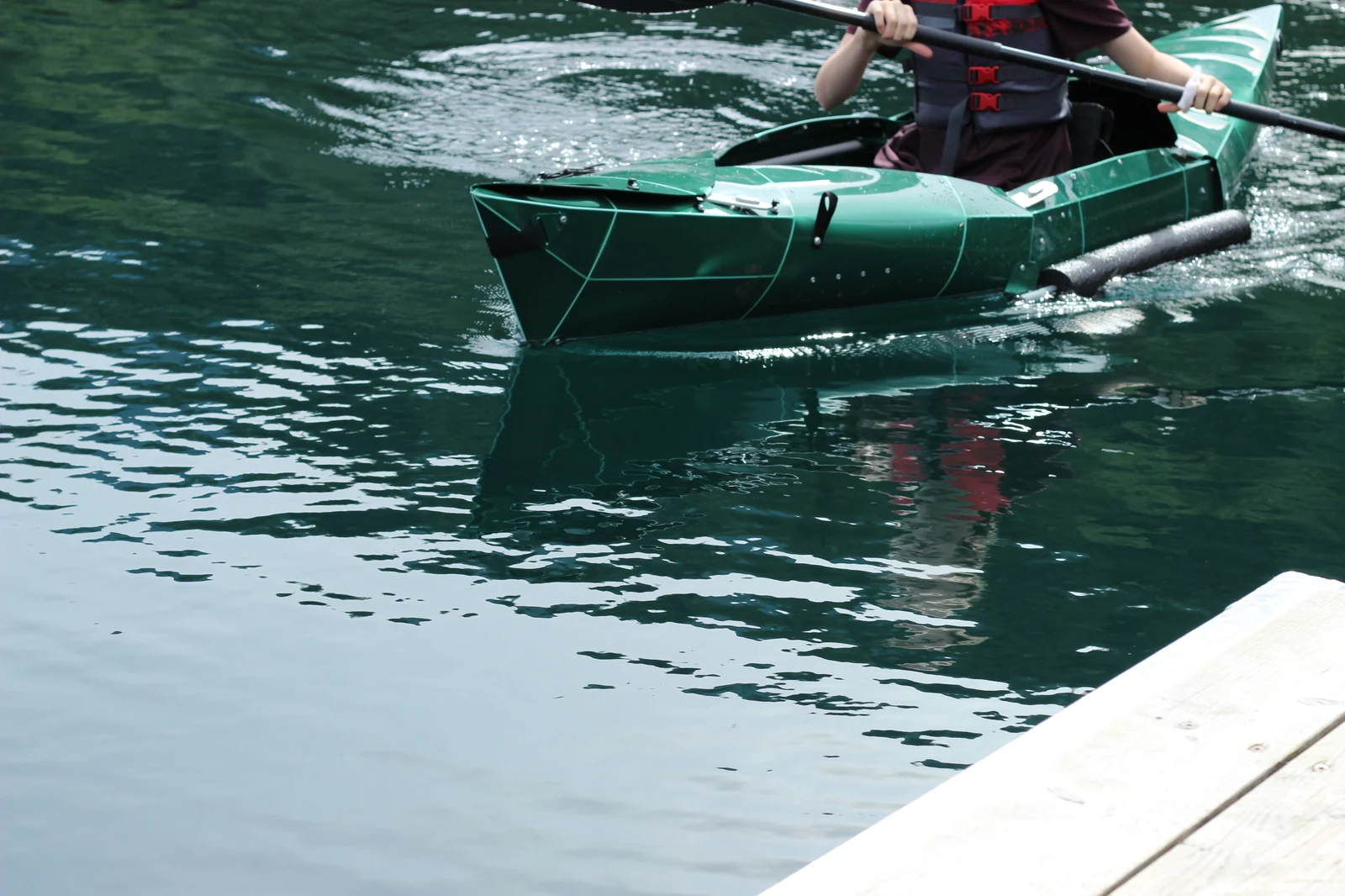
Tucktec Pro kayak from a low water angle with the paddler mid-frame and the bow profile reflected on the calm water surface
From a low water angle near the dock, you can see how the kayak actually sits in the water — the hull rides high, the bow line is clean, and the reflection on the calm green water shows the boat's clean profile. The waterline on the green hull is exactly where it should be for a properly-balanced paddler load. Nothing in this view suggests "compromised folding boat" — it just looks like a kayak doing kayak things.

The bow detail — what makes the Z-fold actually work
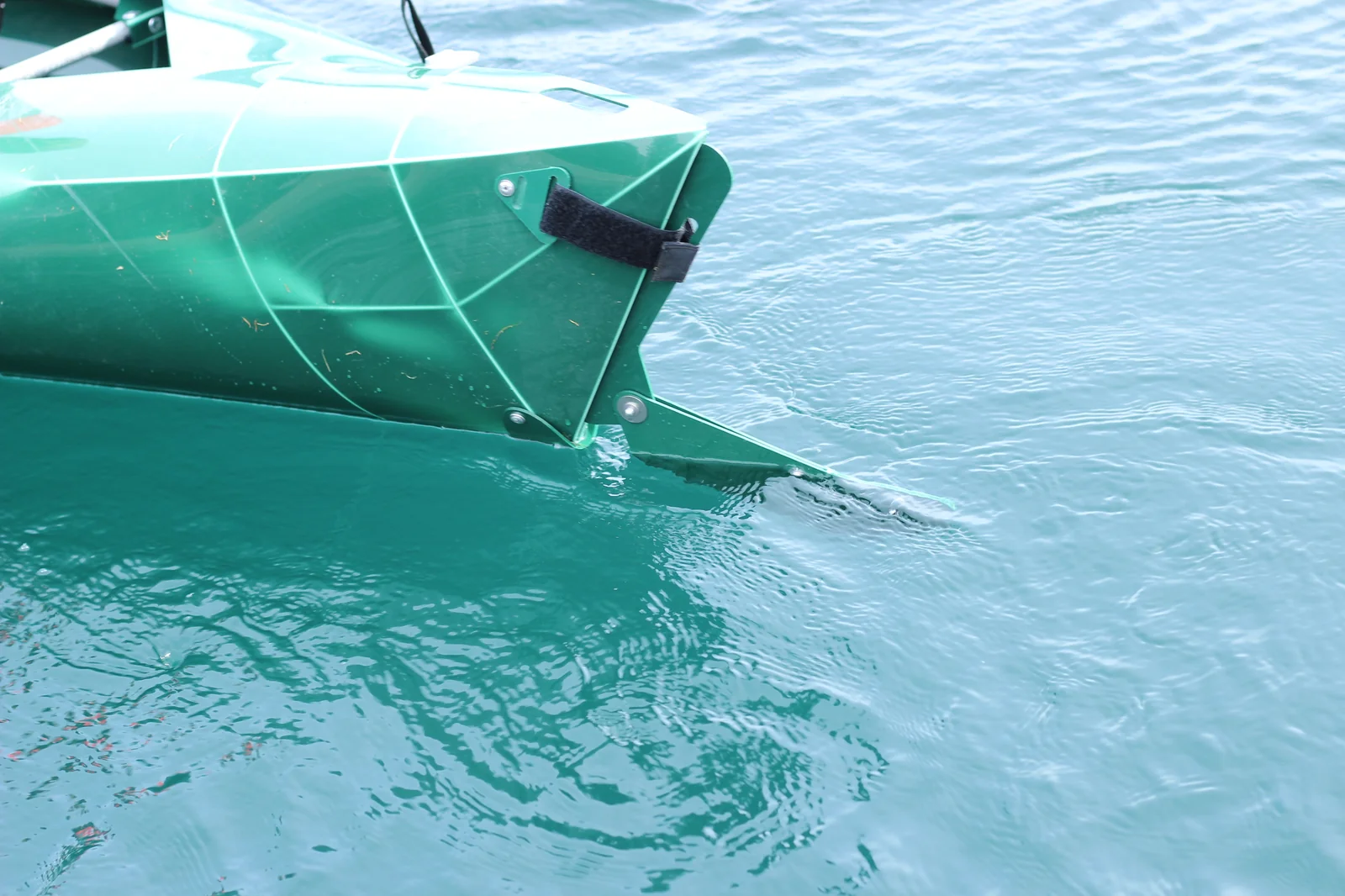
Close-up of the bow of the Tucktec Pro kayak in the water showing the velcro retaining strap and a small skeg fin visible below the waterline
The bow in the water at close range, showing the velcro strap loop that holds the folded geometry locked and the small skeg fin visible below the waterline at the keel. The skeg is the secondary tracking aid — combined with the continuous keel line of the assembled hull, it's what lets a 10-foot recreational kayak track straight enough to actually go somewhere. Tucktec describes the skeg as the "included fin" — a small detail with an outsized impact on how the boat behaves underway.

The verdict — for the three domains we actually care about

Going back to the editorial question that opened the review: can a folding kayak genuinely replace a hard-shell for real-world use, or is the portability a compromise you’ll regret on the water? After this first-impressions review, the answer is a confident yes — for the right buyer, this is genuinely a hard-shell replacement, not a compromise. Here’s what that looks like across the three domains our reader base cares about.

For the hunter

The Tucktec Pro is the watercraft that finally answers the “how do I reach that water” question for the hunter who’d happily paddle to a waterfowl spot, a beaver pond, or a backcountry stretch of small water if doing so didn’t require owning a trailer or a roof-rack vehicle. The kayak lives in the truck. The kayak goes to the hunt. The kayak deploys when the spot calls for it and rolls back up at the end of the day. The 300-lb capacity comfortably accommodates a hunter in waders + a packed hunting pack + a soft-cased shotgun or rifle, which is the exact loadout for the use case. Look for future hunting posts where we use the Tucktec in an actual hunting situation.

For the off-grid and preparedness reader

The Tucktec Pro is the watercraft for the off-grid or preparedness reader who wants water mobility in their kit without dedicating a section of garage to a boat. It folds flat, it stores anywhere, and it’s there if a deployment scenario calls for water access. For the reader who’s already built out an off-grid power system (we cover Bluetti for that) and an emergency sanitation system (we cover Separett for that), the Tucktec is the natural shelter-adjacent piece — the take-anywhere watercraft that completes the kit without taking the storage space a traditional kayak would demand.

For the angler

The Tucktec Pro is the watercraft for the angler who wants a take-anywhere fishing platform — for the backcountry pond, the urban river spot, the cottage lake at the in-laws, the friend’s trip you don’t want to drive a whole truck-and-trailer rig to. The boat has the 300-lb capacity to accommodate the rod-and-tackle loadout, the foam stabilizer adds the static stability that matters when working a rod, and the optional fishing accessories (rod holder, cup holder, fold-up anchor) Tucktec sells separately let the buyer build out the angling configuration over time.

Where someone might still want a traditional hard-shell

The Tucktec Pro is the right call for the buyer who values portability, storage, and the take-anywhere lifestyle the folding form factor enables. It is not the right call for the buyer who paddles open ocean, big-wind whitewater, or any environment where a longer touring hull, a closed deck, and skirt-compatible cockpit are non-negotiable safety features. For those use cases — touring, sea kayaking, real whitewater — a traditional hard-shell is the right tool. The Tucktec Pro is a recreational kayak for flat water, small water, and the calm-to-moderate conditions our reader base actually paddles on. For that buyer, the trade is not a compromise — it’s the entire point.

Bottom line

The Tucktec Pro Folding Kayak is one of the most genuinely useful single-product solutions we’ve reviewed this season — a $380 USD, made-in-USA, 300-lb-capacity hard-shell kayak that folds flat enough to live behind the back seat of a sedan and assembles in about two minutes once you’ve practiced. It paddles like a real kayak because it is one. It opens up a category of water access — for hunters, preppers, and anglers alike — that the traditional kayak’s storage-and-transport problem had effectively closed off.

The first-impressions verdict is a confident 4.5 out of 5. We are reserving a half-point for the v2 follow-up review covering the kayak in either a hunting water-crossing or a backcountry fishing deployment — that’s where the boat’s full editorial value will get tested.

Buy direct: Tucktec Pro Folding Kayak — $380 USD, $35 shipping, 3-year warranty (with registration), 90-day return policy.

As an affiliate partner, Hunt & Live may earn a commission from qualifying purchases made through links on this page. This does not affect the price you pay. Learn more.
tucktec folding-kayak portable-kayak origami-kayak hard-shell-kayak kayak-review made-in-usa hunting-kayak fishing-kayak off-grid-watercraft
Share