
Review · LifeStraw · Water Filters
LifeStraw Personal Water Filter Review
Pros
- Removes 99.9999% of bacteria and 99.9% of parasites — proven filtration
- No batteries, moving parts, or chemicals — just suck and drink
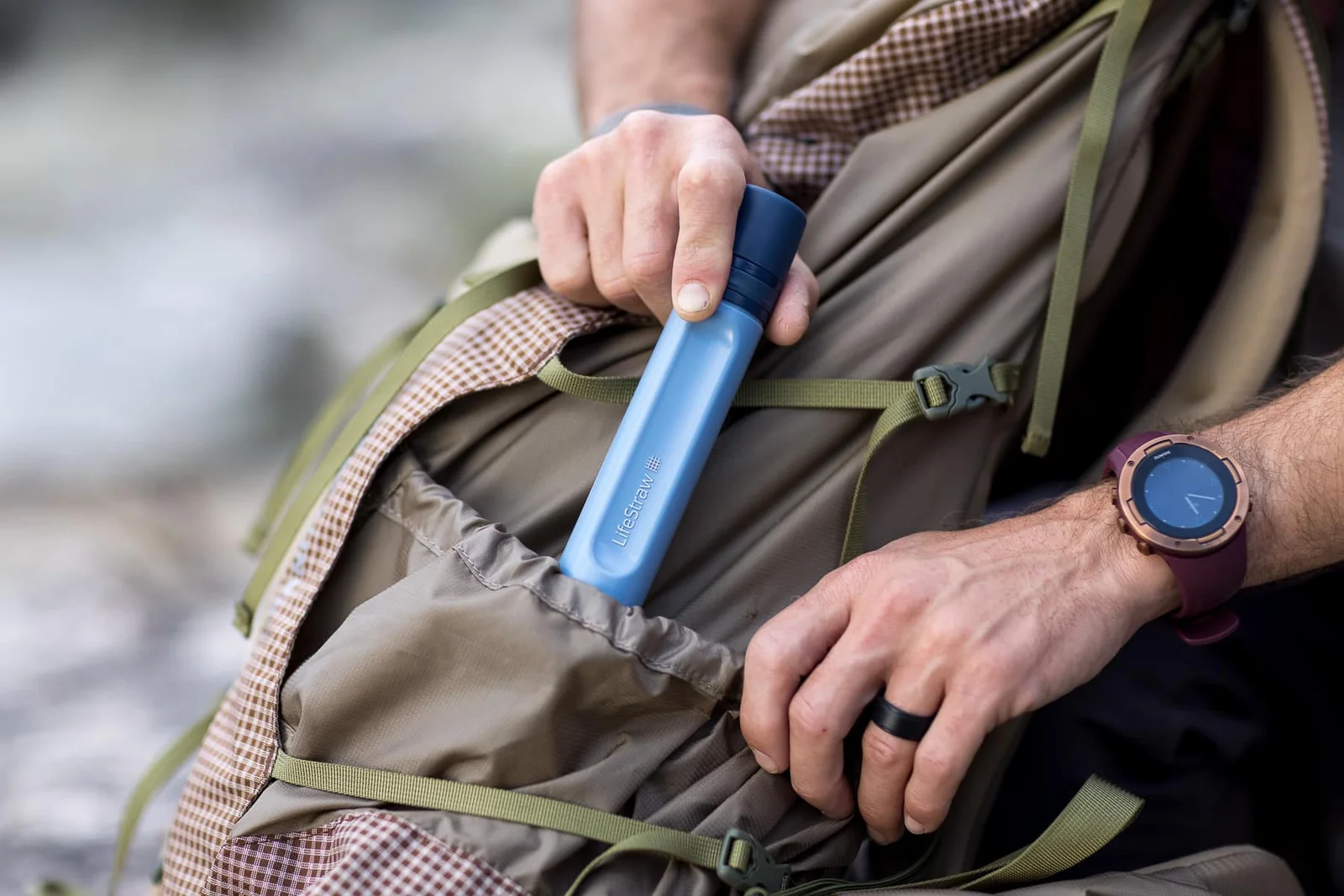
- Weighs only 2 oz — practically weightless in a pack or survival kit
- Filters up to 1,000 gallons (4,000 liters) per unit
- Under $20 — cheapest reliable water filtration you can buy
- No setup time — drink directly from any freshwater source
Cons
- Cannot filter viruses — not suitable for international travel to areas with viral water contamination
- Does not remove chemicals, heavy metals, or dissolved solids
- Drinking position is awkward — you must get down to the water source or use a container
- Flow rate decreases as the filter accumulates particulates
- Cannot store filtered water — drink-as-you-go only
Overview
The LifeStraw Personal Water Filter has become one of the most recognized survival products on the market. At under $20 and weighing just 2 ounces, it promises clean drinking water from virtually any freshwater source. We tested it across multiple water sources over several months to see if the reputation is deserved.
How It Works
The LifeStraw uses hollow fiber membrane filtration with a 0.2-micron pore size. Water is drawn through the membrane by suction — you literally drink through it like a straw. The microscopic pores are small enough to trap bacteria (like E. coli and salmonella) and protozoan parasites (like giardia and cryptosporidium) while allowing clean water to pass through.
No batteries, pumps, or chemicals. No priming or setup. Just put one end in water and drink from the other.
Filtration Performance
The LifeStraw meets EPA standards for bacteria and parasite removal:
- Bacteria: Removes 99.9999% (Log 6 reduction)
- Protozoa: Removes 99.9% (Log 3 reduction)
- Microplastics: Filters particles down to 0.2 microns
What it does NOT filter:
- Viruses — The 0.2-micron pores are too large to catch most viruses. In North America, this is rarely a concern for backcountry water. For international travel, use a purifier instead.
- Chemicals and heavy metals — Pesticides, industrial runoff, and dissolved minerals pass through. Don’t use it downstream of agricultural or industrial areas.
- Salt — It’s not a desalination device.
Field Testing
Mountain stream (Colorado, 9,000 ft): Crystal clear water with potential giardia risk. The LifeStraw worked perfectly — good flow rate, no taste issues, completely natural drinking experience. This is the ideal use case.
Pond water (Missouri, stagnant): Slightly murky water with visible sediment. The LifeStraw handled it but flow rate was noticeably slower. The filtered water tasted clean with no off-flavors. We’d recommend pre-filtering through a bandana for very turbid water.
River water (Wisconsin, spring runoff): Higher sediment load from snowmelt. Workable but the slowest flow rate of our tests. After this session, backflushing by blowing air through the outlet end restored most of the flow rate.
Puddle water (emergency simulation): We deliberately tested with the worst-looking water we could find — a muddy rain puddle. It worked, though flow was very slow. The filtered water was clear and tasted fine.
Practical Limitations
The biggest drawback is the drinking position. You must either get down to the water source and drink directly (uncomfortable and wet), or scoop water into a container and drink from that. There’s no way to fill a water bottle with filtered water for later — it’s drink-as-you-go only.
For day hikes and emergency kits, this isn’t a major issue. For camp use where you need to filter water for cooking, cleaning, or storing, you’ll want a gravity filter or pump system instead.
The flow rate starts strong but decreases over the filter’s lifetime as particulates accumulate in the membrane. In practice, we noticed a significant slowdown after about 200 gallons of moderately turbid water. Backflushing helps but doesn’t fully restore initial flow.
Comparison to Competitors
vs. Sawyer Mini ($25): The Sawyer connects to water bottles and squeeze pouches, making it far more versatile. It also filters 100,000 gallons vs. the LifeStraw’s 1,000. For $5 more, the Sawyer is the better backcountry choice.
vs. Katadyn BeFree ($45): Faster flow rate, connects to a collapsible flask, and filters 1,000 liters. More convenient but more expensive and the flask can develop mold if not dried properly.
vs. Water purification tablets ($8): Tablets kill viruses too, but take 30+ minutes to work and leave a chemical taste. The LifeStraw is instant with no taste penalty.
Who Should Buy This?
Best for: Emergency kits, car glove boxes, bug-out bags, and as a lightweight backup in any outdoor pack. At $20, everyone should have one.
Not ideal for: Primary backcountry water filtration (the Sawyer Mini is more versatile), cooking water needs, or areas with viral water contamination.
Final Verdict
The LifeStraw does exactly what it claims — provides safe drinking water from freshwater sources with zero setup and negligible weight. Its limitations are real (no virus removal, awkward drinking position, no water storage), but at under $20, it’s essentially an insurance policy you throw in every pack and forget about until you need it. Everyone who spends time outdoors should own at least one.
Rating: 4.4/5 Stars
Tested across 4 different water sources over 3 months. Review conducted independently with no manufacturer compensation.