
Hunt & Live

Lynchburg County, VA

79,287 residents · 49 sq mi · 1,618.9/sq mi · 2% rural

Climate
56.4°F
45.3" rain/yr
Water
humid
Aridity index 1.7
Hardiness
Zone 8b
Winter low ~16.3°F

About Lynchburg County

Lynchburg is an independent city in Virginia, United States. Located in the foothills of the Blue Ridge Mountains along the James River, it had a population of 79,009 at the 2020 census, making it the 11th-most populous city in Virginia. It is nicknamed the "City of Seven Hills" or the "Hill City." Lynchburg was founded in 1757 by John Lynch, a Quaker ferry operator and abolitionist. During the American Civil War, Lynchburg's strategic importance helped it remain the only major city in Virginia not recaptured by Union forces before the war's end.
36
Prepper Suitability
worsebetter
National rank: #2400 of 3,109
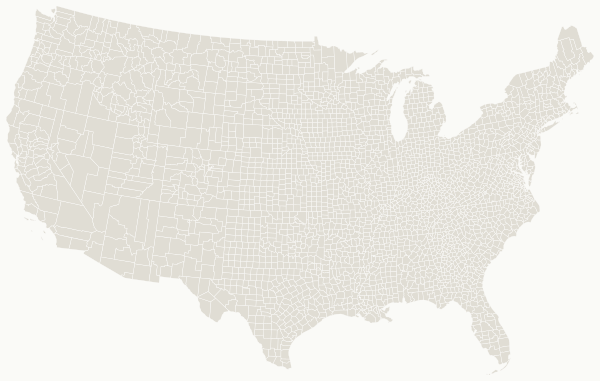
Locator map
Location within the continental US

Prepper Assessment

Living in this area offers a mix of urban and rural experiences, with a population density of 1,618.9 people per square mile. The climate is characterized by a mean annual temperature of 56.4°F and an average of 45.3 inches of rainfall per year, which supports a growing season suitable for various crops in USDA zone 8b. The proximity to the Blue Ridge Mountains provides a scenic backdrop and access to natural resources, although the limited rural space (only 2%) may restrict larger homesteading endeavors.

The county faces several natural hazards, including strong winds (FEMA rank 78) and hurricanes (rank 74), which could impact self-sufficiency efforts. The area also has a relatively high population density, ranking in the 97th percentile, which may lead to increased competition for resources and a sense of crowding. While the median home price of $196,000 is reasonable, the overall cost of living could be a concern for those on a tight budget, with a median household income of $56,243.

This county may be a good fit for individuals or families seeking a balance between urban amenities and rural living, particularly those who can navigate the challenges of natural hazards. However, it may not be ideal for those looking for extensive rural land or complete isolation due to the high population density. Homesteaders should be prepared for potential weather-related disruptions, making resilience planning essential for successful living in this area.

AI-generated analysis based on county data (climate, hazards, density, housing, economy). For general orientation only.

Key Facts

Ranked #2,088 nationally
Out of 3,109 CONUS counties for composite prepper suitability.
#104 of 133 in VA
Ranked #104 of 133 counties statewide for prepper suitability.
Dominant hazard: strong wind
FEMA ranks strong wind risk at 78/100 here — the leading natural threat.
Urban: 1,619/sqmi
Densely populated at 1,619 people per square mile.
Climate profile
Classified as humid with a 56.4°F annual mean and 45.3" of annual precipitation. USDA hardiness zone 8b.
Housing & taxes
Median home value $196,000.

Score Breakdown

Violence
45
percentile (lower = safer)
Disasters
49
percentile (lower = safer)
Density
97
percentile (lower = emptier)
Overall FEMA Risk
49.3
NRI composite (0-100)

Natural Hazard Profile (FEMA NRI)

Cold Wave 17
Earthquake 73
Hail 28
Hurricane 74
Heat Wave 45
Riverine Flood 65
Ice Storm 47
Landslide 66
Lightning 74
Strong Wind 78
Tornado 32
Wildfire 9
Winter Weather 48

Monthly Climate (1991–2020 normals)

Average temperature
JFMAMJ JASOND
Monthly precipitation (inches)
JFMAMJ JASOND
Summer high
86.8°F
Winter low
26.3°F
Heating degree days
4,216
Cooling degree days
1,096

Housing & Economy

Median home value
$196,000
Median HH income
$56,243
Price to income
3.5×
Property tax rate
0.88%
~$1,724/yr median

Community Profile

Median age
28.4
Homeownership
48.7%
Poverty rate
17.5%
Unemployment
5.4%

Connectivity

Broadband households
74.8%
No internet access
8.1%

Explore Lynchburg County Further

Similar Counties

Data sources. Prepper scores are national percentile ranks of firearm fatalities (County Health Rankings 2024 / CDC WONDER), FEMA National Risk Index 2023 composite disaster score, and population density (ACS 2022 + TIGER 2022 land area). Climate from NOAA nClimDiv 1991–2020 normals. Hardiness zone is estimated from climate data and may differ from the official USDA PHZM. Demographics and housing from Census ACS 5-year 2022. All scores are for comparison purposes only and do not constitute advice about where to live.